Device Photos
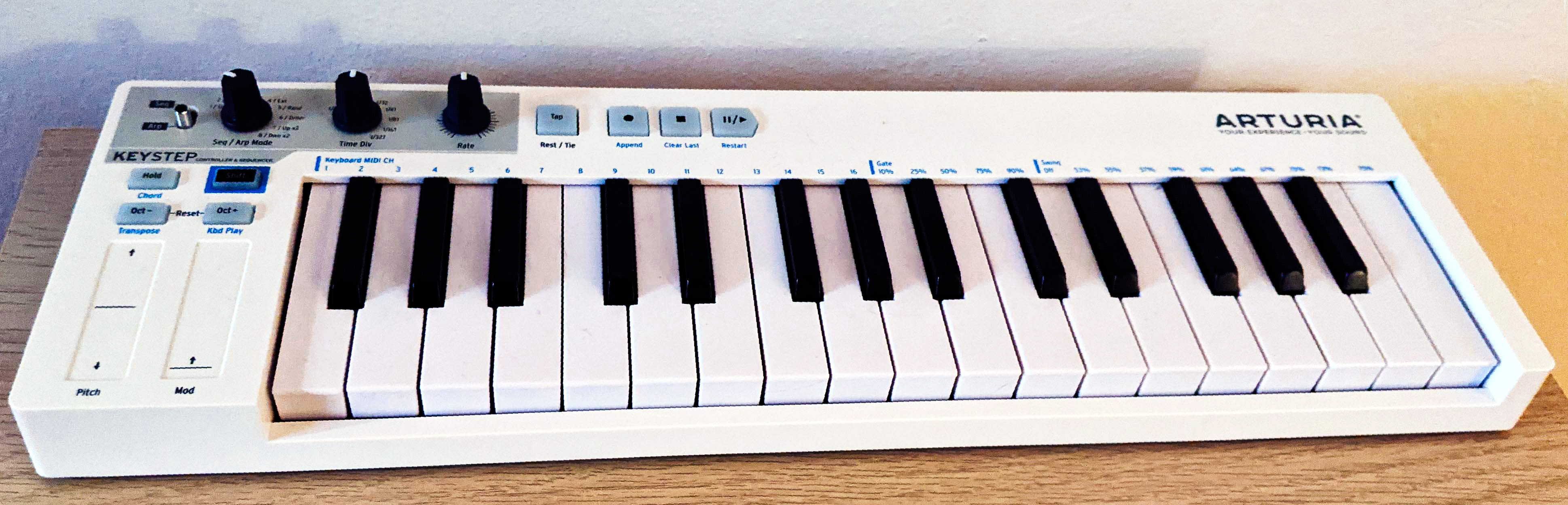
Front
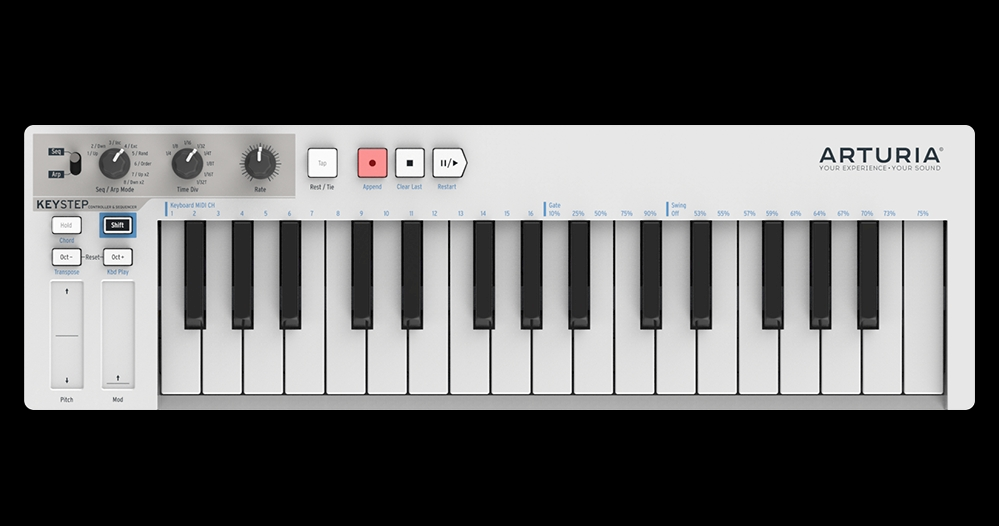
Top
Basic data
Name
Arturia KeyStep MK1 (Legacy)
Category
1) MIDI controllers / keyboard controllers
Type
32_KEY_COMPACT_KEYBOARD_CONTROLLER_WITH_CV_SEQUENCING
Specimen
A
Inventory tag
HW-2024-KL-KEYSTEP-MK1-001
Condition
OK
Physical parameters
Dimensions (mm)
—
Dimensions (inch)
—
Weight
—
Format
—
Material
—
Manufacturing (Period)
—
Manufacturer
—
Power
Voltage
USB bus power
Current (typical)
0.4 A
Current (max)
0.6 A
Polarity
N/A
Connector
USB Type-B
AC/DC
USB
Internal/External
External
Note
Can be powered from a computer, USB adapter or USB power bank. No external PSU required.
Warning: Check the polarity of the source before connecting! Improper power supply will damage the device.
Firmware and serial number
Serial number
226309
FW version (current)
Not stated
Check date
2026-03-04
Previous version
N/A
Bootloader
N/A
Update Link
Backup File
Not stated
Quick Summary
Compact 32-key MIDI keyboard with step sequencer, CV outputs and USB connectivity. Older MK1 version — newer MK2 exists.
Product Description
Arturia KeyStep MK1 — Compact keyboard MIDI controller with integrated step sequencer, CV/Gate outputs and USB connectivity
Features and functions
- 32 dynamic keys with velocity and aftertouch sensitivity — expressive control for MIDI synths
- Integrated step sequencer — up to 16 steps per sequence with real-time editing
- CV/Gate outputs — 1V/octave CV and 10V gates for eurorack/Volca/analog synths
- MIDI IN/OUT on DIN 5-pin connector — full MIDI implementation for external hardware
- USB MIDI — class compliant, connect directly to computer without driver
- Headphone output with stereo mini-jack connector — built-in audio monitoring
- Master Volume mini-fader — quick volume control
- Mod Wheel — pitchbend + modulation controls for expressive playing
- Octave range — Octave Up/Down buttons for expanding the range of 32 keys to more octaves
- LCD display — displaying sequences, tempos and states
- Tap Tempo — tempo synchronization without metronome
- Internal power supply — USB bus power (0.4A typical consumption)
- Compact portable design — only controller without sound engine
- Wireless-ready — Arturia Wireless dongle compatible (optional)
- Legacy version — MK1 model is an older type (there is MK2 with improvements)
Primary I/O (quick orientation)
| Domain | Inputs | Outputs | Note |
|---|---|---|---|
| MIDI | USB MIDI (Type-B - class compliant) | USB MIDI + DIN 5-pin MIDI OUT (5-pin DIN connector, MIDI standard) | Dual MIDI output — USB and DIN. Ideal for old synths and modern DAWs. |
| CV/Gate | — | Gate OUT (3.5mm TS mono), CV OUT (3.5mm TS mono) | 0-5V CV range (1V/octave). Compatible with Volca, eurorack, Moog Mother-32 and others. |
| Audio | — | Headphones OUT (3.5mm stereo mini-jack) | Only for monitoring MIDI sound from external synths (not built-in sound) |
Controls
FRONT / TOP (user control)
- 32x dynamic keys with velocity and aftertouch sensitivity
- Octave Up/Down buttons — extension range
- Transpose buttons — transposing sequences
- Tempo button — setting the tempo
- Step buttons — for step sequencer editing
- Gate button — check gate time
- 7× LED indicators — status display (tempo, sequence, octave)
- Master Volume mini-fader — volume control
- Mod Wheel (left hand) — pitchbend + modulation
Service / hidden elements
- LCD display — displays sequence, tempo, mode
- Tap Tempo functionality — synchronization without metronome
- Wireless dongle port (optional) — Arturia wireless module
Connectors and connections
Connector matrix
| Interfaces | IN | OUT | Spec / note |
|---|---|---|---|
| MIDI | USB MIDI (Type-B - class compliant) | USB MIDI + DIN 5-pin MIDI OUT (5-pin DIN connector, MIDI standard) | Dual MIDI output — USB and DIN. Ideal for old synths and modern DAWs. |
| CV/Gate | — | Gate OUT (3.5mm TS mono), CV OUT (3.5mm TS mono) | 0-5V CV range (1V/octave). Compatible with Volca, eurorack, Moog Mother-32 and others. |
| Audio | — | Headphones OUT (3.5mm stereo mini-jack) | Only for monitoring MIDI sound from external synths (not built-in sound) |
Latency and jitter
Clock sources
Internal tempo (tap tempo capable), USB MIDI Clock
Clock IN/OUT format
PPQ (pulses per quarter note) — standard MIDI sync
Typical latency
< 10 ms (USB MIDI latency)
Jitter spec
Typical < 150 ppm (parts per million timing deviation)
Buffer support
512 samples (for USB audio)
Impedance and signal levels
Line Level (dBu)
-10 dBV (CV outputs)
Mic In level
—
Output Impedance
~1 kΩ (CV), 32 Ω (headphones)
Input Impedance
~100 kΩ (CV/Gate inputs on external devices)
THD
< 0.5% (ulta-low distortion)
Frequency Range
20 Hz — 20 kHz (headphone output)
Other Specifications (from metadata.specifications)
| Key | Value |
|---|---|
| No other specifications | |
Additional technical details
| Key | Value |
|---|---|
| No additional technical details | |
Typical routing
- KeyStep MK1 + Volca Bass (classic setup): Old Czech combination of Keystep with Volca Bass synth
• Connect KeyStep MIDI OUT (5-pin DIN) → Volca MIDI IN
• CV OUT → Volca CV IN (Filter control or Pitch modulation)
• Gate OUT → Volca Gate IN (sound trigger)
• KeyStep generates sequences from here, Volca plays sounds
• Tempo synchronization via internal tap tempo - KeyStep MK1 → Eurorack (CV/Gate principles): Integration with eurorack modular synthesizer
• CV OUT → VCO pitch input (1V/octave standard)
• Gate OUT → envelope trigger input (5V gate)
• MIDI USB → DAW for sequencing
• Keyboard plays eurorack modules directly through CV/Gate
• Headphones: monitor nothing (KeyStep has no sound), listen to eurorack OUT - KeyStep MK1 in DAW workflow: Use with computer and software synths
• Connect USB → computer
• DAW (Ableton, Logic, etc.) sees KeyStep as a MIDI input device
• Play on KeyStep keys — sequencer data goes to DAW
• Create step sequences on KeyStep, send MIDI notes to VST synths
• Simultaneously: CV outputs → control external hardware synths
Connection instructions: The examples below show typical signal flows in practice. For specific details (jitter, buffering), see section above.
SW / drivers
| Component | Windows | macOS | Linux | Note |
|---|---|---|---|---|
| No specific driver data; use the Documentation/Links section. | ||||
Custom firmware details
Author
—
FW family
—
Custom FW targets
- No explicit custom FW targets in metadata.
Custom CC mapping
| CC | Meaning |
|---|---|
| No custom CC mapping. | |
Custom FW global settings
| Settings | Meaning |
|---|---|
| No custom global settings. | |
Custom FW extended menu
| Item | Detail |
|---|---|
| No extended menu details. | |
Documentation and manuals
Manufacturer / Links
- Official site of manufacturer
- eBay — search Arturia KeyStep MK1 (Legacy)
- Aukro.cz — search Arturia KeyStep MK1 (Legacy)
- HudebníBazar.cz — search for Arturia KeyStep MK1 (Legacy)
- MIDI.cz — search for Arturia KeyStep MK1 (Legacy)
- Kytary.cz — search for Arturia KeyStep MK1 (Legacy)
- Heureka.cz — search for Arturia KeyStep MK1 (Legacy)
- Gear4music.cz — search for Arturia KeyStep MK1 (Legacy)
- Muziker.cz — search for Arturia KeyStep MK1 (Legacy)
Service log
| Date | Event | Who | Note |
|---|---|---|---|
| 2026-03-04 | Rename + metadata update to MK1 variant | Studio Administrator | Renaming to arturia-keystep-mk1 clarifies legacy status. Images moved to arturia-keystep-mk1. Features and hw_pic paths updated. |
| 2026-03-03 | Initial inventory | Studio tech | Added to inventory |
Presets / User banks
Storage type
Internal flash memory — nonvolatile storage
Number of banks
16 sequences
Current bank
User selectable
Backup File
—
Export format
USB MIDI export (sequences as MIDI file)
Note
KeyStep MK1 stored sequences internally. Backups can be captured via USB MIDI during editing.
Notes / service / modifications
- Older MK1 model - there is a newer MK2 with improvements (pad sensitivity control, more sequences, etc.)
- USB power supply — completely safe, no external source
- CV/Gate compatibility — fully compatible with Moog Mother-32, Volca series, eurorack
- MIDI dual output — USB and 5-pin DIN allow parallel use
- Wireless optional — Arturia Wireless MIDI dongle is available as an accessoriy
- Headphone output — only for monitoring, without built-in audio
- Portability — ideal for live gigging or studio mobility