
Chinese "gift" to the world? BRI, GCI and Chinese idea of global order
1. 15. March 2023: what exactly did you announce
Date 15. 31 March 2023 He imagined Jinping at the High Meeting of the Communist Party of China with the world's political parties Global Civilization Initiative - Global Civilization Initiative (GCI). In his speech, he linked it to the question of modernization and the claim that no single civilization or group of countries has a monopoly on the right path to modernization. The official Chinese formulation builds on four motives: respect for the diversity of civilizations, "common values of humanity," heritage and innovation of civilizations, and intensified interpersonal and cultural exchange. Full text of the speech - Xinhua.
GCI was not declared an international treaty, organisation or legally binding regime. It is a political-normative initiative: the language, framework and set of principles that Beijing puts into bilateral diplomacy, party forums, cultural cooperation, multilateral debates and a broader concept of "community shared by the future of humanity." It is therefore appropriate to consider it in a different way than, for example, the WTO, NATO or a specific investment agreement. Its impact is mainly due to whether other states and institutions take over its concepts.

2. From BRI to GCI: layered architecture
China's global policy of the last decade has not been created by one document. Individual initiatives are burrowing. In September and October 2013 you introduced the ground Silk Road Economic Belt and maritime 21st Century Maritime Silk RoadThe project was a comprehensive project, Belt and Road Initiative (BRI). In 2015, the UN formulated a more pronounced concept of "community with a shaded future for mankind." The Commission also notes that the Commission has not taken into account the fact that the measures in question are in line with the MEIP.
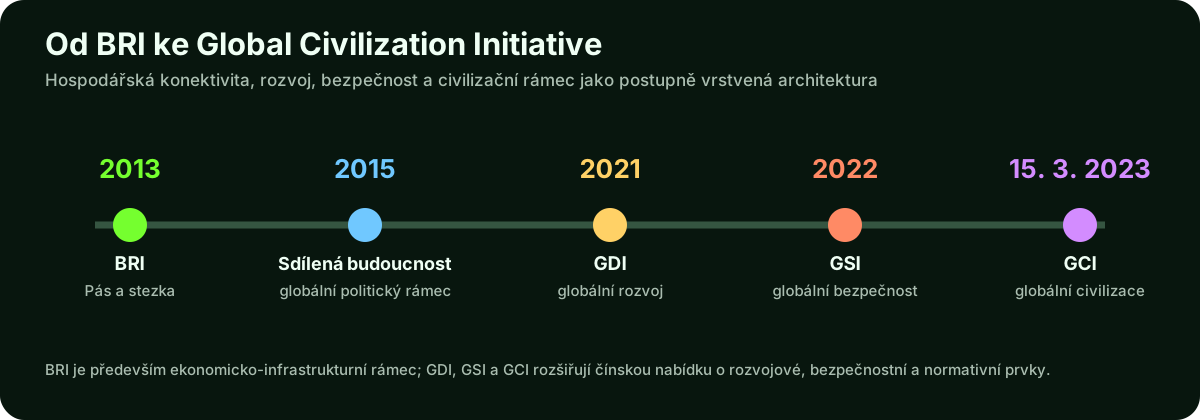
These layers are of different nature. BRI is the most material: ports, railways, energy, logistics, telecommunications and financing. The GDI is transferring Chinese language to the area of development policy. GSI is articulating security principles, including indivisible security, sovereignty and dialogue. GCI enters the most abstract area - values, culture, legitimate ways of modernization and the relationship between civilizations. Together, they are creating a Chinese answer to the question of what globalisation should look like in a world where, according to Beijing, one power or one historical model is no longer meant to be a dominant measure.
3. BRI details: what is Belt and the trail
BRI is not one infrastructure project and does not have a single list of legally approved buildings. It acts as a broad umbrella under which bilateral loans, investments by state enterprises, railway corridors, ports, energy facilities, industrial zones, digital infrastructure or educational cooperation can be included. The Chinese White Paper of 2023 describes it as a platform based on consultation, joint contributions and shared benefits. White Paper of the State Council of the PRC, 2023.
The original geographical metaphor linked ground Eurasia and sea routes across the Indian Ocean. In practice, BRI has spread far beyond the historic Silk Road - Africa, Latin America, the South Pacific and digital networks. This flexibility is a source of strength and an analytical problem: it cannot be assumed that every project financed by the Chinese bank is managed by Beijing according to one detailed geopolitical plan.
Chatham House research underlines that Chinese development finances are institutionally fragmented and projects often arise in combination with Chinese incentives, state-owned interests and demand from the government of the recipient country. The recipient is therefore not a passive object. Local governments, elites, firms and political priorities are making significant codetermination of what will stand up, under what conditions and whether the project will succeed. Chatham House - Debunking the Myth of Debt-trap Diplomacy.

4. Economic logic BRI
For China, BRI has several economic functions at the same time. It expands trade routes and logistics nodes, creates foreign contracts for Chinese construction and technology firms, links inland provinces to markets, promotes the use of production capacities and increases the safety of some supply chains. It may be attractive for other reasons to the beneficiary countries: many developing economies have long-term road, rail, energy and port deficits and traditional multilateral financing may not cover all projects or come with longer approval and other conditions.
This is where "push" factors on the Chinese side meet "pull" factors on the recipients. Corridor construction is not automatically a Chinese dictate; but at the same time, the funding party gains both economic and political weight. The relationship can therefore be both beneficial and asymmetrical.

5. The potential and benefits of the project
The World Bank's independent analysis of 2019 did not describe BRI as either a clear success or a mere geopolitical trap. It modelled the potential of transport corridors and concluded that, when completed, it could shorten travel times along corridors by up to 12%, increase corridor economy trade by about 2.8-9.7% and global trade by 1.7-6.2%. The model also estimated that transport projects could help to bring 7.6 million people out of extreme and 32 million out of moderate poverty. These are model estimates, not ex post measurements of the actual result achieved. World Bank - Belt and Road Economics.
The key word is cross compliance. At the same time, the World Bank stressed that much of the benefits depend on reforms in customs procedures, trade barriers, open procurement, cross-border coordination and quality of domestic institutions. The railway will not create the export industry itself; the port will not solve corruption, education or inefficient governance itself.
This is why countries' experience is different. Indeed, for some corridors, the infrastructure has removed a narrow throat. Other times, traffic forecasts were too optimistic, costs increased or the economy could not use new capacity. BRI is too wide for one universal verdict.

6. Debt, transparency and dispute over "debt-trap diplomacy"
The most famous criticism by the BRI is that China is deliberately providing unsustainable loans to acquire strategic assets in case of problems. This strong version of "debt-trap diplomacy" is not well founded as a universal explanation. Chatham House argued in analysing frequently cited cases, including Sri Lanka, that the available evidence did not support a simple model of a preplanned trap and that domestic political elites, broader debt structure and other creditors had a significant role to play.
But that doesn't mean that the debt problem is fictional. In the large dataset of Chinese foreign projects, AidData pointed out a significant amount of debt outside the normal central government balance, contractual non-transparency and implementation problems. The debt distress studies show that Chinese creditors had to restructure loans or provide rescue liquidity in a number of cases. AidData - Banking on the Belt and Road · Dekt Distress on China's Belt and Road.
The objective conclusion is therefore twofold. First, the claim about a unified Chinese strategy "lend, let fail and seize" is too mechanical. Secondly, the opaque credit conditions, fiscal risk and asymmetry of the negotiating power are real and very serious in some countries.
7. BRI as geopolitics - yes, but not simply
The large infrastructure has always geopolitical consequences. The port, rail, data network or energy interconnection changes the trade directions and creates long-term dependencies. Chinese companies gain access to markets, Beijing political contacts and partner states have an alternative source of capital. In this sense, BRI is an instrument of economic statehood and Chinese influence.
But it would be a mistake to see every bridge or power plant as a hidden military project. Economic and strategic motives may overlap without being identical. Some projects have a clear commercial logic, others have a symbolic value, others are the result of local lobbying or political decisions made by the partner government. More precisely, talk about the geoeconomic platform;that gives Beijing the chance to transfer the economic presence to political influence in the long term, not a perfectly centralised plan for all investments.
8. GCI: four basic proposals
GCI stands on four points formulated by Xi Jinping in March 2023.
| Principle | Chinese wording | Practical Interpretation | Possible voltage |
|---|---|---|---|
| The diversity of civilizations | Equality, mutual learning, dialogue and inclusion. | No state has a monopoly on legitimate political culture. | It can protect pluralism, but also provide an argument against external criticism of the domestic regime. |
| "The Common Values of Humanity" | Peace, development, equality, justice, democracy and freedom. | Values are to be shared, but their concrete implementation may differ between civilizations. | The question of where pluralism ends and relativism of universal rights begins. |
| Heritage and innovation | Modernization is meant to draw on its own history and culture. | Rejection of the idea that the modern state must copy one Western institutional path. | Tradition can be a source of identity and a tool for legitimizing current power. |
| ♪ People-to-people exchange ♪ | Cultural, academic, interpersonal exchange. | Soft power, education, party diplomacy and cultural institutions. | The exchange may be bilateral, but in an authoritarian environment, content can be politically selected. |
At the abstract level, the first and fourth points are compatible with classical multilateralism: dialogue, cultural contact and rejection of the civilisation hierarchy are not exclusively Chinese values. The second point is more contentious - not because China uses the words' democracy 'or' freedom ', but because it claims that their importance must be interpreted in the light of specific civilisation and national conditions.
9. Modernization does not equal westernization
One of the key motives of GCI is the idea that modernization does not have to mean westernization. Historically, this argument is understandable to China. The nineteenth century was linked to the military pressure of Western powers, opium wars and unequal treaties. In the twentieth century, Chinese elites repeatedly sought to accept science, industry and institutional modernization without losing cultural and political autonomy.
Today's Chinese formulation claims that industrialization, technological development, urbanisation and education are not the property of one civilization. That's analytically defensible. The dispute begins when the legitimate pluralism of travel is based on the conclusion that external criticism of violations of individual rights is merely cultural implication. Modernising pluralism and universality of some human rights are not logically incompatible - and it is their relationship that is being led by a substantial part of the current dispute.
10. Universal values versus various civilisation interpretations
The Chinese language of GCI does not use the wording that freedom or democracy should not be universal. On the contrary, they are classified as "common values of humanity." But at the same time, he insists that different civilizations can give these values different content and that one model should not be imposed on others.
This position partly overlaps with the principle of sovereign equality and non-interference in the UN Charter. At the same time, however, the Charter contains support for human rights and fundamental freedoms, and the post-war human rights system is based on the idea that fundamental rights are not given to man by the state, but as a human. UN Charter · What are Human Rights?.
This creates real regulatory stress. China's interpretation highlights the state, stability, development, collective interests and legitimacy of various political paths. Liberal human rights tradition places a stronger emphasis on individual rights, political pluralism and the possibility of external control of the commitments made by states. Nor is the party analytically accurate to reduce to a single slogan: Western states themselves apply universal standards inconsistently, and China is not the only state of the global South that criticises the inequality of current institutions. At the same time, this inconsistency does not itself undermine the existence of international human rights obligations.
11. Why is the offer attractive to the part of the global South
China's rhetoric resonates where there is experience of colonialism, unequal trade relations, structural programmes, political conditionalisation of aid or a sense of inadequate representation in the institutions created after World War II. The criticism of the "double standards" of the West is therefore not only Chinese marketing; it follows the earlier traditions of the Bandung Conference, the Movement of the Uninvolved and the demands of the new international economic order.
At the same time, the "global south" is not a single block. India is a strategic competitor of China, many states combine partnerships with Beijing and Washington, and governments choose on a specific topic. Carnegie points out that China's attempt to present itself as a natural leader of the global South is facing trade conflicts, debt experience, environmental issues, and regional security disputes. Carnegie - The Challenges Behind China's Global South Policies.
It is therefore more accurate to talk about competition than to create a single "Chinese bloc." Many countries are trying to maximize their autonomy by working with more centres of power simultaneously.

12. Russia, Ukraine and timing of GCI
GCI was introduced 15. On March 2023 and Xi Jinping went to Moscow several days later. The time proximity is politically important, but it does not prove itself that the initiative was created as a defense of the Russian war on Ukraine. Its wording follows the longer-term Chinese concepts of civilisation pluralism, sovereignty and rejection of ideological blocks.
Yet there is a overlap with part of Russia's criticism of the Western Order: opposition to American hegemony, criticism of the expansion of security structures, and the argument that Western "value policy" can serve power interests. But China's position also formally highlights territorial integrity and sovereignty - a principle that creates tensions with Russian and Ukrainian territories. This is why Chinese rhetoric about war is often formulated as a combination of support for sovereignty, calls for action and the requirement to respect all parties' "legitimate security concerns."
Brookings points out that a similar combination of sovereignty and "legitimate security concerns" creates confusion as to how Chinese principles of global governance would be applied to specific conflicts. Brookings - China, the United States, and the future of a roules- based international order.

13. Chinese and Western models: real differences and similarities
| Zone | Chinese emphasis | Liberal Western Emphasis | ♪ That's overlapping ♪ |
|---|---|---|---|
| Suverenity | Strong principle of non-interference and autonomy of the regime. | Suverness is a foundation, but it can be limited by contractual human rights obligations and collective mechanisms. | Both traditions are now in the UN Charter. |
| Development | Infrastructure, stability, economic growth and capacity of the State. | Development linked to governance, market, institutions and often human rights. | Conformity to the importance of trade, infrastructure and SDGs. |
| Democracy | Various national forms and results legitimacy. | More emphasis on the competition of political forces, elections, civil rights and control of power. | Both sides use the concept of democracy, but define its institutional core differently. |
| International Order | Multipolarity, the larger role of the global South, the less Western normative monopoly. | "Rules--based order," alliance structures, legal and institutional continuity of the postwar system. | Both sides publicly support the UN, trade and international cooperation. |
The difference is not simply 'China without rules versus the West with rules'. The dispute is also led by who makes the rules, who interprets them, how they are enforced and whether they are applied symmetrically. China's criticism of double standards can be a real reality in concrete cases; but this does not mean that all Chinese alternatives are neutral or that Beijing itself does not apply economic and political pressure.
14. What GCI is - and what is not yet
GCI is primarily the normative platform and instrument of diplomacy. It does not contain its own court, financial institution, binding decision-making mechanism or membership with legal obligations. Its importance is therefore measured by how its concepts are made into joint declarations, party diplomacy, educational programmes and forums with the countries of the global South.
For the supporter, its main value is in rejecting civilisation superiority: the modern world, according to them, needs more ways to develop and less tendency to ideological crusades. For the critics of the GCI, the language of "civilisation diversity" can serve to weaken the universal standard of human rights and to legitimise authoritarian regimes under the motto of cultural diversity. Lowy Institute and Human Rights Watch criticise this dimension; on the contrary, China's official texts describe it as protecting pluralism and the equality of civilizations. Lowy Institute - related analysis of the Chinese global normative framework · Human Rights Watch - China 2024.
Both interpretations can describe a part of reality. The language of the initiative really supports cultural pluralism; it is also beneficial for governments that reject international criticism of their domestic order. Practical application will be crucial, not just the declared principle.
15. How BRI changes after the first decade
The first decade of BRI was linked to large infrastructure projects and the rapid growth of foreign Chinese lending. The later period is sobrier. Some partners' debt problems, Chinese economy slowdown, experience with difficult-to-implement mega-projects and greater international control have pushed the emphasis towards more financially cautious, technological, green and smaller projects.
That doesn't mean the end of the BRI. It means that it is less accurate to imagine it as a permanent construction of giant ports and railways. Digital infrastructure, energy, logistics, industrial chains and "high-quality BRI cooperation" have gained greater weight. The Chinese White Paper of 2023 underlines this shift itself.
At the same time, BRI is connected to GDI, GSI and GCI. The material infrastructure is thus given a development, security and civilisation language. This combination is strategically more important than any single project.
16. Conclusion: "gift," alternative or power project?
BRI and GCI can be read in three ways - and none of them itself describes the whole picture. First is developing: China has indeed financed the infrastructure for which demand existed, and improving connectivity can have measurable economic benefits. Second is geoeconomic: investment, credit and standards create long-term Chinese influence and reduce the monopoly of Western institutions on development financing. Third is normative: GCI is trying to change the language of legitimacy of the world order from universalist liberalism to greater emphasis on sovereignty, civilisation pluralism and more ways of modernization.
Objective evaluation must hold two thoughts at the same time. The Western postwar order has not always been applied consistently and many states have legitimate reasons to demand greater representation and a smaller hierarchy. At the same time, 'civilisation diversity' cannot decide on its own whether a specific intervention in individual rights, non-transparent credit or political pressure ceases to be a problem. The same rule should apply to China, the US, the European Union, Russia and other powers: to evaluate concrete negotiations, the treaty, the project and the legal commitment, not just its own civilisation slogan.
17. Primary and analytical resources
Full speech, presenting GCI. State Council Information Office
White book BRI, October 2023. World Bank
Belt and Road Economics: Opportunities and Risks of Transport Corridors. AidData
Banking on the Belt and Road. Chatham House
Debunking the Myth of Debt-trap Diplomacy. United Nations
The UN Charter - sovereignty, cooperation and human rights. OHCHR
The universality of human rights. Carnegie Endowment
The limits of China's policy towards the global South. Brookings
China's Global Initiative and the Future of the Rule-based Order. Lowy Institute
The normative and human rights dimension of China's global initiatives.