
HITLER'S END: BUNKRO SEB, FORCE EVIDENCE AND TEORIES OF THE RURAL
INTRODUCTION
The doubts about Adolf Hitler's death were not raised with the Internet. They appeared practically immediately in 1945. The Allies didn't have a body that could be shown publicly, the Soviets kept the remains hidden, and Joseph Stalin even suggested to Western officials that Hitler might have escaped. The FBI and other services therefore recorded and examined reports of its alleged occurrence in Europe or South America.
But the existence of investigative files later became a false argument: "The FBI sought Hitler, so she believed he survived." In fact, the intelligence service is looking at a very unlikely possibility if its impact is sufficiently severe. The documentation of the hypothesis is not a confirmation of the hypothesis.
More types of evidence are available today than in May 1945: statements of the bunker people, Hitler's dental records, the identification of the jaws and dental bridges, and a modern forensic review of the remains kept in Russian archives.
1. THE LAST DAYS IN BERLIN
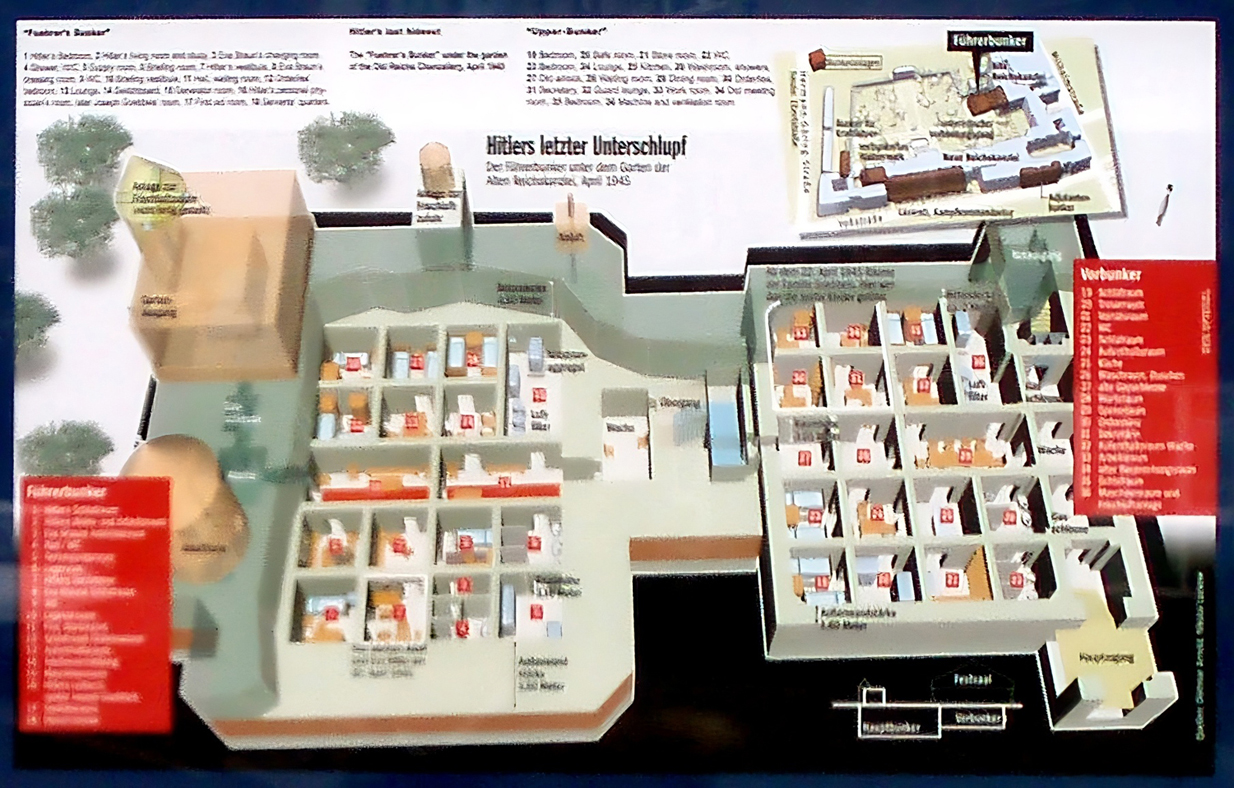
At the end of April 1945, the situation of the Third Reich was militarily hopeless. The Red Army fought in Berlin, the connection with most German forces fell apart, and Hitler stayed in the Führerbunker under the Reichstag chancellor.
On 29. On April he married Eva Braun and dictated a political and private will. The next day, 30. On April, according to the testimony of the bunker people, they both committed suicide. Hitler used a firearm; cyanide appears in the descriptions as part of a prepared suicide procedure. Eva Braun died after ingestion of cyanide.
The bodies were carried into the chancellor's garden, covered in gasoline and lit on fire, according to Hitler's previous instructions. It's the attempt to burn that's one of the reasons why the complete corpse didn't remain easily identified.
2. WHAT THE SONETS FOUND
Soviet troops have taken over the Chancellor's area and searched for Hitler. In May, a heavily burned human remains were found. The identification focused mainly on teeth and jaw, because dental work survived fire better than soft tissue.
Hitler had extremely large and specific dental structures. The members of his dentist's staff were able to describe and identify the distinctive bridges, crowns and other elements after the war. A later comparison with X-rays and dental documentation was provided by one of the strongest identification evidence.
3. WHY SOVETY SECRETS MADE CONSPIRATION
The Soviet Union could have ended much of the speculation after finding the remains. Instead, he kept information secret and individual officials made contradictory communications. Stalin at the Potsdam Conference claimed that Hitler may have escaped to Spain or Argentina.
The motive could have been political and intelligence: uncertainty kept Western allies alert, and the Soviets kept control of information they thought was sensitive. But the result was an ideal basis for decades of speculation.

4. FBI plates: Evidence of an escape or ARCHIV of a statement?
FBI Vault is publishing dozens of pages of material today about Hitler's alleged postwar footprints. There are tips, letters, information about people claiming to have seen Hitler, and possible South American contacts.
It is necessary to read the document type. When someone told the FBI that Hitler was living in Argentina, the announcement could have been part of the file. That didn't make him a certified report. The archives of the security services contain a huge number of claims that were recorded precisely to be verified.
A similar error occurs in the case of undisclosed UFO files: the existence of the file confirms that the Office has received or addressed a report, not automatically the truthfulness of the reported phenomenon.
5. ARGENTINA WAS A REAL ROUTE FOR NACITICAL ADVERTIVES
One reason Hitler's escape theory is emotionally convincing is that many Nazi and fascist leaders actually fled to South America. Adolf Eichmann lived in Argentina before Mossad kidnapped him in 1960. Joseph Mengele escaped to South America and was never brought to justice.
There were so-called ratlines - networks that helped refugees to obtain documents and move to Italy, Spain, Argentina and other countries. Part of the aid was provided by individual church officials, part was based on political and intelligence networks.
This proves that the escape of a prominent Nazi to Argentina was technically possible. It doesn't prove Hitler went through this path. The possibility is to start an investigation, not a result.
6. DITAL EVIDENCE OF 1973
Forensic dental examiner Reidar F. In 1973, Sognnaes and colleague Ferdinand Strøm published an analysis that compared Hitler's famous dental records and X-rays with a description of Soviet remains. They concluded that dental identification provided convincing evidence of his death in 1945.
Dental identification is extremely useful in court medicine in burned bodies. The combination of roots, fillers, bridges, crowns, missing teeth and individual work by a dentist can be more practical than facial appearance.
7. MODERAL REVIEW OF RUSSIAN INTEREST
In 2017, the French team gained extraordinary access to parts of Hitler's alleged remains stored in Moscow. The results were published in 2018 in the European Journal of Internal Medicine.
Researchers examined the teeth and part of the jaw and compared their condition with historical X-rays. The conclusion was supported by the identification of Hitler. Studies found no traces of evidence on the teeth that contradicted the known dental profile.
The review concerns a separate skull fragment, which in the past was also attributed to Hitler and for which other testing indicated a female origin. But that's not logical evidence that the jaw and teeth are fake. These are two separate items with different identification history. The most reliable evidence stands on the teeth and jaw, not on the contentious fragment of the skull.
8. WHAT WOULD HAVE TO BE THE SET OF THE EXPLANATORY RUNNING
A serious alternative hypothesis cannot only find inconsistencies in Soviet communication. She would have to explain the entire evidence file:
- why several people from the bunker independently described suicide and body destruction;
- why the jaw found is consistent with Hitler's very specific dental work;
- how it would be physically transported from surrounded Berlin to an airport or any other escape route;
- why there is no reliable postwar photograph, biological sample, financial trace or document with verifiable provenance;
- How many of these great secrets would keep dozens of participants for decades.
The theory of escape is often solved only by the first part - "the Soviets lied" - and the others jump.

9. ARGENTINE POINTS
The U-530 and U-977, which had given up in Argentina after German surrender, became the popular transport vehicle in legends. But the investigation did not prove that they were carrying Hitler. The time data and crew testimony do not match this scenario.
Also, the fact that the actual unusual fact - late surrender of submarines - was later used as a carrier for a claim that is not documented itself.
10. WHY THE STORY SURVIVES
The death of one of the most famous dictators of history without a publicly exposed body is exactly the situation in which alternative naratives are created. Hitler was also a symbol of a regime obsessed with secret weapons, bunker and underground devices. The idea of the last secret escape therefore fits his image.
Finally, the real escapes of Eichmann, Mengele and others create the right intuition that the post-war search was not a perfect success. The error occurs only when this general fact is replaced by a concrete conclusion without proof.
11. WHAT CONCLUSION IS REQUIRE TO DAILY EVIDENCE
The historical method does not work with absolute metaphysical certainty. He asks which hypothesis explains the most independent sources with the least number of additional assumptions.
Suicide Hypothesis 30. On April 1945, he explains the testimony from the bunker, the will, the attempted burning of the bodies, the Soviet find and dental identification. The escape hypothesis must assume faked death, a replacement body or a fake jaw, secret transportation from a besieged city, long-term conspiracy of witnesses, and decades of life without verifiable trace.
Therefore, current forensic and historical evidence strongly supports the death of Adolf Hitler in Berlin 30. April 1945.
CONCLUSION
There was nothing irrational about the postwar doubts. In May 1945, transparency was lacking, the Soviets deliberately complicated information, and Nazi refugees were actually disappearing abroad. It was right to check every lead.
After eight decades, we're not in the same evidence situation as the FBI agent back then. We have more detailed archive materials and forensic dental examination. Skepticism is useful when it uses the same rigour for both official and alternative claims. It is in this test of Hitler's postwar life theory that will not stand as well as a dental and witness suicide in a bunker.

12. MARTIN BORMANN: EXAMPLE OF HOW THE LEGAL ACT IS ACTUALLY RESOLVED
Hitler's secretary Martin Bormann was long after the war one of the most famous "missing Nazis." For decades, reports have been coming in that he was spotted in South America. In Nuremberg he was even tried in absentia.
In 1972, skeletal remains were found near the site where the witnesses described Bormann's last movements during construction work in Berlin. The identification was later enhanced by genetic analysis and the German authorities concluded that he died in Berlin in May 1945.
The Bormann case is methologically interesting. It shows that decades of testimony about an alleged fugitive may coexist with the fact that a man actually died at the scene of the last struggle. Human memory, facial similarity and media desire for sensation create a large number of false positive identifications.
13. WHY ALL THE SCIENTIFIC IS ALWAYS EVALUATED
The testimony of a man who was in a bunker in April 1945 and describes an event that he was immediately present with has no other evidence than the postwar memory of a man who saw a similar older man 20 years later in a restaurant in Argentina.
The historian evaluates the time distance, the possibility of observation, the interest of the witness, changes in testimony and independence from other sources. More witnesses are not really "independent" if they all draw from the same newspaper story.
This is why hundreds of postwar sightings do not have to outweigh several high-quality physical and documentary evidence.
14. DNA and LIMITS OF GENETIC EVIDENCE
In public debate, the "Hitler DNA test" is often required as the only conceivable final evidence. But for historical remains, DNA is not always the best or only one identification tool. The material that is heavily burned may be contaminated or degraded and we need a reliable reference sample of the relative to compare it.
The forensic identification therefore uses a set of characters. In Hitler's case, teeth are extremely informative precisely because they were unusually specific and there are pre-war X-rays and descriptions of prosthetics. The identification is not only based on the fact that the Soviets wrote "Hitler" on the box.
15. WHAT WOULD CHANGE THE PRESENT CONCLUSION
The historical conclusion is not a religious dogma. It would change if, for example, postwar biological material with proven provenance and convincing genetic binding appeared, an authentic series of documents proving an escape route or physical remains that would clearly disprove dental identification.
This evidence is not yet known. Therefore, it is rational to work with the best-documented hypothesis, not the most dramatic hypothesis.
RESOURCES AND OTHER READING
[1] FBI Vault - Adolf Hitler, classified reports and investigative material.
vault.fbi.gov
https://vault.fbi.gov/adolf-hitler
[2] Sognnaes, R. F.; Strøm, F. - The odontological identification of Adolf Hitler: Definative documentation by X-rays, autopsy interferations and autopsy findings, Acta Odontologica Scandinavica (1973).
tandfonline.com
https://www.tandfonline.com/doi/abs/10.3109/00016357309004612
[3] Charlie, P. et al. - The remains of Adolf Hitler: A biomedical analysis and definitive identification, European Journal of Internal Medicine (2018).
doi.org
https://doi.org/10.1016/j.ejim.2018.05.014
[4] PubMed - bibliographic record of a study on Hitler's remains.
pubmed.ncbi.nlm.nih.gov
https://pubmed.ncbi.nlm.nih.gov/29779904/
[5] U.S. National Archives - Nazi war criminals and post war escape / intelligence records.
archives.gov
https://www.archives.gov/research/holocaust