
Kurds: a nation divided among states
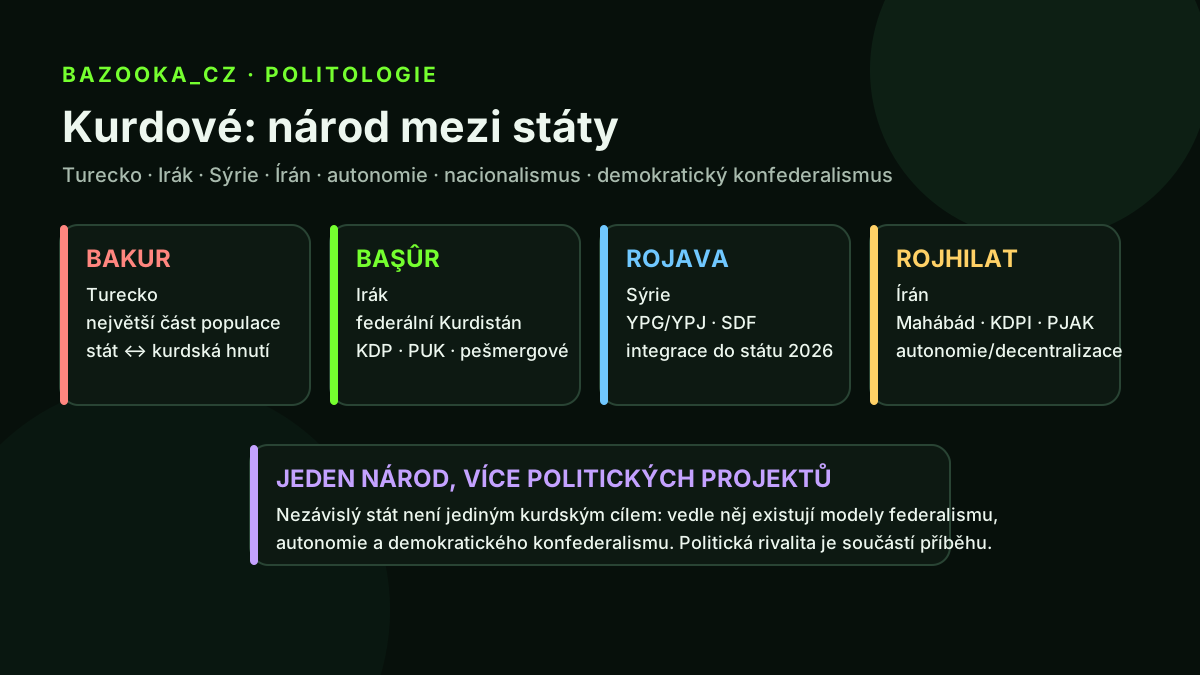
Kurds are described as one of the largest nations without their own sovereign state. This sentence is only true as a first orientation. There are several countries, language variations, parties, armed movements, native and regional traditions, as well as different ideas about the future - from a separate state to federalism and autonomy to democratic confederalism. Kurdish history is therefore not only a story of a "nation that was not allowed to stand," but a story of variable borders, power alliances, internal rivalries and repeated attempts to create permanent political institutions.
Content
- Who are the Kurds - and why are there not one political block
- Interactive map of places and milestones
- Sèvres 1920: autonomy and conditional possibility of independence
- Lausanne 1923 and consolidation of new borders
- Turkey, PKK and the Transformation of the Targets from State to Confederalism
- Iran: Mahabad, KDPI, PJAK and various objectives
- Iraq: Anfal, Halabja and the way to federal autonomy
- Reference 2017: voting was not enough to be statewide
- Syria: Rojava, YPG / YPJ, SDF and war against ISIS
- The African and the Limit of the American-Kurdish Alliance
- Syria 2026: end of SDF, not end of Kurdish question
- State, autonomy, or democratic Confederalism?
- Kurds against Kurds: KDP, PUK, PKK and others
- "The only friends of the Kurds are the mountains" - what this shortcut explains and what it covers
- Why did not the united Kurdistan arise
- What can be expected next
- Movies on the subject
1. Who are the Kurds, and why are they not a single political bloc?
Kurds are an Iranian nation speaking several Kurdish languages and dialects. The largest Kurdish population lives in Turkey, Iraq, Iran and Syria; smaller communities exist in other states, and large diaspora. Precision numbers are difficult because of different prices, political sensitivity and different definitions of identity. Council on Foreign Relations works with approximately 30 million people and stresses that the Kurds are among the largest nations without their own sovereign state.
But this wording may lead to a misconclusion that there is one "Kurdish national programme." It doesn't exist. The Kurds are nationwide interconnected, but their political experience was formed within four different states. Each had a different constitutional order, a different relation to language rights, a different army and other regional alliances. The result is different political traditions.
Czech overview The Commission notes that the Commission has not taken into account the fact that the measures in question are in line with the MEIP. captures the basic geography and importance of Iraqi autonomy. However, its postwar description of Sèvres and Lausanne requires legal clarification: Sèvres did not directly establish "Great Kurdistan ', but established a procedure for local autonomy and possible later independence under the conditions of further compliance.
2. Interactive map: cities, milestones and layers
The top right layer switch distinguishes between current geography, historical milestones, war against ISIS and the update of Syria in 2026. Large intermittent circles are only indicative and do not constitute ethnic, legal or national borders.
3. Sèvres 1920: what the contract actually offered
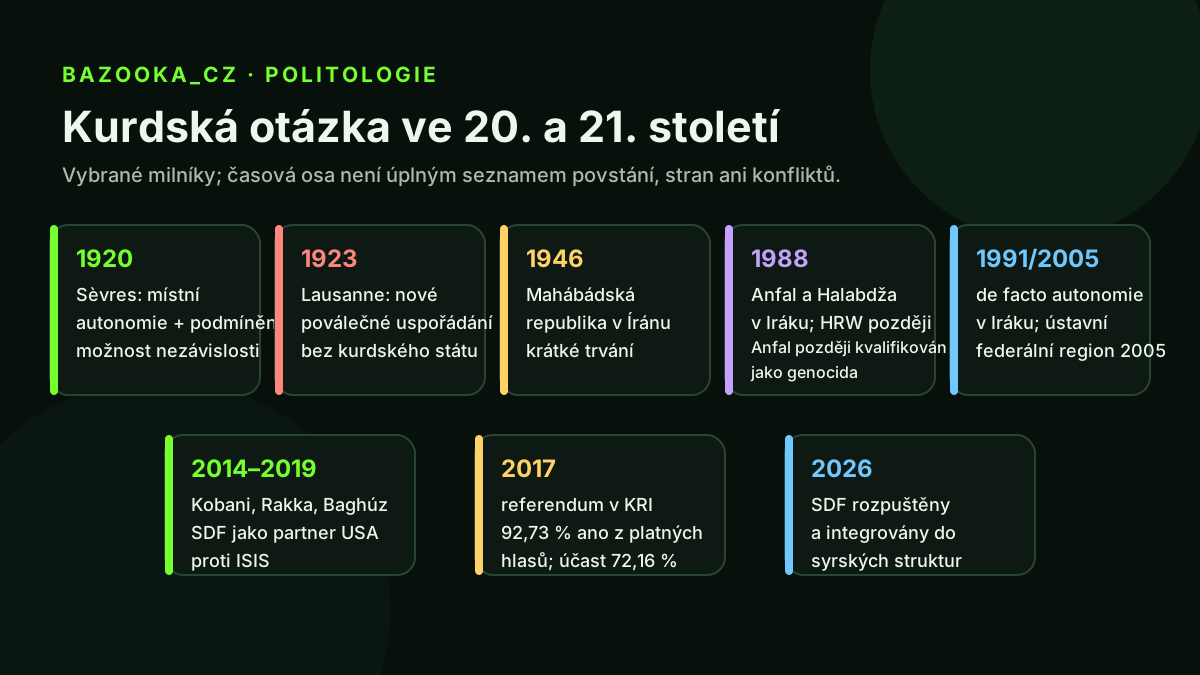
After the defeat of the Ottoman Empire in World War I, the victorious powers tried to create a new postwar order. The contract of 10. On August 1920, it contained a separate section called Kurdistan. Article 62 provided that the British, French and Italian representatives were to prepare a plan local autonomy for defined primarily Kurdish areas east of Euphrates.
Article 64 went on, but on a conditionally basis: if the population of these areas would prove to the League of Nations the majority will for independence within one year and if the Council of the Nations recognised that the population of the United Nations was capable and recommended of and able to, Turkey should have agreed to waive the rights to the territory. The text also provided for the possibility of voluntary connection of Kurds from part of the Mosula villa to the state thus created, if any.
The full text of Articles 62-64 is available in the British contract edition and in the transcription Treaty of Sèvres, Part III. Therefore it is more accurate to write that Sèvres opened the legal path from autonomy to possible independenceNot that she simply "promised the Kurds to stand."

Why didn't this journey take place? The Treaty has never become a stable basis for a new Turkish order. The Turkish national movement led by Mustafa Kemal rejected Sèvres' terms, militarily changed the situation, and the renegotiation ended with the Lausanne Treaty in 1923. The original mechanism of Kurdish autonomy and possible independence has disappeared from the post-war proposal.
4. Lausanne 1923: not the only "division of Kurdistan," but decisive consolidation
It is often said that Lausanne "divided Kurdistan into Turkey, Iraq, Iran and Syria." As a popularization shortcut, this represents the result - the Kurdish population remained within several states - but historically, it is more accurate to formulate the process more carefully. Iran was not the new mandated state of the Ottoman Empire, and the borders in the region had more historical layers. Iraq and Syria evolved in the British and French mandates, while the new Republic of Turkey was able to promote military and diplomatic conditions far more favourable to post-war conditions than in Sèvres.
The key is that Lausanne no longer contained a mechanism that would lead to a separate Kurdistan. From this moment on, Kurdish policy has increasingly taken place within national borders. This created one of the long-term paradoxes: a common identity across borders existed, but political organisations, the security environment and the immediate targets have become increasingly different.
5. Turkey: the largest Kurdish population, PKK and the change of political goal
The largest part of the Kurdish population lives in Turkey. The relationship between the Republican state and Kurdish identity was for most of the 20. The century is burdened with centralization policy, restrictions on public use of Kurdish at different times, uprisings, large security operations, and later parliamentary Kurdish policy.
Kurdish Workers' Party (PKK), based at the end of 70. In 1984, Abdullah Öcalan's flight began an armed conflict against the Turkish state. Its ideological development is essential to understanding the current Kurdish issue. The original Marxist-Lenin and nationalist ideas of a separate Kurdistan have gradually turned into the öcalanova tradition towards Democratic Confederalism: a decentralised system of local government, commune, participation of women and multi-ethnic institutions, which may not theoretically require the emergence of a new nation state.
The PKK remains the subject of security and legal conflict. The European Union continues to hold it on its list of persons, groups and entities subject to counter-terrorist restrictions in 2026; see: Council Decision (CFSP) 2026 / 455 and her July revision. Turkey also considers PKK to be a terrorist organisation.
6. Iran: Mahabad, KDPI and PJAK — why wanting a state is not enough
The Iranian branch of Kurdish policy shows well how different targets can exist within one national space. The significant symbol is Republic of Mahabada 1946. The short-lived Kurdish unit in the northwest of Iran was created in an extraordinary post-war situation and was heavily dependent on Soviet presence and support. After changing the international situation and withdrawing Soviet forces, it has ceased. But its symbolic significance survived much longer than the Republic itself.

The current Iranian Kurdish organizations cannot be reduced to one separatist program. Analysis of the March 2026 Alarm Diary Points out that a significant proportion of the organisations operating from Iraq's Kurdistan refers to the decentralisation, autonomy or federal arrangements of Iran.
The article distinguishes in particular two traditions. PJAK is ideally associated with the öcalanova current and the idea of a decentralised, pluralistic political arrangement. KDPI / PDKI is based on another, more specifically national-territorial tradition associated with Mahabadius and historical Kurdish nationalism. There are other parties and armed groups. The differences between them are not cosmetic: they relate to Iran, to the idea of federation or independence, to the power of power, and to the strategy of armed or political struggle.
Here, the media acronym "the largest nation without a state" is least sufficient. The program cannot be automatically derived from the identity. A Kurdish actor may demand the right to self-determination while understanding its fulfillment as a democratized federal Iran, not as a secession.
7. Iraq: from repression to the strongest Kurdish autonomy
Iraqi Kurdistan has undergone a different development. Kurdish parties and the Iraqi state led during the course of 20. centuries of repeated conflicts about autonomy, territory and power. The darkest chapter presents Saddam Hussein's regime and campaign Anfal at the end of the 80. flight.
Human Rights Watch After analysing Iraqi government documents and hundreds of testimonies, Anfal concluded that he was a genocide campaign against Iraqi Kurds. HRW estimated at least 50,000 and up to 100,000 deaths, described mass executions and disappearances, destruction of approximately 2,000 villages, forced movements and use of chemical weapons.
The most famous symbol is Halabja, hit by chemical weapons in March 1988. The number of victims varies from one source to another, but they were thousands of civilians. Therefore, Halabja is not just an episode of military history; it has become part of Kurdish collective memory and argument for security autonomy.
After the Gulf War and the Kurdish uprising in 1991, a de facto self-government area was created in the north of Iraq. The Kurdish institutions themselves have gradually consolidated and have been integrated into the new federal order of Iraq after the fall of Saddam's regime. Article 117 of the Iraqi Constitution of 2005 expressly recognises the Kurdistan region and its existing authorities as a federal region.

The Kurdistan Regional Government (KRG) has a parliament, a government and own security and military structures known as the pesmergs. At the same time, it is not an independent state: currency, foreign relations, federal budgetary relations, disputed territories, and in particular energy issues, are the subject of complex relations with Baghdad.
In addition, there are two dominant political traditions within the region: the Kurdish Democratic Party (KDP) associated with the Barzat family and the Patriotic Union of Kurdistan (PUK) historically linked with the Talabing family. Their rivalry in the past has also grown into armed conflict, but at the same time they have created institutions that are the basis of today's Kurdish autonomy.
8. Referendum 2017: strong electoral mandate, weak path to independence
25. On 9 September 2017, a referendum took place in the Kurdistan region and some of the disputed areas, asking whether they should become an independent state. According to the results published by the Election Commission and summarised The Kurdish Institute in Paris was 72,16% and 92,73% of the votes in force were "yes."
The referendum has shown strong support for independence between the voting participants. At the same time, however, it showed a line between internal legitimacy and Ability to create an internationally functioning state. Baghdad refused a referendum, neighbouring states did not support border change, and Kurdish key foreign partners did not transfer a military alliance against ISIS to support Kurdish independence.
The subsequent clashes over Kirkuk and other disputed territories have led to the loss of part of the positions held by Kurdish forces during the war against ISIS. Iraqi Kurdistan remained a federal region. This case is one of the purest examples of the rule: a referendum can create a democratic mandate, but it will not create borders, diplomatic recognition, trade corridors or security guarantees..
9. Syria: Rojava, YPG/YPJ, the SDF and the partnership against ISIS
The Syrian Civil War has created an environment in which Kurdish structures in the north and north-east of the country have gained unprecedented room for self-administration. Kurdish People's Defense Forces, the YPG and the female YPJ, have become a key military force. A political experiment called Rojava and later the wider autonomous administration of North-East Syria inspired democratic Confederalism and highlighted local self-government, women's representation and multi-ethnic institutions.
In 2015, Syrian Democratic Forces (SDF), a coalition with Kurdish core and a significant Arab component were formed. The United States used them as its main local ground partner against the Islamic State. The US Department of Defense has repeatedly described SDF as a partner who, with the support of the coalition, has been working against ISIS; in March 2019, Baghazu, the last major territorial enclave of self-proclaimed caliphate in Syria, fell.
The battle for the Kobani in 2014- 2015 was of exceptional symbolic importance. At a time when ISIS controlled vast territories in Syria and Iraq, Kurdish troops with intense air support to the coalition kept the city and then pushed ISIS out of the area. Then there were other operations, including Manbija and Rakka.

Czech period text Radio Wave of March 2018 captures the moment when Kurdish forces felt at the same time as the Western's key partner against ISIS and as an actor at risk of Turkish intervention. His front question - why the Kurds "left alone" after fighting ISIS - captures precisely one of the long-term motives of Kurdish geopolitics, but must be understood as a period interpretation, not as a universal law.
10. Afrin: when American, Turkish, Russian and Kurdish interests broke up
Turkey has long seen the YPG as a security threat because of their ties to the PKK. In January 2018, it launched an operation against Afrina in North-West Syria. The Turkish and its supported Syrian forces conquered the region in March 2018.
For Kurds, this episode was proof of the limited alliance with the US: US cooperation with the SDF was focused mainly on the defeat of ISIS and did not create a security guarantee for all Kurdish regions against Turkey. At the same time, Russia's role in Syria's airspace and in relation to Damascus has proved to be strategic.
Radio Wave then quoted Kurdologists and security analysts who spoke of the feeling of Kurdish disappointment from both the West and Russia. For the analytical article, however, it is more precise to separate emotions and political assessments from the contractual commitment: The military coalition against the common enemy is not an automatic alliance for all future goals of partners.
11. Syria in 2026: the end of an independent SDF, not the end of the Kurdish question
Following the fall of Bashar Assad's regime and the change in Syrian power order, the relationship between Damascus and SDF has changed fundamentally. According to Reuters from 25. 31 August 2026 SDF has announced formal dissolution as a separate military force within the framework of integration into Syrian state structures. The YPG, which formed the core of the SDF, has already been integrated into a new military framework.
Three days later Reuters informed, that former SDF Commander Mazlou Abdi was appointed as Advisor to Syrian President Ahmed al-Shara. This move symbolized the transition of part of the Kurdish leadership from the role of an autonomous military actor to a state political order.
However, integration has not solved all the disputes. Reuters 2. September 2026 described the meeting of the YPJ on the future role of female fighters in the new security institutions. Another controversial area remains Kurdish schools, language rights, local government and the scope of constitutional guarantees.
This development is also important for the general debate on nations without a state: a political project may lose its own army or territorial administration without the disappearance of national identity and the requirement for institutional protection. The Syrian Kurdish issue moved from the de facto military autonomy model in 2026 to negotiations on the status of Kurds within the new Syrian state.
12. State, autonomy, or democratic Confederalism?
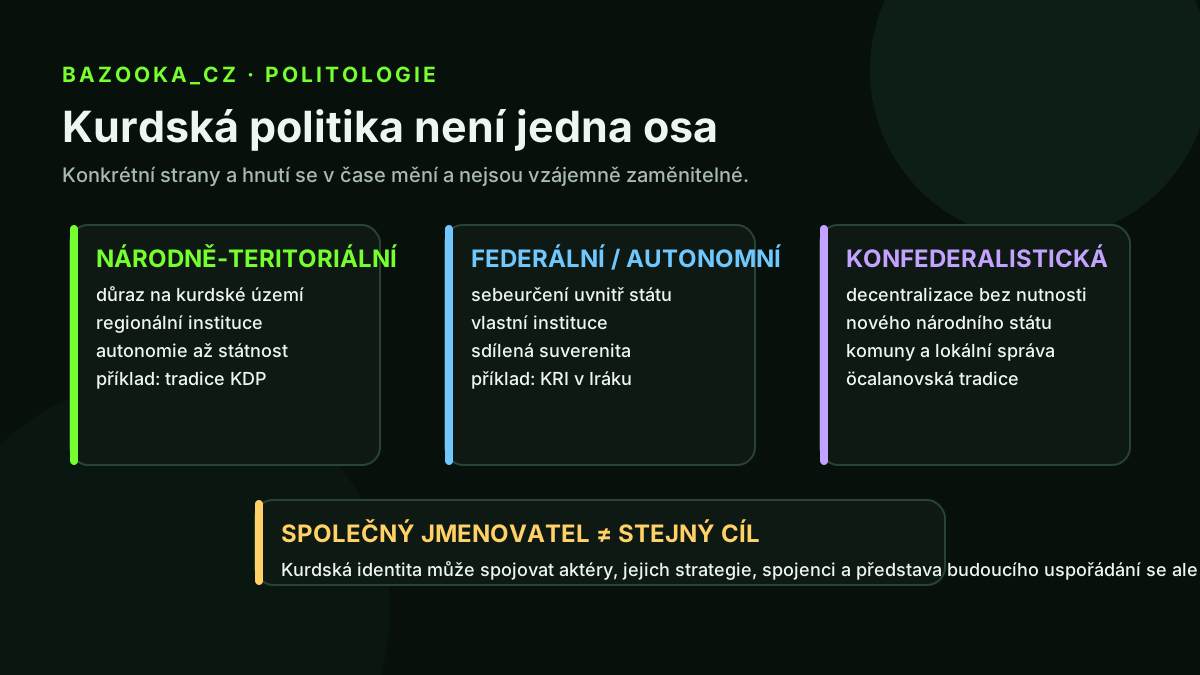
It is precisely the diversity of political models that is the most important part of the Kurdish story. In simple terms, three overlapping currents can be distinguished.
Independent Kurdistan
The classic nationalist project sees self-determination as the creation of a separate Kurdish state. The most significant figure was in Iraq's referendum in 2017 and historically in Mahabad.
State within the State
The Iraqi model combines the Kurdish Government, Parliament and the armed forces with constitutional responsibility for Iraq. Similar logic is also supported by some Iranian Kurdish parties in different forms.
Decentralisation without a new border
The Öcalanova tradition shifts the center of gravity from creating a new nation state to local government, communities, pluralism and the autonomy of communities across existing borders.
These projects may temporarily meet in a tactical objective - for example, in the defence of cultural rights or in a common enemy - but their long-term ideas of power differ. That's why it makes no sense to talk about the Kurdish plan in a single number.
13. Kurds versus Kurds: internal rivalry is not a marginal remark
The romantic idea of a nation united against four states ignores the fact that the Kurdish parties have been having tough political and armed conflicts. In Iraq, the KDP and the PUK dominate; their power bases, economic networks and foreign relations are not the same. In the wider region, there is long-term tension between the barzanian tradition of KDP and structures connected ideally or organically to PKK.
Alarm log This difference describes as a conflict of two relatively coherent political traditions: one oriented on national-territorial autonomy and pragmatic regional diplomacy, the other towards democratic Confederalism. This division is not absolute, but it helps explain why Kurdish parties may differ in their attitude towards Turkey, Iran, Damascus, the United States or Israel.
At the same time, internal pluralism reduces the possibility of creating a single negotiating body for the entire Kurdish-occupied territory. But it is not just about "weakness." It is also a natural consequence of centuries of political development in four different states.
14. "The only friends of the Kurds are the mountains" - a useful motive, not a universal law
The saying is effective, because Kurdish modern history contains a number of episodes where the external power supported the Kurdish player for a specific conflict, but did not support his broader political objective. Such situations create in Kurdish political memory a motive for "abandonment" or "betrayal."
However, it is necessary to distinguish precisely what was actually promised. In Iraq, after 1991, the Western no-fly zone did not represent recognition of an independent Kurdistan, but created conditions for autonomous administration. In years of fighting ISIS, US SDF assistance was a military partnership against a particular enemy; it was not a public obligation to support a separate Kurdish state or to protect all Kurdish regions from Turkey militarily. In 2017, the KRI's foreign partners supported the Peshmergs against ISIS, but did not support the referendum as a path to immediate independence.
The same goes for the opposite: Kurdish parties themselves led pragmatic diplomacy and made relations with powers whose interests conflict. KDP was building economic relations with Turkey, PUK was maintaining other regional links, Iranian Kurds were operating in a security environment influenced by Tehran, and Syrian SDF were dependent on US support to fight ISIS.
The most accurate conclusion is not "the great powers always betray the Kurds," but rather: Kurdish movements repeatedly entered asymmetrical tactical alliances in which their long-term national goals did not coincide with those of a stronger partner.
15. Why a united Kurdistan did not emerge
| Factor | How does it work |
|---|---|
| Division between several States | The project of united Kurdistan would require a change in the borders of Turkey, Iraq, Iran and Syria - four states with their own security interests. This is considerably more complex than the Art Nouveau dispute within a single state. |
| Resistance of neighbouring states | Neighbors have their own Kurdish populations and often fear precedent. They can therefore work together against border change even when there are rivals on other issues. |
| Inland geography | The potential Kurdish state would be heavily dependent on its neighbours for transit, trade, energy and access to world markets. |
| Mixed territories | Cities and areas such as Kirkuk are of high strategic importance to the multiethnic population. Therefore, the simple "ethnic border" is neither technically nor politically obvious. |
| Different Kurdish political objectives | KDP, PUK, PKK, PJAK, KDPI and Syrian Kurdish structures are not one organization. It is different in ideology, allies and the idea of a final arrangement. |
| Variable support for the great powers | The US, Russia, Iran, Turkey, and other actors supported the various Kurdish forces in different situations. But a stable international coalition for the creation of a single Kurdistan has not been established. |
| Existence of a functional alternative in Iraq | The Federal KRI provides a high level of self-government without full independence. For a part of the elites, protecting this position can be more practical than changing the boundaries at risk. |
| Transforming the very idea of self-determination | Part of the Kurdish movement no longer sees the nation state as the single or best target and seeks more decentralised forms of power. |
Sèvres is therefore an important symbol, but it is not a complete explanation. Even if the 1920 postwar treaty came into force exactly as it was originally proposed, it did not guarantee the automatic unification of all Kurdish regions. And for over a century, the political and demographic reality of the region has changed so much that the current problem cannot be solved by simply returning to the map of 1920.
16. What can be expected next: the question of institutions more than one line on the map
The future of Kurdish policy cannot be reduced to the question of 'will Kurdistan ever be?'. In Iraq, the relationship between KRG and Baghdad, budget, energy, disputed territories and the stability of regional institutions is an immediate problem. In Turkey, the transformation of armed conflict after the disarmament process of the PKK and the scope of democratic and linguistic reforms may be of fundamental importance. In Iran, the key relationship between central power and decentralisation or autonomy projects remains. In Syria, after the dissolution of the SDF in 2026, it is decided how many elements of former self-government, cultural rights and gender institutions will be transferred to a new state framework.
This creates several possible political trajectory without being called a "Kurdish objective": stronger federalism in Iraq; broader regional and cultural autonomy in other states; decentralisation without changing international borders; gradual integration with constitutional guarantees; or, in some parts of the political spectrum, the continuing demand for independence.
This is what makes the Kurdish issue an extremely appropriate case study of the relationship between nation and state: it shows that a common identity does not in itself determine the institutional form and that international policy often rewards the ability to create and maintain functional institutions more than historical justice of abstract claims.
17. Movies on the subject
The films are not historical sources. But they can show the personal experience of civilians, refugees and fighters, which legal documents and political maps only catch on to a limited degree.
Sun Warrior (2018)
Drama inspired by Kurdish women's troops and the fight against ISIS. The film is a cultural interpretation of the topic, not a documentary record of individual events.
Turtles can fly (2004)
The Bahman Ghobadi film tracks children in refugee camps before the American invasion of Iraq and links Kurdish issues to mines, displaced and long-term consequences of war.
Resources and further reading
Czech Source Analysis
Primary, legal and professional resources
Image resources
- Kurdistan 1920.png - WikiEditor2004, CC0.
- Republic of Mahabad and Iranian Azerbaijan 1945-1946 - WikiEditor2004, CC0.
- Iraq and Kurdish flags in Erbil - Giorgio Montersino, CC BY- SA 2.0.
- Kurdish YPG Fighters - Kurdichstruggle, CC BY 2.0.