
Nations without a state: self-determination, boundaries and geopolitics
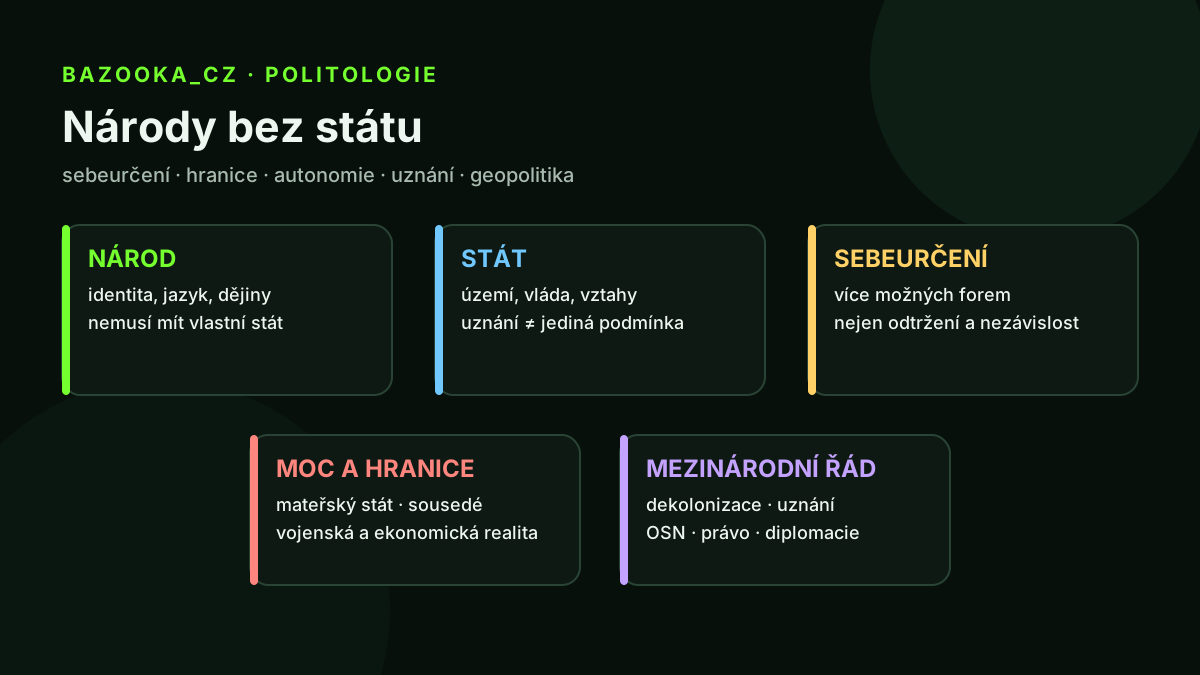
Why have some nations turned into states, while others have remained divided between several countries, gained only autonomy or found themselves in a long-term unresolved position? The answer is not hidden in a single treaty, nor in the simple law of "every nation on its own state." The creation of a state is the result of a coexistence of self-determination, borders, institutions, military and economic power, the attitude of the mother state, neighbours, great powers and international recognition.
Content
- National, people, state and citizenship
- Self-determination versus territorial integrity
- What does statehood and recognition mean?
- Interactive map of selected cases
- Kurds
- Palestine
- Sri Lankan Tamils and Tamil Eelam
- Western Sahara
- Tibet
- Uygurs
- Balloons
- Rohings and legal stateless
- Catalonia, Basque Country and Sami
- When did the new states, on the contrary, arise?
- Correlation Model
- Conclusion: the map of the states is not a map of the nations
1. The nation, the people, the state and citizenship are not the same.
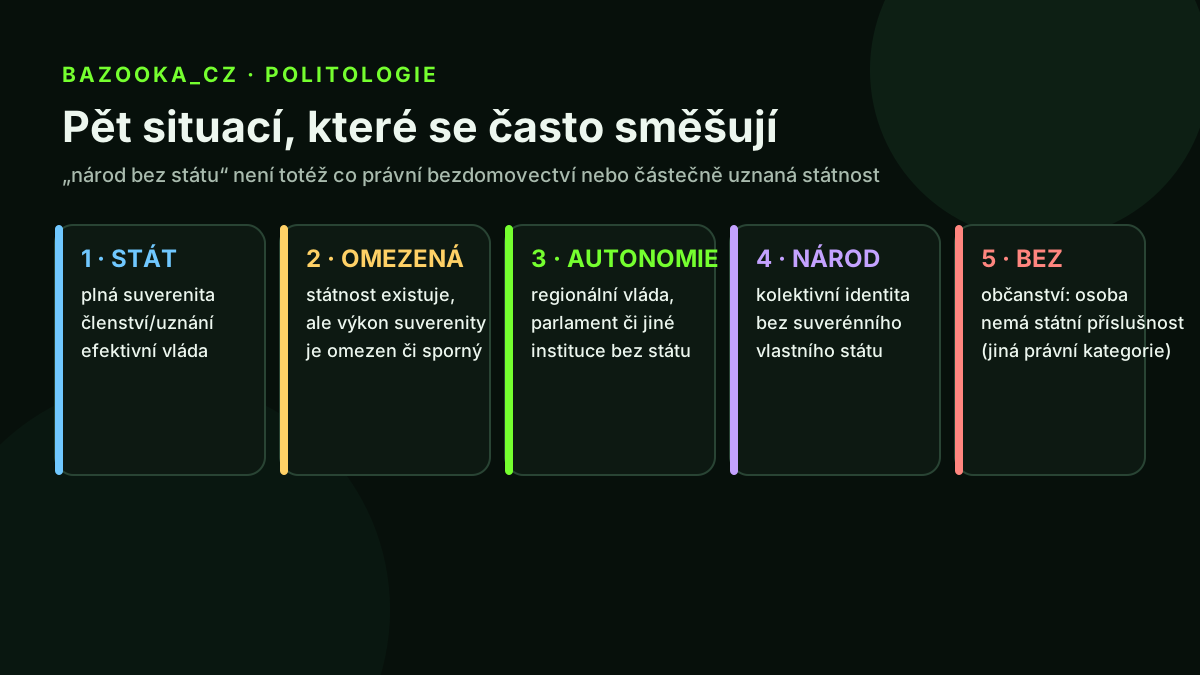
In public debate, several different categories often come together in a single sentence: "a nation should not become." But the nation is primarily a historical and political community whose members can share language, culture, historical memory or the idea of a common political destiny. The State is, on the other hand, a public authority organisation over a certain territory and population. And citizenship is the legal relationship of an individual to the state. One person can therefore be a culturally national of a nation that does not have its own state, while being a full citizen of another State; likewise, a person may have no legal nationality without automatically meaning the existence of a national project of his own state.
This dissertation is crucial for comparing Kurds, Palestinians, Rohings, Tamils, or Sami. The Kurdish issue is primarily a question of national identity, divided between several states and various projects of autonomy or self-determination. Palestine is another problem: The State of Palestine exists as an internationally recognised state project and has since 2012 the status of non-member observation state in the United Nationsbut the practical performance of sovereignty, territorial control and final political order remain unresolved. The Rohings are, in turn, an extremely important example. legal stateless, that is, lack of citizenship.
2. Self-determination versus territorial integrity
UN Charter include the development of friendly relations based, inter alia, on the principle of equal rights and the self-determination of nations among the objectives of the United Nations. At the same time, Article 2 of the Charter places international order on sovereign equality of states and prohibits the threat of force or use of force against their territorial integrity or political independence. So these principles exist side by side.
Declaration on the Principles of Friendly Relations, UN General Assembly Resolution 2625 (1970), expressly states several ways of self-determination: the creation of a sovereign independent state, a free association or integration with an independent state, and other political status freely chosen by the people concerned. The same document contains a safeguard clause against the disruption of territorial integrity or political unity of sovereign states, which is governed by the principle of equal rights and self-determination and have a government representing the entire population without discrimination.
The most institutionalized form of self-determination was decolonization. The UN, in the case of non-autonomous territories, distinguishes, inter alia, the creation of an independent state, free association or integration. This is why Western Sahara, for example, is a legally and historically different type of case from Catalonia or Kurds.
3. What does statehood mean and what does recognition mean?
The standard reference point is: Montevideo Convention, 1933. Article 1 of the Treaty states four traditional features of the State: the permanent population, the defined territory, the government and the ability to enter into relations with other States. Article 3 also states that the political existence of a state is independent of recognition by other states. However, recognition is extremely important in practice: it allows for fuller diplomatic relations, participation in international organisations and access to a number of legal and economic mechanisms.
It is therefore appropriate to separate at least four questions: whether there is a political nation or a people; whether there is an effective government and control of a territory; whether this department fulfils the characteristics of statehood; and whether other states recognise it. These questions may have different answers.
Good illustration is Kosovo. The International Court of Justice, in its 2010 advisory opinion, noted that the Declaration of Independence itself of 17. It did not infringe international law on February 2008. However, the Court has not declared the general right of all nations or regions to a unilateral secession. His question was narrower: whether a specific declaration violated applicable international law. See ICJ, Advisory Opinion of 22 July 2010.
4. Interactive map: similar names, different legal situations
Points are indicative geographical signs, not border claims. In the disputed territories, the map does not deliberately draw "definitive" political boundaries.
5. Kurds: a great nation, but not one political project
Kurds are often referred to as one of the largest nations without their own sovereign state. Estimates vary; Council on Foreign Relations works with approximately 30 million Kurds living primarily in Turkey, Iraq, Iran and Syria. At the same time, the same source underlines that the Kurds are not politically monolith: regional, party, family and ideological interests may be diverted.
After World War I, the Sèvre Treaty of 1920 contained a special section on Kurdistan. However, it was not an immediate establishment of the state. Articles 62-64 provided for a proposal for local autonomy for defined mostly Kurdish areas and, under certain conditions, opened up the possibility of later independence. The post-war arrangement changed and Lausanne did not create the Kurdish state of 1923.
Today's Kurdish policy includes several different models. Iraq's Kurdistan is a constitutionally recognized federal region with its own institutions. Part of the Kurdish movement in other countries promotes autonomy or federalism. The Öcalanova tradition associated with the PKK has developed the concept of democratic Confederalism, which does not necessarily presuppose a classic new nation state. In addition, there are more significant nationalist and separatist currents.
6. Palestine: it is not easy to say "nation without state"
The Palestinian case needs to be categorised more precisely. United Nations General Assembly in Resolution 67 / 19 of 29. On November 2012, Palestine was granted status Non-Member State of observation. The UN Secretariat has been using the label since then State of Palestine; the current UN website lists Palestine, along with the Holy See, among non-member observation states. See Resolution 67 / 19 and UN Non-Member States.
The main problem is therefore not simply "absence of state," but limited and questionable exercise of sovereignty, occupation of territory, territorial fragmentation, security regimes, Jerusalem status, settlements, borders and absence of final political order. Moreover, Palestine is not a full member of the UN. Her case thus shows the difference between State as a legal and diplomatic status and full effective sovereignty. Historical roots, migration, 1948, occupation and settlement system detail the studies From European anti-Judaism to the State of Israel.
7. Sri Lankan Tamils and Tamil Eelam
The Tamils also show why we need to speak accurately. The Tamil population is not in general a "nation without a state" in a simple sense: tens of millions of Tamils live in India, especially in the State of Tamilnád. Separate State project Tamil Eelam concerned mainly the north and east of Sri Lanka and was associated with part of Srielan Tamil policy.
The armed form of separatism was represented by Liberation Tigers of Tamil Eelam (LTTE). Civil war ended in May 2009 with a military defeat of LTTE. However, the end of the armed project did not automatically end Tamil political issues - in particular representation, language and civil rights, decentralisation, post-war responsibility and the form of constitutional order.
The role of India is particularly interesting for comparison with the Kurds. India has a huge Tamil population, but its official policy has long supported political solutions. within the framework of the Single Sri Lanka, including meaningful devolving of powers and fulfilling Tamil aspirations for equality, dignity and self-respect. See Ministry of Foreign Affairs of India.
This is a general geopolitical mechanism: ethnic or cultural proximity to the neighbouring power does not automatically mean supporting border change. The state may have its own security, constitutional and domestic reasons for putting autonomy or decentralisation before secession.
8. Western Sahara: Unfinished Decolonization
Western Sahara is extremely important for comparison, because it is a case that the UN is still leading on the list non-autonomous territories. According to the UN's decolonization website, he's been on this list since 1963. The dispute includes Morocco, the Polisario Front and the Arab Democratic Republic of Sahrawa, as well as a long-term, final resolution of the status.
It is here that self-determination is directly linked to the UN decolonization framework. This distinguishes Western Sahara from regional separatist movements within established democratic states. See United Nations and Decolonization - Western Sahara.
9. Tibet: Conflicting interpretation of history and a firm state power
It is inappropriate to use a single politically burdensome wording without explanation of the dispute with Tibet. The People's Liberation Army entered the East Tibetan region in 1950 and Tibetan forces were defeated at Chhamda. In 1951 it followed the so-called 17-point agreement between representatives of the Central Government of the PRC and Tibetan representatives.
China's official interpretation refers to this process as a "peace liberation" and understands Tibet as a historical part of China. On the contrary, Tibetan exile institutions and some of the specialised literature stress military pressure and question the voluntary nature of the agreement. Expert study in The China Quarterly analyses negotiations after the Battle of Chad and the work of the Chinese leadership with promises, threats and coercion.
Today, the Tibetan Autonomous Region is part of the People's Republic of China. It is essential for this article that the historical existence of a self-governing political identity does not determine the outcome of statehood in itself: military control, international environment and long-term integration into the power system of the PRC were also decisive.
10. Uighurs: identity, autonomy and human rights are not the same as a unified separatist program
The Uighurs are the Turkish, mainly Muslim population concentrated in the current Uighur Autonomous Region of Xinjiang in the PRC. Some historical and exile currents used the concept of Eastern Turkestan and some activists demand independence, but it cannot be concluded that the entire Uighur population is the same political target.
Human rights are a separate issue. OHCHR in 2022 evaluation He stated that the extent of arbitrary and discriminatory detention of the Uighurs and other predominantly Muslim groups in the context of broader restrictions on fundamental rights could constitute international crimes, particularly crimes against humanity. The Chinese Government rejects this interpretation and frames its policy primarily as a fight against terrorism, extremism and separatism.
It is important for analytical comparisons to separate three things: the existence of a national identity, the issue of rights and autonomy, and the specific support of separatism. They're connected, but they're not interchangeable.
11. Baloch people: a nation across borders and several forms of nationalism
The Balthar population lives primarily in Pakistan and Iran, as well as in Afghanistan. Baltharian nationalism historically included very different requirements - from cultural and economic rights to political autonomy to separatism and the idea of an independent Baluchistan. The overview of the development of Baltharian nationalism in Pakistan and Iran is offered, for example, by the academic work of SOAS. Baloch nationalism: Its origin and development.
Like the Kurds, the borders intersect a wider ethnolinguistic space. At the same time, the geographical indication "Baluchistan" must not be confused with the unified political will of all Balučres. Part of the policy is autonomy, part of the separatist, part of it is within existing state institutions, and the armed organisations do not automatically represent the entire population.
12. Rohingya: why legal statelessness requires a category of its own
Rohings are an appropriate example of why the term "stateless" is treacherous in translation between law and political science. UNHCR states that the Rohings were deprived of citizenship in Myanmar and represent the largest population of stateless persons in the world. In mid-2025, UNHCR registered around 1.8 million Rohings as the largest reported stateless population.
That is the first question individual rights to nationality, protection and civil status. It can be linked to ethnic identity and political rights, but it is not analytically identical to Kurdish or Catalan disputes over the form of statehood.
13. Catalonia, Basque Country and Sami: other types of self-determination
Catalonia
Catalonia has its own autonomous institutions within Spain, while at the same time having significant political flows that promote independence. The 2017 referendum was rejected by the Spanish constitutional order and led to a deep political and legal conflict. This is therefore a dispute within a functioning European state, not a classic decolonization.
Basque country
The Basque National Identity goes beyond Spain and France. However, there is a large autonomous government in Spain. The history of the ETA's armed separatism and today's institutional policy represent a significantly different phase of the same wider national problem.
Saami / Saapmi
The Sami live across Norway, Sweden, Finland and Russia. The modern agenda focuses primarily on indigenous rights, language, culture, soil, reindeer grazing and various forms of political representation. It is not accurate to present Sami as a unified separatist movement seeking a new sovereign state.
These examples show that self-determination can mean much more than changing the international border: cultural autonomy, parliamentary representation, federalism, language rights, regional fiscal powers, or the protection of indigenous life.
14. When did the new states, on the contrary, arise?
Understanding unsuccessful or unfinished projects is easier if we compare them to cases where new statehood has actually come into being. Bangladesh, Eritrea, Timor-Leste and South Sudan are not the same stories. However, everyone shows a different combination of the breakdown or transformation of the previous political framework, armed conflict, international negotiations, referendums, external support and subsequent recognition.
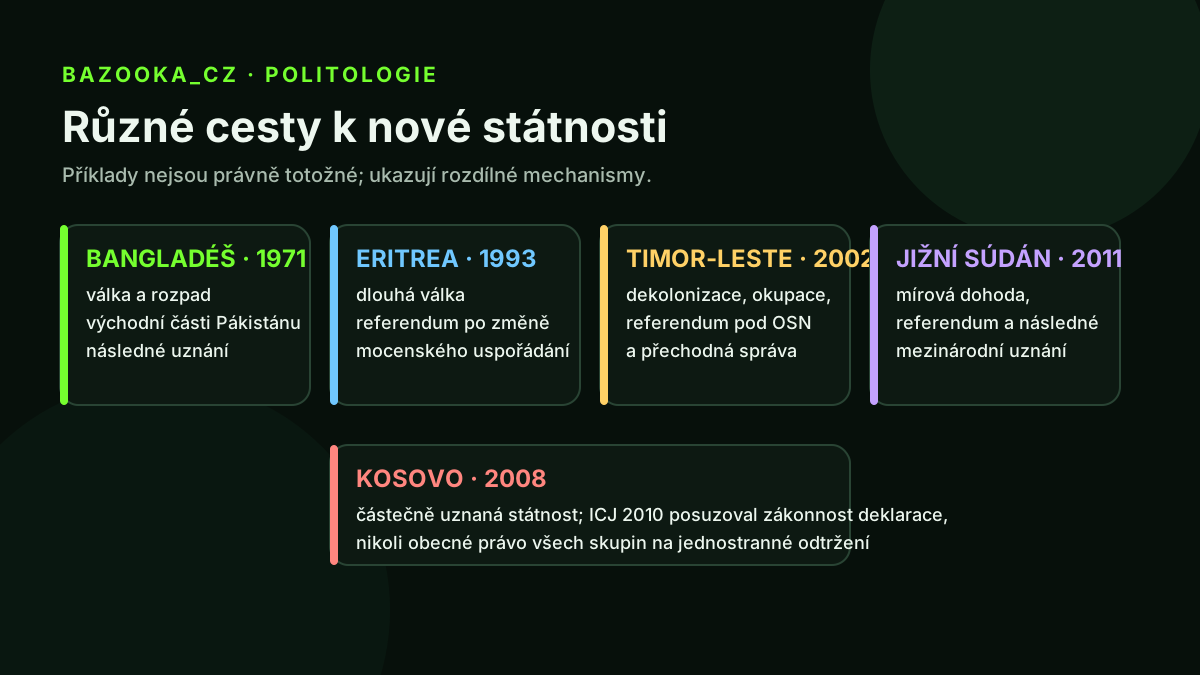
The single legal formula is not a common element, but a change in the political balance in which the new unit has managed to achieve institutional and diplomatic progress. Somewhere there was a decisive referendum based on a peace agreement, elsewhere a decolonization process, elsewhere a collapse of the older state order or the outcome of the war.
15. Comparison model: seven questions before the creation of the state
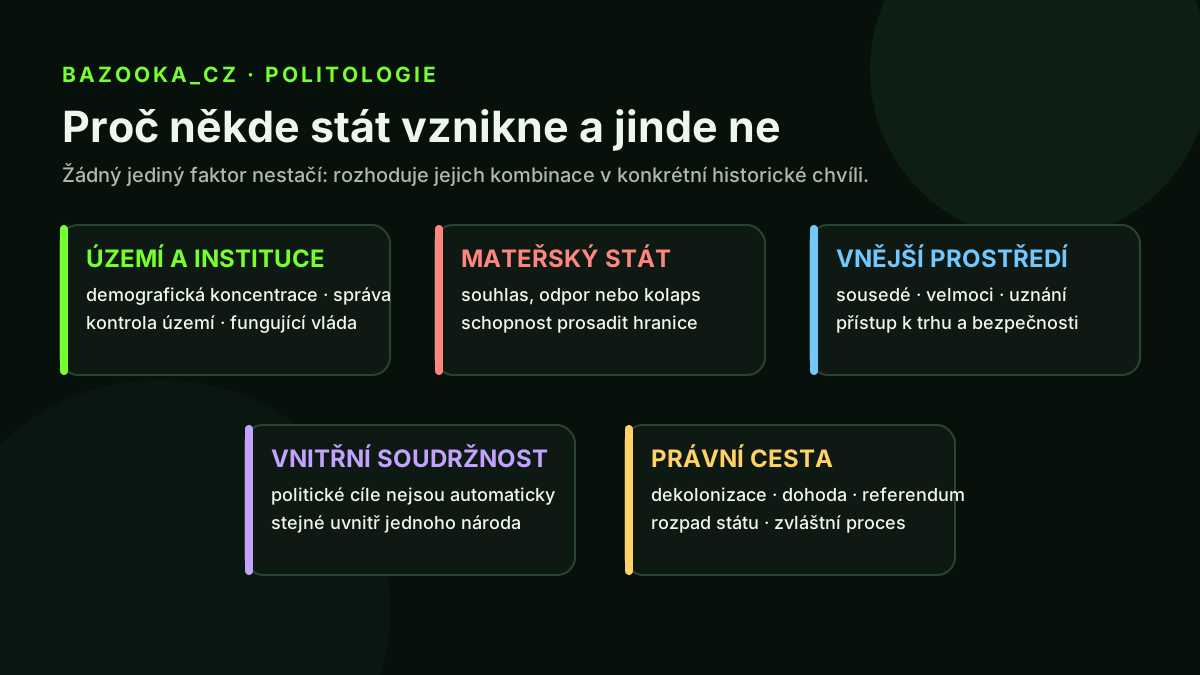
| Question | Why is it important | Kurds | Palestine | Western Sahara | Sri Lankan Tamil project |
|---|---|---|---|---|---|
| Is the population territorial? | It facilitates the management and definition of a territorial project, but does not address mixed areas. | Yes, in a number of regions, but over four major states. | Yes, but with territorial fragmentation. | Yes, and a large refugee and diasporic component. | Historically, in particular, the north and east of Sri Lanka. |
| Are there institutions of their own? | The functioning administration increases the capacity to act as a political whole. | Strong in the KRI; in Syria, structures were fundamentally integrated into the state in 2026. | Yes, but with limited performance and divided administration. | Polisario / SADR has its own structures; the control of the territory is questionable and uneven. | LTTE has established a de facto administration which was destroyed in 2009 by military destruction. |
| Is the mother state okay? | The agreement or peace agreement significantly reduces the cost of changing borders. | Turkey, Iraq, Iran and Syria did not support the creation of a united Kurdistan. | The core of the Israeli-Palestinian dispute and the peace process. | Morocco and Polisario have fundamentally different ideas of final status. | Sri Lanka rejected the separate Tamil Eelam. |
| How are the neighbors coming? | The Inland New State is particularly dependent on borders, trade and transit. | Key factor; neighbours have their own Kurdish populations. | Regional states are an important part of diplomacy and security. | Algeria and Mauritania are affecting the regional framework. | India supports Tamil rights and devolution, not the new Tamil Eelam. |
| Is there stable international support? | A short-term military alliance may not mean supporting statehood. | There was repeated tactical cooperation, not a permanent consensus on independence. | Extensive international recognition, but not full UN membership, and not full of effective sovereignty. | The UN maintains a decolonization framework; however, the final solution is lacking. | The international environment did not bring a separate statehood in 2009. |
| Is the political project internally united? | One identity may contain several competing ideas about the arrangement. | Not significantly: statehood, autonomy, federalism and Confederalism. | Palestinian policy has its own deep institutional and party contradictions. | Polisario is the dominant player in the project of independence. | Tamil's policy was and is wider than the LTTE. |
| Is there a legal-political way? | Decolonization, agreement, constitution or international process can institutionalise legitimacy. | No unified path for the entire Kurdish territory. | The international state status exists, the final arrangement does not. | The UN's explicit decolonization agenda. | The current framework is aimed at rights and devolving within Sri Lanka. |
16. Conclusion: the map of the states is not a map of the nations
A modern political map of the world was not created by each nation getting its own state. It is the result of the disintegration of empires, colonial administrative borders, wars, agreements, revolutions, migration, demographic blending and strategic compromises. The borders therefore rarely copy exactly the language, ethnic or historical areas.
That doesn't mean self-determination is an empty principle. Does that mean Self-determination and statehood are not the same thing. The political community can seek its own determination through state, federation, autonomy, decentralisation, shared institutions or other forms. And, while a large part of the population promotes independence, the emergence of a new state usually also depends on the ability to create institutions, maintain territories, secure economic links, manage minorities within new borders and obtain sufficient international acceptance.
It is equally important not to exaggerate the role of colonial "lines on the map." Many borders were indeed created according to imperial and strategic priorities, not according to the wishes of the local population. At the same time, however, populations were often so mixed that even purely ethnographic borders would not be created by states without minorities. Any new division can therefore solve one problem and create another.
Resources and further reading
Other context
Kosovo is discussed in detail in a separate study; the broader institutional question is addressed by the article on UN reform.