
American power, hegemonic space and recurring patterns of foreign policy
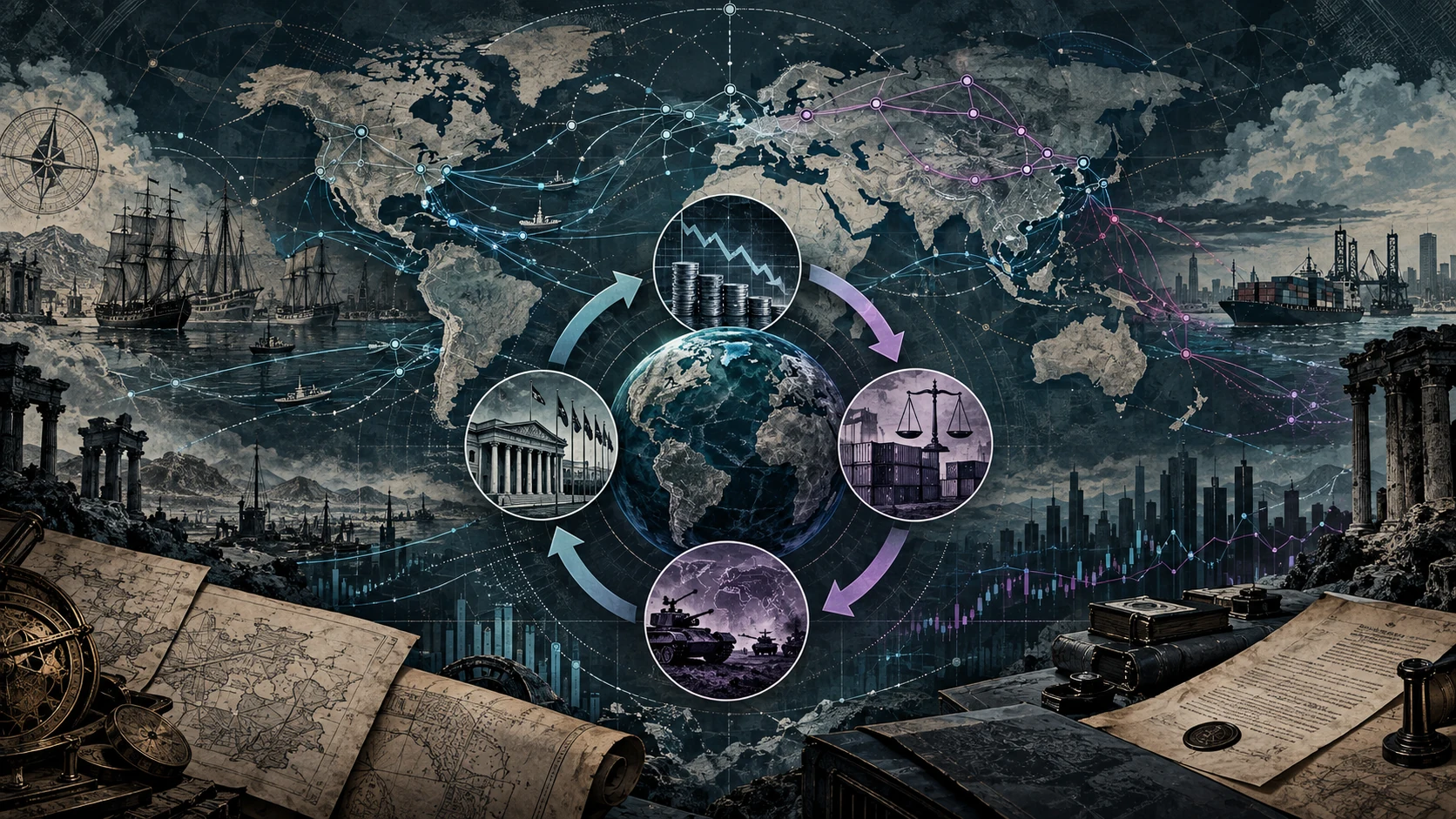
Content
- The roots of America's expansion and transformation of power tools
- From World War I to the postwar order
- Power mechanism: from motive to recurring scenario
- Yugoslavia, Iraq and Libya: three forms of the same mechanism
- Military-industrial complex and long-conflict economy
- Breakdown of the Eastern Block and Czech Transformation
- Ukraine: competition for geopolitical orientation of the state
- Iran: coup d'état, penalty spiral and regional security dilemma
- International humanitarian law and responsibility for attacks on civilians
The roots of America's expansion and transformation of power tools
Continuity and breakthroughs of American power
The continuity of American power is not a fixed plan, but a repeated combination of territorial security, trade-related approach and institutional superiority. In the nineteenth century, this relationship was mainly about the Western Hemisphere and the Pacific. After World War II, he gained a global dimension because he leaned on the dollar system, the alliance network, international organisations, and a permanent military presence. Each period must therefore be read in its own terms, not as a simple continuation of the colonial empire by other means.
The important turning point represents the transition from direct intervention and protectorate practices to a wider set of indirect instruments. Sanctions, technology export control, security assistance, training, financial institutions and diplomatic recognition can change the decision-making area of another country without sending troops. These instruments can promote stability and the defence of allies, but they can also create dependencies, weaken internal pluralism or prolong conflict. Therefore, their effect should be assessed on the basis of a specific case and a time horizon.
Moreover, after 1991, the environment changed, not the need for critical analysis. The demise of bipolar rivalry allowed interference without an immediate balance of two superpowers, but at the same time extended legal and public control over their legitimacy. The subsequent return of the great power competition has shown that institutions created at the unipolar moment are not politically neutral: for some states they are a framework of cooperation, for other instruments of unequal influence. This ambivalence is the key to the following case studies.
Before 1880, the frame in embryonic form existed.But more like gradually composing strategies of expansion and superiority, not as one finished "master plan" for post-war UN / World Bank institutions. You're up 1944–1945 and were formed in multilateral conferences by dozens of states, even though the US had an extremely strong weight in them and set a large part of the rules.
The most accurate wording, according to the available evidence, is this:
First, the American logic of continental expansion and hemispherical exclusivity was created; Only later did it become a project of ocean, financial and ultimately global hegemony.
I'd put it like this:
1) Not yet "global hegemony," but very soon "exclusive sphere"
1803- 1840s: continental expansion
By 1803, Louisiana Purcas has dramatically enlarged the US territorial base. In the first half of the 19th century, American foreign policy dealt with Oregon, the southwest and other territorial shifts. It's not a global order yet, but it's Imperial logic of space expansion, resources and security depth.
1823: Monroe's doctrine
This is the first really important, based on the available evidence. an idea degree of hegemonyMonroe's doctrine originally said "Europe should not return to the Western hemisphere," not "we will rule the world." But she created the principle that Western hemisphere is a special strategic area of the USALater, it became the basis for America's demands for regional primacy and intervention in Latin America.
This is essential:
- not global hegemony,
- but no entitlement to exceptional status and exclusion of other powers from "their" space.
2) Prior to 1880 external projection of power appears
1853-1854: Perry and opening Japan
Commodore Perry's trip to Japan is a very important moment because it shows that the US is no longer just dealing with land, but also projection of force across the ocean for trade, supply and strategic nodesThe Office of the Historian explicitly states that the opening of Japan was to strengthen the American position for trade and diplomacy in Asia and that trade with China led the US to expand its presence in the Pacific.
This is the first clear proof, according to the available evidence, that American logic extends from:
- continent
na
- Maritime network, ports, supply points and trade corridors.
3) So what existed before 1880
Let me get this straight:
There was already:
- expansive thinking (Manifest Destiny + Territorial Growth),
- hemispheric exclusivity (Monroe),
- growing Pacific and Asian commercial-strategic projection (Perry, ports, China trade).
It has not yet existed in its finished form:
- fully developed Global Maritime Empire,
- openly formulated world hegemon doctrine,
- institutional World Financial Regulation under American leadership.
All this is more composed from end of 19th century and especially after 1944.
4) When the embryo becomes a real hegemonic project
Here's a few milestones:
1890s: Mahan + Ocean Power
Alfred Thayer Mahan, in his work on naval power in 1890, systematized the idea that world power stood on control of seas, fleets, trade routes and basesThat's almost the textbook basis for a later American global projection.
1899-1900: Open Door
"Open Door" to China is no longer just a defense of its own continent. It is a requirement that no power closes a large market outside the US. This is a very important step towards an informal empire: not always direct colonization, but enforcement of rules such that American capital and trade have access everywhere.
1904: Roosevelt Supplement to Monroe's doctrine
It's definitely breaking down here. Office of the Historian writes that Roosevelt's Corollar had originally turned passive doctrine into justification United States intervention in Latin AmericaThat's almost an open acceptance of the role of "regional cop."
1944–1945: Bretton Woods + UN
This is where it comes from institutional layer of hegemonyBretton Woods created IMF and World Bank; The UN was founded in San Francisco with 50 founding states. These were not unilaterally "American firms," but they were institutions created when the US was the strongest economy and main organizer of the postwar order. So more accurate than "America founded the UN and the World Bank itself" is: The US helped create a postwar multilateral order in a form that strongly reflected their power and preferences.
5) What can be documented as "earlier framework"
Yes. roots are before 1880But not in the sense of:
- "they already had a detailed plan for the UN and the World Bank."
More like:
- She was already forming. American exceptional,
- entitlement to excluding rivals from their sphere,
- expansion as normal,
- and gradual transition from Territorial expansion k maritime, commercial and ultimately financial dominance.
Conclusion on historical roots
If I had to say it as accurately as possible:
Before 1880, the US's basic hegemonic code existed - expansion, exclusive hemisphere sphere, and growing projection of power across the ocean. But the real project of the global order became two more stages: the late 19th century through maritime and commercial doctrine, and after 1944 through international institutions and the dollar / financial system.
The analysis shall take the form of: 1) time axis 1776-1945 and 2) Ideas map, but with one important remark in advance:
It doesn't look like one secret coherent plan since 1776. More like sequential layering: first continental expansion, then hemisphere exclusivity, then ocean and commercial projections, and finally after 1944, the institutional world order strongly shaped by American power.
1) Time axis 1776-1945: node moments of American hegemony
1. 1776- 1783: State creation and strategic autonomy It is not about hegemony, but about the creation of a separate power centre outside the European system. Independence itself has already created a precondition for the future American own sphere, independent of the British Empire.
2. 1803: Louisiana Purchase Buying Louisiana doubled the size of the United States. This is a key point, because American power has leaned on a huge territorial and resource base. Without this continental base, later ocean and global projection would be much weaker.
3. 1823: Monroe's doctrine First big idea break. The doctrine has determined that the Western hemisphere should not be recolonized by European powers. It's not a claim on the world yet, but it's a claim on Exclusive strategic space USA in America.
4.1830s-1840s: Manifest Destiny At this time, American expansion is beginning to justify itself ideologically: the US is "destined" to spread across the continent. The Office of the Historian explicitly describes that diplomacy and Western expansion were led by the ideology of Manifest Destiny. This is an important transition from simple expansion to believing that expansion is historically justified.
5. 1846-1848: Oregon and war with Mexico The Oregon decision and the war with Mexico have completed the American movement to the Pacific. This is essential, because the US is no longer just an Atlantic state and becomes a power with two oceans.
6. 1853-1854: Perry and opening Japan This is where American logic moves from continent to Pacific for the first time. State Department writes that trade with China has led the US to expand its presence in the Pacific and that Perry's main motivation was to create a foothold for trade and diplomacy in the region. That's the germ of the bases, routes, and naval projections.
7. 1898: Spanish-American War and Overseas Handholds After the war, the US became the holder of Puerto Rico, Guam, and the Philippines. This is a huge breakthrough: the United States is no longer just an expansive republic on the continent, but also overseas imperial power.
8. 1899-1900: Open Door in China John Hay formulated Open Door as a policy of equal business opportunity and preserving the territorial integrity of China. It basically meant: we do not necessarily want a colony, but we want rules that will not allow other powers to push us out of key markets. This is an important step towards an informal empire.
9. 1904: Roosevelt Supplement to Monroe's doctrine Originally defensive Monroe turns into an active right to intervene. The Office of the Historian describes this directly as a transition to the role of "regional cop." Here, the exclusive sphere becomes a practical intervention doctrine.
10. 1903-1914: Panama and Channel The Panama Canal was not just infrastructure, but a strategic hub for the global movement of fleets and trade. State Department states that the US has supported the Panama separation from Colombia and has acquired the right to build and manage the channel. This is one of the clean moments when geopolitical logic, trade and intervention come together to one point.
11.199-1913: Dollar Diplomacy For Taft and Knox, economic power is used as an instrument of foreign policy. This is an early version of a later hegemonic style: instead of direct anexus, more often financial ties, loans, investments and their political cover.
12. 1917-1918: Entry into World War I and Wilson's Fourteen Points Entry into war gives the US a decisive voice in the European order, and Wilson will formulate the universalist language of the world order: law, peace, self-determination, collective security. This is a crucial moment when American power is gaining universalist self-justification.
13. 1933: Good Neighbor Policy At first glance, a more moderate turn: less direct military forces in Latin America, more cooperation and trade. But even this can be read as hegemonic adaptation: not abandoning hemisphere superiority, rather its cheaper and more legitimate administration.
14. 1940–1941: Lend-Lise Even before entering the US war directly, they supply allies and become "arsenal of democracy." This turns American industrial and financial power into an instrument of shaping postwar order.
15. 1944–1945: Bretton Woods and the UN This is where all previous developments are institutionally closed. In Bretton Woods, 44 states came together to create IMF and World Bank, and in San Francisco, 50 states completed the UN Charter. It was not "US private projects," but it was created when the US was the strongest economic-military power and could strongly shape the architecture of the rules. This is the transition from expansion and sphere of influence to Institutionalised hegemony.
2) Ideas Map: from expansion to Pax Americana
A. Destiny Manifesto
The basic code of the 19th century: expansion is not only advantageous, but almost "natural" and justified. At this stage, it is mainly about the continent and the belief that the US model has a historical right to growth.
B. Monroe
Destiny's manifesto itself is mainly intra-continental. Monroe adds a foreign policy framework: This is our hemisphere and Europe is supposed to stay out.Here comes the principle of the sphere of influence.
C. Open Door
The next step: it is no longer enough for its own hemisphere; access to large markets outside it must also be guarded. Open Door is a very modern idea: not necessarily to own everything, but Set rules so that no one can close the system against American capital and trade.
D. Mahan
Mahan gives it all strategic technology. If the state wants world weight, it needs a fleet, trade routes, bases, floods and ocean mobility. So Mahan does not bring the goal, but the operational logic of world powerHis influence sits well on the transition from the continental Republic to the ocean power around 1900.
E. Wilson
Wilson gives hegemony a moral language. It is no longer about "our sphere" or "our business," but about world peace, law, self-determination and international organization. Here comes the American style, which will later be typical: national power is expressed in universal language.
F. Bretton Woods
If Wilson was mostly normative, Bretton Woods is structural. Here, the moral language connects to financial architecture. The international economy receives institutions in which the US plays a central role. This is hegemony converted into rules, loans, currencies and reconstruction.
G. Pax Americana
Pax Americana is not one doctrine, but the result of previous layers:
- Destiny's manifesto gives expansive confidence,
- Monroe's sphere of influence,
- Open Door global economic ambition,
- Mahan maritime infrastructure power,
- Wilson universalist language,
- Bretton Woods and the UN institutional skeleton.
After 1945, it will merge into a system in which the US is not just a strong state, but main architect of the rules, security and finance of the Western Order.
A summary of American power developments
If I were to download it into one sentence:
American hegemony was not created by the US planning the UN and the World Bank by 1800; It developed gradually - from continental expansion to hemisphere exclusivity and ocean-trade projection to the postwar institutional order that the US helped to create and benefited most from.
Next "Dark version" of the time axis 1900-2026 - not as a complete list of everything, but as backbone of repeating formula: intervention, occupation, coups, pressure, sanctions, proxy and legal framing.
Important note: Not all points are of the same type or legal weight. Somewhere it was a direct invasion, elsewhere it was a cover operation, elsewhere it was economic coercion, or an intervention with a partial international cover. The point of that axis is to show continuity of imperial practiceNot to say that every case is the same.
1900- 1934: Caribbean and Central America as "American Lake"
1) 1899-1902: Philippines - anexation and suppression of anti-colonial resistance After taking over the Philippines from Spain, the US waged a war against Filipino nationalists who wanted independence, not just the exchange of colonial lords. That's an early clean case: Anexa + military resistance pacification.
2) 1903-1914: Panama - support for separation and acquisition of the canal zone The US has long wanted a transisthmic channel; the Colombian rejection of the agreement followed a Panama secession, and Washington gained control of the territory necessary for the canal. Practically: geopolitical interest + support for the new state + long-term control of the strategic hub.
3) 1904: Roosevelt Supplement to Monroe's doctrine Here, the original "Europe Away from America" becomes an active US right to intervene in the Western hemisphere. The Office of the Historian directly states that military force was increasingly used in practice to "restore stability." That's de facto. formal allowance for regional interventions.
4) 1909-1913: Dollar Diplomacy - Finance as an instrument of domination Taftov'dollar diplomacy"combined loans, financial control and political pressure. Especially in Nicaragua, US credit and strategic interests were directly intertwined with the local power structure. Here you can see the early model: You don't have to colonize right away; just manage debt, customs, banks and security apparatus.
5) 1915-1934: Haiti - occupation, financial control, reconstruction of the state under US supervision American Marines entered Haiti in 1915 and the occupation lasted until 1934. Official documents refer to "pacification," finance contracts and economic development and the US administration of Haitian finance. ♪ Military occupation + fiscal guardianship + overwriting of domestic power under American supervision.
6) 1916-1924: Dominican Republic - military occupation and martial law American documents explicitly state "military occupation" and "establishment of martial law," plus taking control of finance. This is another clean Caribbean case: occupation of the country, military administration, financial subordination.
7) 1912-1933: Nicaragua - long presence, election supervision and security apparatus Official records show an American presence until 1933, overseeing elections and creating / training Guardia Nacional. This is a typical "indirect protectorate ': local sovereignty formally remains, but key levers hold Washington.
1953-1989: Cold War Regiment, Proxy and Rollback'
8) 1953: Iran - Operation TPAJAX / Ajax Today, it is no longer just speculation, but the officially published documentation corpus FRUS: CIA and allies planned and performed the TPAJAX operation against Mosaddek. This is a textbook case. overt regime change.
9) 1954: Guatemala - PBSUCCESS FRUS documents explicitly set out the objectives: "remove cover 'of the existing government and" install and sustain, cover, and pro-US government'. That's almost a laboratory-pure definition of an outbound coup.
10) 1961-1962: Cuba - Bay of Pigs + embargo The invasion of the Bay of Pigs was supported by the CIA and was to overthrow Castro; it did not. At the same time, there was economic pressure, which was formalised as an embargo in 1962. This shows the double track: first cover / proxy invasion, then long-term economic strangulation.
11) 1964-1973: Vietnam - escalation through Tonkin, bombing, war of wear and tear The Office of the Historian says directly that the incident in the Gulf of Tonkin and its resolutions provided justification for further American escalation. Later documents also show how the "supposed" second attack has become a problem of administrative creditworthiness. It's a model: incident → political approval → massive escalation.
12) 1969-1970: Cambodia - secret bombing and expansion of war FRUS documents show planning and arguments for hitting targets in Cambodia and confirm secret bombing. Dark meaning: Enlargement of the war for publicly recognised conflict borders.
13) 1970-1973: Chile - destabilization Allendeho and fast receiving junta The Office of the Historian and FRUS document American opposition support, efforts to weaken Allende and the subsequent rapid recognition of the Pinochet junta after the coup. The precise level of direct operational management on 11 September 1973 is the subject of debate, but American role in previous destabilization and acceptance is documented.
14) 1980s: Nicaragua - Contras, port mining, ICJ judgment Here it is extremely strong in law: the International Court of Justice decided in 1986 in the Nicaragua v United States case and, among other things, rejected America's justification for collective self-defense. It's one of the toughest official legal records about illegal use of force, non-intervention and proxy cylinder.
15) 1983: Grenada - direct invasion Office of the Historian speaks directly about "joint American... military invasion." That's a simple case: small state, regional crisis moment, rapid invasion and change in force ratios.
16) 1989: Panama - Operation Just Cause Office of the Historian states that Bush sent over 20,000 troops to Panama to overthrow / capture Noriega. Here you can see the late-cold style: rapid invasion, legally and politically framed as necessary action, effectively regime change by force.
1999-2014: unipolar moments and "humanitarian" or "counter-terrorism" framework
17) 1999: Yugoslavia / Kosovo - bombing without the mandate of the UN RB The Office of the Historian summarises that the failure of Rambouillet followed NATO's 78-day air campaign against FRJ. This is a key transition: humanitarian argument + alliance actions + lack of mandate of the Security Council.
18) 2001-2021: Afghanistan - from self-defense to 20-year occupation and state-building At the beginning, there was a stronger international support than in many other cases: UN RB adopted resolutions 1368 and 1373 after 11 September and NATO first activated Article 5. But the initial answer to 9 / 11 gradually became Long war, occupation and reconstruction of the statewhich can be read in the "dark" axis as a transformation of self-defense in imperial mission creep.
19) 2003: Iraq - invasion based on the WMD framework and "Coalition of the willing" The Bush administration has publicly built a case to disarm Iraq and violate UN resolutions; At the same time, she spoke of "moment of truth" and ultimatum Saddam. There was an invasion without a new explicit mandate of the UN RB, then the CPA and the dissolution of the Iraqi army. It's an archetype: legal framing + coalition + regime change + long breakdown of consequences.
20) 2011: Libya - protection of civilians, then fall regime and vacuum Libya is more complex because the intervention was linked to the 2011 international framework, but US and Allied actions ended with the fall of Gaddafi and the ensuing chaos. Today's US documents themselves state that countries have faced division and violent conflict since the fall of the regime. In the dark axis, this is the case: humanitarian / protective framework → de facto regime change → State breakdown.
21) 2014- present: Syria - air campaign and long military presence without the consent of Damascus The US announced a broad coalition against ISIS in 2014. From the point of view of the "dark axis," it is important that this was extended military action in the territory of a foreign Statewhose legitimacy was derived from the fight against terrorism, not from the consent of the Syrian Government.
2018- 2026: sanctions, recognition of alternative governments, targeted killings, new war with Iran
22) 2018: Iran - departure from JCPOA and "maximum pressure" The Trump administration withdrew from JCPOA and re-imposed sanctions, subsequently formulating a "new strategy" against Iran. This is an important moment because it shows a form of hegemony without invasion: breaking the agreement + secondary sanctions + economic and diplomatic strangulation.
23) 2019: Venezuela - the recognition of Juan Guaidou and the attempt to delegitimize existing power The US has officially recognized Guaidou as "interior president." It's not a tank invasion, but it's a clear form. political intervention in legitimacy and entitlement to government in a foreign state, accompanied by penalty pressure.
24) 2020: Kassim Solemani's killing in Iraq DoD stated that the strike was aimed at deterring future Iranian attacks, and that the Solaeus "was actively developing plans" for further attacks. Even if someone accepted American logic, in the dark axis, it's a turning point: targeted killing of a high-ranking representative of another state on the territory of a third State, with the risk of a wider war.
25) 2026: USA + Israel - direct hits on Iran Today, 28 February 2026, Reuters and AP state that Trump has announced "major combat operations" in Iran, coordinated with Israel, against Iran's military and other objectives; At the same time, he called on the Iranians to "take over." It's not just penalty pressure or cover action anymore, but Open military escalation associated with rhetoric of regime change.
What comes out of that "dark axis" as a pattern
When I download it into several sentences, the long sequence shows a fairly stable model:
- 1900- 1930s: direct occupation and financial guardianship in the Caribbean and Central America.
- 1950s-1980s: cover coup, proxy war and anti-communist legal / moral framework.
- 1990s-2010s: humanitarian and counter-terrorist justification for bombing, invasion and long missions.
- 2018–2026: a combination of sanctions strangulation, recognition of alternative governments, targeted liquidation and re-open war with Iran.
And the hardest wording I would stand by is:
America's hegemonic style has been changing in technology over the centuries, but not in the core: it is repeatedly a claim to determine who can rule, what regimes are acceptable, which markets and routes must remain open and when it is allowed to circumvent the full sovereignty of another state.
1) "Dark axis": Latin America, 1823-2026
1823: Monroe's doctrine. Basic thesis: the Western hemisphere is a special area to which European powers are not to return. It's not open world hegemonism yet, but it's already entitled to exclusive sphere of influence.
1845-1848: Texas, war with Mexico, Guadalupe Hidalgo. Official American history itself describes that Polk led to America's largest territorial expansion through the annexation of Texas and the war with Mexico; for the "dark axis" it's a clean case expansion by force and transfer of territory.
1898: Spanish-American War and Puerto Rico. After the war, peace forced Spain to give up Cuba and advance the US of Puerto Rico; From a Latin American perspective, the US joined the Caribbean as Colonial and military powerNot just as a regional republic anymore.
1903- 1914: Panama and Channel Zone. After Colombian resistance, Panama's secession came and the US gained control of the canal zone; It's a textbook moment when strategic infrastructure, border change and American power It's a single package.
1904: Roosevelt Supplement to Monroe's doctrine. Office of the Historian explicitly describes that the originally defensive doctrine has become the basis for United States intervention Latin America. This is the legal-idea key to the entire 20th century in the region.
1909-1913: Dollar Diplomacy. Taft's policies combined loans, financial supervision and political pressure; In critical reading it means moving from simple invasion to model "financial guardianship + local security redevelopment".
1912-1933: Nicaragua. American presence, oversight of security institutions and the formation of Guardia Nacional show a model of indirect protectorate: formal sovereignty remains, but key levers hold Washington.
1915-1934: Haiti. The US Marines occupied Haiti for almost two decades, and the US took a large part of control over finance and government; That's one of the cleanest cases occupation + fiscal supervision in the region.
1916-1924: Dominican Republic. Official documentation uses terms such as military occupation and martial law; this is no longer about "influence," but about Military direct management.
1954: Guatemala, PBSUCCESS. FRUS documents indicate the objective of "remove cover" existing government and "install and sustain, cover, and pro-US government." That's almost a definition. overt regime change.
1961-1962: Cuba - Bay of Pigs + embargo. A failed CIA-backed invasion and a subsequent long embargo show a double model: first cover operation, then permanent economic strangulation.
1965: Dominican Republic again. FRUS captures the build-up of American forces and subsequent reconstruction of the security apparatus after intervention; It's a cold-war model of "intervene, stabilize, rebuild."
1970-1973: Chile. American role in previous destabilization Allendeit is decarbonously well documented in the rapid acceptance of the result after the coup; even though historians argue about the exact degree of operational management on 11 September 1973, pressure to weaken and replace unsatisfactory government It's documented.
1980s: Nicaragua - Contras and ICJ judgment. International Court of Justice in the Case Nicaragua v. United States rejected America's justification by collective self-defense and noted a violation of the principles of non-intervention and a ban on the use of force; that is legally one of the hardest moments of the entire axis.
1983: Grenada. NATO wasn't there; It was a rapid American invasion of a small state in the Caribbean, classically framed security and stability.
1989: Panama. Operation Just Cause was an open invasion to remove Noriega and rearrange the circumstances in the country; This is a direct transition from pressure to regime change power.
2019-2022: Venezuela - recognition of the alternate head of state. The US has officially recognised Juan Guaidó as the "interior president" and has been actively working on international recognition of parallel legitimacy. It's not a tank invasion, but it's a clean form. intervention in the question of who is entitled to rule.
2020s-2026: less Marines, more sanctions, and more de-legitimization. In Latin America, American style is now more often manifested through sanctions, financial isolation, recognition / non-recognition of governments and security cooperationNot through long occupation like in the '20s.
2) "Dark axis": Eastern Europe after the collapse of the Eastern bloc / USSR
Here you need to be precise: It's not a copy of Latin AmericaLess direct American coups, more extending security space, bombing, political funding, institutional integration and long-term NATO border shift.
1991-1999: opening up of NATO enlargement. NATO itself states that after 1999, further waves of enlargement followed; Critically speaking, it's a start. gradual transition of American-Atlantic military architecture to the east.
1999: Czech Republic, Poland, Hungary join NATO. At the Washington summit, NATO explicitly welcomed three new members and called it a new step in the alliance's history. In the "dark axis," it's the moment when the former Eastern bloc definitely begins to turn into US / NATO security deflection.
1999: Yugoslavia / Kosovo. The Office of the Historian states that Milosević's rejection of Rambouillet led to a 78-day NATO air campaign; This is a crucial precedent for the critical axis: bombing of the European State without the mandate of the UN RB and at the same time the first great war to which new allies, including the Czech Republic, have been brought into it.
2000: Serbia - Otpor a "democracy promotion" ecosystem. Today, Ned herself recalls that the Serbian movement Otpor played a "vital role" in the fall of Milosevic and became an inspiration model for similar movements in other post-socialist countries. That's not proof of "secret procedure," but it's a documented example. an American-funded environment that helps to change the internal policy of foreign states.
2003: Georgia - Rose Revolution as a regional template. NED explicitly states that similar Challenger organisations were created after Otpor in Georgia and Ukraine. Critical reading: Washington does not use tanks, but Civil funding, training, election monitoring and institutional patronage for the change of elite.
2004: Ukraine - Orange Revolution and long-term American investment. Victoria Nuland In her official speech, she said that the US had invested over $5 billion in helping Ukraine in the "secure and prosperous and democratic Ukraine" goals. NED also says that Ukraine has been its big partner since 1989. So critical interpretation is not a "sudden spontaneous break," but long-term political-institutional cultivation of space.
2008: Bucharest Summit - Ukraine and Georgia "will become members of NATO." This is a crucial point. NATO has officially declared that Ukraine and Georgia will become members. From Moscow's point of view and part of the critics' point of view, it was the moment when Western security expansion stopped looking like an open door and started acting like direct intervention in the post-Soviet sphere.
2014: Ukraine - Maidan, post-Maidan and open American support. In 2014, Nuland and the State Department spoke openly about financial, technical and macroeconomic assistance to Ukraine; American diplomacy was very active in the crisis. That alone does not prove "American coup," but in the dark axis it means deep co-forming of the country's political and economic direction at the time of regime change.
2014-2021: institutionalisation of Ukrainian Euro-Atlantic trajectory. NATO has repeatedly confirmed that the Bucharest decision persists and that Ukraine is moving through reform and integration frameworks. Critical reading: it is not only about support, but about gradual conversion of the state to a compatible part of Western security architecture.
2022-2026: war in Ukraine and massive militarization of space. After the Russian invasion, the American and alliance role is open: finance, weapons, training, intelligence, long-term integration. From an American point of view, it's the defense of an contested country; "Dark axis" is the completion of a 30-year process in which Eastern Europe has changed into the main front zone of the American-Russian confrontation.
3) Dark axis: Middle East, 1945-2026
1948: rapid recognition of Israel. The US recognized the new state of Israel on the day of its announcement. By itself, it is not yet "intervention," but it is the founding moment of America's role in regional power balance and one of the main sources of long-term mistrust in part of the Arab world.
1953: Iran - Ajax / TPAJAX. Declared American materials and FRUS confirm that the CIA played a key role in the operation against Mosaddek. It's archetypal. overt regime changewhich returns to the region as a blowback to this day.
1957-1958: Eisenhower doctrine and Lebanon. Eisenhower's doctrine created a framework for US intervention in the region, and its first real test came in Lebanon in 1958, when the US sent troops at the request of Chamoun. Critically: Doctrine + rapid force application + mode stabilization.
1980: Carter's doctrine. Carter said that an attempt to gain control of the Persian Gulf would be considered an attack on US vital interests and would be reflected by "any means necessary, including military force." This is the pure moment when the Persian Gulf becomes formally declared vital American space.
1991: Gulf War. The Bush administration created a broad coalition against Iraq after its invasion of Kuwait. Legally and politically, it's a different case than 2003, but in the "dark axis," it's important because it's soaring. American military presence and dominance in the Persian Gulf.
2003: Iraq - invasion and CPA. The Office of the Historian states that the US-led coalition attacked Iraq on 20 March 2003, occupied Baghdad and set up the Coalition Provisional Authority as a civilian authority. This is one of the cleanest modern cases regime change + occupation + direct administration of a foreign state.
2014- present: Syria - coalition against ISIS. The US has officially created a global coalition against ISIS in Iraq and Syria. From an American point of view, it's an anti-terrorism operation; Critically speaking, long-term use of force on the territory of a foreign state without its consent, with a continuing military and political trail.
2018: Iran - breaking JCPOA and "maximum pressure." Trump resigned from JCPOA and renewed extensive sanctions. This is an example of hegemony without invasion: unilateral breaking of the agreement and economic strangulation with extra-territorial impact.
2020: Kassim Solemani's killing. The Pentagon said that the strike was to scare away future Iranian attacks and aimed at a commander who "actively developed plans" against Americans. Critically: targeted killing of a High Representative of a foreign State in the territory of a third StateWith a huge escalation risk.
2026: USA + Israel attacks Iran. Reuters, AP and others today report that Trump has announced "major combat operations" in Iran, while at the same time publicly talking about Iran taking over its government. It's not just penalty pressure or cover action anymore, but Open military escalation with rhetoric of regime change.
4) Transferring the entire axis into a recurring algorithm
Here's a condensed model that comes out of the three regions over and over:
1. Business / strategic interest. First, space is defined as "vital ': a channel, oil, alliance, market, buffer zone, sea route, base or competition of the power. Monroe, Carter's doctrine and NATO's enlargement are precisely such acts of marking space as strategically essential.
2. Narative. Then comes the communication framework: stability, humanitarian necessity, the fight against communism, terrorism, authoritarianism, WMD, the defense of allies, democracy. The narratives need not be pure lies; often it is selective highlighting of part of realitywhich is politically sold to home and allies. Kosovo was framed as a halt to violence, Iraq 2003 as disarmament and security, Ukraine as a democracy and Euro-Atlantic choice.
3. Surgery. Only then is the instrument chosen: anexus, maritime pressure, sanctions, cover action, financing of the opposition, bombing, invasion, CPA, recognition of alternative government or long military presence. Latin America shows an older version of the Marines; Eastern Europe more often version with NATO, NGO and security integration; Middle East all versions at once.
4. Legal framework. Each operation will be given legal or quasi-legal cover: government invitation, collective self-defense, civil protection, counter-terrorism, resolution, "interior president," coalition of the willing. The point is not always strong legality, but sufficient legitimacy for domestic and allied audiences.
5. Institutionalization of the result. After the intervention comes the reconstruction: security apparatus, financial supervision, CPA, alliance membership, reform program, long-term civil society support, penalty regime or permanent bases. Here, a one-time hit turns into structure.
6. Blowback. In the end, there will be long consequences: resistance, radicalization, proxy wars, anti-Americanism, institution breakdown, new authoritarianism, greater dependence of allies, or, on the contrary, the emergence of alternative blocks. Iran 1953, Nicaragua of the 1980s, Iraq after 2003 and today's Eastern European militarization show that short-term "victory" often generates long, expensive and destabilizing return wound.
The most concise formula in one sentence:
The interest denotes space as vital → narativi makes the intervention morally and politically sellable → the operation will change the ratios of forces → legal framework it will wrap up → institutions fixate the result → blowback will produce another crisis that justifies the next round.
From World War I to the postwar order
U World War I One could say that the US was not only interested in "winning," but also co-determine the postwar order of Europe and the wider international orderOffice of the Historian states that the immediate reason for the US's entry into the war in April 1917 was the German unlimited submarine war, but Wilson's goals went beyond defending America's maritime interests; his Fourteen Points were to be the basis of postwar peace and post-war negotiations. The US National Archive explicitly states that 14 points have become the basis of the post-World War I peace negotiations. That is not excessive: The US wanted to reorganize Europe after the war according to its ideas of order, law and security.
U Interwar Germany Three things that are often thrown into the same bag need to be distinguished:
1) The US helped stabilize Germany after World War I
It's documented. Office of the Historian states that Dawes and Young's plan were part of the reparation solution and that American banks' loans helped keep the German economy afloat until 1928; when they dried up, the German economy collapsed. That was some help. The Republic of WeimarNot Hitler. This is important in the timeline, because American financial capital was really involved in what post-war Germany looked like - but Not in the sense of "USA built Hitler"More like being deeply involved in interwar European financial architecture.
2) The available sources do not support Hitler by the US government before the war
Here I would be very precise: There is no strong evidence for US official State support for HitlerWhat is well documented is rather the opposite: in the 1930s, American politics was mostly isolationist and neutralNot Prohitler. Office of the Historian states that Congress adopted in 1935-1937 Neutrality Actsto prevent the US being drawn into another European war, and that American isolationism was strong at that time. At the same time, USHMM states that the US government and the public had information about Nazi persecution of Jews, but the reaction was limited due to depression, neutrality and anti-immigration moods. It's a moral failure, but it's not the same as State aid to Hitler.
3) Some American companies and individuals with Nazi Germany had ties
That's a different plane. USHMM states that Henry Ford spread anti-Semitic ideas and that its texts had an international reach; Ford is often referred to as a character Hitler admired. At the same time, US official diplomatic records from 1933 show that the Nazi regime has also been pushing American companies operating in Germanyto declare that they are not owned or controlled by Jews or "Marxists." This confirms that American business in Germany existed and was pushed by the regime to adapt. But that still doesn't automatically imply that Washington as Hitler's state knowingly built.
Then there's an important break:
4) Once it was a real European war, the US gradually leaned towards Britain and the allies, not Germany
The Office of the Historian states that Roosevelt wanted to help the British, but was bound by domestic law and public opinion; Neutrality Act 1939 introduced model cash-and- carry and in 1941 came Lend-Lise, which has made it possible to supply material to countries "vital to the defence of the United States." That was a clear shift. against GermanyNot in favor of Hitler.
So what's the most honest conclusion?
Precise definition:
- Yes"The US wanted to co-shape a new European arrangement after World War I. Wilson's project was about that.
- Yes, US capital and banks played an important role in interwar Germany through reparations and loans.
- But the strongest evidence available does not show that the US government systematically supported Hitler as a project before World War II. Rather, it was a mixture of isolationism, appeasement in a wider Western environment, a weak response to Nazism, and at the same time that some American companies and individuals were trading with Germany or had sympathy for it.
In one sentence:
The US had a clear interest in rearranging Europe after World War I, but the statement "America supported Hitler before the war" is too harsh; More precisely, the US state has long been passive and isolationist, while some of America's capital and some of Germany's elite continued to trade or share anti-communist or anti-Semitic attitudes.
Next harder but still honest version:
The strongest thesis is not "the US created Hitler," but rather: America's financial capital became deeply involved in European order after 1919, helped stabilise Weimar Germany through credit architecture, and when the credit model broke after the 1929-1931 crisis, it contributed to a social-political collapse in which Nazism grew sharply. At the same time, British elites responded with appeasement, while the US state remained isolationist for a long time. That's more accurate than "America supported Hitler."
And one more important correction: "Israeli" factor until 1919-1941 does not belong tobecause the state of Israel was created in 1948. It makes sense to talk about American and British States, banking, industry and some specific companiesNot about the "Israeli" role.
1) Hard version 1919- 1941
1919-1924: Versailles created a problem that, without American money, could not carry steady
After World War I, Germany was burdened with reparations and Europe was tied with a debt chain: Germany was to pay the winners, the winners were to pay off the war debts further, and the United States was a key creditor. This is precisely the environment in which banking and state power joined into one post-war architectureWhen it started in 1924 Dawes' plan and later Young's plan, the American players were not a party; were directly within the construction of the new European financial regime.
1924-1929: Wall Street did not support Hitler, but financed the stabilisation of Weimar
Office of the Historian states that American bank loans helped keep the German economy afloat until 1928In addition, Young's 1929 plan was run by another American, Owen D. Young. This is a key point: American capital did not finance "Nazism," but stabilisation of the German system in a way that made it dependent on the continuation of foreign creditSo when someone says "Wall Street was up to her neck," it's true in that sense. But it's not accurate to make it directly aware of Hitler's support.
1929-1933: the crisis broke the credit model and the banking sector became an accelerator of political collapse
State Department writes directly that if American loans dried up, German economy flounderedWell, she started to collapse. In 1931 Hoover then proposed a moratorium on intergovernmental debts and reparations in an effort to prevent a European financial collapse. At the same time, the academic work on the 1931 German banking crisis shows that German banks had a high share of short-term foreign resources and were vulnerable to sudden capital outflows. This implies an important inference: The banking sector was not a secondary scene, but part of the mechanism that turned the economic crisis into a political disaster..
What does that mean politically?
Here you need to speak precisely: bankers "didn't make Hitler" in a simple sensebut the system of reparations, credit and fragile international financing created conditions in which Germany's economic and social situation deteriorated drastically following the collapse of the credit. That's what helped the extremists. This is an analytically strong sentence, and it does without conspiracy. It relies on a documented fact of dependence on US loans and a documented fact of drying them out; The link to political radicalisation here is a reasonable historical inference.
1933-1939: the American state was not prohitler, it was mainly passive and isolationist
Office of the Historian states that in the 1930s, American politics was strongly pushed isolationism, an enhanced memory of World War I and the Great Depression. The Neutrality Acts of 1935-1937 should have kept the US out of European conflict and restricted the sale and transport of weapons to belligerents. Roosevelt had a more international instinct, and already in 1937 in "Quarantine Speech," he warned against aggressors, but domestic political reality held him back. So the hard version for the US is more like, not the active state support of Hitler, but long passivity, neutrality and unwillingness to bear the costs of timely confrontation.
1930s: part of the American business and some elites had ties with Germany
This painting is getting dark. USHMM states that in the 1930s, Coca-Cola, IBM, Ford and General Motors deep links to the German economyUSHMM also states that Henry Ford He was admired by Hitler and other Nazi leaders for his anti-Semitism. That in itself is not yet proof that "America as a State supported Hitler," but it is strong evidence that Part of American capital and some prominent figures were neither sterile nor morally pure against Nazism..
2) Comparison of USA-UK with Hitler
Who was passive?
The US has been more passive longer. American passivity was mainly legislative and social: isolationism, Neutrality Acts, and the reluctance to be reintroduced into the European war. Roosevelt wanted to slow down the aggressors more, but until 1939-1941 he was severely restricted at home.
Who was retreating?
Britain retreated more directly and visibly. The UK National Archive states that in Munich Chamberlain agreed that Hitler would get the Sudets in exchange for the promise that he would no longer want another territory. The Imperial War Museum and the USHMM explain that the appeal was driven in Britain by an attempt to avoid another war after the trauma of World War I, but also by economic and military unpreparedness. So while the US was mainly passiveBritain was more actively receding.
Who funded what?
In this context, the role divided is pretty clear:
- USA / Wall Street: significantly involved in Interwar financial stabilisation of Germany through loans and reparation architecture.
- United Kingdom: her key role was less American-style "creditor engineering" and more in diplomatic and strategic management of the European balancewhich slipped into the appeasement in the 1930s. This does not mean that the British finances were not important, but in the hard line we are now following, the UK's responsibility is most visible at political concessions to Hitler.
Who ever "turned"?
Britain turned sooner and harder in terms of formal war: After the German invasion of Poland, on September 3, 1939 declared war on Germany. The US turned around: Neutrality Act 1939 allowed "cash and carry," in 1941 came Lend-Lise And it was only after Pearl Harbor that they entered the war fully. This is a fundamental difference: Britain went from appeasement to war in 1939; The US went from neutrality to material support and then to war until 1939-1941.
3) How exactly does the banking sector fit into this
Here's one hard formula:
war → reparation and debt → financial stabilisation through credit → dependence on the flow of capital → banking / monetary crisis → social dissolution → political radicalisation → appeasement or late militarized reaction. In interwar Europe, the formula is well seen: US loans helped stabilise Germany, their drying out, and the wider European financial crisis of 1931 broke the model, and political space was radicalized. The British elite, under the pressure of economic weakness and fear of further war, have long voted for appeasement.
So the hardest honest wording is this:
The banking sector was not a "secret director of Hitler," but it was an essential part of a mechanism that, after 1919, made Europe financially fragile, and after 1929-1931 brought it into such a deep upheaval that Nazism benefited enormously.
4) What not to derive from this
I wouldn't go all the way to saying,
- "American government knowingly built Hitler,"
- Or "Wall Street Wanted Nazism."
I couldn't find a solid basis for that. But what has a solid foundation is this:
- The United States wanted after 1919 co-forming the European Order,
- American finance was critical for interwar Germany,
- The banking crisis was key collapse accelerator,
- The American State was in the 1930s long passive,
- The British State was longer appealing,
- and some American companies and some elites had with Nazi Germany problematic business and idea links.
If you want, I'll pick up one of the following two ways:
- I'll make it one compact 1919-1941 axis every year.,
- or I will convert this into a general model "finance → political collapse → extremism → appeasement → war"which we will then compare to today.
Here the analysis comes to what is rightly called in the Czech environment betrayal of Czechoslovakia or Munich treason.
More specifically: The Munich Agreement of 29-30 September 1938 was a decision by Germany, Italy, Britain and France, which forced Czechoslovakia to withdraw from the Sudeta without being a full participant in deciding on its own territory and defence. USHMM states that Germany, Italy, the United Kingdom and France signed the agreement and that Czechoslovakia had to surrender border and defence positions; German troops then occupied the area between 1 and 10 October 1938.
Why is the designation "betrayal" justified
- Czechoslovakia was not equally allowed to decide on itself.
- Britain and France have de facto accepted Hitler's demands at the expense of a third state.
- It was not just an ethnic issue, but also a strategic disarmament of the Republic. - loss of border forts, industry and defence lines. Both Britannica and the other summaries indicate that the agreement has enabled the German anexi Sudet; current historical evaluations normally see it as the peak of the appeasement.
What did Britain and France do?
Neville Chamberlain sold it as a deterrent to war; The British National Archives state that he had an agreement in Munich, according to which Hitler was to get the Sudets in exchange for a promise that he would no longer have any more territorial requirements in Europe, and Chamberlain framed it at home as a "peace for our time." But already in March 1939 Nazi Germany broke the rest of Czechoslovakia, so Munich failed according to its own declared goal.
Why was it fatal for Czechoslovakia
It wasn't an "extra piece of land," it was an "extra piece of land." State defencesThe period and later summaries show that the loss of the Sudets resulted in the loss of the border defence system and much of the industrial and energy base; by doing so, Czechoslovak sovereignty has become something only very fragile. Britannica summarises that the agreement has enabled the annexation of the Sudet, and the extended historical reports also draw attention to the fundamental strategic value of border and fortification.
Classification in the wider framework
Here are all the layers we talked about:
- Europe's banking and economic weakness after the crisis,
- British and French fear of another great war,
- appeasement as an attempt to buy time,
- Sacrifice of a smaller State having a smaller negotiating weight,
- belief that Hitler will be satisfied with limited profit.
The British National Archives, as well as the interpretation materials for the appeal, show that Chamberlain wanted to prevent the war and, at the same time, armed Britain because it itself felt unprepared; that is the key - Munich was not only naivety, but also cynical attempt to postpone conflict at the cost of a foreign state.
And where was the U.S. in that?
Munich was not the main player USA but Britain and FranceThe American role was more like passive and isolationist; the British government's historical blog explicitly recalls that in the United States, there was a consensus that America should remain outside European wars. That means: for the "betrayal of Czechoslovakia," the main political responsibility lies with London and ParisNot Washington.
The toughest honest formulation
The Munich Agreement was not only a "false compromise," but a conscious sacrifice of Czechoslovakia in the name of appeasement - in the name of short-term peace for Western powers. That is why it is held in the Czech historical memory as betrayalNot just a diplomatic mistake.
Power mechanism: from motive to recurring scenario
From motive to consequence
Click on the step to show its meaning. The colours correspond to the article methodology; the diagram describes the analytical procedure, not the automatic chain of causes.
The most common driving engines of American (and generally power) foreign policy are:
- Primacy: maintain military / technological superiority and prevent the emergence of an equal rival.
- Safety dilemma + risk prevention: efforts to eliminate threats before they grow (often leading to excessive reactions).
- Hegemonic stability / order control: The idea that "the world works" when it is supervised by rules that the US sets and forces.
- Economic-financial levers: protection of a system where the dollar and the penalty range give a huge advantage; pressure for open access to markets and resources (not always directly "oil," often more strategic infrastructure and rules).
- Alliances and commitments: alliances drag into conflict, sometimes even against rational damage minimisation (and vice versa).
- Home invents: political gain from "hardness," lobbying influence, defense industry, bureaucratic inertia of the security apparatus.
- Low price of hits for center, high for periphery: if domestic costs (bodies, money, political responsibility) are not immediate, the system tends to intervene.
This together generates what then from the outside acts as: arrogance, double standards, violations of law - even without personal hatred.
Here is a "typical scenario" (workflow) that repeats in various variations - from sanctions to cover / proxy to direct hits. Not like conspiracy, more like institutional machine with stable ingredients.
Typical scenario: Crisis → tool escalation → legal framing → inertia
0) Pre-crisis: pre-set world maps
Before anything happens, there are:
- priority regions (routes, alliances, technological chokepoints),
- "Templates" of enemies (state / movement can easily be described as a destabilizer, terrorist, authoritarian),
- Completed institutions (bases, intelligence, penalty apparatus, military aid programs).
This is why the reaction often looks "automatic": the system has already prepared tracks.
1) Event: incident, coup, attack, humanitarian disaster, "red line"
A trigger will be created that can communicate easily:
- "threat to the ally"
- "attack on our people"
- "terror"
- "genocide / massacres"
- "proliferation"
- "violation of international rules"
The key is Communication abbreviationThe easier it is, the easier it will get political support.
2) Framing: who is the aggressor, who the victim, what is "unacceptable"
Fast "narrative shaping" (messages, briefs, statements, guidance of selected information) will take place. A moral structure arises:
- Good vs. Bad
- Defense vs. aggression
- Stability vs. chaos
It doesn't necessarily mean a lie; means selective highlighting and simplify reality into a format that goes through domestic politics.
3) Internal selection of tools: "what we can do quickly and at low home risk"
The escalation ladder is typically considered inside the apparatus (it is often driven from the least expensive for the home audience):
- diplomatic pressure (Demarche, Isolation, Resolutions)
- penalties (financial, technological, secondary)
- Military assistance / training (Allies, "partner forces")
- cover event (intelligence support, cyber, operation "s plausible dentiability")
- proxy war (weapons, logistics, news, sometimes PMC)
- limited blows / no- fly / blockade
- Direct intervention (most expensive politically and materially)
Typical preferences are: high impact, low direct liability, low domestic losses.
4) Legal framing: "how to make it pass"
Here, the perception of "double standards" is often broken. The following structures shall be used instead of a direct "mandate ':
- "collective self-defense '/" preemptive' arguments
- "invitation" from a friendly government (legitimacy questionable but formally applicable)
- "AUMF '/ broad domestic authorization (USA)
- "humanitarian necessity '(although the UN legal framework is weaker)
- "our participation is not war" (in language: operation, Mission, support)
Point: if there is no clean legal window, search is legal-communication solutionthat reduces domestic and alliance costs.
5) Coalition and legitimization: "We are not going alone"
Practically often built:
- a coalition of the willing,
- information sharing,
- common sanctions regimes,
- Burden sharing.
This is not just about legitimacy; It's about cost distribution and making it an "international event," even if one power is the mover.
6) Escalation and path determination: as soon as it runs, it's hard to reverse
Here comes the "machine to continue":
- sanctions create a domestic lobby that doesn't want to retreat "without victory"
- arms supply creates commitments, reputation bets
- secret operations increase the risk of detection → pressure to "finish it"
- Every other victim moves public opinion to "we've already sacrificed so much, we can't lose."
This is a key mechanism: commitment → reputation → escalation.
7) Impact: often asymmetric and long-term
In the short term, it can be achieved:
- changes to the scheme,
- the weakening of the rival,
- temporary "deterrence."
In the long term, however, often:
- breakdown of institutions (power vacuum),
- radicalization, civil war, migration,
- "blowback ',
- The erosion of international standards (when power bypasses rules, it sets precedence for others).
Important: costs are often exported outside, while the domestic political system evaluates mainly the short horizon.
Three most common "variants" scenarios
A) Penalties as primary weapon
Crisis → moral framing → sanctions → secondary sanctions → technological embargo → long economic war. Advantage: low domestic risk. The disadvantage: collective punishment, humanitarian effects, creating alternative blocks.
B) Proxy conflict (most common modern class)
Crisis → Arm "partner" → News / Logistics → Escalation "to not lose" → Long exhaustion. Advantage: indirect participation. The disadvantage: prolonged conflict, loss of control over actors.
(C) "Humanitarian" / "Rules of Procedure" intervention
Crisis → emotional legitimacy → coalition → limited blows → mission creep → state breaks down / creates vacuum. Advantage: moral support at home. The disadvantage: bad "day after" planning.
Why does it look (and often is) like "reckless monitoring of your own interests"
Because in all these branches there is an implicit metric of success:
- low costs for the centre
- maintaining creditworthiness
- Rival weakening / escalation control
- domestic political marketability
And human, legal and institutional damage to the periphery is often a secondary parameter.
Yugoslavia, Iraq and Libya: three forms of the same mechanism
Yugoslavia, Iraq and Libya in the same raster
The comparison separates the public justification, the legal framework and the means used. The same category does not mean that the cases were identical.
Systematic analysis can be shown on the case of Yugoslavia (specifically NATO intervention in 1999) and involvement of the Czech Republic, which entered NATO in March 1999.
- Pre-crisis: world maps
Since the 1990s, Western institutions (NATO, EU) have been seen as a tool for stabilising post-communist Europe. In both the US and NATO, the concept has been extended that "humanitarian intervention" (after Bosnia 1995) can be legitimate if diplomacy and the UN fail.
- Event: Kosovo and exodus
The conflict in Kosovo escalated - especially following failed negotiations in Rambouillet. There was a mass exodus of Albanians, which was medially framed as a humanitarian disaster.
- Framing: ethnic cleansing, Milošević as the culprit
Western media, politicians, and NATO have framed the situation as "stopping genocide." Milosevic's Serbia has been described as an aggressor. The use of force has been presented as "necessary" to halt a humanitarian disaster.
- Choice of tools: diplomacy failed, air campaign selected
Following the failure of the Rambouillet negotiations, NATO opted for an air operation (which was a "low-cost" intervention for NATO, because it was air strikes without ground deployment).
- Legal framework: without UN mandate, reference to humanitarian necessity
The mandate of the UN Security Council has not come out because of the veto of Russia and China. NATO therefore used the framework of "humanitarian intervention" and "stopping ethnic cleansing" as a legitimizing argument.
- Coalition and participation of new members: Czech Republic freshly in NATO
The Czech Republic (entry on 12 March 1999) was formally involved in supporting the operation. It was proof of 'Western unity' and, at the same time, political pressure on the new member to show loyalty and involvement.
- Escalation and inertia: 78 days bombing, "mission creep"
Operation Allied Force lasted 78 days. The objectives gradually expanded from purely "humanitarian" protection to broader pressure on the Milosevic regime.
- Impact: short-term success, long-term tension
Milošević retreated, Kosovo de facto gained autonomy. In the long run, however, legal issues (intervention without UN mandate) and geopolitical tensions (relations with Russia, precedents for future interventions) remained.
The analysis shows that the Czech Republic was drawn into the operation as a new member of the alliance where solidarity was expected. For the Czech Republic it was politically sensitive (fresh after entry), and the formal legitimacy framework (UN) was missing - yet the alliance relied on humanitarian and political necessity.
We look at the invasion of Iraq in 2003 through the same pattern:
- The pre-crisis: Iraq was seen as a strategically important region (Middle East, oil). Saddam Hussein has been referred to as a destabilizer since the 1990s. Institutions - sanctions frameworks, intelligence - have already been set up.
- Event: After 9 / 11, fear of "threats" grew in the US. Iraq has been designated a state that is supposedly developing weapons of mass destruction and promotes terrorism. The "red line" just happened to avoid this threat.
- Framing: Saddam was described as an aggressor, the US as a defender of global security. The key narative was "prevention" so that another 9 / 11 would not happen.
- Instrument selection: Diplomatic pressure (UN resolution) has failed. Military intervention was elected because the US believed in the regime's rapid collapse.
- Legal framework: UN mandate was not. The US has used "AUMF" and "preventive self-defense" arguments.
- Coalition: The "Coalition of the willing" was built. A part of NATO and its allies joined, but legitimacy was weaker than the UN mandate.
- Escalation: After the rapid fall of the regime came "mission creep": long occupation, rebellion, reconstruction. "We can't leave" inertia.
- Impacts: In the short term, Saddam has been overthrown. Long-term: chaos, sectarian violence, the rise of ISIL, the weakening of trust in international law. The costs were spread over the region in particular, while the US faced reputational and financial costs.
The same formula can be applied to Libya 2011:
- The pre-crisis: Libya has been strategically perceived for oil and migration to Europe. Gaddafi was a long-standing authoritarian player who was perceived as a potential destabilizer of the region.
- Event: Arab Spring. The uprising started in Libya. The incidents in cities like Benghazi have led to concerns about civilian massacres. The red line has become the deterrence of a humanitarian disaster.
- Framing: Gaddafi has been identified as a tyrant, rebels as victims. The narratives were about protecting civilians from mass violence.
- Choice of instruments: First UN Resolution 1973. Then the n-fly zone and NATO air strikes. It was limited military intervention, without the use of ground forces.
- Legal Framework: The UN Resolution provided a formal basis (civil protection). It is still debated whether the mandate has been exceeded.
- Coalition: NATO led by the US, France and Britain. The coalition was presented as global responsibility.
- Escalation: After the fall of Gaddafi, a power vacuum was created. Mission creep - chaos, faction, civil war.
- Impacts: In the short term overthrown by Gaddafi. Long-term: state breakdown, migration, permanent conflict, precedent for future interventions.
Military-industrial complex and long-conflict economy
Military Expenses USA 1949-2025
Switch between stable and current prices, share in GDP and per capita expenditure. Move over the graph to view the year.
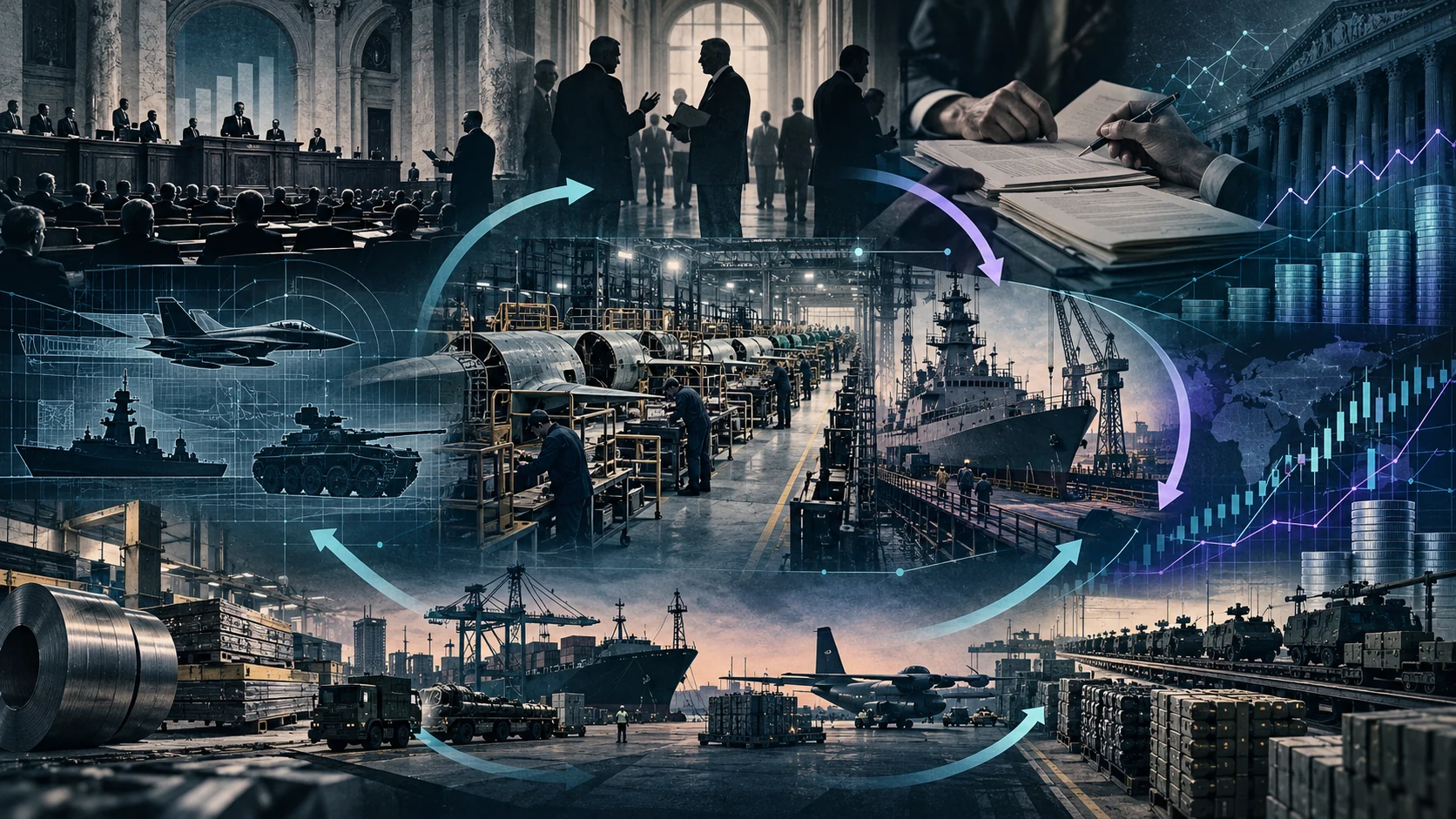
Military industrial complex is a real factor. The exact wording is:
Not that the weapons companies themselves "run history," but have a strong material interest in high tensions, large budgets, fast purchases, long conflicts, and stock recovery. And this interest can be transferred to politics through lobbying, revolving door, think- tanks, media experts, and links to a security apparatus. Eisenhower already summed it up in 1961 by warning against "military-industrial complex."
According to the available evidence, the most accurate framework is as follows:
1) Yes, they earn on wars and escalation
It's not an impression, it's a structural fact. When the voltage rises, it grows:
- demand for ammunition, PVO, missiles, drones, sensors,
- pressure on rapid foreign purchases,
- the willingness of States to sign long contracts,
- tolerance for higher margins and extraordinary budgets.
The Foreign Military Sales system is very active today; In January 2026, the DSCA continuously publishes other large packages and approved possible sales to Israel in the order of billions of dollars and Saudi Arabia in the PAC-3 package for an estimated $9 billion. This alone does not prove "conspiracy," but clearly shows that escalated security environment = huge business.
2) For the US, this mechanism is particularly strong
Because the US is not just a big state, but at the same time:
- the world's largest arms exporter,
- the main organiser of security networks,
- a provider of arms, training, logistics and financing to partners.
As a result, US foreign policy and the US defence industry are not the same, but They strengthen each otherWhen Washington calls the region a crisis, it opens up the scope for sanctions, military aid, FMS, replenishment supplies and new weapons programs. Moreover, in 2025, DSCA was given the impetus to accelerate and reform foreign defense sales, which shows that the state is actively optimizing the export channel.
3) The political influence of industry is real
I wouldn't argue with the slogan, but the mechanism:
- lobbying,
- the financing of campaigns,
- former officials and soldiers moving into the industry,
- pressure on budgets through congressmen from districts where there are factories and jobs.
Watchdog and think- tank analysis in 2024-2025 state, referring to OpenSecrets data, that the US military industry spent over $139 million on lobbying in 2023 and in 2024 it was already in almost 150 million, with around 950 lobbyists; At the same time, tens of millions of dollars went to the campaigns. It's not a marginal influence, but systemic presence in policy making.
4) For Israel, the motive is also real, but a little different
Israel has a significant defence industry; According to SIPRI, he was the eighth largest arms exporter in the world in the period 2020- 2024 with a share of 3.1% of global exports. At the same time, it is also a major recipient of American weapons: SIPRI states that in 2020-2024, the US delivered 66% of Israeli imports of major weapons. That means double logic:
- Israeli companies are interested in exports and in their systems being combat-certified and politically supported;
- American companies they are interested in Israel buying, restocking and modernising.
So yes: US and Israeli arms sectors have an objective economic interest in the militarized environmentIt's just not necessarily the same as "they want every particular war." They want the world to remain dangerous enough to make their product politically indispensable.
5) Where caution is required
It would be a mistake to say: "armourers cause all wars."
That's too easy. Wars and escalations usually arise from a combination of:
- geopolitics,
- spheres of influence,
- safety dilemma,
- domestic policies,
- ideology,
- It is only then that it is added. industrial interestthat pushes harder answers, higher budgets, and longer maintenance of conflict.
It's more accurate to say: The arms industry is not the only engine, but it is a very powerful accelerator and stabilizer of the escalation system.
6) How the mechanism works in practice
The most common formula is:
- a crisis occurs,
- The state is framing her as a security threat,
- companies offer "solutions" in the form of systems, ammunition and modernization,
- Think- tanks and experts explain why a harder answer is needed,
- Congress / Government approves budget or package,
- the conflict is extended or extended;
- the need to restock and buy a new generation of systems.
This creates positive feedback: war lives on contracts, contracts strengthen political influence, political influence facilitates further militarized responses.
7) The hardest sentence I would stand for
Yes, US and Israeli arms corporations have a material interest in an escalated security environment and in high volumes of arms purchases; They do not explain all wars in themselves, but they are one of the key reasons why conflicts are so easily transformed into long, expensive and increasingly supplied escalation cycles.
This mechanism can be described without conspiracy language.
The most accurate wording is this: arms firms usually do not create conflict out of nothing, but they have a strong interest in making the world perceived as dangerous in the long term, in making countries buy, replenish and enter into multi-annual contracts. With the US, the mechanism is extremely strong, because Washington also determines the security framework, finances allies, approves exports, and has the world's largest weapons industry. SIPRI states that the US held around 43% of the world's exports of major weapons between 2020- 2024.
How the business mechanism works in Ukraine
In Ukraine, the model is most visible and least abstract. According to the State Department, from February 2022 to January 2025, the USA provided around: USD 66,9 billion Military assistance. At the same time, the Pentagon explains that aid runs through two major channels: either the weapons are taken from US warehouses over Presidential Drawdown Authority, or through Ukraine Security Assistance Initiative Government directly contracts with industryto create new equipment for Ukraine. In addition, DoD explicitly states that part of the Ukrainian additional funds went to Strengthening the American Defence Industrial Base.
This means that the war in Ukraine is not just "exports of finished items" for the US industry, but also replenishment business:
- send older or existing supplies,
- Congress will supplement the money,
- companies will receive new contracts for the production of compensation and capacity expansion,
- The conflict creates additional demand for ammunition, PVO, drones, sensors and service contracts.
SIPRI also states that Ukraine was in 2020- 2024 the world's largest importer of main weapons, 45 % its main supplies came from the USA.
So here is the motive of industry quite straightforward: The longer the intense war lasts, the longer orders, capacity expansion and long service and production cycles run. This does not mean that "Ukraine was made for armed forces," but it means that after the outbreak of war, extremely strong industrial interest in long-term supply and modernisation.
How the mechanism works for Israel
Israel is actually two connected business circuits.
The first is American. SIPRI states that the USA provided 66% of Israeli imports of main weaponsDSCA then announced in January 2026 possible sales to Israel including AH-64E Apache for USD 3.8 billion, package for Namer APC for USD 740 million and AW119Kx for USD 150 million; even in 2025 approved other Israeli packages, including ammunition guidance kits.
The second is the Israeli domestic industry. The Israeli Ministry of Defence announced that the country's defense exports in 2024 reached record USD 14.7 billion; Reuters added that the main tractors were missiles, missiles and air defence systems and that more than half of the exports went to Europe.
So here the mechanism works like this:
- American companies They earn from Israel buying, replenishing and modernising;
- Israeli companies They earn that the conflict environment increases demand for their systems and strengthens the image of "combat-proven" technology.
It is no coincidence that, after a period of high regional tension, Israeli exports have grown to record, while Washington has approved other large packages.
How the mechanism works for Iran
For Iran, the model is different: Iran is not primarily a customer, but a threat to the market.
Iran's permanent image as a missile, nuclear and regional threat justifies long shopping cycles in Israel and Arab monarchies. DSCA approved possible deliveries in addition to Israeli packages at the end of January 2026 PAC-3 MSE for Saudi Arabia for USD 9 billionDuring the same period Trump announced "major combat operations" against Iran and the AP described another major US weapons approval for Israel and Saudi Arabia together through USD 15 billion.
That means Iran is operating in this ecosystem as Permanent source of demand after:
- PVO and missile defense,
- fighters and attack helicopters,
- ISR / sensors,
- maritime surveillance,
- and especially after Interceptor and ammunition replenishment after each exchange of strikes.
Politically, it's sold as a deterrent; economically it is stable and recurring market.
So Iran is more accurate to say: Not that the gunmen "want Iran," but the existence of a lasting Iranian danger is extremely advantageous to them because they are keeping regional security purchases going. And when the conflict grows into direct blows, the business cycle accelerates.
What's in common
In all three cases, the same mechanism is:
- State to indicate threat,
- safety apparatus defines needs,
- Industry offers solutions,
- Government will pay or guarantee,
- war / voltage consumes supplies,
- followed by new contracts and expansion of production.
There's no need for a secret center. It's enough that institutions, budgets, alliances and companies have harmonised advertisements.
Comparison with the old British Empire
There's a lot of similarity, but instrument has changed.
The British Empire cost more on a triangle Trade → fleet → finance than today's model threat narrative → arms contracts → security dependenceBank of England was founded in its own history 1694 as a private bank to function as Government bankerBritish historians then summarize that the strong fleet supported global trade and the customs revenues from trade financed further expansion of maritime power.
Similarly, East India Company did not start out as an army, but as a business; Her business support points in Surat, Madras and Mumbai became key hubs of British influence in Asia. Here you can see an older imperial model: first market and port, then protection, then military and political control.
The largest similarity
For both Britain and the US, the same core applies: private gain and state power will link up around "strategic space." Only the main commodity has changed:
- UK: routes, ports, customs, insurance, colonial goods, maritime domination.
- USA: arms, military assistance, interoperability, bases, technology, security guarantees.
Maximum difference
The British Empire was often directed towards direct holding of territories and routesThe American model more often goes to security environment managementin which allies buy American systems, rely on American logistics and are integrated into the US strategic framework. That's less "flag over the colony" and more network of dependencies.
Partial conclusion on the political economy of the conflict
Yes, in Ukraine, Israel and around Iran, there is a real business mechanism in which conflict or lasting tension creates huge and recurring orders. And historically, it is analogous to the British Empire - only instead of the East India Society, the ports, and the Royal Navy today play a similar systemic role as a weapons company, military aid, missile defense, and alliance interoperability.
Breakdown of the Eastern Block and Czech Transformation
The US played a role in the collapse of the Eastern bloc and the Warsaw Treatybut not in the sense of "one button dropped it." It's more accurate to say:
They were an important external accelerator and strategic opponent, who had long pushed to weaken Soviet control over Eastern Europe, but without the internal crisis of the USSR, without Gorbachev's course change and without domestic opposition movements, the block would not fall apart as it fell apart. The Office of the Historian says this quite openly: Gorbachev's release of Soviet grip over Eastern Europe triggered his own democratic dynamic and Bush's policy was more reactive in 1989. It's better than driving.
What exactly did the US do?
1) Strategically wanted to "release Soviet grip" over the region
It's good to lean on a declassified American document here, not an impression. NSDD 54 of 1982 formulated the US target towards Eastern Europe as "loosen the Soviet hold on the region' and facilitate its "eventual reintegration into the European Community of nations." That's very strong evidence that Washington He knowingly worked to weaken the cohesion of the Soviet bloc.
2) Supported opposition and autonomous forces within the block
The most visible is on Poland and SolidarityOffice of the Historian states that after the introduction of martial law in 1981 Solidarity survived in illegality and thanks support for Western trade unions and Polish exile groupsAt the same time, American and Western broadcasting type Radio Free Europe has long upset the information monopoly of communist regimes; During the Cold War, the RFE / RL was American-funded and focused on communist countries.
3) Push economically and technologically
The Reagan administration didn't just bet on rhetoric. FRUS documents show that the USA wanted to set "security-minded principles" for economic relations East-West, thus subordinate trade and finance to security logic. This means: technology, credit and economic links were not only of economic importance, but also of importance pressure and strategic.
4) Increased pressure on the USSR and outside Europe
The same logic included Reagan's doctrineSupporting anti-communist forces against Soviet allies and clients around the world. The official summary of the State Department describes Reagan Doctrine as supporting anti-communist insurgents "wherever they might be," and Miller Center recalls that Reagan also placed great emphasis on Afghanistan as an expensive Soviet adventure. That in itself did not break the Warsaw Treaty, but increasing the cost of the Soviet Empire as a whole.
What the US didn't do
5) They did not direct the fall of 1989
You need to be strict here. Office of the Historian says the crucial moment came when Gorbachev stopped holding Eastern Europe by force, and that the Bush administration was essentially cautious and reactive. In other words, Washington wanted to weaken the Soviet bloc, but was not the one who "pulled the trigger" in November 1989 in Berlin, Prague or Warsaw.
6) It didn't fall apart just for America
The breakdown of the block had a fundamental internal causes:
- economic stagnation and indebtedness,
- loss of legitimacy of Communist parties,
- domestic opposition movements,
- Gorbachev's perestroika and glasnost,
- and mainly decisions not to repeat 1956 or 1968I mean, don't send tanks.
The CIA itself predicted in its analysis of the late 1980s that changes in Moscow and more courageous reforms further destabilise Eastern Europe and burden Moscow's relations with its satellites.
How exactly does the US relate to the breakdown of the Warsaw Treaty
The Warsaw Treaty has been officially dissolved 1 July 1991 in PragueNATO itself states that. This is the final stage in which the block has actually lost its meaning, because communist regimes in Central Europe have fallen and Soviet power has crumbled. At this point, the US was more of a part a counterpart to which post-communist states began to approachrather than a direct pact breaker in the final act.
Sharp Summary
Hard but honest version:
- Yes"The US had a thought strategy Unleash Soviet control over Eastern Europe.
- Yes, support the information, political and partly organisational environment that helped the opposition forces.
- Yes, economic, technological and military-strategic pressure increased the cost of maintaining the empire for Moscow.
- But no.It wasn't like Washington "made" 1989 alone. The bottom line was that The USSR no longer had the capacity or will to hold the block together by force.
According to the available supporting documents, the most accurate sentence is as follows:
The US was a long-term external pressure that was working to weaken the Soviet bloc; But the collapse of the Warsaw Treaty only occurred when this pressure was combined with internal exhaustion of the system, domestic opposition and Gorbachev's refusal to use an old imperial power model.
Here you need to make one important correction and one important affirmation at the same time:
♪ It's not exactly accurate to say that the state "had no debts before." The Ministry of Finance states that after the division of the Federation in 1993 the Czech Republic took over 2 / 3 of former federal debtAnd CNB also points out that the transformation did not start in "clean zero," but also with open and hidden debtswhich didn't fully show up until later.
Authentication: But the wider point will stand. In the 1990's, the transformation really came together with fast transfer of state property, weak supervision, subcapitalized banking sector, soft law enforcement and environment that many people in retrospect describe as "a country without law"After years, CNB wrote very openly that the largest banks provided undersecured loans to businesses and that privatisation loans contributed to the growth of bad debt and later banking sector problems.
The most precise wording according to the available supporting documents is as follows:
After 1989, it was not only "democratisation and the market," but also a power transfer of assets in an environment where law, supervision and capital market were weaker than the speed of privatisation. This created an extraordinary space for tunneling, spilling losses into banks and ultimately into public finances.
What happened?
1) Property transfer was faster than the creation of control institutions
The aim was to transfer a large part of the economy from state hands to private ones as quickly as possible. The World Bank describes Czech and Slovak privatization as rapid and multifaceted privatisationThe problem was not only in privatisation itself, but in that it was done in an environment where the capital market, corporate governance, insolvency practice and law enforcement were only under construction.
2) Domestic capital was missing, so the transformation was financed by debt
CNB and banking supervision later described that the economy was general capital shortfall, and therefore the transformation and privatisation were largely financed loansThis meant that banks lent to companies and privatisation structures under high risk conditions, often with weak collateral. When it became clear that some of these companies were not viable or that the assets were being carried out, bad loans remained in the banks.
3) "Tunnelling" was not just a folk swear, but a systemic phenomenon
The CSU writes in its retrospective to the banking sector about "wild transit," lack of regulation and the fact that the term was created in the Czech Republic. tunneling as a label for fraudulent draining. This is important because it is not just a later political slogan; even official or semi-official institutions acknowledge retroactively that the legal framework and supervision lacked reality.
4) The losses of the private sphere eventually shifted to the state
This is where the described debt relationship is fulfilled. It wasn't just that the state suddenly started borrowing for no reason. The big part of the problem was that Private or bank-absorbed losses were later addressed through the consolidation of banks, guarantees, bailouts and other public costs. The CNB directly writes in its balance sheet retrospective that the banking sector has assumed a significant burden of both open and hidden debts and that their seriousness has only been shown later in transition.
5) The debt was not "from nothing," but from a combination of three processes
- taking over part of the federal debt after the split-up of the State,
- financing of transformation and bank bailouts,
- and the wider flow of public finances in the new Republic.
The MF of the Czech Republic confirms the takeover of some of the federal debt in 1993.
Was it "the necessary price of transformation," or a controlled theft?
The honest answer is: Part was structural and part was a failure of the rules - a major failure.
It is not fair to say that:
- Everything was preplanned as one central conspiracy,
- or that every privatisation transfer was a crime.
But it is also not fair to say that:
- It was just an inevitable painful modernization,
- and that "a few excesses" spoil a different pure image.
The firmer and more precise thesis is:
The transformation has been ideologically set so that the rate of transfer of assets takes precedence over the quality of the legal framework and supervision; This has not only created room for random excesses, but has structurally favoured actors capable of controlling banks, funds, businesses and political ties.
According to the available evidence, the core of the whole thing.
"Land without law" - does that fit?
As a publicity acronym, yes, but legally, I would say,
Not that the laws weren't, but their quality, enforceability and institutional capacity were not enough for the pace and aggressiveness of the property transfer.
That's an important difference. It wasn't literally anarchic space without standards; it was a space where:
- the standards have been unfinished,
- supervision was weak,
- The courts and police responded slowly,
- and economic power often overtook the state.
Both CSU and OECD texts on transition economies confirm that weak institutions and corruption risks were a major problem in transformation.
Connections to a wider formula
This thesis goes well into the general mechanism that we talked about:
- political breakthrough - the fall of the old regime,
- ideological narratives - "fast to market, fast to privatize, state is a problem,"
- transfer of assets - coupons, funds, loans, privatisation projects,
- weak legal framework - insufficient supervision, weak enforcement,
- Valuation - tunneling, bad credit, bank collapse,
- socialization of losses - the costs ultimately go to the state and the public,
- new oligarchic structure - property is private, losses are public.
This is the hardest but still defensible description of Czech transformation experience according to the available evidence.
One more thing: why do so many people still see it as fraud?
Because from the perspective of an ordinary man, the sequence really looked like this:
- it was said that "now it will be ours and free,"
- a large proportion of the common property then changed the owner in circumstances that the common person could not understand or control,
- the rule of law was weak,
- and the account eventually appeared in bank bailouts, debt and social costs.
So even though the slogan "before debt-free, then debt-taking and stealing" is simplified, The emotional core of the experience corresponds to a real historical problem.
One thing is needed here. correct accurately:
Czechoslovakia was actually expelled from the IMF in 1954, due to non-compliance with Member States' obligations, in particular the failure to provide the required data; However, after November 1989, Returned to the IMF September 20, 1990 and CSFR became 152nd member. After the Federation broke up, membership was transferred to the Czech Republic and the Slovak Republic on 1 January 1993. So the 1990's don't say "we weren't in the IMF." On the contrary: The Czech Republic had a stand-by arrangement with the IMF in 1993- 1994 approved to 177 million SDR, pumped 70 miles SDR; in more recent IMF reports already mentioned in the Czech Republic Outstanding Purchases and Loans: NoneIn other words: it was not a long-term dependence on the IMF, as with other countries, but there was a relationship and a short draw.
The following are three parts:
- Czech Republic 1990- 2000 year after year
- Coupon privatisation and tunneling mechanism
- comparison Czech vs. Poland vs. Russia
1) Czech Republic 1990- 2000 year after year
1990
- The transformation begins: liberalization, the collapse of the old planning system, opening up the economy, returning to the Brettonwood institutions. IMF in its history writes that the new democratic Czechoslovakia rejoined the IMF after the Velvet Revolution in September 1990.
- A major start problem: market institutions, banking supervision, bankruptcy and capital law were weaker than the rate of changeČNB later described that at the beginning the adequate conditions for the creation and functioning of banks were missing and supervision was still formed.
1991
- It's on. quick and multifaceted privatisation; World Bank describes Czech and Slovak travel as rapid and multifaceted privatisation.
- The transformation is strongly ideologically guided in favour of speed: the market is to be created "on the move," even if the legal framework is not complete. IMF historical retrospective states that Czechoslovensko introduced restrictive macro-policy very strongly and without much external pressure.
1992
- The first wave of coupon privatisation is underway; arise investment privatisation funds (IPF)which will begin to concentrate scattered population coupons. The OECD later described as one of the key weaknesses dispersed ownership structure resulting from mass privatisation and consolidation of IPF shares.
- There is already a problem: the owner is "formally private," but corporate control is unclear and corporate governance is weak. The OECD explicitly states that Czech corporate governance was lagging behind in a number of respects and that this may explain weak productivity growth.
1993
- A separate Czech Republic is established. Membership in the IMF and the SB continues with a succession.
- State debt already exists in January 1993; MF of the Czech Republic in its statistics states in January 1993 the total central government debt 172.12 billion CZKIt itself refutes the abbreviation "zero debt."
- At the same time, due to rising bad loans, the government is transferring a large proportion of the non-performing loans from the main banks to Consolidated banksThe CNB study states that this was decided in 1993 to "clean up" banks for future privatisation.
1994
- The banking sector is rapidly swaying. The CSU states that banks' assets have increased sharply and that there has already been a significant growth in the sector at this time.
- IMF records as of July 31, 1994 at the Czech Republic outstanding credit via 336 million SDRwhile later reports show that these liabilities have already been repaid and there are no outstanding loans in recent times. This confirms: there was a short debt to the IMF, but it was not a long subordination to a chronic debtor.
1995
- The peak impression of "Czech miracle": growth, low unemployment, optimism-charged politics.
- But there are problems below the surface: weak law enforcement, bank and business links, soft credit. The OECD and CNB later agree on weak corporate governance and problematic lending.
1996
- Macro imbalances and weak restructuring are beginning to be seen.
- Later sources indicate that the legal framework remained weak and property rights were poorly enforceable, which was the real restructuring of firms. In 2000, the OECD summarized this very hard: legal framework remains wear and property rights difference to assert.
1997
- The monetary / financial crisis and the end of the "Czech miracle."
- CNB states that the share of bad loans in total loans reached around 30% in 1997This is a huge number and shows that the problem was not marginal but systemic.
- In retrospect, privatisation has not in itself brought automatic discipline; often it simply changed the form of control without actual responsibility.
1998
- Turnover is coming to a deeper restructuring of banks and greater openness to foreign investors.
- The study by ČNB states that the government finally adopted a programme to privatise banks in 1998, which led to a gradual takeover of the sector by foreign investors.
1999
- IMF in its report states that Czech public debt was still very low, below 20% of GDP, and by 1995, budgets were in surplus. This is important: the problem of the 1990s was not primarily "explosion State debt"in today's sense, but rather transfer of private and bank losses to the public sector and weak institutional functioning.
- At the same time, the OECD continues to criticise the weak legal framework, problematic ownership structures and insufficient corporate governance.
2000
- It is already clear that the Czech way was specific: rapid privatisation, but delayed "catching up" in law, supervision and restructuring.
- In 2000, the OECD still writes that the legal framework is weak, property rights are difficult to enforce and corporate governance is below the level needed for effective restructuring.
2) Mechanism of coupon privatisation and tunnelling
Basic mechanism
- Citizens were given the opportunity to obtain coupon books and put points in businesses or in investment privatisation funds.
- Many people did not decide directly and entrusted coupons to funds.
- It was created mass privatisation without a sufficiently strong core of the responsible ownerThe OECD later referred to this as one of the critical weaknesses of Czech transformation.
Why was it vulnerable?
- Diversified ownership
A lot of small shareholders didn't have real control power. The OECD directly states that dispersed ownership after mass privatisation was a critical weakness.
- Funds collected control but without adequate supervision
Funds could concentrate voting rights without a strong regulatory and legal framework. The OECD and academic reports repeatedly link the Czech model with the poor corporate governance.
- Banks were themselves weak and linked to businesses
The CNB states the continuing links between large state banks and businesses, which contributed to inefficient management and growth of bad credit.
- Poor bankruptcy and judicial framework
In 2000, the OECD was still pushing for new commercial code and bankruptcy legislation; the old framework was not enough.
What is "tunneling" in this context
ČSÚ writes very openly that a term was created in the Czech Republic tunneling as a synonym for fraudulent draining. At the same time, it adds that the lack of regulation associated with the privatisation process has led to excessive risk tolerance and criminal activities by the management and owners of many banks.
It practically meant:
- the disposal of valuable assets from enterprises;
- debt to companies for the benefit of linked entities,
- unfavourable transfers of assets,
- loans to "friendly 'firms with no real return,
- and eventually transfer losses to the banking system.
Why did the losses eventually socialize
When banks held bad loans, the state cleaned them through transformation institutions Consolidated banksThe CNB states that already in 1993, the NPL bulk moved to this institution to clean up the banks. That's exactly the mechanism: profit privatized, loss later transferred to the public sector.
3) Comparison Czech vs. Poland vs. Russia
What was specifically Czech
Czech Republic
- extremely fast mass privatisation,
- strong role IPF / Funds,
- relatively low public debt in the 1990s,
- but weak corporate governance, weak courts and the big problem of bad bank loans. Both the OECD and IMF / academic reports link this to scattered ownership and an incomplete legal framework.
Poland
- IMF explicitly contrasts in its summing state Poland as "slow but liberate progress" with faster models of Czech and Russian. That's a good shortcut.
- Poland generally went more gradually, with less reliance on the Czech type of coupon meat and a more robust role of foreign capital and gradual restructuring in some segments.
- The result was not so iconic Czech phenomenon of "fund tunneling," although of course it had problems too. World Bank has long argued that privatization to foreign investors has generally led to a better restructuring result than other forms.
Russia
- IMF writes much harder: rapid privatisation fared even worse in RussiaRussian program 1992-94 transferred over 15,000 companies into private hands, but insider privatisation did not bring restructuring and the second wave was not transparent.
- Subsequent loans-for- shares IMF explicitly mentions the second wave, which was even more problematic.
- So Russia's specifics were: not just weak corporate governance, but much harder State oligarchisation, a huge concentration of assets and a link between business, politics and security structures.
Comparison
- Czech Republic: fast privatisation + dispersed ownership + fund tunnelling + bank bailouts.
- Poland: slower and more careful way, less "Czech" fund anarchy, more gradual construction.
- Russia: quick privatisation in even harder form, insider capture and later oligarchy model.
On that IMF remark,
This consideration has half the truth:
- yes, historically, Czechoslovakia was out of the IMF from 1954 to 1990 because it was excluded / forced to leave due to non-compliance and non-data provision;
- but no, for the 1990s it is no longer true: CSFR returned to the IMF in September 1990 and the Czech Republic had a short standard- programme of 1994-1994, although not some long subordinate type of "IMF dictated to us for decades."
So the exact sentence would be: The Czech transformation crisis of the 1990's was not mainly a debt crisis towards the IMF; was rather a crisis in the construction of privatization, corporate governance, banking sector and law enforcement.
This fits into a broader framework quite wellI would just put it more precisely so that several different things don't mix together.
The toughest but still honest version
After 1989, not only did the "modernisation" take place, but also the change in the position of the Czech economy in the European labour division: from a relatively broad industrial base, a large part of the country has moved into the role of a subcontracting and assembly base, specifically linked to the German and European car chains. That doesn't mean "everything was destroyed," but it means that narrowed domestic decision-making autonomy, some of the domestic brands and corporate centers disappeared and key export and investment flows came under foreign control.
What has a solid factual basis
1) Czechoslovakia really had an extremely wide industrial profile
Historically, it was a country with a very strong industrial tradition: engineering, rolling stock, weapons, aviation, heavy machinery, electrical engineering and consumer production. In the interwar period, arms production and export were concentrated in large enterprises such as Skoda Works and Armory Brno. At the same time, current industry materials recall that Czech countries have almost a century-old tradition in aviation as well, and that Communist Czechoslovakia was among the major producers and arms exporters.
So the sentence "from pin to locomotive" is stylization, but not complete nonsense. It expresses the fact that the industry at the time was much more vertically integrated and widely branched than today's economy.
2) Today's Czech Republic is extremely dependent on the car chain
This is no longer a feeling, but a hard structural fact. According to AutoSAP, in 2025, the automotive industry created about 9% of GDP, 34% of industrial production and 24% of national exports; CNB also states that motor vehicles and their parts accounted for more than a quarter of Czech exports of goods and that together with electrical equipment and engineering it is a very concentrated export profile. The OECD and CNB also point out that the Czech industry is sensitive to the problems of the German automotive sector.
So the label "the montage of Europe for the automotive industry" is an exaggeration, but outlines the real Overconcentration per production chain.
3) Foreign inspection is high
CNB writes that companies under foreign control account for almost 75% of Czech exports and that Germany is by far the largest direct investor in the Czech Republic. This item fits into a broader analysis: the economy is formally "private and open," but the decision-making centres of much of export performance lie outside the Republic. One expert overview also points out that the Czech motor motor motor vehicle is among the most dependent on foreign capital in Europe.
What needs more careful wording
No: "Everything home was destroyed"
That would be too strong. The Czech Republic still has significant domestic capacities in some areas - defence industry, part of engineering, aviation, rail, specialised production and many strong medium-sized companies. Current CzechTrade materials and branch catalogues show that Czech aviation and part of high-value manufacturing still exist and follow a long tradition.
Yes: "domestic industrial sovereignty has narrowed"
That's more accurate. It was not only "natural modernisation," but also:
- the demise of part of the domestic brands and decision-making centres,
- the transfer of a large part of the production to subsidiaries of foreign groups,
- subcontracting orientation instead of full domestic product sovereignty,
- and stronger dependence on foreign demand, mainly from Germany.
How does this fit into a wider algorithm model
If I convert it to the framework we were building:
1. Market opening + privatisation
A rapid transformation opened up the domestic economy and transferred assets faster than strong domestic capital and strong corporate governance rules. We have already demonstrated that this has created a space for exerting value and a weak domestic ownership core.
2. Foreign capital inflow
That had two faces:
- positive: investment, technology, market access, productivity growth,
- negative: moving decisions out, adapting the economic structure to the needs of transnational chains.
Moreover, Czech investment incentives for foreign investors have been specifically developed since the late 1990s and have been legally culminating in the Investment Incentives Act 2002.
3. Specialization in one role
The result is not entirely "colony," but asymmetric integration:
- main R & D, branding and strategic management often elsewhere,
- for us production, components, logistics, part development and skilled work,
- but still within a structure not determined by Prague or Brno, but by a transnational centre.
4. Restriction of competition
Here I would be careful with the word "deliberate destruction of competition," but it is true that integration into large Western European chains naturally limited the scope for the creation of fully autonomous domestic competitors in certain segmentsIf the key export and investment infrastructure is in the hands of foreign groups, the home company has a harder way of becoming a truly equal European player. It's more like structural effect of integration than simple one-time sabotage.
One sentence that connects the whole thing
Not that the Czech Republic stopped producing after 1989, but changed from an economy with wider domestic industrial sovereignty to an economy heavily integrated into foreign production chains - most notably automotive - where much of exports, capital and strategic decision-making lie outside of home control.
And even harder supplement: That is why many people see the transformation not only as a "transition to freedom," but as a combination of a privatization transfer of assets and a subsequent change in the economic role of the country from a manufacturer with a broad scope to a subcontracting base of the European Centre. This is an interpretation, but it fits well on a documented high export concentration, a high proportion of foreign-controlled exporters and a high dependence on automotives.
transformation + privatisation + incentives + foreign capital + export concentrations = change in the country's role in the European labour division. The most precise wording is not "all was destroyed," but: domestic industrial sovereignty has narrowed down and much of the economy has moved into the role of subcontracting and assembly base, especially for the German-European Automotive Chain. Today the car is doing roughly 9% of GDP, 34% of industrial production and 24% of exportswhile companies under foreign control create almost 75% of Czech exports.
1) Specific list of sectors: what existed then and what remained today
A. Heavy engineering and "wide industrial range"
Czechoslovakia had a very wide industrial profile: engineering, transport technology, weapons production, electrical engineering, aviation, rolling stock and consumer production. The "pin to locomotive" acronym is an exaggeration, but it shows that the economy at the time was much more vertically integrated and wider than today's Czech Republic. Current industry and historical materials confirm the long tradition of Czech aviation, arms production and engineering.
Today, it's not like the heavy machinery industry is completely gone. Parts have lasted Railway industry, specialized engineering and some high-value segments. For example, the Czech railway industry had a turnover around in 2024 CZK 133 billion and export formed 50% of turnoverSo the sector stayed alive and competitive. More specifically: the industry itself did not disappear, but its weight and position in the economy changed.
B. Aviation
The aviation industry is a good example where the word "destruction" does not apply. Czech Republic still has CzechTrade strong air tradition and domestic industry continues to produce transport aircraft, training machines, ultra-lights, components and specialized systems. Here's more accurate to say: The massive state-borne sector has become a smaller, specialised and more export-niche branch.
C. Armaments production
Not even the weapons industry disappeared. Historically, it was very strong in Czechoslovakia and remains significant today. The difference is that it used to be part of a much wider industrial and geopolitical strategy of the state, while it now works more like Specialized Export Sector in the Open EconomyIn other words: He survived, but is no longer the carrier of the entire economy.
D. Rolling stock and transport technology
This is another sector that Not extinctbut no longer determines the profile of the entire economy. Rail industry is still strong, export and technologically capable, only today stands next to a much more dominant automotive chain. When the car has 24% export and rail 133 billion CZK turnover, you can see the difference in scale.
E. Electronics, batteries, machines
ČNB states today that apart from cars and parts, the Czech Republic has a comparative advantage in export Electronic equipment, electrical batteries, electricity distribution equipment and certain engineering groupsThat's important, because it corrects too rough a "we only have cars" thesis. The more accurate conclusion is: the economy is not just a motor motor, but the motor motor is obviously a dominant gravity center.
F. What really changed
The strongest shift wasn't just in it, what is produced, but Who owns it, who decides it and what chain it belongs toČNB states that companies under foreign control are almost 75% export and that Germany is by far the largest investor. This means that although production remains industrial and technically demanding, much of the strategic decision-making lies outside the Czech Republic.
2) Timeaxis 1990-2025: how the Czech Republic became an automotive base
1990- 1993: opening, privatisation, weak home ownership core
At the beginning of the transformation, the market quickly opened up, privatization started, while the legal framework and corporate governance were weaker than the pace of change. The OECD already wrote in 2000 that The legal framework remained weak and ownership rights were difficult to enforce, which has hampered the restructuring. This is crucial, because it was at that time that it was decided whether to create strong domestic ownership or rather open space for later foreign takeover and dependence on transnational chains.
1993- 1998: privatisation took place, but the order was just catching up
In the second half of the 1990s, it was increasingly shown that a rapid change in ownership in itself would not create a healthy capital market or effective restructuring. Weak supervision and governance have slowed the emergence of a stable domestic business core. This is precisely the phase where the Czech transformation became more hall to later dominance of foreign capitalthan the road to massive domestic industrial bourgeoisie.
End of the 1990s to 2000: the onset of systematic investment incentives
It's breaking here. The Czech State has started actively attracting large investors and industrial projects; today's government and CzechInvest materials directly follow investment incentives to Act No. 72 / 2000 Coll. This did not just mean foreign investment as "something that came," but as strategically supported development model.
2000- 2010: integration into German production space
At this stage, the Czech Republic has firmly established itself in the supply and production system of Central Europe, mainly in connection with Germany. The CNB now explicitly states that strong links with Germany are not only geographical and commercial, but also proprietaryThis means that it is not only that "Germans buy a lot," but that the Czech export model is structurally linked to foreign owned companies and the German industrial cycle.
2010-2020: Automotive as a central pillar
In this decade, the motor engine is no longer a strong sector, but main axis of the whole industrial specialisationThe AutoSAP in earlier surveys stated before the pandemic that the car was around a quarter of exports and more than a quarter of industrial production; The latest overview for 2025 shifts to 9% of GDP, 34% of industrial production and 24% of exportsThis is exactly the moment when car and part production becomes a system dependency.
2020- 2025: high productivity but also high vulnerability
Today's model is strong, but vulnerable. Reuters pointed out in 2024 that both the Czech Government and AutoSAP are concerned about the effects of stricter emission rules precisely because the car industry weighs so much on GDP and employment. At the same time, Le Monde described this year that the Czech economy is closely integrated with the German industry and that dependence on low-cost subcontracting in the automotive sector is becoming a weakness. That's very close to the term "montovna Europe" - not as absolute truth, but as critical diagnosis of excessive specialisation and dependence.
3) Critical Interpretation Theme of Czech Transformation
I'll write it down as hard as I can, but I'll keep it real.
Thesis
The Czech transformation did not only lead to the creation of a market economy, but also to the transfer of the country from a relatively widely-strained industrial economy to a position of a strongly open, foreign owned and export-concentrated subcontracting base, especially for the German car chain.
Defendant points
1. Privatization took place faster than the creation of a fully-fledged legal and property order. In 2000, the OECD explicitly stated that the legal framework remained weak and property rights were difficult to enforce. This means that the transfer of assets was preceded by rules designed to protect, manage and discipline the property.
2. The domestic ownership core was weak, so foreign capital became the key restructuring force. When a weak domestic corporate governance comes together with market opening and later incentives, the logical result is that stronger foreign groups take on a decisive role. Today's fact that almost 75% export creating companies under foreign control, showing how deep the shift was.
3. Investment incentives institutionalised the model "come here to produce." Since the Investment Incentives Act 2000, the State has actively supported companies that move production or expand it here. This had undisputed benefits - employment, technology, export growth - but it also fixed a model in which the Czech Republic is particularly attractive as a place for manufacturing and integration into foreign chains, not necessarily as a centre of equity and final strategic management.
4. The result is high export concentrations and dependence on one core sector. Automotive today consists of roughly 9% of GDP, 34% of industrial production and 24% of exportswhich is an extremely high concentration per country. CNB adds that the export structure is closely linked to Germany and foreign ownership. This is precisely the type of vulnerability that a country with higher industrial sovereignty would have less.
5. Suverenita was not lost formally, but structurally. No one has cancelled the Czech state. But when much of exports, capital, and strategic decisions lie in foreign-owned structures, and the economy is extremely sensitive to the German cycle, then sovereignty is limited. structure of dependence, not legal status. This is the most accurate and strongest formulation of this analysis, according to the available evidence.
Synthesis of Czech Transformation
Czechoslovakia / The Czech Republic has not only gone from a "plan to a market," but from a model of a widely spaced domestic industrial economy to an open economy connected to foreign capital and foreign chains; privatization and weak rules have weakened the home ownership centre, incentives have strengthened the flow of foreign investors, and the result was strong export specialization, most in the automotive industry.
And the sharpest version with one sentence:
Not that the Czech Republic stopped production, but stopped determining to such an extent what, for whom and under whose control it produces.
If more precise wordingSo according to the available evidence, you can say this:
Not "the West has appointed a government" in a literal sense, but after 1989, an environment was created in which players and currents had a significant advantage that were compatible with the Western political, economic and security frameworks. Václav Havel was elected President of the Federal Assembly on 29 December 1989 and in June 1990 the first free elections took place after decades; It was therefore a formal domestic political process, not a direct 'external appointment'. At the same time, it is evidenced that Western organisations supported the Czechoslovak democratic and dissident environment before 1989, and that the US strategy towards Eastern Europe had explicitly followed the weakening of the Soviet grip of the region.
The most accurate model is this:
1) It was not a direct "installation," but strong selection effect
After the fall of the regime, there was no neutral field where all possible directions would have the same chance. The benefits were obtained by elites which:
- were acceptable to the domestic anti-communist public,
- were understandable and credible to the West,
- while offering rapid integration into Western structures.
This later turned into a very clear strategic direction: accession of the Czech Republic to NATO in March 1999 and to the EU in May 2004.
2) The West did not come "rule directly," but set trajectory
This is crucial according to the available evidence. It was not necessarily about Washington or Brussels saying 'this man will rule'. More like a trajectory:
- democratisation,
- market reforms,
- opening up foreign capital,
- Euro-Atlantic integration,
- and gradual compatibility with NATO / EU institutions.
Once this trajectory was established, it started to favour the domestic politicians, experts and business groups that carried it on. This is not the same as the colonial administration; It's more like structural alignment of the country into the western space.
3) This formulation can be rewritten into a hard but defensible sentence
Instead of "an appointed government loyal to those who helped replace it," I would write:
After 1989, in Czechoslovakia, and then in the Czech Republic, the elites, which, although they came from a domestic coup and elections, had been strongly convergent with the interests and institutions of the Western bloc, which had long supported and welcomed their emergence. That's sharp, but still factually sustainable. Western support for democratic forces and later rapid integration into NATO / EU are documented; It would be less conclusive to claim that it was a direct "puppet appointment."
4) Connection to previous analysis on privatisation and economy
This is where it gets interesting. If you connect:
- Western-oriented elites,
- rapid market transformation;
- weak domestic capital,
- investment incentives,
- and subsequent integration into the EU / NATO,
then you get a model where the country is politically and economically equals in a direction which is favourable to the Western Centre:
- security as a new NATO member,
- economically as an open market and investment space;
- as part of European chains.
That doesn't mean everything's been written in the same room since the beginning. Does that mean political change and economic integration went in one direction and strengthened each other.
5) Where caution is required
It would be too strong to say:
- "Havel and Associate were directly American agents,"
- or "free elections were just theater."
I don't have the hard evidence available, and it could be for data. On the contrary, it can be argued that:
- The West has long supported the opposition and democratisation environment in the Eastern bloc,
- After 1989 he quickly adopted new elites as partners,
- and the result was deep political and economic integration into Western space.
Definition of the interpretation thesis
Probably not "government" in the literal sense, but yes: after 1989, a power arrangement was established in Czechoslovakia, which was domestic but strongly pro-Western in orientation and gradually very compatible with the interests of the US and Western Europe.
Ukraine: competition for geopolitical orientation of the state
At this point, it is accurate to say that the image of the "pure democratic revolution" is too smooth.If I take it legal and procedural, something more complicated comes out:
1) Yanukovych was originally legitimately elected President
The 2010 elections were judged by international observers from the OSCE / ODIHR as competitive and in principle consistent with democratic standards; The ODIHR 's runoff confirmed' that the presidential election fulfilled most of the international commitments. So the claim that Yanukovych has been legitimately elected, is factually correct.
2) In February 2014, however, a real constitutional and power split
After bloody escalation of protests Yanukovych left Kiev and subsequently the country; Reuters, Britannica, and the OSCE describe this as the escape / disappearance of the President at the moment of the collapse of his power. Parliament then responded by depriving it of its powers and writing early presidential elections. This is not Russian or Western propaganda, it is a fundamental sequence of events documented across resources.
3) Legally it was disputedbecause it didn't go through a clean impeachment procedure
Here, according to the available evidence, there is a strong argument. A normal constitutional way to appeal the president in Ukraine was a complex impeachment procedure. However, on 22 February 2014, the Council adopted a resolution that the President "withdrew from the exercise of constitutional powers" and issued early elections. That was politically effective, but constitutionally not completely pureI serious later descriptions talk about constituent crisis and that Parliament was dealing with a vacuum caused by the president's escape. More specifically: It was not a standard textbook power transfer, but a crisis solution in a breakdown.
4) So the question is not "coup or not" in a simple sense
The most precise wording according to the available supporting documents is:
It wasn't a clean coup like "someone lost the election and the army knocked him down," but it wasn't a clean, perfectly constitutional power exchange. It was a hybrid: a mass uprising + a collapse of presidential power + a crisis, a legally contested decision by Parliament.
This fits a lot better than both propaganda extremities.
5) To that "things like a bad dream"
This conclusion requires one substantial reservation.
What is firmly documented:
- At that time, violent breakdown of state authority.
- The President has escaped.
- Parliament acted in a state of extraordinary chaos.
- There was a temporary power arrangement and early elections.
What is very likely / long-term known:
- The Ukrainian Parliament had a long-term problem with gross conflicts, physical struggles and procedural culture. Reuters also has documented fights in the Council over the years, so the idea of a "civilized, sterile parliamentary environment" in Ukraine does not really fit.
What cannot be said to be certain without further verification:
- that precisely the key vote on 22 February 2014 in the Verkhová Council, it was evidently mass through absent Members and their cards.
In Ukraine, the problem of button pressing / piano voting was well known, but the available sources do not allow this claim to be securely extended to a decisive vote.
Attention: Reuters has a source of voting power for absent Members, but this concerns Crimea Parliament The President
6) Anti-constitutional laws?
Here you need to distinguish two different things:
A) "Dictatorial Laws" of 16 January 2014
Under Yanukovych, tough anti-protest laws were adopted, which were widely criticised as repressive and were soon abolished. That's part of "bad dream."
B) Steps after 22 February 2014
After Yanukovych's escape, the problem was not so much that everything was legal, but rather that part of the steps were critically purposeful and constitutionally tense - in particular, removing the President from the full impeachment procedure. This is a legal dispute that is real, not made up.
7) What does this mean for our wider debate
If I connect it to our framework:
- legitimately elected president existed,
- a deep political and security crisis has come,
- The president escaped and left a power vacuum,
- Parliament solved it. politically functional but legally questionable in a way,
- The West quickly accepted this as a new reality,
- On the contrary, Russia framed it as a coup and used it as part of the justification for its next steps.
This is the most accurate skeleton according to the available evidence.
Conclusion on the 2014 constitutional crisis
Yes: Yanukovych was a legitimately elected president, and yes, the end of his reign in February 2014 had elements of legal and procedural chaos that cannot be properly swept under the carpet. At the same time, it was not just a "conspiracy to overthrow," but a crisis of power after mass protests and the president's escape. The most honest description is: a constitutionally questionable change in power in the conditions of a violent state crisis.
This is a real problem, not just propaganda.But it needs to be described precisely, because it's usually exaggerated on both sides.
1) Extreme right in Ukraine existed and was violent, but did not control the whole country
Indeed, at and after Majdan, radical nationalist and far-right groups, mainly Freedom and Right sector. Reuters already wrote in March 2014 that fear of the influence of extremists was not invented, although the claim that "Ukraine fell into the hands of the fascists" was overshot. Freedom House later described the Ukrainian extreme right as a real threat to democracywhich uses violence and intimidation to restrict freedom of assembly and expression.
So the most accurate sentence is: The extreme right was not the majority political representative of Ukraine, but was visible, militant and at certain moments had a disproportionate street and symbolic influence.
2) The "rudeness of protest" was no accident
The OCE and other summaries indicate that in January and February 2014 protests in Kiev They became stronger and more violent.That means the image of a purely non-violent civil protest is incomplete. At the same time, it is not accurate to say that all violence was just the work of the extreme right; It was a broader collapse of order, escalation of clashes, and brutal state interference and part of the protest camp.
So the more accurate wording is: The far right was not the only force of Majdan, but it was one of those parts that brought high levels of street aggression, discipline and willingness to go into physical conflict.
3) After 2014, some of these groups really started acting as a street force
Here, the analogy with "brown shirts" can be understood, even if I use it carefully. Freedom House in 2018 wrote that extremist groups in Ukraine proved limit the rights and freedoms of citizens, in particular, freedom of assembly and expression, and that the police often did not stop them, or that the action prohibited them directly on grounds that they were unable to ensure security. This is a very serious indicator extra-formal street theoremIn addition, Freedom House describes in a broader 2020 report that the State has sometimes used these groups formally and informally and some right-wing paramilitary structures have been integrated into the security area.
That's close enough to the model:
- not the majority government of fascists,
- but tolerated or instrumentally used radical street,
which puts pressure on public space.
4) "State Purification of War Criminals" - here we come to memory policy
This is one of the strongest points in your criticism based on the available evidence. In 2015, Ukraine adopted a law which recognised the status of independence fighters to members OUN and UPA while creating legal protection for their "monuments." Reuters then wrote very sharply that the law gives OUT and UPA free moral passageway despite their terrible past and that criminalising the criticism of such organisations is incompatible with the country's European ambitions. The USHMM later also pointed out that the law was illegal to insult the memory of OUN and UPA fighters.
So here's the fair thing to say: Yes, part of Ukraine's state memory policy after 2014 was actually directed towards rehabilitation or heroization of forces deeply burdened by collaborations, anti-Semitism and participation in ethnic violence. It's not Russian fiction; Western and Jewish institutions also criticised this.
5) But it's still important not to shoot the finish
It would be a mistake to say: "Ukraine = Nazi State."
That's not what the facts available support. The extreme right had in Ukraine weaker electoral powerbefore it matches her media image. Reuters already pointed out in 2014 that these groups are visible and influential in the street, but that is not the same as the democratic majority of the country. Freedom House also distinguishes radical groups from the entire Ukrainian democracy and refers to them as threat to democratic development, not as the full equivalent of the state.
So the most accurate framework is:
- Not the Nazi state,
- but State which, after 2014, tolerated, exploited or symbolically legitimized part of the far right environment in some periods.
6) How does this fit into a wider analysis
In a broader context:
- After February 2014, Legal and power crisis situation,
- In such a situation, militant groups have more weight than their voting power,
- The state then sometimes makes a compromise: instead of suppressing them hard, part of them absorbs, tolerates or symbolically rewards,
- The result is the long-term strengthening of a radical nationalist language and memory policy.
Partial conclusion on radical right and memory policy
Yes: support or tolerance of the Ukrainian extreme right is a real problem. These groups had disproportionate influence on the streets, used violence and intimidation, and a part of the state after 2014 also contributed to the heroization of historically very dark nationalist formations. But this does not automatically mean that the whole of Ukraine was or is "fascist"; It is more accurate to talk about a dangerous mix of crisis states, militant nationalism and politically purposeful memory rehabilitation.
- Bandera / OUT / UPA
- Azov and other radical structures
- The exact timeline of February-May 2014
- What can and cannot be honestly said about the role of the United States
1) Bandera / OUN / UPA without propaganda
Stepan Bandera was neither a "pure national hero," nor simply a propaganda cartoon. He was the leader of the radical branch of the Organisation of Ukrainian Nationalists (OUN-B), which wanted an independent Ukrainian state and fought against Soviet domination, but its environment was also strongly ethnonationalist and part of its structures was involved in anti-Semitic violence and cooperation with the Nazis in the early stages of the war. USHMM states that OUN-M and "to some extent OUN-B" supported the Nazi genocide of Jews, associated Jews with Bolshevism and contributed to the atmosphere of violence.
UPA (Ukrainian rebel army) It was not only created as a "Nazi unit," but it cannot be cleansed by the anti-Soviet guerrillas. Both historians and memory institutions link it to the fight against Germans and Soviets at different stages of the war, to ethnic violence against Poles, and to part of its members and related structures in anti-Jewish violence. Simplified: the fight for national independence and participation in serious crimes shall not be excluded; both are part of the truth. * *
Ukraine's post-2014 memory policy has often flattened this dark image towards heroization. Reuters wrote that the 2015 Act on "Independence Warriors" admitted the honorary status of the OUN-UPA and created a very problematic framework which, according to critics, has effectively moralized or protected figures and organisations associated with civilian massacres. That's a legitimate criticism, and it's not a Russian invention.
So the most accurate sentence is this: Bandera, OUN and UPA belong to the history of Ukraine's struggle for independence, but are also associated with extreme ethnic nationalism, anti-Semitism and involvement in war crimes; A state that Heroids them without these shadows forges its own history.
2) Azov and other radical structures: what is myth and what is reality
Myth: "The whole of Ukraine is Nazi and Azov controls it." It's not publicly documented. Even critical Western sources distinguish between the whole of Ukraine and radical groups that had a disproportionate street and security weight, but did not control the country's majority electoral policy. Freedom House expressly refers to the extreme right as threat to Ukrainian democracyNot as an identity of the entire state.
Reality: Azov really had far-right roots. * * Reuters in 2015 described Azov as an ultra-nationalist volunteer battalion and later a regiment whose origin and symbolism were associated with a radical right. Reuters recalled in 2024 that the US ban on the aid of Azov had been based for years on concerns about these roots.
Important correction: Azov did not arise before Majdan, but until May 2014After the fall of Yanukovych. That is essential because the claim that the US had secretly supported Azov before Majdan, doesn't fit in time. Azov himself was founded on May 5, 2014 and was only later incorporated into the National Guard.
But that doesn't mean there was no radical right in front of Majdan. There were structures like Freedom, various nationalist groups and later Right sectorwhich were visible on the street, disciplined and willing to violence. In 2018 Freedom House described that extremist groups in Ukraine used violence and intimidation, and that the state could sometimes not stop them or treat them with too much softness. In addition, the US Human Rights Report for 2018 reported attacks or threats against LGBTI actions and other minorities.
After integration into the state, the situation changed partly, but the dispute did not disappear. Reuters stated in 2024 that Washington, after years, reopened the possibility for the current Azov Brigade to receive American weapons, because after the investigation, it did not find evidence of human rights violations under the Leahy Act; At the same time Reuters recalled that it was a unit with controversial far- right roots. This is important: Today's Azov is not the same as the 2014 volunteer militia, but the historical burden on the brand is real.
The most precise wording: Ukraine's far right was not a majority political current, but it had a disproportionate influence in the streets, in some security structures and in memory policy between 2014- 2018; Azov was her most famous symbol, but not the only one.
3) The precise timeline of February-May 2014
18-20 February 2014
Violence escalated sharply in Kiev. Reuters and other summaries describe that on February 18, protests spilled over into deadly clashes in Parliament, and dozens of people were killed in the centre of Kiev in the coming days. That was no longer a common protest, but open collapse order.
21 February
Yanukovych and opposition leaders have signed an agreement facilitated by foreign ministers France, Germany and Poland. This envisaged a return to constitutional change, a government of national unity and early elections. But the agreement barely lasted a day because the regime was falling apart faster than a paper solution.
Night 21 / 22 February
Yanukovych left Kiev. Reuters and Britannica report that he actually escaped or disappeared from the center of power and refused to resign, creating a power vacuum.
22 February
Verchov's board voted to recall Yanukovych and put out an early presidential election on May 25. Reuters described it directly as a parliamentary appeal after the president's departure from the capital. It was legally questionable because it did not take place through a clean impeachment procedure; politically, however, it worked as a crisis takeover at the moment. The OCE subsequently worked on the fact that on 22 February the Parliament issued the elections.
23 February
Parliament has chosen Oleksandra Turchynova President of the Council and soon thereafter the President-in-Office. At the same time, one of the most controversial things of the whole transition phase was taking place: the Council approved the repeal of the 2012 Law on Regional Languages, which was seen as a strongly hostile signal in Russian-language areas. The president of the interim phase did not sign the move, but the political damage was already done.
27 February
Arseni Jaceňuk became Prime Minister of the transitional government. Britannica states that it was an installation of an interior government with Jacennik at the head. This is also an important point because of a later debate about American influence, because it was Jaceňika who favored Nuland in a leaked conversation with the US ambassador.
28 February
Ukrainian Foreign Ministry officially invited OSCE/ODIHRto monitor the presidential elections scheduled for May 25. This shows that the new power was very quick to give itself international legitimacy through the electoral process.
March 2014
Russian operations have already taken place in Crimea and the crisis has internationalized. Britannica and Reuters summarize that Yanukovych's fall almost immediately went into the Crimean and broader Ukrainian-Russian crisis. Within Ukraine, voluntary and paramilitary structures were also consolidated.
April-May 2014
There was an armed conflict in Donbass in the east of the country. It is in this context that volunteer battalions have started to develop and grow; Azov was created on 5 May 2014That's exactly why time needs to be separated. Majdan and later paramilitary consolidation.
25 May 2014
The presidential elections were held, which the OCE / ODIHR considered competitive and in crucial parts of the country corresponding to democratic commitments, despite a very difficult environment. Petro Poroshenko won in the first round. This gave new powers stronger electoral legitimacy than the transition phase of February.
4) "The US secretly supported radical groups before Majdan, and Majdan was merely the culmination of US efforts to exchange power" - what can and cannot be said
I'm going to split this place up hard.
What is well documented
The US has long supported the pro-Western, democratic and civil environment in Ukraine. Victoria Nuland In December 2013, she publicly said that since 1991 the US has invested through $5 billion to assist Ukraine in 'European aspirations', democratisation and reform; In November 2013, the Senate stated that only in the fiscal year 2013 it went through $100 million programmes concerning electoral reform, justice, law enforcement and civil society. It's not secret, it's open policy.
The US has also been actively working on the political outcome of the crisis. Nuland-Pyatt's leaked call from early February 2014 showed that Washington was discussing the composition of a possible future government and that Nuland favored Jacenik as "the guy." Reuters then described it as a leaked record of America's political transit strategy in Ukraine. That's strong evidence. political intervention and preferences of specific actors.
America's strategy towards Ukraine and Eastern Europe was long-term anti-Russian / anti-Soviet in the sense that it wanted to weaken Russia's influence and pull Ukraine to the West. This results from a long line of American policy, as well as from public speeches and funding. That's not disputed.
What is likely as an interpretation
Majdan was not a purely spontaneous eruptive moment of nothing. It was the culmination of a long conflict on the country's orientation while drawing on the years of civil society, media, NGOs and pro-European networks that the West supported. But that doesn't automatically mean that all of Majdan was "made from the outside." According to Freedom House and other sources, the Ukrainian civil society was real, active and domestic before 2014, although it received Western support.
What is not publicly documented
I did not find solid public evidence that the US secretly financed or controlled Ukraine's extreme right-wing radical groups, such as the future Azov, the True Sector or similar structures before Majdan. That's an important point.
- U Azo it doesn't fit in time, because it was created after the fall of Yanukovych.
- At the wider far right, I found a lot in available sources about its existence and violence, but Not solid public evidence of pre-majedan secret American support to these radicals.On the contrary, America's open aid, which can be well documented, was aimed at reforms, media, elections, civil society and pro-Western political trajectory, not explicitly on neo-Nazi or extremist cells.
The most honest conclusion to the US
Yes, the US has worked long-term to remove Ukraine from the Russian sphere of influence, actively supporting political change during the 2013-2014 crisis, and preferring specific pro-Western actors. However, the available public sources do not provide a strong enough basis to claim that far-right radical groups secretly built or financed the main instrument of coup before Majdan. It's more accurate to say: The US supported a change of direction and created an environment in which the radical right could play a disproportional role on the street, but this is not the same as the proven direct secret management of these groups.
Synthesis of the whole thing in one skeleton
- Bandera / OUT / UPA: national emancipation traditions associated with heavy crimes and anti-Semitic violence.
- Outer right after 2014: not the majority of the nation, but a real militant force with disproportionate street and symbolic influence.
- February 2014: legitimately elected president fled, parliament made a politically effective but constitutionally questionable change of power.
- USA: long-term and openly supporting Ukraine's pro-Western transition and actively working on a desirable political outcome during the crisis; But I couldn't find solid public evidence of pre-Majedan secret support specifically for extremist radicals.
Such suspicion is not illogicalBut you have to hold two things at the same time:
- There are reasons to doubt the simple version of "only Yanukovych's shooters did everything.",
- I don't see solid public evidence that it was organized by "foreign agents" or that it was evidently one major false-flag operation of the opposition.
The most accurate conclusion corresponding to available sources is:
What is firmly documented
Yes, the official investigation was long leaky and damaged. Reuters already wrote in 2014 about serious investigation errors, missing weapons, bullets taken and forensic traces removed. This alone means that a clean and undeniable image fell apart very soon.
Yes, part of the later judicial and investigative conclusions attributed the key part of the shooting to former Berkut members on February 20. Reuters stated in 2023 that the Ukrainian court sentenced three former police officers in the murder case of 48 protesters on 20 February 2014. This is an important counter-argument against the idea that "only some unknown third actors shot."
At the same time, there was already a category "unique snipers." In April 2014, OHCHR wrote about the commitment of the Ukrainian authorities to clarify the cases of "including from unilerated snipers." This shows that the UN did not work with a completely closed version of a single firing line and one perpetrator.
What does that mean?
This consideration is that "maybe someone other than government snipers fired."He's not out of reality. It's possible hypothesisNot a crazy idea. The reasons are three:
- the investigation was damaged and the evidence disappeared,
- The early human rights reports have also been mentioned Unidentified shooters,
- For years, full responsibility for all episodes of killing has not been achieved, and both OHCHR and other institutions have criticised weak progress and impunity.
What cannot be closed as a proven fact
I wouldn't say:
- that is demonstrated, that it was an opposition-driven false-flag operation,
- or that it is demonstratedthat it was run by foreign agents,
- or that Yanukovych's forces didn't fire.
The last is important: later court decisions and charges against Berkut show that shooting security forces at protesters isn't just propaganda.but also has legal support in Ukrainian proceedings.
Alternative explanation of the shooting in February 2014
That's a logical objection, but it proves nothing in itself. Inability of the scheme maintain political control over the city does not exclude that individual components:
- firing chaotic,
- act without a single command,
- or that there were multiple armed actors in the area at once.
This is the most likely framework, according to the available evidence: not a perfectly managed operation of one party, but a disintegration of command, more shooting resources, chaos, provocation, and the subsequent destruction of part of the evidence. That explains well why after so many years the picture remains incomplete. It relies on documented investigation problems and an unidentified shooter category.
Conclusion on unexplained aspects of the shooting
It is reasonable to doubt the simple version that only Yanukovych snipers caused all the deadly shooting; At the same time, available sources do not provide solid public evidence that this was a proven foreign-controlled false-flag operation of the opposition. Most likely is a mix of state fire, possible other unidentified shooters, command collapse, and a botched or damaged investigation.
The term "US advisors" includes several different groups. The timeline looks like this:
1) Civil / Economic / Reform Advisers
These appear since the resumption of IMF membership and the return of Western aid after 1990, i.e. practically Since the early 1990s.
- CNB writes that after the resumption of IMF membership 20 September 1990 negotiations on financial assistance and technical assistance have been opened; Ukraine had similar Western reform aid after the break-up of the USSR through the IMF, USAIDs and other channels in the first half of the 1990s.
- In the second half of the 1990's, US government materials describe Ukraine USAID-funded advisors for pension reform, banking standards, fiscal and macroeconomic reforms and other areas of government.
Reforms, economy, media, civil society and governance advisers have been active since the early 1990s.
2) Military advisers and military links
There's an important difference between long-term cooperation and later more direct presence of instructors / coaches.
- Since 1993 Ukraine has a very close link with California National Guard within State Partnership ProgramAmerican military resources describe this explicitly as a relationship lasting Since 1993.
But that was not the model of "American advisors run the Ukrainian army." It was more like long military-military socialization, exchanges, advice, interoperability and relationship building.
3) More direct American coaches / advisors in connection with the war after 2014
Here's the major break.
- The Pentagon states that after the Russian invasion of Crimea and Donbas in 2014 a number of new training and partner activities have been created.
- Joint Multinational Training Group-Ukraine (JMTG-U) started in 2015The Pentagon says so directly.
- At the beginning of the year 2022 American officials talked about Ukraine being Small contingent of American and Alliance advisors and coachesNo permanent American bases and no combat units.
Summary of the role of foreign advisers
- Civil / Reform American Advisers: Since the early 1990s.
- Long-term military partnership: Since 1993.
- More direct military training and advisory mission after the war in Donbas: from 2014, institutionalised mainly since 2015.
Classification in the wider analytical framework
If you ask in the sense of "since the US systematically built influence in Ukraine," the most honest answer is:
Politically-economically since the early 1990s, militarily-institutionally since 1993 and significantly intensified after 2014.
This way the development can Frame in this wider model: not as an isolated "Ukrainian story," but as Part of America's long-term formation of its own geopolitical space.
According to the available evidence, the most honest wording is as follows:
After 1991, Ukraine was not only "another new democracy" for the US, but a key border area between the Russian and Western spheres, in which Washington had invested politically, institutionally, economically and militarily in order to gradually pull it out of Soviet-Russian orbit and bind it to the Euro-Atlantic Order. This is not a conspiracy thesis, but an interpretation based on official American, allied and military resources.
American influence in a broader institutional framework
We have already shown that America's policy has long worked like this:
- define the strategic area,
- Supports compatible elites and institutions,
- builds long-term bonds through finance, reforms, military, media, NGOs and security cooperation,
- The crisis then uses it as an accelerator of change,
- and finally space fixes to the wider American-Western framework.
This pattern has been in Eastern Europe since the Cold War. CIA Published Document NSDD 54 From 1982, he says quite openly that the primary long-term goal of the US in Eastern Europe is "loosen the Soviet hold on the region' and facilitate its "eventual reintegration into the European Community of nations." This is an almost textbook formulation of building its own geopolitical space.
2) Ukraine as "intermediate countries," not neutral space
NATO itself states that relations with Ukraine have begun in 1991When the newly independent country entered the North Atlantic Cooperation Council, and 1994 joined the Partnership for Peace. Then: Since the inception of Ukraine, its institutional link to the Euro-Atlantic space has been ongoing. This does not mean membership, but it means long, systematic attraction.
If I translate it into our language:
- it was not about swallowing Ukraine immediately,
- but long-term transfer it to a west compatible zone.
3) American influence was not only political but also military-institutional
It's important here that it's not just NGO and diplomats.
American military ties to Ukraine running Since 1993 over California National Guard - Ukraine State Partnership ProgramThe National Guard itself describes this as a partnership set up in 1993 to develop and strengthen a strategic partnership between the US and Ukraine. Later American military sources explicitly say that this link should help to ensure that "the end of the Soviet Union would be irreversible"That's a very strong sentence, and it fits exactly the logic of "forming your own space."
So if you're asking if Ukraine has long been processed as part of a wider Western space, the answer is: Yes - politically, security and institutional.
4) Maidan then was not the beginning, but the acceleration break
This is a key frame based on the available evidence.
Majdan was not the beginning of American influence in Ukraine. It was crisis peak long-built indicative changes.
- The US has long supported reform and pro-Western direction,
- NATO and the US military have long built interoperability,
- Western institutions have long drawn Ukraine into their regulatory and security framework,
- and at the moment of crisis 2013-2014 this long process He accelerated rapidly.
In this analysis, the following shall therefore apply: Majdan was a less "sudden explosion" and more "turning point in a long-term geopolitical tug about whose sphere Ukraine would belong."
Consequences for the region's security architecture
Ukraine can be read as:
- buffer zone,
- transition zone,
- space that does not remain neutralbecause neutral space between the blocks is unstable and not controllable for the great power.
So, from the US perspective, it was not just about "promoting democracy," but about:
- weakening Russian influence,
- moving security architecture east,
- creating a compatible state on the edge of post-Soviet space,
- and long-term anchoring of Ukraine in the Western institutional system.
That's exactly the logic. global space under American leadership.
Claim boundary
I wouldn't say:
- that the US "owns" Ukraine,
- Or that everything that happened there was under command from Washington.
That would be for the dates.
But I would say: Ukraine has been systematically built since the 1990s as a candidate for the move to the Western geopolitical space, and Majdan was the turning point that accelerated and made the move visible.
Institutional convergence synthesisation
When we include Ukraine in the same framework as Latin America, Eastern Europe or the Middle East, we see not an isolated event, but long-term US work on reforming the border space to become part of a wider Western order - politically, security and institutional. Majdan was then not the beginning, but the rapid acceleration point of this process.
Both parts can be inserted into this broader framework "building compatible space".
1) Timetable 1998-2014: American influence in Ukraine
1991-1994: opening of space
After the collapse of the USSR, Ukraine entered Western cooperative structures very soon. NATO states that relationships have begun in 1991 entry into the North Atlantic Cooperation Council; and 1994 entry into Partnership for Peace. This is the first layer: not yet membership, but institutional attraction.
At the same time, the US civilian and reform line ran. The US has publicly funded reform and democratisation programs in Ukraine since the 1990s; Nuland later said that since 1991 the US has invested through $5 billion to assist Ukraine in the area of democratic institutions, economics and "European aspirations." It's an open, not a secret framework of long-term influence.
1993: a long military-institutional link begins
American National Guard states that partnership California National Guard - Ukraine running Since 1993This is important because there is an uninterrupted line of military socialization, exchanges, training and interoperability. It's not about direct command, it's about long building of relationships and compatibility.
1997: Relationship gets political superstructure
NATO recalls that in 1997 has been signed Charter on a Distinctive Partnershipthat created the NATO-Ukraine Commission. This moved the relationship from general cooperation to a permanent political mechanism.
2002: Action plan
NATO states that 2002 was accepted NATO-Ukraine Action PlanThis is already a significantly deeper form of drawing: not just contact, but programming of institutions, defence and safety standards.
2004: Orange Revolution as the first big test
2004 was not the beginning of American influence, but the first great moment when Ukraine's orientation dispute became an open crisis. It is important here to stick to accuracy: long-term funding of civil society, electoral and institutional reforms is publicly documented; less documented is the claim about direct street traffic. More specifically, the West already had built networks and compatible eliteswhich have gained an advantage in crises. Nulanda's later wording of $5 billion frames it back well.
2008: Bucharest Summit - open strategic promise
This is the breaking point. NATO states that it was decided at the Bucharest Summit that Ukraine becomes a member of NATOThis is exactly when building a "compatible space" turns into publicly declared geopolitical trajectory.
2009-2013: Annual National Programme and deeper integration
After Bucharest NATO introduced in 2009 Annual National Programme as the main instrument of further integration. This means that even without the Membership Action Plan, practical approximation continued. From the point of view of our model: normative and security rewrites, though without formal membership.
2013: American political investment is publicly admitted
In December 2013, Nuland publicly said that the US had invested through $5 billion to support "secure and prosperous and democratic Ukraine." This is an extremely important point because it shows that US work on Ukrainian orientation was neither small nor short-term.
2014: Majdan as the acceleration point, not the beginning
Majdan was not the beginning of American influence; was his Acceleration breakAt the same time, we know that American diplomacy has been actively working on the desired political outcome of the crisis - the nuland- Pyatt showed that Washington also dealt with the personnel composition of a possible post-exit arrangement. It doesn't mean "the US controlled everything," but it means Active interference with political transit.
After 2014: military phase intensifies
The military plane increased significantly after 2014; The Pentagon later described that the training mission JMTG-U started in 2015Within our framework it is a transition from long preparation of compatibility to open safety anchoring.
2) Comparison: Ukraine vs. Czech / Poland - how to build "compatible space"
Common formula
For all three countries you can see a similar algorithm:
- political leeway from Soviet space,
- institutional attraction to the West,
- Reform and Economic Assistance,
- Military socialization / interoperability,
- creation of domestic elites compatible with the Western Framework,
- where appropriate formal integration.
This fits well with America's older strategic goal of loosening the Soviet grip over the region.
Czech Republic and Poland: faster, cleaner, formally more successful integration
The Czech Republic and Poland were pulled into NATO faster and with less open violent disruption than Ukraine. NATO states that both countries joined the Alliance in 1999This means that "compatible space" has managed to be fixed relatively quickly and formally.
The following countries had a model:
- the fall of communism,
- pro-Western elite,
- economic transformation;
- NATO entry,
- later EU entry.
The crises were smaller and less geopolitical, because Moscow was no longer able or willing to hold them by force, and the West had more room for smooth absorption in Central Europe.
Ukraine: same direction but other difficulty
Ukraine went after the same trajectory, but with much more resistance and greater strategic importance for Russia. NATO's relations started in 1991 / 1994 and were further deepened, but unlike Czech and Polish, Ukraine remained border areawhere the West worked on compatibility without fast full absorption.
So the difference is this:
- Czech Republic / Poland: compatible space was relatively quickly institutionalized and closed.
- Ukraine: compatible space was built for a long time but remained openly questionable and conflicting.
Military layer: Ukraine had a long approach without final closure
Since 1993, Ukraine has had military-institutional ties with the US through the National Guard, but has not received rapid formal anchoring as Central Europe. This created a special condition:
- deep enough compatibility to be strategically important,
- but not deep enough to be out of dispute.
This is exactly the recipe for a long geopolitical drag.
3) Synthesis in wider context
Synthesis that maintains the boundary between documented facts and interpretations:
The Czech Republic, Poland and Ukraine can be seen as different phases of the same American-Western project: the conversion of post-Soviet and post-communist space into a network of politically, economically and security-compatible states. The difference is that the Czech Republic and Poland have been successfully absorbed, while Ukraine has remained a long, unfinished and highly conflict border area.
A more rigorous interpretation which is still separate from the direct evidence:
Ukraine was not just an object of "supporting democracy" for the US, but a key piece of geopolitical space that was to be pulled out of Russia's orbit and integrated into the wider Western order - just like the former Central Europe, with much more resistance and much greater risk of war.
That's what you can say. only half as you write.
What fits
1) Ukraine had a neutral / non-block line, and this was a sensitive topic for Moscow and the West. The 1990 declaration of sovereignty has already spoken about the intention of becoming "permanently neutral" outside military blocks. Later, the 2010 Act defined Ukraine as "European non-aligned state," and NATO also explicitly said at the 2010 Lisbon Summit that it respected Ukraine's "non-bloc" policy. NATO also recalls that from 2010 to 2014 Ukraine actually led non-alignment policyThis means that this thesis "Ukraine was neutral / non-block" has a real basis.
2) The conflict with Russia was indeed also related to the fact that Ukraine was long-extended between two premises. At the same time, however, Ukraine has not been "neutral" in terms of a sterile area without Western ties: relations with NATO have run since 1991, since 1994 it has been in Partnership for Peace and since 1997 it has had a formal "Distinctive Partnership" with the Alliance. So the problem wasn't just "West broke neutrality," it was more that Ukraine has long been a non-block formally but at the same time gradually attracted to Western institutional spacewhich Moscow saw as a strategic threat.
What needs fixing
3) It is not accurate to say that "after Majdan, Russian language was banned." After the fall of Yanukovych, the new majority in Parliament actually tried to abolish the 2012 law, which gave Russian regional status in many areas. But the President-in-Office... Promulsil, so the OSCE law remained validReuters then wrote that the President-in-Office refused to sign the amendment. So as a political signal, it was explosive, and the exit felt it very negatively, but The wording "banned Russian" is actually too strong for 2014.
4) Language policy became stricter later, mainly by law of 2019. Reuters described in 2019 a law that strengthened Ukrainian as a compulsory language in much of the public sphere. This is a real shift towards a harder state-steal, and Russia used it as an argument. But it already is. phase other than the immediate start of Donbass in spring 2014.
What happened with Donbass?
5) Donbas started not only with the "ban on Russian" but with a combination of power vacuum, fear, identity and Russian support. The Crisis Group states that in March and April 2014, Donbas activists moved from protests to direct actions and were encouraged by enthusiasm and support from Russia. Reuters from April 2014 already wrote about pro-Moscow armed men and pro- Russia separatistswho occupied the buildings and refused to withdraw. In other words: one of the catalystsbut the armed separation started thanks to organized pro-Russian mobilization and material background.
6) The more precise formula is therefore: not "the language was banned and therefore Donbas was created," but: After the fall of Yanukovych, the new power took several symbolic very provocative steps towards the Russian-language exit, the most explosive of which was the attempt to abolish the regional language law; he became a strong mobilization tool, but the war itself in Donbas lit up in combination with pro-Russian armed action and Russian support for separatists.
And by 2022,
7) It is not accurate to say that the Russian invasion in 2022 was only a direct continuation of language dispute. Reuters summarized in 2024 that the Kremlin still demands, among other things, that Ukraine remain neutral and give up its ambitions for NATO. This confirms that Ukraine's neutrality and security orientation are key to MoscowBut reducing February 2022 to a "response to a Russian ban" would be too simplistic. It was a broader combination: the dispute over the sphere of influence, NATO, Donbas, Crimea, the identity of the state and Russia's imperial logic towards Ukraine.
Conclusion on Ukraine and the war
This skeleton of argument is partly correct, but it needs to specify three points:
- yes, Ukraine had a non-block / neutral framework and its erosion was a major problem for Russia,
- yes, after February 2014, steps were taken, which the Russian East saw as a threat, in particular an attempt to abolish the regional language law,
- but no, Russian was not simply "banned" in 2014, and no"Neither Donbas nor the 2022 invasion can be honestly explained only by language; Without pro-Russian armed mobilization, Russian support for separatists and a wider dispute over Ukraine's geopolitical orientation, you will not explain this development.
When I rewrite it into one hard but precise sentence:
The crisis arose from the dragging of Ukraine between neutrality, the West and Russia; The Maidan language conflict was a powerful detonator symbol, but the armed disintegration of Donbass and the later Russian invasion were the result of a broader geopolitical conflict, not just one language issue.
Table of milestones 2000- 2025
| Year / period | Milestone | What does it mean in this context "compatible space" |
|---|---|---|
| 2000–2003 | continued NATO / EU contacts, reform assistance | Long "soft" input: institutions, reforms, interoperability (without membership) |
| 2004 | Orange Revolution | the first major orientation break; Dispute over country direction becomes a mass crisis |
| 2005–2007 | continuing approach to the West, internal polarization | integration without final anchoring → State remains geopolitically "open" |
| 2008 | The Bucharest NATO Summit: "Ukraine will become a member" | public strategic signal: future anchoring in the Western security area |
| 2010 | Non-block law / non-alignment | formal neutral framework but practical links continue |
| 2010–2013 | paradox "nebulity + approximation" | long-term compatibility building without formal membership; USA / EU invests in institutions |
| 2013 (end) | rejection of the EU association agreement → Majdan | the crisis is about state orientation; Long rolled curling |
| February 2014 | collapse of power Yanukovych + crisis takeover by parliament | politically functional, constitutionally questionable; transition from "open" space to a sharp geopolitical phase |
| February-March 2014 | language episode (attempt to repeal Law 2012, not signed) + Crimea | Language as detonator (signal), Crimea as hard geopolitics (force) |
| spring 2014 | Donbas: armed separatist crisis + Russian support | Transformation of the dispute on orientation to armed fragmentation of the state |
| May 2014 | Election (Porošenko) + creation of voluntary units (Azov up to Majdan) | new legitimacy of power; the safety vacuum also fills the paramilitary structures |
| 2015 | Minsk II + start of JMTG-U (training) | peace framework vs. parallel deepening of military compatibility with the West |
| 2015–2019 | OUN / UPA memory policy, pressure of nationalism | symbolic identity anchoring; controversial heroization strengthens polarization |
| 2019 | language law (Ukrainian in public) | a tougher state identity policy; Russia uses it, but it's not the primary cause of Donbass 2014 |
| 2019 | Zelensky | Attempted de-escalation, but the structure of conflict (Crimea / Donbas / geo) lasts |
| 2020 | NATO Enhanced Opportunities Partner | the next step of compatibility without formal membership; for Moscow the signal shift |
| 2021 | Russian Mobilisation + Security Ultimatums | The dispute is changing to the question of the whole security architecture |
| 2022 | full-scale invasion | "compatible space 'turns into a front space; neutrality fades in fact |
| 2023–2024 | massive Western military and financial anchoring | Ukraine is effectively integrated into the Western Security Ecosystem without membership |
| 2025 | negotiating contours: Russian pressure on neutrality / NATO | confirmation that the core of the dispute is still: who determines Ukraine's orientation |
(It relies on NATO's overview of relations with Ukraine and on public resources for US long-term support and milestones from 2013- 2014; The main milestone framework is based on publicly documented NATO chronology and recognised historical surveys.)
Critical Interpretation Theme to Ukraine
Critical thesis in one sentence: Ukraine was from 90. The year systematically attracted to the Western institutional and security area; the decisive turning point occurred after 2004 and, in particular, after 2008, when NATO publicly declared future membership, making the "neutral interzone" a strategically controversial territory; the crisis 2013- 2014 was not a random explosion, but an acceleration of the long-term orientation project, which triggered Russian counteractions and subsequently grew into Donbas and war.
1) Long-term drawing without formal absorption
Ukraine was not "neutral void": its links to NATO began in 1991 / 1994 and gradually institutionalized. At the same time, the US and the EU have long financed reform and civil infrastructure. This created compatible framework: elites, institutions, standards, contacts.
2) Translation 2008: Public promise of membership
Bucharest 2008 gave a clear signal that Ukraine belongs to future NATO space. That was a quality change: the "partnership" became public geopolitical commitmentFor Moscow, it meant that Ukraine should no longer be a buffer, but a shifted border of Western space.
3) Non-bulletproof fiction (2010- 2014)
Ukraine had a formal non-block status, but, at the same time, convergence programmes and political work on European orientation were running. The result was a paradox: the country was formally non-block but structurally increasingly ready for Western integration. This is precisely the mechanism of "compatible space": first compatibility, then crisis, then fixation.
4) Majdan as accelerator and constitutional shock
February 2014 brought a politically functioning but legally questionable takeover of power after the President's escape; At the same time, leaked information showed that the US was actively engaged in the personnel configuration of the post-exit government. There's no need to make it "remote control," but just admit it was about active co-formation of transit.
5) Identity signals as detonators
The attempt to quickly touch the language law of 2012 (even if it was not signed) acted as a powerful signal that new power would be different, and for the Russian language exit it was a symbol of threat. This type of step doesn't often break the state alone, but Gives ammunition to separatist mobilization.
6) Donbas: armed fragmentation + Russian support
Donbas didn't just come from the tongue; It came from a combination of power vacuum, identity, local mobilization and Russian support. The result was a long war that became Russia's permanent lever and a permanent burden on Ukraine's sovereignty.
7) After 2015: peace on paper, compatibility in practice
Minsk II was a political band-aid, while military and institutional compatibility with the West continued to grow (training, assistance, interoperability). This further deepened the "compatible space," though formally without NATO membership.
8) 2022: transition to an open war on the sphere
The full invasion is the height of the dispute: Russia has refused to lose Ukraine from its sphere; The West refused to admit Moscow's veto over Ukraine's orientation. Neutrality has practically wiped out and Ukraine has become a front partner of the Western security area.
Brightest conclusion
Ukraine is a textbook case of building a "compatible space": long-term institutional and security convergence + crisis break + fixation in the new bloc - and against this Russian attempt to keep Ukraine as a buffer or satellite. Language and identity were detonators, but the core was the sphere of influence.
Iran: coup d'état, penalty spiral and regional security dilemma
Development of Iran in 1975-2026 and establishment of a stable conflict machine (USA / Israel vs. Iran), not as a conspiracy, more like inertia institutional system.
Milestones 1975-2026 (table)
| Year | Milestone | Why is it a knot in this model |
|---|---|---|
| 1975 | Iran-Iraq (border, Shatt al-Arab) | Regional balance before the revolution; The deal will break later and become one of the forefront of Iran-Iraq's war. |
| 1979 | Islamic Revolution + US Relationship Break | Transformation from the pro-Western pillar into an anti-American regime; the long logic of sanctions / isolation / deterrence begins. |
| 1979–1981 | Capture of the US Embassy and hostages (444 days) | Persistent trauma and political "bitterness" in the US-Iran relationship; the start of an era of hostility. |
| 1980–1988 | Iran-Iraq War (Iraq denies the 1980 Algeria Agreement) | The militarisation of the Persian Gulf; opens up space for direct USIran incidents at sea. |
| 1988 (April) | Operation Praying Mantis (The US is attacking Iran's naval targets) | The direct fight of the US-Iran Gulf: deterrence + escalation precedent. |
| 1988 (July) | Iran Air 655 (290 dead) | A total collapse of confidence; for Iran, proof that the US is capable of catastrophic "incidents" without consequences. |
| 1995 | Large American Penalties (EO 12959) | Penalties become the main weapon: low domestic costs, high pressure, long inertia. |
| 2002 | Natanz / Arak exposure (nuclear programme) | Nuclear axis of conflict: non-proliferation vs. Iranian "deterrence / sovereign." |
| 2015 | JCPOA (14.7.2015) | Attempts to transfer conflict to control mode + penalty relief. |
| 2018 | USA leaving JCPOA (8. 5. 2018) | Break: return to "maximum pressure," Iran is gradually increasing its nuclear bets. |
| 2020 (January) | Killing Kassim Solemani USA | Moving towards targeted destruction of the High Representative → high risk of regional war. |
| 2022–2023 | Protests after the death of Mahsy Amini + Hard Crackdown | The regime's internal legitimacy is weakening; The regime often relies on harder security logic and foreign escalation. |
| 2025 (June) | US strikes 3 Iranian nuclear sites (12-day war context) | A direct hit on nuclear infrastructure: precedent that "preventive" intervention is possible even without a long war. |
| 2025 (autumn) | Iran declares the end of JCPOA / "snapback" debate | Disintegration of diplomacy → return to sanctions and deterrence as default. |
| 2026 (February-March) | USA + Israel strikes again, a global legal dispute | Reuters has an explaner whether American attacks are legal → exactly our point "legal framing vs. reality." |
How to frame this in this model "creating global space"
A) What the US / Israel typically monitors (stable inputs)
- Non-proliferation of nuclear weapons (to prevent the NPT regime from falling apart and starting a regional nuclear plant)
- security of Israel and allies in the Gulf
- free shipping routes and energy (Hormuz = system chokepoint)
- maintaining creditworthiness: when a great power declares "red line," it is hard to reverse (path determination)
B) What Iran typically monitors
- survival (internal stability + deterrence from outside)
- strategic depth via regional networks and proxy (cheaper than direct confrontation)
- deterrence: nuclear program is an insurance policy for Iran (minimum) against "Libya / Iraq scenario"
- sovereignty: sees sanctions and inspections as a breach of autonomy
"Workflow" of Iran in version, also used for analysis of Ukraine
- Pre-crisis: finished tracks
- United States Sanctions apparatus (1995 +)
- Final "nuclear axis" of the dispute (2002 +)
- complete regional security network (USAs-Allies-Israel)
- Trigger
- JCPOA detection / inspection / breach, ship attacks, missiles / drones, red line hit
- Framing
- USA / Israel: "non-proliferation, terror, ally defense"
- Iran: "sovereignty, defense, illegal aggression"
- Tool escalation (preferred curve)
- sanctions → cover / cyber → proxy → limited strikes → direct strikes (2025 / 2026 showed that you can skip straight to hitting strategic targets)
- Legal framing
- Article 51 of the United Nations / Collective Self-Defense vs. "Outside International Law" (Macron)
- Reuters solves the legal issue of American strikes explicitly
- inertia and blowback
- Praying Mantis + Iran Air 655 as "memory nodes" for Iranian narative
- US departure from JCPOA → Iran increases bets → increasing pressure to "solve by force"
- internal crisis (2022-23 protests) increases regime hardness and tendency to escalate
Synthesis of Iranian Chapter 1975-2026
Iran has changed from ally to system rival after 1979; Since 1995, the sanctions have become the main weapon, since 2002 the nuclear program has been the main axis of the dispute, JCPOA 2015 has been a short "diversion of the machine," US 2018's departure brought the conflict back to escalation logic, and in 2025-2026 they raised the bar with direct hits on nuclear infrastructure and an open legal dispute over the legality of the use of force.
The following sections also provide critical interpretations of the alternative views of Washington and Tehran; the individual claims remain separate from the substantiated facts.
A) Critical argument: ten points (penalty → incidents → legal framing → blowback)
1) Normalisation of economic war
Since the 1990s, the US has made sanctions an essential tool for policies towards Iran. This created a regime that is difficult to shut down: sanctions have their own lobbies, their own bureaucracy, and their own reputation bets. Result: conflict is permanent.
2) Secondary sanctions = extra-territorial pressure
Sanctions often also affect third parties, creating the impression of "American law for the whole world" and pushing other states into obedience under the threat of financial cuts. This increases anti-American block behavior and search for dollar bypasses.
3) "Nonproliferation" as a universal justification for escalation
Since 2002, the nuclear programme has enabled almost any pressure to be framed as "necessary prevention." This has shifted the standard: instead of diplomacy, "prevention" becomes an evergreen cause for coercion.
4) JCPOA as proof that diplomacy works - and breaking it as proof that it does not work
The 2015 agreement showed that de-escalation was possible. But leaving the US 2018 sent a signal: Even if you agree, it can be abolished by political changeThis undermines the logic of the negotiations and reinforces Iran's argument that the only certainty is hard deterrence.
5) Modified change as a hidden (or sometimes open) ambition
When American rhetoric slides to "Iranian people should take over their government" and similar statements, Iran reads it as confirmation that the target is not just nuclear surveillance, but regime changeThat radicalizes Iran's security policy.
6) Targeted liquidation and cover operations move conflict to the "grey zone"
The operations of the Solaway 2020 are both legally and strategically explosive: they set a precedent for killing state officials on the territory of a third country. This leads to the logic of retaliation and the normalisation of "selective war."
7) Escalation of incidents in the Gulf and proxy war
Once the economy is suffocated, the regime often responds asymmetrically: proxy, infrastructure attacks, pressure in Hormuz. The US then responds by strengthening the present, which further increases the likelihood of an incident. Emerging security dilemma in practice.
8) Legal framework ("legal framework") as a replacement of a mandate
When there is no mandate of the UN RB, self-defense, collective self-defense, prevention are used. The criticism of Macron's "outside international law" shows that allies often do not see it as pure. Result: erosion of international standards and precedents for other powers.
9) Externalisation of costs
The main costs (civil damage, migration, destabilisation of the region) are borne by the region's states. The Centre (USA) often bears less direct damage, which creates a temptation to continue pressure policy. This maintains the conflict in the long term.
10) Blowback: Cycling conflict
Each escalation creates:
- radicalisation within Iran,
- greater legitimacy for the hard line,
- greater motivation for "latent" nuclear deterrence,
- and regional militarisation (arms racing, PVO, missiles).
This brings the system back to the beginning: more threats → more sanctions / strikes → more blowback.
A critical conclusion in one sentence: the US has created a long-term coercive system that sometimes impedes Iran's capacity in the short term, but strengthens Iran's security maximism, destabilizes the region and erode international law - thereby producing further rounds of conflict.
B) Alternative Interpretation: View of Washington and Tehran
B1) Washington: defense of American position (what would a lawyer say)
- Nonproliferation is existential: Iran with a nuclear weapon would trigger a chain effect (Saudis, Turkey, Egypt) and break the NPT. Prevention is cheaper than a solution to a nuclear net in the world's most explosive region.
- Iran is not a "normal state ': supporting armed groups in the region, attacking through proxy, threatening Israel. Penalties are "milder" than war, and they're supposed to force the regime to change its behavior.
- JCPOA was inadequate / temporary: did not deal with enough rockets and regional activities, she had sunset classes. Leaving was necessary because the deal would only delay the problem.
- Self-defence and collective self-defence: If Iran (or its proxy) attacks US forces or allies, the US has the right to respond. Targeted strikes are more accurate than an invasion.
- Removal: If the US does not "show force," the aggression of the opponent will increase. Hardness reduces the likelihood of a bigger war.
Washington conclusion: Pressure, sanctions and sometimes force are needed to prevent nuclear proliferation and protect allies; The alternative is nuclear Iran and a regional collapse.
B2) Tehran: defence of Iran's position (what the Iranian regime would say)
- Suverenita: Iran has the right to a civilian nuclear programme. The West uses nonproliferation as an excuse to maintain dominance.
- The US broke the first agreement: JCPOA was confirmed by an international agreement, Iran carried out inspections, and the US left. This proves that "agreements with the West" are unreliable.
- Penalties = collective punishment: they fall on civilians and are a form of economic war. Those who are strangling the state's economy cannot, then, morally condemn themselves for defending themselves.
- Removal is rational: countries that did not have deterrence (Iraq, Libya) have ended in a regime change. Iran has learned its lesson: it must have powers that discourage the attack.
- Proxy as defense at depth: In an environment where there are American bases and allied regimes, it is logical for Iran to have regional levers. Without them, he'd be an easy target.
Tehran conclusion: The US is waging an economic and military war against Iran; Iran's hardness is a defense of sovereignty and survival.
What's most valuable about our analysis
Comparison of critical arguments and both alternative interpretations shows the following mechanism:
- USA see: proliferation + proxy → pressure + punches
- Iran see: pressure + punches → need of deterrence + proxy
And the system keeps itself up because each side has arguments that make sense to her at home.
This is exactly what follows. meta-tableIt is designed to be "applicable in the debate": for each point it contains (1) a typical US claim, (2) Iran's counter-argument, (3) a weakness / blind spot of both naratives, (4) realistic exit ramp - a step that would have a chance to reduce escalation without one side having to "surrender."
Meta-table: USA ↔ Iran ↔ weaknesses ↔ exit ramp
| United States of America | Anti-argument by Iran | Weakness (where it scrubs) | Realistic exit ramp |
|---|---|---|---|
| "We defend the proliferation. Iran must not acquire a nuclear weapon. ' | "We have the right to a civilian nuclear program; The West uses it to dominate." | The US often mix a civilian program with military intent without publicly documented "imminence." Iran, on the other hand, ignores that some steps (enrichment, inspection friction) are objectively increasing suspicion. | New agreement "JCPOA-plus light": limits of enrichment + more permanent monitoring + gradual and reversible release of sanctions (snap-in / snap-back), without "regime change" rhetoric. |
| "Penalties are milder than war." | "Penalties are economic war and collective punishment." | Sanctions often become permanent and create humanitarian consequences; Iran uses sanctions as a universal excuse for its own repression and economic failure. | Humanitarian and financial channel with guarantee (medicines, food, civilian parts, humanitarian banking corridor) + audited abuse regime. |
| "Iran supports terror / proxy, we must protect the allies." | "Proxy is defense in depth against American bases and Israeli power." | The US often does not distinguish between different groups and motives; Iran pretends to be out of control when it suits it. | Regional "rules of the road": ban attacks on civil infrastructure + definition of red lines (bases, shipping routes) + channel for de-conflict (direct military line). |
| "Punches were self-defense / collective self-defense." | "It's illegal aggression without a UN mandate." | Self-defense comes across a test of necessity / proportionality and "imminence '; Iran, in turn, conceals its own escalation steps through the proxy that supply self-defense arguments to the other side. | Ceasefire + international investigation framework for incidents (UN / independent commission) + commitment by both parties to limit strikes on military targets and de-escalate. |
| "JCPOA was bad: Sunset classes, didn't solve rockets." | "The US is out of the deal, deals with the West are worthless." | The US has damaged its credibility; Iran used the break-up of the agreement to raise leverage instead of returning to compliance. | Founded return: first, return to full IAEA verification and limits, then phasing out key sanctions; to solve rockets separately (not as a condition "all or nothing"). |
| "We must maintain deterrence, otherwise the opponent will escalate." | "US hardness forces us to increase deterrence (including nuclear latency)." | Both sides drive a spiral of security dilemma: each step "for safety" reads the other as a preparation of the attack. | De- escalation package: stop attacks on base / ship-lines ↔ stop some penalty extensions ↔ moratorium on further nuclear escalation. |
| "We don't want a regime change, just a behavior change." | "Your real goal is to change the regime; Therefore we must defend ourselves." | The rhetoric of "let the people take over" destroys trust; Iran uses this to legitimize repression and the hard line. | Formal Declaration "no regime change" + restrictions on public rhetoric ↔ Iranian commitment not to use proxy to attack the US / allies. |
| "The security of Israel and the Gulf allies is crucial." | "Israel / the US makes impunity, Iran is a permanent target." | The US often loses legitimacy by double standards; Iran, in turn, overrides the role of "defender of oppressed" and ignores the civilian effects of its network. | Regional Security Forum (Gulf + Iraq + Iran + power) - minimum agenda: Hormuz, missiles / drones, incidents, civil infrastructure. |
| "If we retreat, we will be weak; domestic policy. ' | "We cannot retreat; The inner hard line will eat us." | On both sides of the path- dependency: reputation, home audience, lobby. A rational compromise looks like defeat. | "Win- win" package for domestic audiences: the US receives verification and stop nuclear escalation; Iran will receive measurable sanctions and security guarantees. |
| "We must protect the global order / international rules." | "You break the rules; sanctions / strikes are out of the law." | When a great power bends the law, it erodes the standards; At the same time, Iran relies selectively and violates it through proxy. | Return to the multilateral framework: UNSC / IAEA as the main forum + supervision of implementation + dispute mechanism to avoid unilateral jumps. |
What's realistic about "exit ramps"
The realists aren't big ideal agreements to "solve everything," but small packages which:
- are verifiable (IAEA, monitoring),
- are reversible (snap-back),
- And each side they give, something for the home audience.
The following are 3 scenarios for 2026 (de-escalation, "frozen war," regional enlargement) and for everyone triggerswhich would most likely start it. I write it in the logic of "what is needed for the system to go into the next mode," not as a prediction.
1) De- escalation
How does it look?
- The blows shall be stopped or significantly reduced to: symbolic / defensive action.
- Iran will limit proxy attacks on US bases and shipping routes.
- The US / Israel will limit further hits on Iranian territory.
- It'll run. limited diploma. channel (e.g. through Oman / Switzerland / Qatar) and the "mini-agreement" on nuclear surveillance + sanctions relief.
What triggers it
- Bilateral exhaustion and fear of the Great War
- after several rounds of retaliation when both sides see that the next step brings more risks than profits.
- Unique "near miss"
- the near mass death of Americans or the civilian disaster in Iran / Israel, which will force leaders to stop (because otherwise it would grow to a full war).
- De- compliance rules agreement
- hotline + list of prohibited targets (civil infrastructure, certain bases) + controlled response mode.
- Exit ramp that can be sold at home
- USA: "We have stopped nuclear escalation, we have monitoring"
- Iran: "We have sanctions and guarantees against regime change"
That's the key: both sides need to look like they haven't budged.
2) "Frozen War" (most likely middle variant)
How does it look?
- The direct blows will shrink, but violence does not end.
- The conflict moves to:
- cyber attacks, sabotage actions,
- sporadic hits on proxy targets,
- conflicts at sea,
- Penalties and "political wars."
- Occasionally Rocket / drone episodes, but mostly below the thresholdso it doesn't trigger total escalation.
- The nuclear issue will remain open: Iran can push for "latency," the West holds sanctions.
What triggers it
- Lack of confidence in the agreementBut also fear of full war
- typical "neither peace nor war."
- Home Policy in the USA and Iran
- no one wants to sign a compromise that looks like defeat; They prefer to hold a low-level conflict.
- Proxy autonomy
- even if Tehran or Washington want peace, part of the players (militia, radical faction) can maintain heat.
- Sanctions inertia
- sanctions are badly abolished and often continue to be packed; It keeps confrontation normal.
3) Regional enlargement (worst option)
How does it look?
- The conflict gets out of hand:
- massive attacks on US targets in the region,
- Direct hits on Iran's infrastructure on a larger scale,
- the closure / obstruction of Hormuz,
- Involvement of multiple states (Gulf, Lebanon, Iraq, Syria, Yemen) in the "hot" phase.
- There is a growing risk that Iran will accelerate nuclear escalation (latency → breakthrough) or that there will be a direct confrontation between the US-Iran.
What triggers it (typical triggers)
- High American Victims
- e.g. the impact of the base with tens to hundreds of dead (it is a classic "tripwire" for a hard answer).
- Attack of critical energy infrastructure
- large refineries, LNG terminals, pipelines, power plants in the Gulf; A jump in prices and the pressure of allies on direct action.
- Closure of Hormuz or massive attacks on shipping
- when maritime routes become unreliable, great powers respond quickly and hard.
- Error identification / "false alarm"
- a misassessment of the attack (who fired), which will trigger a disproportionate retaliation.
- The collapse of the control regime in Tehran
- internal decomposition or coup may lead to different safety fractions escalating "on their own."
- Intentional escalation due to domestic politics
- sometimes the leader "elects war" to overcome the internal crisis (risky, but happening).
Quick Diagnostics: How to Know which script is currently running
- De- escalation: a verifiable channel is created and a specific "trade" (monitoring ↔ relief) appears.
- Frozen war: long weeks / months minor incidents + penalty war without breakthrough.
- Extension: First high victims, big energy shock, Hormuz, or the open entry of other states.
The difference between the reaction to civilian victims and the reaction to American military victims can morally act as a double meter.
The term "tripwire" here does not mean justification for escalation, but describes the mechanism by which US domestic policy converts some type of loss into pressure on a hard response:
- Mass civilian casualties in Iran are tragic and (unless they pass the proportionality / prevention test) may also be an IHL violation. But in America's political system, does not cause immediate escalation unityIt's more like,
- international convictions,
- part of domestic criticism,
- pressure to investigate,
- but not automatically "we have to make it harder."
- Mass American Victims (tens +) On the contrary, almost always starts:
- broad media mobilisation,
- Congress and public pressure "reply,"
- a reputational trap for the President ("weak man"),
- and hence greater probability of hard escalation.
That's exactly the cynical difference between:
- moral weight (civilian lives are lives), and
- political causality (which will trigger a decision in Washington).
The more accurate resolution works with two different escalation triggers:
Two types of tripwire - moral and political
- Moral tripwire: large civilian victims (e.g. children, schools) → loss of legitimacy, international isolation, legal pressure.
- Political tripwire (USA): great American victims → escalation more likely because domestic politics will switch to "revenge."
And yes: this is one of the reasons why a lot of people say that the current system of power behavior does not belong to a civilized world - because it practically works by: The lives of the periphery are less political than the lives of the centre.
International humanitarian law and responsibility for attacks on civilians
From target to liability identification
Four separate questions prevent the legal assessment from being limited to the claim of one party or the very result of the attack.
It follows purely Legal / IHL response schools and general strikes on cities with civiliansWithout forensic data, specific incidents cannot be evaluated; However, the legal framework shows: When it could be a war crime and what the attacker would have to proveTo say it was a legitimate military target.
Basis: what the IHL prohibits and allows
1) Distinctions (distinguishing)
- Civilian and civilian objects must not be targeted.
- Schools are civilian objects (like houses, hospitals, civil infrastructure), unless they become a military target.
The ICRC summarises this as: civil objects are protected, if and until are not a military target.
2) When a civilian object becomes a "military target"
According to AP I Article 52 (2), the military objective is only what:
- by its nature / location / purpose / use contribute effectively to military action; and
- its destruction / conquest / neutralization gives specific and direct military advantage.
That's a hard test: it's not enough "there's a soldier around" or "it might come in handy." Must be about real military use.
3) Proportionality
Even if the target is military, the attack is prohibited if the expected collateral civil damage appears to be excessive given the specific and direct military advantage.
4) Prevention (measure)
The attacking party shall:
- to verifythat the target is military,
- choose means and methodswhich minimise civilian damage,
- cancel or interrupt an attack if it appears to be illegal / disproportionate,
- give effective warningif circumstances permit.
When can an attack on a school be a war crime
A) When is this typically a war crime
Attacking a school can be a war crime especially when one (or more) applies:
- The school wasn't a military target. (no military use) and was attacked intentionally.
- The attack was Insecrimination (cannot be targeted at a specific military target, or a method has been used that does not distinguish).
- The attack was Inappropriate (the civilian losses were predictably excessive).
- Attacker has not chosen feasible measures (did not check the target, did not choose more accurate ammunition, did not perform warnings, attacked during school time without necessity, etc.).
Important: Roman Statute ICC explicitly mentions as a war crime intentional attacks on buildings intended for educationunless they are a military target.
OHCHR (UN experts) now explicitly recalled: schools are civil objects; intentional attacks on schools that are not military targets are war crimes under the Rome Statute.
B) What would the attacker have to prove to defend it as a legitimate target
In order for the attacker to legally claim "the school was a legitimate military target," he would have to be able to prove in confidence (at least internally, and ideally afterwards):
- Specific military use of the school (e.g. command, ammunition storage, firefighting position, combatants' accommodation, communications hub).
- Time element ("for such time"): that the military use was taking place at the time of attackNot "sooner."
- Verification: how he verified that there was no error (intelligence, research, signals, observations).
- Proportionality: how he assessed expected civilian losses vs. direct military advantage.
- Precautions: why it was not possible to choose a less harmful way (attack time, weapon, angle, warning, alternative target).
Without this, the defense is weak, and the attack has a high risk of qualification as illegal.
Hit cities with civilians: what's legal and what's not
1) "Attacking the city" as such is a legally suspicious concept
The relevant question in the IHL is: Was the attack aimed at specific military targets within the city, or was it a mass bombing / terrorism of the civilian population?
- Intentional attacks on civilians are forbidden (and typically war crime).
- Flat / incriminating bombing in a densely populated area, it is high risk because it often fails to meet the distortion and proportionality.
2) When can a hit in the city be legal
A hit in the city may be legal if:
- heading for specific military objective (AP I 52),
- civil damage is not excessive,
- And the assailant carried out all practicable measures (AP I 57).
3) What the attacker has to typically prove in "city" blows
To strike a target in a densely populated area,
- detailed target file (why it's a military target)
- choice of weapon with regard to the environment (accuracy, radius),
- Timing (minimisation of civilian presence),
- warning (if feasible),
- and transparent post-strike assessment (what hit, what didn't, why).
Practical "red flags" that could be a war crime
Regardless of the conflict side, there are extremely risky signals:
- attacks Without a clearly identifiable military target,
- Multiple strikes on Civil objects (schools, hospitals) with vague claims,
- use of weapons with broad effect in a dense installation,
- missing or unreliable evidence of military use of the object,
- obvious ignorance of warnings / timing / alternatives.
Two important notes to make it fair
- Even if a civilian object is used for military purposesIt doesn't automatically mean "free fire." We still have proportionality and precautions.
- Legal evaluation is about information at the time of decision (ex ante), not just about what shows up ex post. But the assailant must be able to show that he verified and minimized the damage.
Next Specific examples, where from serious sources (MSF, Pentagon / DoD, UN, Reuters / AP) can be documented breach of IHL / Geneva Conventions or at least very serious suspicion and / or documented torture and cruel treatmentI present to everyone. What happened? and what legal problem It is.
1) Kunduz, Afghanistan (2015) - MSF hospital destruction
- What happened: American AC-130 repeatedly intervened at Médecins Sans Frontières Hospital in Kunduz; MSF reports 42 dead.
- What the Pentagon said: DoD / Gen. Campbell: "direct result of human error" + systemic / procedural failure; The US said the troops didn't know it was a hospital.
- Legal problem: if not performed properly Objective verification and Precautions, is a violation of the obligations under AP I Article 57 (minimally illegal attack; war crime would also require an element of intent or conscious recklessness, which the US denied).
2) Abu Ghraib (Iraq, 2003- 2004) - torture and degrading of prisoners
- What happened: systematic abuse and humiliation of detainees in an American prison.
- Acquired responsibility: Both Reuters and AP describe civil actions and judicial verdict against the CACI contractor for a role in torture; At the same time, a number of military convictions and disciplinary measures from that time are generally documented.
- Legal problem: torture / cruel treatment is severe breach Geneva rules and at the same time war crime (depending on the qualifications of conflict).
3) CIA Detention & Interrogation Program after 9 / 11 - Torture and Cruel Treatment
- What happened: The Senate investigation (SSCI) concluded that "Enhanced interference" was brutal and inefficient; According to the report, the CIA provided inaccurate information and circumvented surveillance.
- Legal problem: torture and cruel treatment are prohibited absolutely (without "exceptions"), they violate the Convention against Torture and the basic rules of the IHL.
4) Haditha (Iraq, 2005) - killing civilians with American Marines
- What happened: After the IED explosion, American Marines killed 25 unarmed civilians.
- Legal problem: as regards the deliberate killing of civilians or the excessive use of force, war crime (attack on civilians / murders) The case is also known for the problematic consequences of liability in proceedings.
5) Nisour Square (Baghdad, 2007) - killing civilians contractors
- What happened: Security shooting (Blackwater) killed civilians; The UN explicitly states that criminal action has been taken in the US against civilian contractors for killing civilians in Baghdad 2007.
- Legal problem: Even if it was a contractor, it's part of a bigger problem. use of force in occupied space and State responsibility for the forces deployed and the regime.
6) Guantánamo / Treatment of detainees - UN long-term criticism (CAT)
- What happened: The UN Committee against Torture has repeatedly criticised the US for dealing with detainees, investigations, accountability and redress. (Here I quote directly the negotiations and conclusions in the UN frameworks, not just comments.)
- Legal problem: prohibition of torture and cruel treatment + obligation to investigate, punish and provide redress.
Which is "breach" vs. "suspicion"
- Abu Ghraib + CIA program: the hardest and least controversial cases documented torture / cruel treatment.
- Haditha: heavy civilian killing with long-term responsibility controversy.
- Kunduz: DoD has admitted serious failures; The legal qualification of "war crime" depends on intent / recklessness, but the IHL's breach of the duties of precursations / verification is a very serious matter.
- Nisour Square: civil slaughter of contractors, the UN and the US have dealt with this legally.
- Guantánamo / CAT: system criticism and international legal framework.
There are hundreds of these cases.It just needs to be kept within a categorical framework, otherwise it becomes an infinite list without structure. It's best to divide it into Type of infringement and for each one put a couple of "canonical" cases + to say why the other hundreds fit into the same template.
1) Intentional or reckless killing of civilians / massacres
Haditha (Iraq, 2005)
- 25 civilians killed after the IED incident; the case symbolizes the problem of the rules of engagement and subsequent liability.
My Lai (Vietnam, 1968)
- Classic historical precedent: mass killing of civilians by American soldiers, often referred to as "textbook" war crime (and a demonstration of how the state sometimes punishes only a part of the perpetrators).
Why are there hundreds of them: In every long occupation / anti-rebel campaign, incidents arise from a combination of stress, bad ROE, dehumanization and impunity.
2) Indiscriminate / disproportionate attacks (discrimination + proportionality)
Kunduz (Afghanistan, 2015) - MSF Hospital
- The Pentagon has admitted errors and systemic failure; for IHL typical case: Objective verification + prevention failed.
"Shock and Awe" (Iraq, 2003) - debate on proportionality and civil impact
- Not every specific strike is automatically a crime, but the campaign is often quoted in the debate on proportionality, the choice of targets and civilian impacts in cities. (This is typically based on HRW / Amnesty's work and academic analysis.)
Why are there hundreds of them: modern air campaigns are headed "exactly," but in a dense development, error / bad intel quickly turns into a massacre.
3) Torture, cruel treatment, humiliation, illegal detention
Abu Ghraib (Iraq, 2003- 2004)
- Symbol of systemic failure: torture / humiliation + weak responsibility higher in chain of command.
CIA black sites + "extended abortion"
- Senate conclusions: brutality, inefficiency, circumvention.
Guantánamo (long-term)
- The international authorities (CAT, etc.) have repeatedly criticised the US for its treatment and lack of redress.
Why are there hundreds of them: Detention in asymmetric conflicts puts pressure on "information at all costs" and legal grey zones.
4) Contrators and "outsourcing of violence" (PMC)
Nisour Square (Baghdad, 2007) - Blackwater
- Key case: civilian casualties, the problem of jurisdiction and the responsibility of contractors.
Why are there hundreds of them: contractors often fall under less stringent supervision than the military; It creates gaps in accounting.
5) Coercive collective punishment (sanctions, blockades, destruction of infrastructure)
Here it is more legally complicated (jus ad bellum vs. IHL vs. humanitarian law), but "hundreds of cases" mean more hundreds of episodes of impact:
- sanctioning regimes that impair access to medicines and civil works;
- destruction of electricity / water and subsequent secondary civil damage.
Why are there hundreds of them: It is a "low-cost" instrument of power, and the effects are often passed on to civilians.
6) "Signature strikes," drones, targeted killings (grey zone)
Here are a lot of incidents where there is a dispute:
- who was the target,
- what was the verification,
- whether the target was combatant,
- whether it was proportionality.
Why are there hundreds of them: drones reduce domestic political costs so that they are used more frequently; At the same time intel errors are inevitable.
How to make it solid "hundreds" without chaos
The judgment may be delivered only by a court or an independent examination. But on the basis of publicly available evidence from 2026, which articles and principles of US international law at least risk breaking (and in some cases are directly accused of this), and what the law says.
I'm dividing it down to (A) jus ad bellum (whether it is even legal to use force) and (B) IHL / Geneva Law (how to fight).
A) Jus ad bellum - UN Charter (Legality of use of force)
1) Article 2 (4) UN Charter - Prohibition of the use of force
Basic rule: states are to refrain from threatening by force and using force against the territorial integrity / political independence of another state.
Risk of infringement in 2026: if the attacks on Iran did not have the mandate of the UN RB and were not properly justified by self-defence, they fall under the prohibition of Article 2 (4). Macron publicly referred to it as "beyond international law."
2) Article 51 of the UN Charter - Self-defence
Self-defense is permissible, "if an armed attack Occurs" (if an armed attack occurs) and is to be reported to the Security Council.
Risk of infringement in 2026: If the US based the action on "preventive" logic without proven immediate (imminence) or without a clear link to an ongoing armed attack, the legal basis is weak - Reuters made an explaner directly for this war.
B) Geneva Convention / IHL (rules for conducting attacks)
When an international armed conflict occurs (which is typically based on US direct strikes on Iran), the IHL basic rules - in particular:
3) Disposition principle (ICRC Customs IHL Rule 1)
The attacks may only be aimed at fighters and military targets; civilians cannot be targeted.
4) Civil objects (including schools) are protected unless they are a military target
Civil objects cannot be attacked unless they are a military target (i.e. do not contribute effectively to military action and their destruction does not give a specific direct military advantage).
Concretization 2026: OHCHR (UN experts) condemned the deadly hit on the girls' school in Iran and requested independent examinations; They specifically frame this as a possible serious breach of the IHL when it comes to attacking a civilian object.
5) Proportionality (ICRC Rule 14)
Even if the target is military, the attack is prohibited if one can expect excessive civilian losses due to the expected direct military advantage.
Concretization 2026: Reuters quoted experts that some American strikes on Iran could fulfil the signs of war crimes (typically just through proportionality / dissertation / prevention).
6) Precautions - obligation to take practicable measures (ICRC Rule 15 / 16; AP I Art. 57)
The attacker must verify the targets, choose means and tactics to reduce civilian damage, cancel the attack if it is manifestly disproportionate, and warn if circumstances permit.
7) Indiscriminatory attacks / attacks on the city
"Attack of the City" as a whole is legally suspected. Legal is just an attack on specific military objectives in the city where proportionality and prevention are met. If it is attacked in a way that does not distinguish, it is an incrimination attack (prohibited by the ordinary IHL).
C) Charter of Human Rights (excluding IHL)
Here it is legally more complicated, because cross-border strikes are the subject of a dispute over the extent of the extracurricular application. But in general:
- Right to life (e.g. ICCPR Article 6) is relevant in situations where the State has effective control over the territory / persons; for clean air strikes, it's often questionable.
- Prohibition of torture (CAT) is absolute - relevant in the event of detention / interrogations outside the law. (I do not now have a specific 2026 basis for this happening - I am just stating the legal framework.)
Brief list of "most load-bearing" items for 2026
If it is proven that the US was attacked without a clear mandate and without fulfilling the conditions of self-defense, then it is primarily:
- United Nations Charter Article 2 (4) (prohibition of force)
- UN Charter Rule 51 (self-defense only in armed attack; necessity, proportionality, UN RB report)
If it is proven that the strikes have affected schools / cities without a military objective or disproportionate, then it's all about:
- Distinctions (ICRC Rule 1)
- Proportionality (ICRC Rule 14)
- Precautions (ICRC Rule 15 / 16 / AP I 57)
- And in a particular case, the Minab United Nations schools, experts, talk about very serious suspicion and demand an examination.
- Was it a military target?
- Was proportionality defensible?
- were precautions effectively fulfilled?
- what articles / rules would potentially violate that?
Resources and related texts
References are also inserted directly for the relevant claims. This list serves as a common portal to legal texts, historical records and institutional background.
- UN Charter
- International Court of Justice: Nicaragua versus USA
- National Archives: Pentagon Papers
- FRUS: Iran 1951-1954, retrospective union
- US Senate: Church Committee
- CIA: Reflections on the Family Jewels
- The history of FRUS and the problems of uncovering
- Monroe's doctrine
- Roosevelt Supplement
- Open door policy
- dollar diplomacy
- Fourteen points
- Dawes' plan
- neutrality laws
- Lend-Lise
- Bretton Woods
- Military industrial complex
- coup in Iran in 1953
- Guatemala 1954
- Cattle Bay
- Gulf of Tonkin
- Allende
- Bucharest Summit Declaration
- NAT-Ukraine relations
- Victoria Nuland
- OSCE/ODIHR
- Freedom House
- Holocaust in Ukraine
- relations with the IMF and the World Bank
- State debt
- Czech export dependence on Germany
- Czech automotive industry
- Iran's Crisis
- Operation Praying Mantis
- withdrawal from JCPOA
- Kassim Solemani's killing
- Roman Statute
- Article 51 UN Charter
- ordinary international humanitarian law
- Article 52 Additional Protocol I
- Article 57 Additional Protocol I
- attack in Kabul in August 2021
- Abu Ghraib
Follow-up studies
The general power framework continues to study the various historical nodes in detail.