
HOW THE ISLAMP ACTUALLY EXAMINATED: HISTORIC PRAMENTS, THE LATER ANTI AND THE "VATICAN PROJECT" Theory
INTRODUCTION: TWO DIFFERENT QUESTIONS
One of the most famous polemical theories about the creation of Islam is based on Albert Rivera's dramatic assertion: Islam was to be deliberately created by the Roman Catholic Church as a geopolitical instrument against Jews and uncontrolled Christians. Mohamed, Chadija and her relatives Waraqa ibn Nawfal were to be part of a long-term Vatican operation.
Such a claim can be historically tested. It is not enough that it sounds provocative, nor that some elements of Islam resemble Jewish and Christian traditions. We have to ask: who is the source? When did he record his story? Are there independent documents? Does the timeline correspond to the institutions that were supposed to implement the plan?
The result is double. Rivera is not a credible historical source and there is no convincing documentation for the Vatican creation of Islam. But modern historical research actually shows that early Islam was not created in the air-void. The Koran and the first Muslim community were created in a late-ancient environment full of Jewish, Christian, Arab and Iranian traditions. That's a much more interesting story than a secret scenario of an institution.
1. WHO WAS ALBERTO RIVER
Alberto Magno Rivera was a former Jesuit priest in the United States who was supposed to know the deepest secrets of the Catholic Church. His claims were particularly popular with Jack T's comics. Chick, who described the Vatican as a hidden power behind communism, Nazism, Islam, and a number of other events.
Even in 1981, Rivera's biography was covered by the evangelical magazine Christianita Today. The investigation came to a crucial contradiction: he did not find a reliable basis for his claim about Jesuit priesthood, some of the data in his autobiography contradicted himself and his true religious and personal history did not correspond to the dramatic story he had told publicly.
That's the key. Unless a single source of extraordinary claim demonstrates its own identity and access to alleged secret archives, its narrative cannot be used as a primary proof of the emergence of world religion.
2. CHRONOLOGICAL PROBLEMS "VATICAN'
The Vatican itself may have a 6-year-old debate. and 7. the century to implement. The Roman bishop was an important church authority, but the medieval papacy in its later institutional and political form did not exist. The West Roman Empire is at 5. The century fell apart and the Mediterranean was divided between the Byzantine Empire, the Germanic Kingdom and other power centers.
Moreover, the Arabian Peninsula was not under effective political control of the Bishop of Rome. Christian communities in Arabia and the surrounding area were among the few currents and language traditions - Syrian, Byzantine, Miaphysicist, Nestorian and others. The idea of a centralised Vatican intelligence operation controlling this area therefore requires evidence that Rivera does not provide.
3. WHAT WE KNOW ABOUT MUHAMMADA
The traditional Islamic sources lay Muhammad's birth in Mecca until around 570, the first appearance around 610, the hijru to Medina in 622, and the death in 632.
The most detailed biographic narrative was created after his death and was preserved by later authors. That's a legitimate reason to read critical. Modern historiography therefore compares Islamic literary traditions with early inscriptions, coins, papyres, the manuscript of the Koran and non-Islamic texts 7. A century.
The result is not a simple confirmation of every traditional detail, but also the disappearance of Muhammad from history. The outside springs are soon capturing Arab movements associated with the prophet and the new monotheistic empire. The debate is led by the precise development of religious identity, chronology of texts and the form of the first community.

4. KORAN AS A TEXT OF THE LATER ANTI
One of the most important changes to current research is that the Koran is no longer studied as an isolated text created in the middle of a cultural vacuum. Researchers plant it in late antiquities - a world in which biblical stories, Jewish midrash, Christian homiliacs, apocryphal traditions, Syrian poetry, and local Arab religious imagery circulated.
This helps explain why the Koran knows Adam, Noah, Abraham, Moses, Mary and Jesus, and sometimes tells their stories differently than the canonical Bible. The similarity doesn't have to be a secret author. Religion is created in cultural communication and controversy with neighbours.
Angelika Neuwirth and other researchers therefore analyse the Koran as part of the late-ancient debate on monotheism, scripture, prophecy and community identity.
5. WARAQA IBN NAWFAL: HISTORIC MOST, NOT VATICAN EVIDENCE
Indeed, the Islamic tradition lists Waraqu ibn Nawfala, a relative of Khadija, as a person familiar with previous monotheistic traditions. In the traditional story, he was to tell Muhammad that he met the same messenger of revelation as Moses after the first revelations.
This is an interesting proof that early Muslim environments knew Christian or biblical ideas. But there is no historical evidence that Waraqa was an agent of the Pope of Rome, that he received instructions from Rome or that he wrote the Koran according to the Vatican scenario.
Rivera's theory uses a real name from tradition here and adds an unsubstantiated organisational identity to it. This is a typical conspiracy-telling mechanism: several verifiable details create a sense that the link between them is also verified.
6. HADYJA
Chadija bint Chuwajlid is the first wife of Muhammad in the Muslim tradition, a successful businesswoman and the first person to accept his religious message. Rivera makes her a Catholic Greek woman sent to seek a suitable leader for a new project.
There are no known period or independent sources for such a CV. Moreover, the idea of a Catholic monastic order that would correspond exactly to a later Western church organization and broadcast an agent to Mecca is largely anachronistic.
7. MARIE AND JESUS IN KORAN
The presence of Mary and Jesus in the Koran is presented in Rivera's theory as a trace of Catholic origin. In fact, it is explained to spread the Christian environment of late ancient. Christianity existed in many forms throughout Syria, Egypt, Ethiopia, Mesopotamia and Arabia.
The Koran recognises Jesus as a Messiah and prophet, but rejects his divinity in the form of Christian trivial theology. It also rejects some of the fundamental elements on which Catholic learning stands. If it were a tool created by the Pope, it would be necessary to explain why the new text is so fundamentally debating central Christian dogmas and why Muslim expansion has taken away vast territories from Christian empires over the next few decades.
8. AUGUSTIN FROM HIPPO: THE LIQUID CHRISTIAN, NOT THE ARCHITECTOR OF ISLAMM
Augustin from Hippo lived in Rome's North Africa between 354- 430. His works on the community of God and the creed are among the most influential texts of Western Christianity.
Rivera's version attaches him to a long-term plan to create Arab religion two centuries later. There are no historical documents for that. In addition, Augustine was primarily dealing with conflicts within North African Christianity, the relationship between the Church and the State, the problem of evil, grace and human will. The idea of an exact operation leading to Muhammad is not consistent with the preserved body of his work.
Rivera's interpretation also attributed Augustine's statements about the Pope as "The Sun" and the absolute ruler of the world. Such quotations must be verified in critical editions, not in polemical brochures. In the commonly available De civilate dei, this alleged passage is not documented in the form in which Rivera quotes it.

9. WHAT MODERN BADATORS ACTUALLY DIFFERENT
Rejection of Rivera's theory does not mean accepting every point of later Islamic tradition literally. The historically critical study of Islam is very lively.
Researchers discuss, for example:
- how quickly the Koran gained its present-day text form;
- what exactly was the relationship of the first believers to the Jews and Christians;
- when the separate "Muslim" identity has clearly separated;
- the extent to which the later snakes reflect 7. The century and to what extent the eight-year-old feud. and 9. the century;
- Aramaic and Syrian Christian culture played a role;
- how to interpret the oldest inscriptions, papyres and coins of Umajyans.
Some revisionist researchers have designed very radical reconstruction. Others are in favour of a more moderate model in which the traditional core of the story remains historically applicable, but must be critically controlled. So there is a real scientific debate - it just doesn't look like Rivera versus "official Islam."
10. THE MOST TRUE KORAN HANDERS
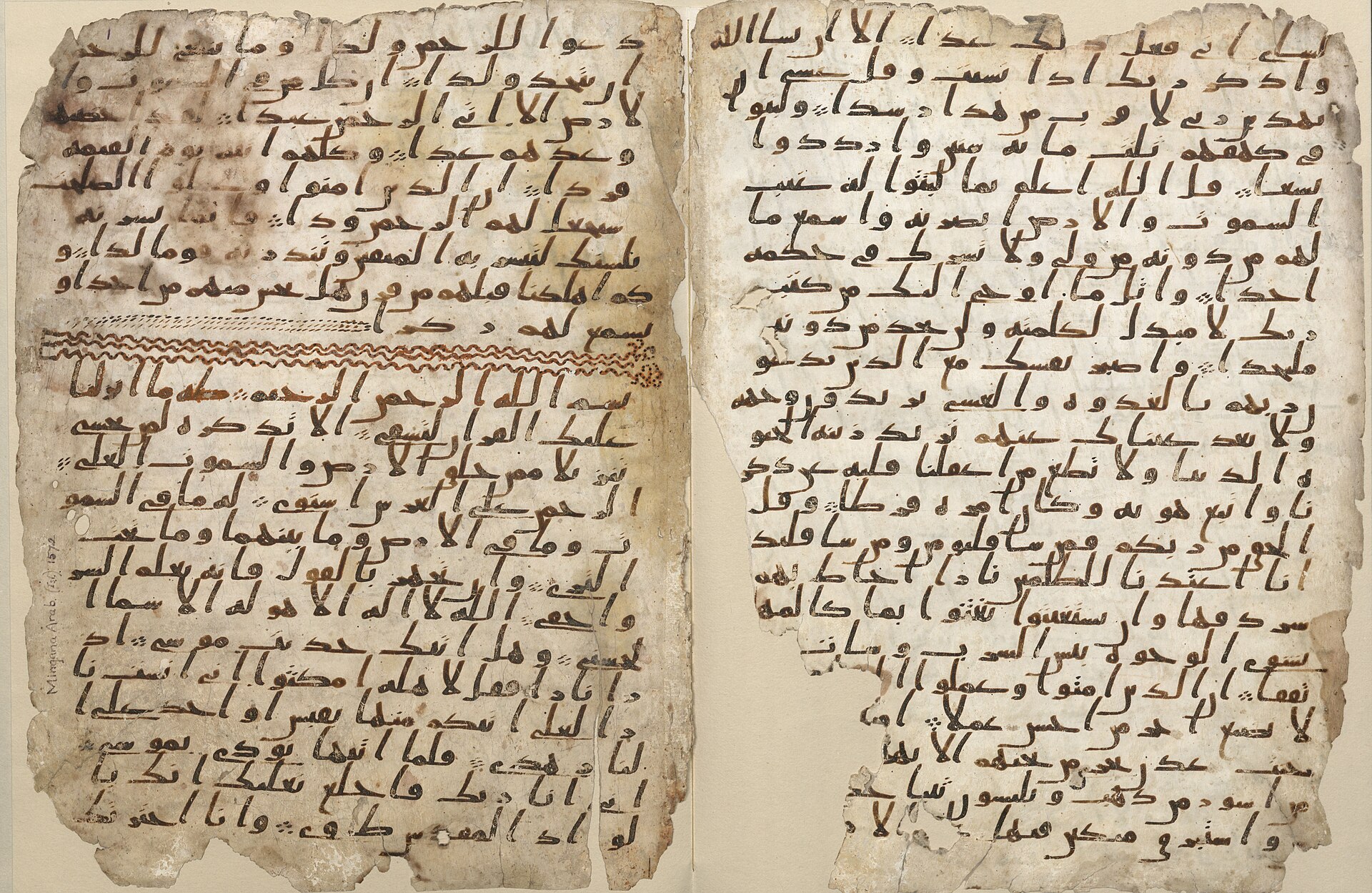
The radiocarbon dating of some early Coran manuscripts has shown that their parchments come from a very early period of Islam. The known one is, for example, the so-called Birmingham Quran manuscript. The date itself refers to the material, not necessarily to the moment of writing, but it supports the existence of the Coran text very close to the time of the first Muslim generations.
It is difficult to reconcile with the theory that Islam was much later assembled as a secret institutional structure. It does not solve all the questions of the Koran's editorial, but it shifts the burden of proof to the late artificial creation.
11. THE DOM OF SKIN AND FIRST PUBLIC NOTES
The Rock House in Jerusalem, from the end of 7. The century contains early Islamic inscriptions with formulas about God, Muhammad and Jesus. These inscriptions show that the new power and religious identity was publicly articulated relatively shortly after the traditional date of Muhammad's death.
At the same time, the inscriptions are explicitly polemical to the Christian images of God's nephew. Again, that does not fit the simple model of a obedient papal instrument.
12. WHY ARE LIVE AND CRISSMAN THINGS SO STRONG IN THE ISLAND
Because Arabia wasn't an isolated island. Business trips linked it to Syria, Palestine, Ethiopia, Yemen, Persia, and the East Roman world. Jewish communities existed in Arabia, and Christian powers and tribes were active in its surroundings.
Religious innovation usually arises with a combination of continuity and controversy. Christianity itself came from the Jewish environment and took over Hebrew scriptures without proving that it was deliberately created by a Jewish central institution. Similarly, the coronical work with biblical characters shows cultural affinity, not necessarily secret authorship.

13. THE CROSS-BORDER AND THE PROBLEMS OF THE LONG-TERM MANAGEMENT Theory
Rivera's theory must explain another huge historical obstacle: if the papacy created Islam as its instrument, why has it led, for centuries, conflicts over the Mediterranean, the Iberian Peninsula, Sicily, the Levant, and later south-eastern Europe with Muslim powers?
The conspiracy response can, of course, declare all these wars a theatre. But that makes the hypothesis unfathomable: every evidence is evidence for it and every evidence against it is supposedly part of the cover. Such a model is not a historical method because there is no observation that could disprove it.
14. HOW TO READ THE STRONG HISTORIC ARGUMENT
An extraordinary claim about the creation of the whole religion should have at least several independent types of evidence: period instructions, financial records, correspondence of organizers, independent testimonies, handwriting with traceable origin and compliance with the chronology of institutions.
Rivera's construction is based mainly on his own authority and later polemical literature. By contrast, the historically critical study of early Islam works with physical manuscripts, epigraphy, numismatics, papyres, Arab chronicles, and external Syrian, Greek and Armenian texts.
15. WHAT THEY'RE TALKING ABOUT NOW, "ACTUAL ISLAME EDUCATION"
Islam was established at 7. centuries in the late-antiquities environment, in contact with Jewish, Christian and local Arab traditions. Muhammad is historically best explained as a true leader of the early religious-political movement, although many details of his biography come from sources written later.
The Koran was created very soon and its oldest text history is the subject of expert research. The first Arab Empire has spread dramatically over the past few decades, at the expense of Byzance and the Persian Saxony. The new religious identity was gradually institutionally and theologically defined.
There is no compelling historical evidence for the theory that this process was planning and directing the papacy.
CONCLUSION
Rivera's story can be examined as an interesting subject of analysis - not as an exposed archive fact. Its true value lies in the question of why people are attracted to an explanation in which it must have an extremely important historical event of the only hidden architect.
The real creation of Islam is more complex. It did not take place in a vacuum chamber and there is no point in denying its Jewish and Christian context. But their serious studies show a network of cultural contacts, disputes and adaptations, not a documented operation run from Rome.
RESOURCES AND OTHER READING
[1] Christianity Today - Jack Chick's Anti-Catholic Alberto Comic Book Is Exposed as a Fraud (1981); examination of Rivera's biography claims.
christianitytoday.com
https://www.christianitytoday.com/1981/03/jack-chicks-anti-catholic-alberto-comic-book-is-exposed-as/
[2] Oxford Academic - The Qur'an and Late Antiquity / Oxford Handbook of Qur'anic Studies.
academic.oup.com
https://academic.oup.com/edited-volume/34388
[3] Angelika Neuwirth - The Qur'an and Late Antiquity, Oxford University Press.
academic.oup.com
https://academic.oup.com/book/11627
[4] Robert Hoyland - Early Islam as a Late Antique Religion, Oxford Academic.
academic.oup.com
https://academic.oup.com/edited-volume/28073/chapter-abstract/212149108
[5] Stephen J. Shoemaker - Muhammad and the Qur'an, historical- critical approaches, Oxford Academic.
academic.oup.com
https://academic.oup.com/edited-volume/28073/chapter-abstract/212149989
[6] University of Birmingham - Birmingham Qur'an manuscript.
birmingham.ac.uk
https://www.birmingham.ac.uk/facilities/cadbury/birmingham-quran-mingana-collection/birmingham-quran
[7] Encyclopaedia Britannica - Dome of the Rock / Early Islam.
britannica.com
https://www.britannica.com/topic/Dome-of-the-Rock