
5D GLASS AND RECALLING ON TIMS OF YEARS: FROM "360 TB DISK" TO HUMAN GENOME AND SILICA PROJECT
INTRODUCTION
When the University of Southampton announced in 2016 the development of "5D" storage of data into glass with a potential capacity of 360 terabytes, the headlines sounded almost like sci-fi: a medium that can survive human civilization. Media reports were not made up, but often mixed laboratory demonstrations, theoretical capacity and the idea of a future product.
Ten years later, technology becomes more interesting - and also more realistic. In 2024 Southampton announced the deposit of a complete human genome in the so-called crystal memory. Meanwhile, Microsoft developed another technological branch of glass archiving in the Silica project and published results in Nature in 2026 with research partners showing multiterabyte capacity and lifetime prospects for over 10,000 years.
1. WHAT "5D'
The name leads to a picture of five spatial dimensions. In fact, this is the way in which individual data structures are described.
Three coordinates correspond to the normal position of the point inside the material - x, y and z. Two other information is encoded into the optical properties of the nanostructure created by a femtosecond laser, such as orientation and size of the double-refraction or retardance.
In other words, one physical point can carry more information than a simple "burn hole" on a CD or DVD.
2. FEMTOSECUND LASER
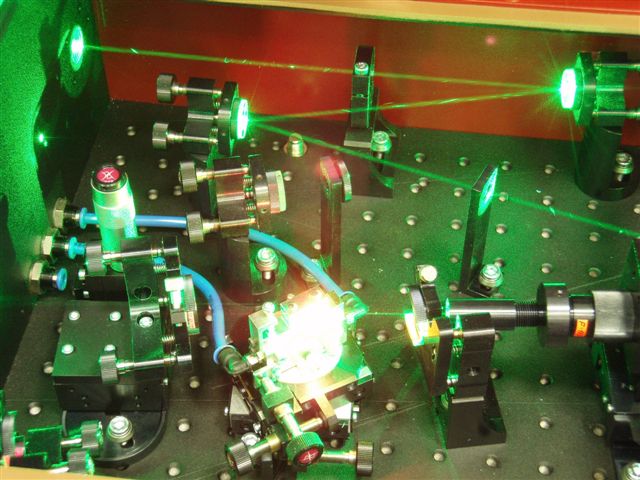
The key is an extremely short laser pulse. Femtosecond is 10 to the minus 15 seconds. Such short pulses can deliver high peak energy to very small volumes inside transparent material without the need to mechanically machine the entire surface.
Microscopic nanostructures are formed in quartz glass, which changes the polarization of light. When reading, these changes can be detected by an optical system and converted back to data.
3. WHY THE GLASS
Silicon glass has several properties suitable for archive. It is chemically stable, it does not contain moving mechanical parts and can withstand both temperature and ionizing radiation very well. Unlike a magnetic disk, it does not need to maintain magnetic orientation of small domains and unlike a flash memory it does not rely on an electrical charge contained in a transistor.
This is important for the 'cold storage' - data that is almost never rewritten, but must be readable over decades or centuries.
4. THE 360 TB NUMBER HAS BEEN APPLIED
Southampton reported a potential capacity of up to 360 TB per medium of a certain size. The number represented a density that researchers considered achievable by storing into material volume and more optical parameters.
It is not right to read the old press release as a notification that there was a 360TB serial drive with a common burner and reader in 2016. Between the laboratory physical density and the commercial storage site, there is the speed of writing, the parallel of lasers, the reliability of detection, error correction, automation and the price of the device.

5. "13,8 MILLIARDY YEARS" - WHAT THE SIGNIFICANT DATA stands for
The media has the idea that glass can withstand the age of the universe. This is extrapolation from accelerated thermal tests of material, not an experiment lasting billions of years.
Researchers shall issue samples to high temperatures, monitor degradation and estimate the rate of change at lower temperatures using a physical model. Such accelerated aging tests are used in material engineering commonly, but their result is a model estimate dependent on the assumption that the degradation mechanism remains the same.
Therefore, it is more sensible to write "extremely long-term archiving" than to literally promise legibility in 13 800 002 026.
6. WHAT WAS GLAD
The researchers demonstrated, for example, the Universal Declaration of Human Rights, the Bible of King James, Newton's Optics and other cultural documents. The point was to show that the medium is not just a random bit test field, but it can carry long real documents.
In 2024, the Southampton team announced the storage of a complete sequence of human genome into a 5D memory crystal. The crystal was stored in the Memory of Mankind archive in the salt cave in the Austrian Hallstatt as an experiment to preserve biological information for a very distant future.
7. _
Archiving has a frequently neglected problem. It's not enough for a physical carrier to stay intact. The future person must know that the data is on it, how it is encrypted and how to read it.
In several decades, ordinary disk drives, tape formats and some professional storage sites have disappeared. For a media designed for thousands of years, technological obsolescence is a greater problem than the physical life itself.
Southampton therefore added a visual "key" to the genome archive with information to indicate the nature of the stored data and the interpretation method to the future finder.
8. MICROSOFT PROJECT SILICA: DETAILED OBJECTIVE, OTHER TECHNOLOGY
Microsoft Research develops Project Silica, which also stores data optically into glass, but the technical design is not identical to the Southampton 5D crystal.
Silica is focused on data centers and cloud archive: the medium does not need to be powered after writing, it is passive and can be stored robotically. Reading uses microscopy and computer processing of the image.
In 2023 Microsoft showed a system of archiving with robotic access to glass plates. In 2026 he published further progress in Nature using borosilicate glass, more commonly produced than very pure fusion silicon.
9. RESULTS 2026: 4,8 TB ON THE GLASS DESIGN
A study in Nature published in 2026 described a record of approximately 4,8 TB on 120mm square glass with a thickness of 2 mm with several hundreds of layers. Researchers reported a significant increase in writing speed and an estimate of the lifetime of over 10,000 years based on thermal tests.
This number is smaller than the popular "360 TB," but that is why it is important: it is a different optimization, focused on practical permeability, more common material and system that tries to bring the data centre closer to operation.

10. WHY THE ARCHICAL DATA DOES WE NEED
Volume cold data is rising rapidly. Organisations deposit advances, medical images, scientific measurements, film masters, legal documents, genomic data and regulatory archives, which are rarely accessed, but must remain available.
Current data centers periodically migrate data between generations of tapes and discs. It uses energy, hardware, and work. A medium with a life of thousands of years could reduce the need for re-writing.
11. GLASS IS NOT A REFUND TO SSD
It's a mistake to compare technology only in terabytes. SSD allows for very fast random writing, lubrication and transcription. Glass archive is designed almost the opposite: write once, read many times, physically preserve for a very long time.
The ideal use is therefore not a laptop operating system, a gaming library or a database with millions of changes per second. It's an archive where long-term integrity and low cost of writing is the most important.
12. WHAT ELSE TO BRING MASSOVED INSTALLATIONS
- the price and speed of laser writing;
- The need for parallel beams or other scaling;
- robust automatic reading;
- the format correction codes and standardisation;
- the economy of media production and robotic libraries;
- long-term decoder availability;
- standards for migration and integrity verification.
Media physics is only one part of the entire storage system.
13. Could they have seen "CIVILIZATION BASIS"?
Technically, a huge amount of text, science, genetic data and cultural works can be stored in small volumes. The real problem with "backups of civilization" is selection, readability and context.
The future society must recognize language, coding, mathematical convention and structure of dat. Therefore, a good civilization archive would have to combine digital density with a physically readable manual - like the Rosetta plate combines multiple systems.

CONCLUSION
The 360 TB notification in five dimensions was not a fraud. She described real research on nanostructured glass, only popular subtitles often left out the difference between laboratory potential and the finished disk.
The post-2016 development shows that the idea did not die. Southampton continued to the archive of the human genome and Microsoft Project Silica moves the glass storage towards an industrial system. The biggest question is therefore no longer whether bits can be kept in glass. The question is whether laser, glass, reader, correction algorithms and long-term standards can be built economically meaningful archive.
14. DATATES NEED CHEST CORCULATION I IN "MATTER" MEDIA
No digital archive should rely on every physical bit to remain perfect forever. Practical systems therefore use error- correcting codes. The data are written with redundancy so that the reader can restore the original information even if a small part of the physical tags grow old, damaged or irreversibly unreadable.
This reduces clean user capacity, but dramatically increases reliability. Therefore, the "TB to medium 'figure always needs to be supplemented by information on whether it is gross physical density or capacity after netting the correction codes, metadata and reserves.
15. HASH AND RULES ON INTEGRITY
Long-term archive must be able to tell if the file is still the same. This is used for cryptographic hash functions and tree integrity structures. The archive can periodically read the medium and verify the checksum without the need to change the content.
For glass with a life of thousands of years, it is paradoxical that the greatest risk can arise not by physical degradation, but by loss of catalogue: we have the perfect plate, but we do not know which data set is on it. Longevity therefore requires as good data management as the medium itself.
16. ARCHIVE ENERGY ECONOMIC
Rotating hard drive consumes power while operating and the data centre must continuously power electronics and cooling. The magnetic tape may be offline, but it requires robotic mechanics and periodic migration between generations.
Glass medium is passive when written. If it can be stored without air conditioning and without periodic overwriting, the greatest savings may not be in the price of the plate but in decades of operating costs. It's just explaining the interest of the hyperscale cloud operators.
17. "READ ONLY" CAN BE A SAFETY ADVANTAGE
A medium that cannot simply be overwritten is not suitable for ordinary work, but excellent for some advances. Ransomware cannot encrypt a archive copy that does not physically support a normal transcription. Organisations may keep legal or scientific records in the format WORM - write once, read many.
Glass can therefore compete not with SSD but with specialised archives, where the invisibility is part of the security model.
RESOURCES AND OTHER READING
[1] University of Southampton - Eternal 5D data storage could record the history of human kind (2016).
southampton.ac.uk
https://www.southampton.ac.uk/news/2016/02/5d-data-storage-update.page
[2] University of Southampton - Human genome stored on 'everlasting' memory crystal (2024).
southampton.ac.uk
https://www.southampton.ac.uk/news/2024/09/human-genome-stored-on-everlasting-memory-crystal-.page
[3] Microsoft Research - Project Silica.
microsoft.com
https://www.microsoft.com/en-us/research/project/project-silica/
[4] Microsoft Research - Project Silica's advances in glass storage technology (2026).
microsoft.com
https://www.microsoft.com/en-us/research/blog/project-silicas-advances-in-glass-storage-technology/
[5] Nature - high-density durable optical data storage in glass / Project Silica research, 2026.
nature.com
https://www.nature.com/articles/s41586-025-10042-w