
THE SUNCTION AND MONTHS "CHANGED THE SITUATION": WHAT IS ACTUALLY CHANGING IN THE OBLIGATIONS
INTRODUCTION
People who have watched the sunrise from the same window for decades, the horizon above the garden or the place where the full moon rises may sometimes have a strong feeling that the celestial body "has moved where it was not." Such observations are not necessarily fictional. The point of sunrise and sunset of the sun and the moon is actually changing - sometimes very strongly.
The mistake is that the Earth or the Moon must have suddenly changed its orbit and astronomers are silent about it. The exact positions of the Earth, the Moon and the Sun are measured by many independent systems: observatory, radar astronomy, laser measurement of the distance of the Moon, satellite navigation and eclipse forecasts. A major unexpected change in trajectory would not be visible from one house. It would break a huge number of accurate predictions at the same time.
1. WHY THE SUNCE DOESN'T GO ALL YEAR IN THE SAME PLACE
The Earth's axis is inclined approximately 23.4 degrees towards the plane of the Earth's orbit around the Sun. This is the tendency that creates seasons.
From the observer's point of view, the sun's declination changes during the year. Around the spring and autumn equinox, the sun rises approximately to the east and sets in the west. In the northern hemisphere, its point of east towards the summer solstice moves towards the northeast and in winter towards the southeast. The higher the latitude, the more marked the difference can be.
Therefore, the sun can come out in June behind a completely different house, tree or hill than in December. If you compare a memory from another month or year without a precise date, change can be surprising.
2. ASIMULATION OF EAST REVEALS AT THE OBSERVER'S PLACE
The exit is not a point, but a direction on an ideal horizon. The real moment when we see the sun affects the height of the horizon. The hill in the east will only cause the sun to be seen after it is geometrically above the horizon; this will also shift the place where we can record it on the horizon.
The observer altitude, the exact latitude and atmospheric refraction are also of importance. The refractory bends the light in the atmosphere and causes the Sun to be seen a little higher at the horizon than it is geometrically.
Therefore, when comparing a photograph taken after years, the State is not sufficient to "be in the same place '. For the exact test, we need the same coordinates, camera height, date, time, focal distance and known horizon.
3. MONTHS ARE MORE COMPLICATED
At the Moon, intuitive expectations are even less reliable. Its orbit is inclined towards the ecliptic field by approximately five degrees and the nodes of this path are gradually rotating. One cycle lasts about 18.6 years.
As a result, the maximum north and south declines of the Moon are not the same every year. During the period of the so-called great lunar standstill, the moon can come out and fit much more north or south than in other years.
The great lunar standstill came again in the period 2024-2025. NASA reminded it of it in 2025 as a natural consequence of the 18.6-year cycle of the moon's runway. For a man who has last watched the full moon very closely, for example, ten years earlier, the magnitude of change may be truly surprising.
4. WHY IS THERE NOT A MONTH EVERY DAY THERE WHERE THERE WAS A NIGHT
The moon moves around 13 degrees a day in the sky towards the stars. It's about 50 minutes later than the day before, but the exact difference is changing. So its phases, declinations and position towards the horizon are rapidly combined.
"The East of the Moon" is not one recurring phenomenon as a clock's hand. The sickle, first quarter, full moon and last quarter are published in different parts of the day and in different places of the horizon.

5. _
Yes - but different than the dramatic version of the story suggests. The gravity system is not perfectly unchanged. The Earth's axis precedes in a cycle of approximately 26,000 years, shows less compulsion and its tendency is slowly changing. The Earth's runway is subject to long-term changes in eccentricity and orientation. The moon is slowly moving away from Earth on average, about a few centimeters a year.
These phenomena are precisely measurable and are included in astronomical models. It's not a sudden leap that would have moved the sun ten degrees over the next few years and stayed hidden.
6. A month's laser
Since Apollo and the Soviet Luna program, there have been retroreflectors on the moon. The ground observatory sends laser pulses to them and measures the time of light return. This can determine the distance of the Earth-Moon with extraordinary accuracy.
If the moon had "changed its course" to the extent needed to explain a dramatically different exit, laser measurement would have recorded a change directly. Moreover, data is not owned by a single secret institution; lunar laser ranging was performed by observatory in different countries.
7. AMOUNT AS A TESTING OF ASTRONOMIC MODEL
The eclipse of the Sun is a brutally accurate test of geometry. To complete the eclipse in the predicted narrow strip on the surface of the Earth, the model must know the position of the Sun, the Earth and the Moon correctly.
Modern eclipses are predicted years ahead with precision, allowing people to travel to a particular city and stand in a belt of totalitarianism. A sudden unknown change in orbit would shift the eclipse belt and the forecast would fail.
Likewise, errors would arise in lunar covers of stars, tidal models, navigation of interplanetary probes and planetary positioning calculations.
8. GPIS AND COUNTRY ROTTING
Global navigation systems GPS, Galileo, GLONASS and BeiDou work with extremely accurate time and satellite geometry. They are not a direct measure of the position of the Sun, but their operation is part of a wider geodesy infrastructure that closely monitors the rotation of the Earth and the movement of its poles.
International Earth Rotation and Reference Systems Service publishes Earth Orientation parameters because rotation is not perfectly uniform. The scientific community therefore does not hide small changes in the Earth's orientation - on the contrary, it regularly measures and publishes them because they are necessary for navigation and astronomy.
9. MAGNETIC FIELDS ARE NOT GEOGRAPHICAL FIELDS
Another common source of confusion is the shift of the magnetic North Pole. This is actually moving and in recent decades, its speed has changed significantly. But the magnetic pole is a property of the Earth's magnetic field, not the axis around which the planet is mechanically rotating.
The compass can therefore point in a slightly different direction over the decades without changing the point of sunrise in a manner consistent with the change in the rotation axis of the Earth.

10. POLAR MOVEMENT AND CHANDLER WOBBLE
Even the rotary pole is not completely stationary on the surface. It performs small movements, including Chandler's fluctuation with a period of approximately 14 months. But the range is within a thousand kilometres of the Earth's surface.
Such subtle changes are geodetically significant, but do not explain the claim that "the sun rises by tens of degrees elsewhere."
11. Could it be that they would be able to make a sudden crossing of the Earth's axis?
A very rapid change in the rotation axis of the entire planet would require a huge change in momentum. Such an event would not be a silent astronomical detail. It would have planetary geophysical consequences and would be immediately detected by global measuring infrastructure.
Sometimes it's confused by geomagnetic repolating. Indeed, the Earth's magnetic field has turned many times in the geological past. But it is a change in the magnetic field in the Earth's core, not the physical overturning of the planet.
12. "EXPERTS ARE BUSINESS" - HOW WOULD THAT SECRET FALL OUT?
The idea of secrecy comes across an organisational problem. Astronomical data is not produced by one government. The sun and moon are monitored by professional observatory, university, amateur astronomers, geodeses, armies, private companies and space agencies of competing states.
If the predictions of astronomical ephemerides suddenly break up with reality, an amateur could verify that. A series of accurately timed photographs of the star field or the cover of the star by the moon would suffice. A global silence agreement would therefore have to include millions of independent observations while ensuring that navigational and astronomical calculations continue to function accurately.
13. HOW TO VERIFIEVE THE HOUSE
The best response to unusual observations is not "I believe NASA" or "NASA lies," but measurement.
Select a fixed point from where you can see the east or west horizon. Record the exact coordinates and take each image from the same location. Save date and time Please include fixed indicative points in the photograph. Then compare the measured azimuth with astronomical ephemeride, for example JPL Horizons, Stellarium or other independent calculations.
In addition, record the stage and declination at the Moon. After a few months, a very graphic map will be created of how naturally the points of the east change.

CONCLUSION
Observing that the sun or the moon rises "elsewhere than before" can be absolutely honest. Astronomy is really predicting major seasonal changes in the solar azimuth and even more complex changes in the Moon. Moreover, the period of the great lunar standstill creates variations that one experiences only several times in life.
However, available measurements do not support claims of recent secret changes in Earth or Moon orbits. On the contrary: the accuracy of eclipses, laser measurements of the Moon and planetary ephemeride shows that the current models of motion of these bodies work very accurately.
14. ANALEMA: PHOTOGRAPHIC EVIDENCE OF THE YEAR MOVEMENT OF THE SULUNE
A very graphic experiment is an analoma. The photographer takes a series of images of the Sun from the same place during the year at the same time of the day and composes the images. The sun does not create a point or a line, but a characteristic eight.
The shape is formed by a combination of the slope of the earth's axis and the ellipticism of the earth's path. It's a visual reminder that "sun at the same time" is not in the same place every day. In this case, there is no need for a sudden change of course to create this great annual movement.
15. ARCHEOASTRONOMY: PEOPLE CHANGED THROUGH TIMES
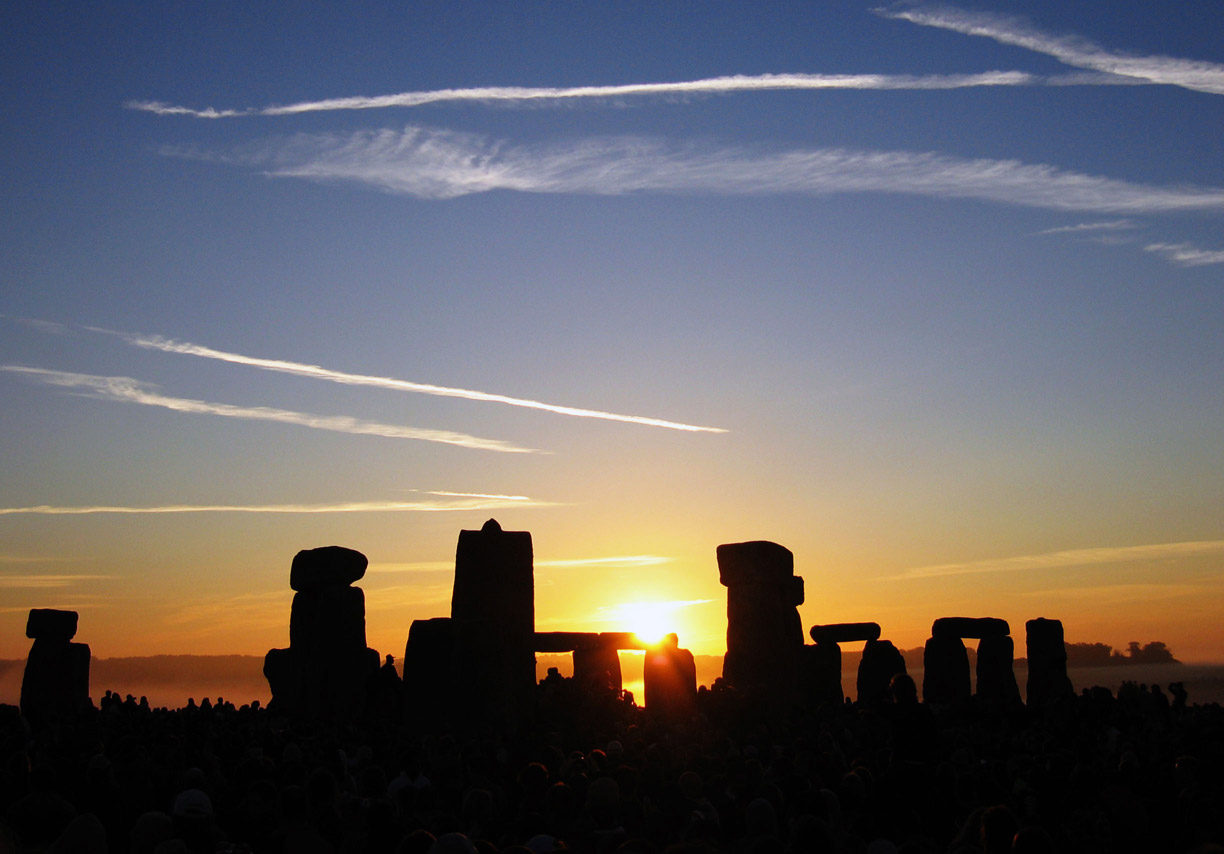
The seasonal extremes of the sun and the long cycles of the moon were important for prehistoric societies. Some monuments and orientation of buildings are examined in relation to solstice or extreme moonlights.
Archaeoastronomy is also a warning against excessive interpretation. If we have enough stones, directions and astronomical objects, some of these matches will be created by accident. Serious research therefore needs statistics, archaeological context and proof that orientation was important for the culture.
16. PRESE: WHY THE "NORTHERLANDS" IS CHANGED
The Earth's rotary axis slowly copies the cone, like the axis of the spiced kats. This phenomenon is called a precedent movement and the cycle lasts approximately 26,000 years.
Today it lies near the North Pole of the Polar, but in ancient times it was not, and in the far future, another star will be playing the role of the polar star. It's a real change in axis orientation towards distant stars, but it's going so slowly that it creates small, accurately measurable shifts in human life.
17. PRACTICALLY TESTS FOR THE WEBO ARTICLE
The future HTML version may contain a simple interactive demonstration. The user enters the latitude and the date and the azimuth of the sunrise and sunset is displayed. The second graph can draw the whole range of points on the horizon for one year.
For the Moon, it would be possible to add a maximum declination curve within the 18.6-year cycle. Such a visual model will allow readers to compare their own memory with the forecast and make the controversial thesis a measurable experiment.
RESOURCES AND OTHER READING
[1] NASA - Seeing Equinoxes and Solstises from Space; Earth's axis slope and annual Sun motion.
sciene.nasa.gov
https://science.nasa.gov/resource/seeing-equinoxes-and-solstices-from-space/
[2] NASA Space Place - What Causes the Seasons?
spaceplace.nasa.gov
https://spaceplace.nasa.gov/seasons/en/
[3] NASA APOD - Major Lunar Standstill 2024-2025 / 18.6-year cycle.
sciene.nasa.gov
https://science.nasa.gov/image-article/apod-2025-june-20-major-lunar-standstill-2024-2025/
[4] NASA / JPL Horizons - precise ephemerides of the solar system bodies.
ssd.jpl.nasa.gov
https://ssd.jpl.nasa.gov/horizons/
[5] International Laser Ranging Service - Lunar Laser Ranging.
ilrs.gsfc.nasa.gov
https://ilrs.gsfc.nasa.gov/science/scienceContributions/lunar.html
[6] International Earth Rotation and Reference Systems Service - Earth Orientation Parameters.
iers.org
https://www.iers.org/