
Why people don't understand each other: perspective, intelligence, knowledge gap and the illusion of consent
Two people can look at the same thing, know the same facts, and yet argue. Sometimes because they have other information. Other times because they give different meaning to the same words. Sometimes they really get along perfectly, but their interests are incompatible. And sometimes one of them says yes on the outside, even though he doesn't agree on the inside. This study combines the psychology of judgment, expertise, social conformities, epistemic humility and the theory of international relations into one work model: Object O and its various projections.

Content
- What does "not to understand" mean?
- A spectrum of perspectives: object O and three true projections
- Why doesn't it come from different perspectives that "everyone has a right"
- From reality to statement: O → P → I → S
- Same words, different mental models
- Compressed communication: a short sentence may not be a short thought
- "Yes" is not the only psychological condition
- Conformity, pluralistic ignorance and public consent
- Preference falsification: when the public position is not a private preference
- Expert and novice: same term, different information density
- Tactical expertise: one can identify a problem before one can explain it
- Curse of Knowledge: The Expert Can't Know What He Knows
- Illusion of depth explanation
- Dunning-Kruger without Internet cartoon
- IQ, rationality, knowledge and wisdom are not the same.
- Motivated reasoning and myside bias
- Why does an experienced person start "everywhere to see amateurs"
- Epistemic download: why does someone stop fixing the surroundings
- Specialization bubble: when the standard of what is "base" is shifted
- Interview as a search for truth versus an interview as a social activity
- Status, identity and face loss
- Intellectual humility: an observer who knows he is an observer
- Working with uncertainty: the power of opinion should correspond to the power of registration
- Observer D: ability to integrate projections
- Institutions as multiple observer systems
- Diplomat, Minister and President: Man versus role
- Mirror imaging and security dilemma
- Two- level games and home audience
- Same facts, different causal models
- If it's not a misunderstanding, it's a conflict of interest.
- Practical method: how to reconstruct the O object
- How the dispute changes according to the type of problem
- Model limits and typical errors
- Synthesis: Understand the projection without losing reality
1. What does "not to understand" mean?
In common language, several different mechanisms are hidden under the phrase "they don't understand each other." The first is simple misunderstandings: And it intends to mean X, but B decode Y. The second is Differential informationAnd he knows data that B doesn't know. The third is Different model: both have the same data, but otherwise they are composed into causes and consequences. The fourth is conflict of values or interests: both get along, but they want a different result. The fifth is strategic communication: one of the participants deliberately does not say the whole of his internal state.
| Situation | And B really get along? | Is the dispute informative? | Typical problem |
|---|---|---|---|
| Misunderstanding | No. | Yes | other meaning of words, incorrect inference |
| Different records | Partly | Yes | everyone sees a different sample of reality |
| Different model | Yes | Not necessarily. | same data, other causality |
| Conflict of values / interests | Yes | No. | X and Y are incompatible targets |
| Fake consent | Often, yes. | No. | public signal Calculation of private opinion |
| Strategic ambiguity | Incompletely incompletely | Controlled | sender does not want to be fully readable |
This distinction is important because each situation requires a different medicine. Misunderstandings can sometimes be solved by defining terms. Information gap by adding data. But conflict of interest will not disappear by "explaining its opinion better" by participants. And strategic communication is, by definition, based on the fact that full transparency may not be the target.
2. A spectrum of perspectives: object O and three true projections
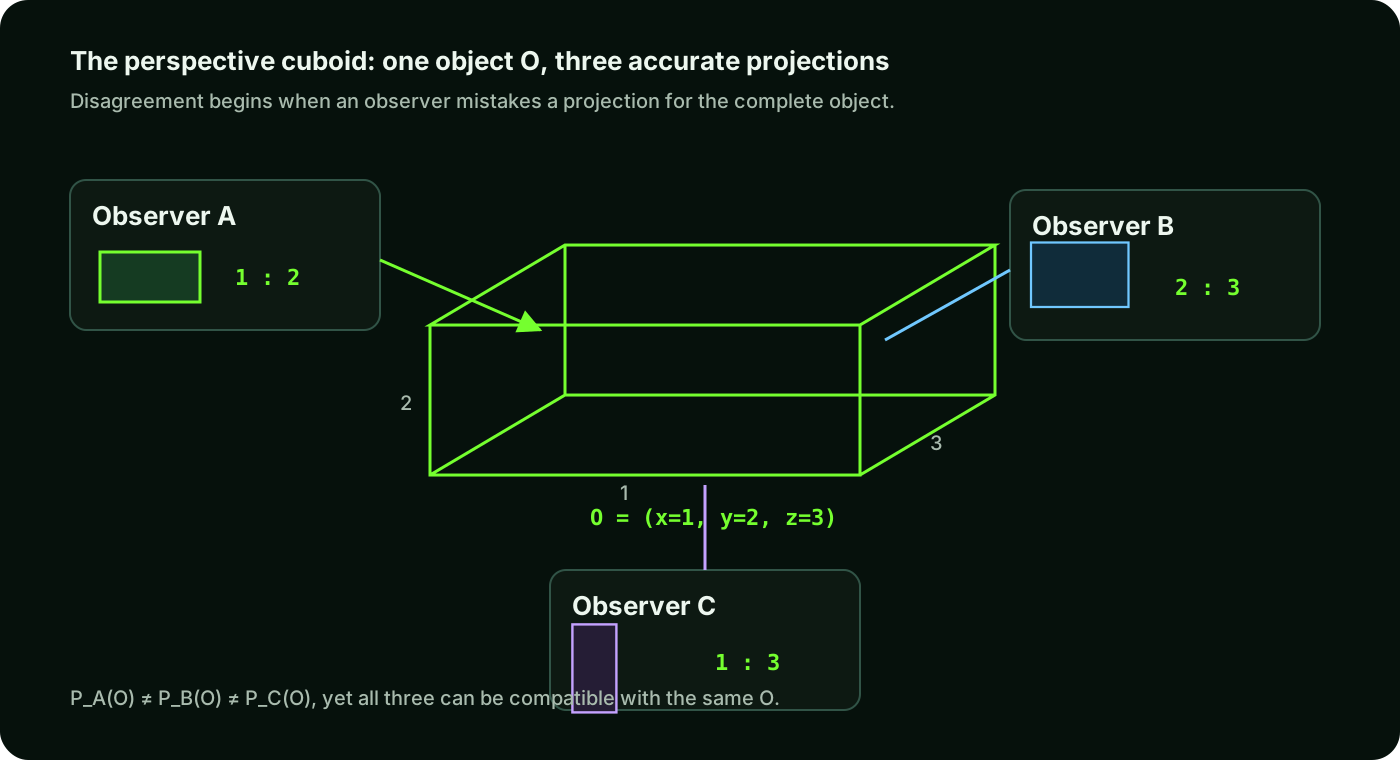
Let's think about the block. O with edge lengths x = 1, y = 2, z = 3. A is looking perpendicular to the x-y plane and seeing a rectangle of 1 × 2. Observer B monitors the y-z plane and sees 2 × 3. Observer C follows x- z and sees 1 × 3. If everyone describes their projection accurately, none of them lie and none need be distracted.
P _ A (O) = 1 × 2 P _ B (O) = 2 × 3 P _ C (O) = 1 × 3The dispute will only arise at ontological jump: from the statement "I see 1: 2" becomes "the object is 1: 2." The observer will replace the property of the projection with the complete property of the object. And they can do the same thing at the same time, B and C.
Interactive perspective cuboid
Click a coloured face or its description to highlight one of the three fixed projections of the 1 × 2 × 3 cuboid. Click it again to show the whole object.
This model can be generalized. Observation is not only a function of the object, but also a position, resolution of the measuring channel, previous knowledge and the way in which the observer categorises the data:
Pzq = f (O, position, channel, distinction, knowledge)So one hardly ever accepts "reality without filter." It accepts a limited cut from which it reconstructs a wider model.
3. Why doesn't it come from different perspectives that "everyone has a right"
A spectrum of perspectives is not a defense of relativism. The fact that different observers have different projections does not mean that any claim is equally valid. If A sees 1 × 2, B sees 2 × 3 and C sees 1 × 3, these three projections are mutually compatible with an object of 1 × 2 × 3. If D were to claim under the same conditions that his orthogonal projection is a circle, his claim would already require a different explanation: another object, another way of projection, deformation, measurement error or false description.
Scientists can compare this problem to an inverse task. We have several measurements created by transformation of an unknown object and we are trying to reconstruct an object that explains all measurements with the least number of additional assumptions. The more independent and quality projections we have, the more space we can see narrows. That is the exact opposite of "everyone's right."
4. From reality to statement: O → P → I → S
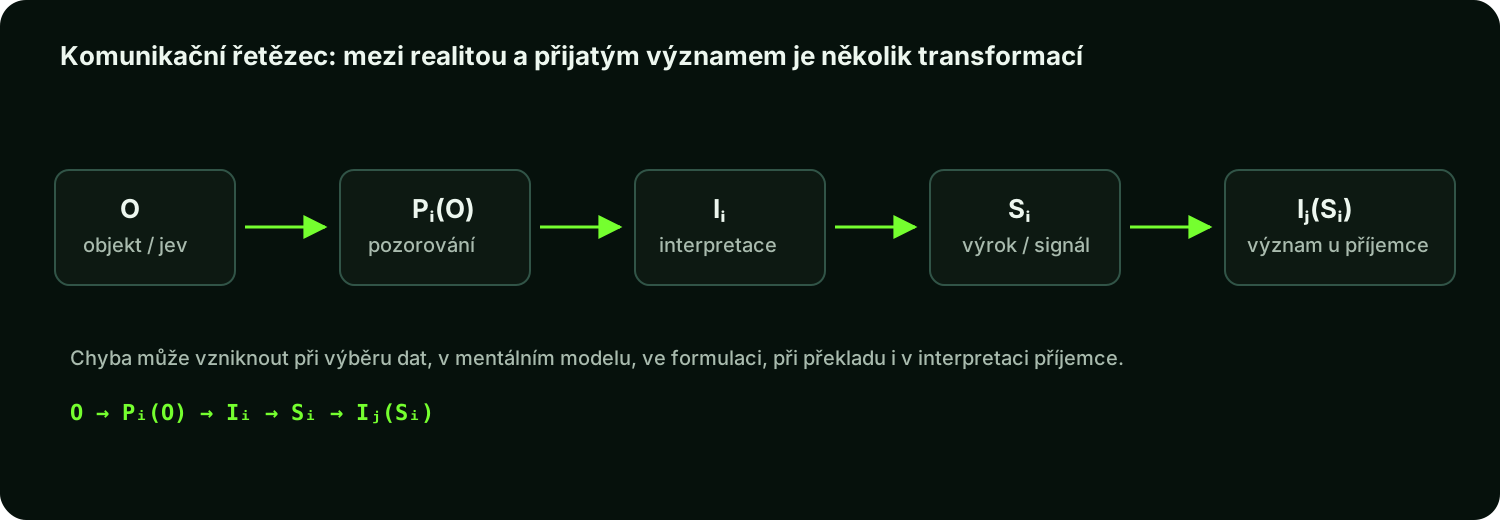
The observation itself is not an interpretation yet, and interpretation is not an expression yet. For one observer, the working string may be written:
O → PCalculation (O) → IHeavy →Moreover, the recipient does not directly read the internal interpretation of Izavec. It only receives a signal from the SJV and creates its own interpretation of the signal:
O → PHeavy (O) → IHeavy → IHeavy (S)There are several different errors. The observer may have poor data. He can see the data correctly, but he can plant it in the wrong causal model. He can misphrase his model. He may intentionally omit a substantial part. The recipient may assign a different meaning or statement to words to a motive which the sender did not have.
5. Same words, different mental models
The word is not a complete content. It is rather an address that activates a network of knowledge, experience and associations in the mind. Therefore, words such as "freedom," "security," "democracy," "terrorism," "artificial intelligence," "energy" or "expert" in two people can produce different rich and partially different models. In a normal conversation, it's often invisible because they both use the same dictionary.
The misunderstanding will only manifest itself when it is necessary to derive something from the concept. Two people may agree to a sentence at the level of the password, but they may differ in every practical consequence. This is how it arises the illusion of semantic consensus: we agreed on the word, and therefore we feel that we agree on the model.
The surface token is the same; the internal representation is not necessarily.
6. Compressed communication: a short sentence may not be a short thought
A large part of human communication works as compression. When two people share a large context, they can pass on a very complex idea in a few words. The term "that is race condition," "that is endogenicity," "that is a security dilemma" or "there is no third dimension" can pass on a whole set of assumptions, procedures and consequences between two experts. The text is short, but the decoding dictionary is stored in the heads of both participants.
For a person outside this common context, the same sentence seems to be an insufficient explanation. The problem may not be that the sender "knows nothing else." He may knowingly or automatically assume that the recipient will complete the hidden premises as well as he did. When this assumption is wrong, the concise appears to be superficial and detailed knowledge remains invisible to the recipient.
This is also important in assessing the intelligence of another person. From one short sentence, it is not safe to deduce how much knowledge is behind it. Some write briefly because they think briefly; others because they expect intelligent context reconstruction. And vice versa: a long answer may not be deep if it only divides a small number of ideas into many words.
Good communication therefore requires an estimate of the common basis. It is important to know which premises can be safely compressed and which must be unpacked. An expert who can't make that estimate can seem incomprehensible. A listener who automatically confuses the undeclared non-existent may, in turn, underestimate the sender's knowledge.
This is where the communication and epistemic problem is connected: one side evaluates the content according to what was explicitly said, the other evaluates it according to what it considers to be, of course, reconstructable. The dispute is not then created by the object O itself, but by how many of the model O must be expressed out loud at a given level of common context.
7. "Yes" is not the only psychological condition
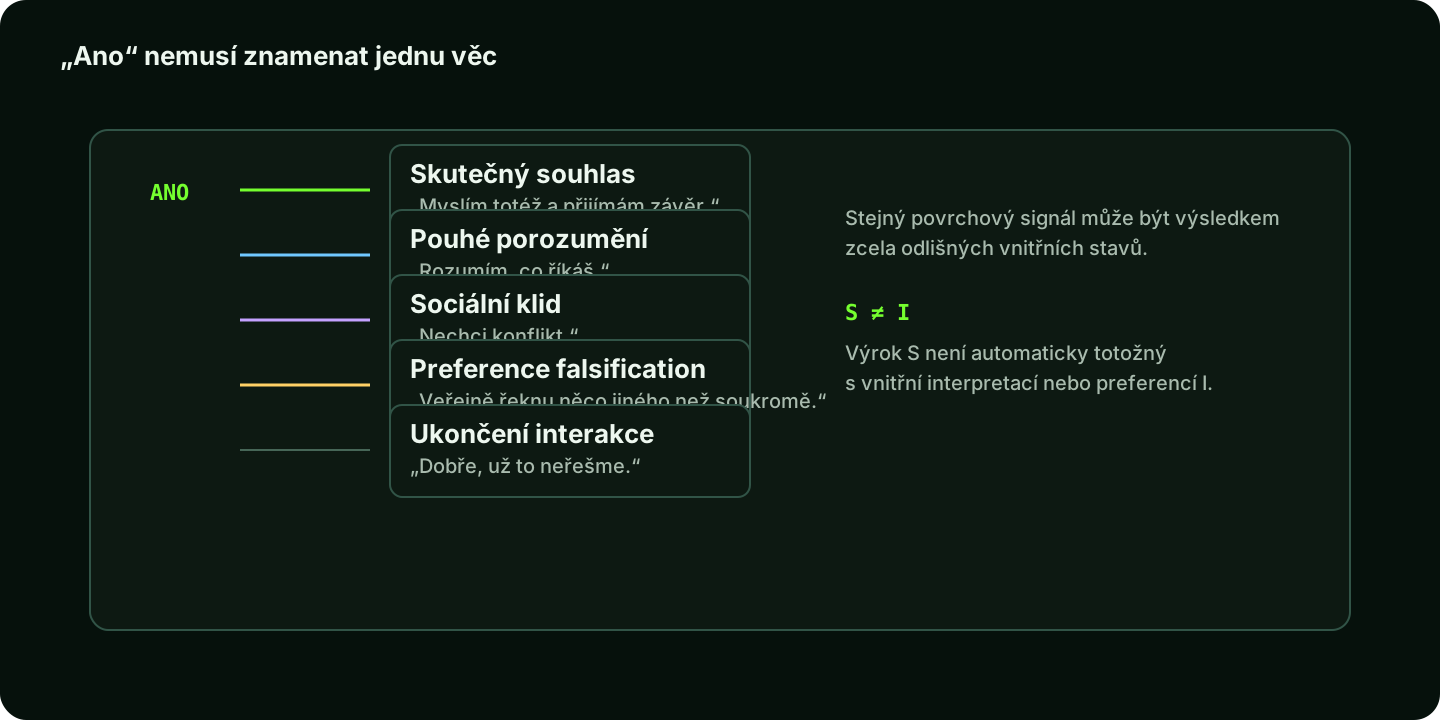
"Yes" can mean real consent, simple understanding, courtesy, an attempt to end the dispute, respect for hierarchy, uncertainty, social adjustment or conscious pretense of consent. It is therefore dangerous to confuse the absence of resistance with the presence of consensus.
In organizations, it can create a chain illusion. Every member of the meeting has reservations, but they see that the others are silent. From the silence of others, he will assume that he is alone with his doubt, and also silent. The group can act unanimously precisely because individuals misestimate the private attitudes of others.
8. Conformity, pluralistic ignorance and public consent
Solomon Asch showed in his classical experiments that the group's unanimous opinion may, under certain conditions, force some people to publicly accept the obvious error of judgement about the length of lines. The purpose of these experiments is not to say that people always follow the majority mechanically, but to demonstrate that the social context is part of the decision-making situation. Asch, 1955.
Another mechanism is: Pluralistic Ignorance. Prentice and Miller have shown in the university environment that people can systematically overestimate how comfortable others are with a certain standard; individuals then respond to an assumed group standard that does not correspond to the private positions of the majority. Prentice & Miller, 1993.
Both mechanisms differ. Conformance describes the group's pressure on judgment or public response. Plural ignorance underlines a miscalculation of what the group really thinks. In practice, however, they can intensify: public adaptation creates a false image of the standard and then it creates further adaptation.
9. Preference falsification: when the public position is not a private preference
Economist and Politologist Timur Kuran uses the term preference falsification for a situation where a person publicly declares a preference other than that which he is privately holding, because public expression has social, political or economic costs. Its model explicitly distinguishes private and public preferences and shows how policy or standard can be stable, even if private support is weaker than public behaviour suggests. Kuran, 1987.
This is an important bridge between interpersonal communication and politics. A public statement is not only a transfer of information; it is also an act of action in the system of rewards, sanctions, reputation and power. One can say 'I agree' because it really does, or because the costs of disapproval are too high in the environment.
10. Expert and novice: same term, different information density
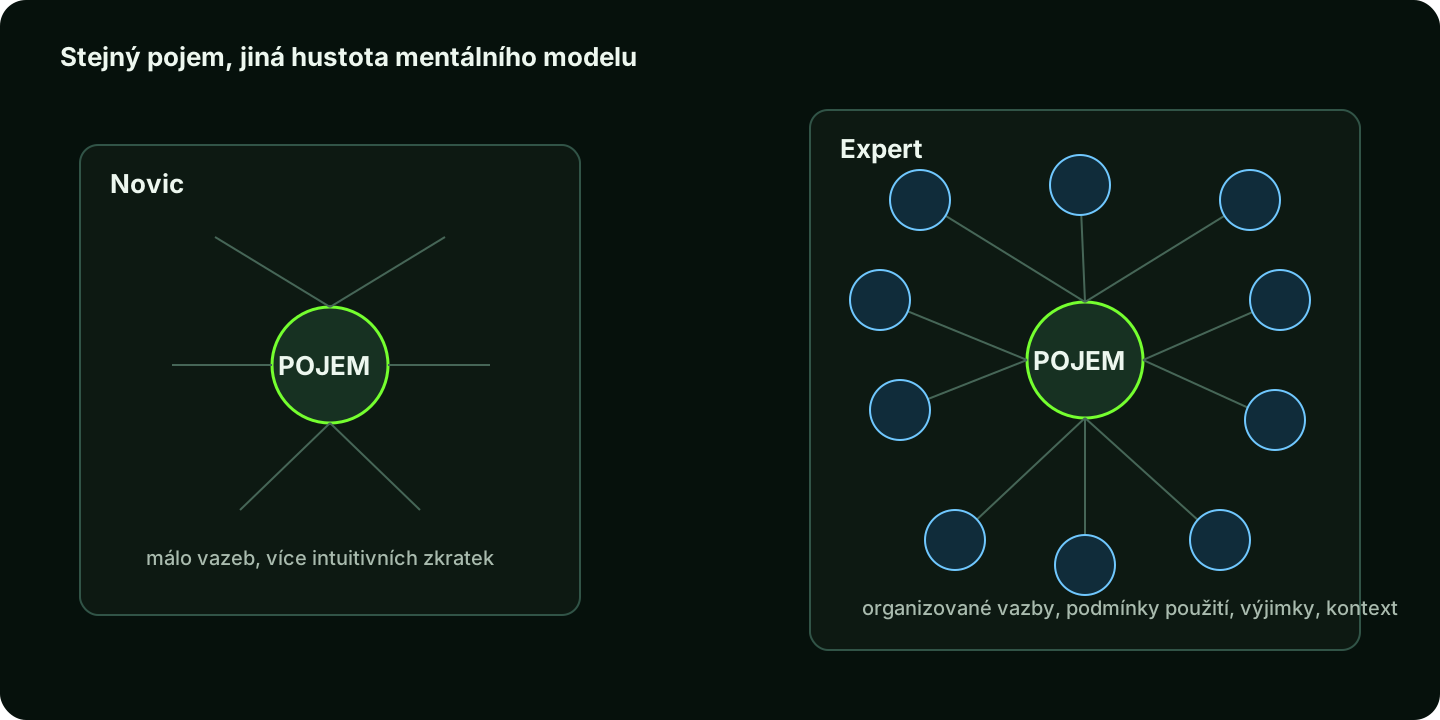
Research on expertise has shown in the long term that experts do not differ from novices only by the number of facts memorized. Their knowledge is better organized around deeper concepts and relevant formulas. American National Academy Report How People Learn summarises that the expertise affects what one notices, how information is organised, represented and interpreted; the relevant knowledge is also recaptured selectively according to context. National Research Council - How Experts Differ From Novices.
That is why two people can hear the same sentence, but one of them can instantly recognize the network of addiction, exceptions and possible errors, while the other appears to be a simple claim. The programmer can see the technical debt, race condition, unresolved peripheral states and scaling problem behind the sentence "it works." The sound man for "sounds good" hears clipping, phase, dynamics and artifacts codec. A historian after one date sees a chain of sources, interpretations and questionable periodicals.
This creates compression asymmetry: expert can wrap a lot of context into a short term. For novices, however, this compressed symbol does not contain the same data. The expert says "endogenicity," "race condition" or "security dilemma," and feels he has explained the essence; the listener only hears the label.
11. Tactical expertise: one can identify a problem before one can explain it
Practice does not create an explicit list of rules. It also creates quick recognition of configurations that are difficult to convert into words. An experienced mechanic can tell by sound that the engine is "not right," an experienced programmer can feel at first sight a dangerous piece of architecture and an experienced sound engineer can immediately hear a problem whose exact location requires further analysis.
That's not proof of infallible intuition. Intuition can be wrong, especially when the situation is different from the environment in which experience was created. But it is wrong to assume that knowledge exists only when one can immediately translate it into linear verbal evidence. Research of expertise summarized in How People Learn shows that experts will notice significant patterns in the domain and organise knowledge so that they can selectively equip the relevant part.
Communication asymmetry is obvious. The expert says, "This is going to be a problem" in two seconds. The other person asks for an explanation. To provide it, the expert must dismantle its fast, compressed representation on an explicit basis. It can take ten minutes and sometimes up to the next measurement. During this time, the listener may have the impression that the first judgment was merely self-confident arguing, even though it was actually a hypothesis created by thousands of previous cases.
The opposite risk is equally important: an experienced person can confuse a known formula for a new case that is only surface-like. That's why the secret expertise has to stay connected to the verification. The best working form is not "I know this because I am an expert," but "my experience model here quickly signals the problem; now let's find out which observable signs will confirm or disprove this hypothesis."
The difference between recognition and explanation is reflected in the teaching. National Academy points out that the expertise itself does not guarantee the ability to teach him well. The pedagogical expertise includes knowledge of the typical difficulties of beginners and the ability to connect new content to their existing representations. So one can be a great solver and at the same time a weak translator of his thinking into the mental model of novice.
12. Curse of Knowledge: The Expert Can't Know What He Knows
Camererer- Loewenstein and Weber described ♪ Curse of knowledge ♪: better informed people have difficulty ignoring information they already know and precisely reconstructing the judgment of a less informed person. In their experiments, this problem has not disappeared even where it would be economically advantageous to feel in a less informed party. Camerer, Loewenstein & Weber, 1989.
It's manifested in communication by skipping between steps. The expert in the head performs A → B → C → D → E and only says A → E because B, C and D are automatic for it. But the listener doesn't have a compression dictionary to restore the hidden steps. Paradox is created: the more obvious the mechanism for an expert is, the easier it can be to underestimate the need to explain it.
13. Illusion of depth explanation
The problem is the opposite way. Rozenblit and Keil described illusion of explanatory depot: people often believe that they understand common mechanisms much more in detail than they do when they are to explain them step by step. The sense of acquaintance can thus be confused with a causal understanding. Rozenblit & Keil, 2002.
That is one of the reasons why debates are difficult. A participant does not have to knowingly pretend to know. His subjective sense of understanding is real - he has not yet been subjected to a detailed explanation test. The question "can you describe the mechanism step by step?" is therefore often more information than the question "understand it?"
14. Dunning-Kruger without Internet cartoon
The original work of Kruger and Dunning in 1999 showed in several roles that the weakest participants greatly overestimated their relative performance and the authors combined this error with a lack of metacognitive ability to recognise their own errors. Kruger & Dunning, 1999. But the Internet version of this result often degenerated into the claim "stupid people always think they're geniuses," which the original study does not say.
In addition, there is a technical debate on how much of the classic shape of the effect is psychological and how much it relates to the statistical properties of the measurement. Gignac and Zajenkowski showed that ordinary quartile graphs are prone to regression to diameter and other artifacts; in their analysis, the effect on intelligence was not significant in other tests. Gignac & Zajenkowski, 2020. Registered study McIntosh et al. also questioned the "dual-burden" explanation and showed that the classic pattern can be strongly pulled by the design of the score. McIntosh et al., 2022. Another reanalysis found a small but statistically significant effect and recommended examining the conditions under which it appears. Dunkel, Nedelec & van der Linden, 2023.
15. IQ, rationality, knowledge and wisdom are not the same.
A high score in cognitive ability tests may give an advantage in abstract thinking, working memory or solving some types of problems. However, it is not a certificate of true opinions, expertise in all fields, and good calibration. The opinions and West have shown that some myside and unilateral biases may be surprisingly little dependent on cognitive abilities. & West opinions, 2008.
It is therefore useful to divide several axes which often come together in the common language:
| Axis | What is it roughly describing | What does not guarantee |
|---|---|---|
| Cognitive ability | speed and processing capacity, abstraction, problem solving | knowledge of a particular field, openness of correction |
| Knowledge | volume and structure of information in the domain | ability to apply knowledge correctly outside the learned context |
| Expertise | long-term calibrated pattern recognition and decision making in the domain | expertise in other domain |
| Rationality | method of updating the beliefs and choice of funds in relation to the objectives | moral correctness of the objective |
| Intellectual humility | ability to recognize limits of your own knowledge and the possibility of error | the accuracy of each particular conclusion |
| Wisdom | integration of perspectives, uncertainty, consequences and values in a broader context | technical expertise in all areas |
A man with high intelligence and low knowledge of the field can create an extremely elegant mistake. A person with long experience can be in a narrow or more reliable position, even if he does not have an extraordinary psychometric score. And a man with both can still succumb to motivated thinking.
16. Motivated reasoning and myside bias
Ziva Kund summarized research motivated: objectives and wishes can influence which strategies people use and what conclusions they consider acceptable, and one often needs at least a seemingly justifiable way to a preferred conclusion. Cunt, 1990.
The opinions and West also show that the tendency to assess arguments supporting their previous positions is more favourable than the opposite does not simply bind to lower intelligence. & West opinions, 2008. High cognitive capacity can help to find errors, but also provide more tools to sophisticated rationalisation of the already preferred conclusion.
That's a major correction to the smart versus stupid model. Many disputes are described better as Various motivated and informed observers with different models.
17. Why does an experienced person start "everywhere to see amateurs"
This feeling can have both objective and subjective components. The objective is that the quality of work and knowledge is uneven in the population and the expert can distinguish between errors that the layman does not see. But, with the growth of its own expertise, the reference point is moving: what was once "good" becomes a minimum standard and the attention shifts to the missing details.
The effect of increased observer resolution is being developed. The sound engineer starts hearing artifacts, programmer of architectural debts, mechanic of atypical engine sound, experienced researcher of methodological weakness. The world did not necessarily deteriorate; the ability to detect the structure of error changed.
The problem is when the locally justified judgment "in this task is the work of poor quality" becomes a global anthropological court "all are losers." Expertise is domain specific and a person who is an amateur in one area can be top in another. Moreover, part of professional work is always a compromise between quality, time, price, institutional constraints and incomplete information.
18. Epistemic download: why does someone stop fixing the surroundings
If one repeatedly finds that a correction of one sentence requires twenty minutes of explaining the underlying assumptions, one can start to make implicit calculations of costs. It's not necessarily contempt. It may be a rational decision that the expected information benefits of a specific conversation do not balance the energy needed.
This creates a phenomenon that we call here, in business terms, epistemic download: one no longer corrects every inaccuracy, no longer develops the argument and uses neutral signals of agreement. From the outside it may seem that he accepted the view; in fact, he merely ended up investing in conversation.
In the long term, however, this mechanism creates a risk of isolation. A person moves into a narrow circle of similarly informed people, his standard of "basic knowledge" moves forward and contacts with the general population become increasingly frustrating. An epistemic bubble of the opposite type is created: not a bubble of ignorance, but a bubble of high specialization.
19. Specialization bubble: when the standard of what is "base" is shifted
The longer one moves among the experts, the more his estimate of what "everyone knows" changes. In a specialised community, a huge amount of knowledge moves into an implicit background. Debates begin at a level to which one must first work for several years outside the field. When an expert returns to the general population, he can experience a strong sense of cognitive slowdown: again, the concepts that his working group no longer articulate.
This effect has two possible errors. The first is impatience: an expert will start to consider lack of expertise as a general failure. The second is an unfair measure: it compares ordinary man not with the ordinary population, but with its narrow reference group of specialists. The result then looks subjectively as if "there are amateurs everywhere," although part of the difference was created by a shift in the reference point.
But that doesn't mean that all frustration is illusory. If one is forced to make decisions with someone who has a significantly weaker knowledge of the relevant field and at the same time a high level of certainty, asymmetry is real. What is important is to name exactly what it consists of: missing facts, weak model, small practice, poor calibration, or just a different domain of expertise?
The specialisation bubble also has a social consequence. The expert can only search for people who may not decompress the basic context. This saves energy, but also reduces its ability to communicate across knowledge levels. Large expertise and a large communication distance can thus be created simultaneously.
The reverse bubble is created in people outside the professional community. Because they do not see internal debates, insecurity and correction of experts, they may feel that experts "are simply complicating simple things." In fact, part of the complexity is not from the need to act wisely, but from the need to maintain the exception model and the conditions that a simple formulation throws away.
20. Interview as a search for truth versus an interview as a social activity
One of the largest sources of friction is the different purpose of the interaction. An analytically oriented person can process a sentence as a claim about a world to be true or false. The other participant uses it as a social signal: wants to make contact, express mood, confirm belonging to the group or simply maintain a smooth conversation.
Epistemic mode
"What is the truth? What kind of data supports that? What model better explains the observation? "
Social mode
"Are we okay together? Do we share a basic position? Do you understand my emotions? "
Status Mode
"Who determines the framework here? Who seems competent? Who loses face? "
Conflict can also arise when the individual sentences are actually correct. A person responds in a different fashion than the one in which the interaction was initiated. A ten-minute correction of technical detail may be epistemically accurate, but it responds socially to a question that no one has asked.
21. Status, identity and face loss
Opinions are not always isolated hypotheses. They may be associated with a professional identity, group competence, reputation or personal history. The correction of the opinion is not only subjectively experienced as updating the model, but as a threat to status. The more public the dispute, the higher the price of admitting a mistake.
This explains why the argument sometimes ceases to be optimized for a common search for truth and becomes a defensive position. At a time when every change of heart means social defeat, there is a bad incentive: even a person who doubts within has reason to continue defending himself.
22. Intellectual humility: an observer who knows he is an observer
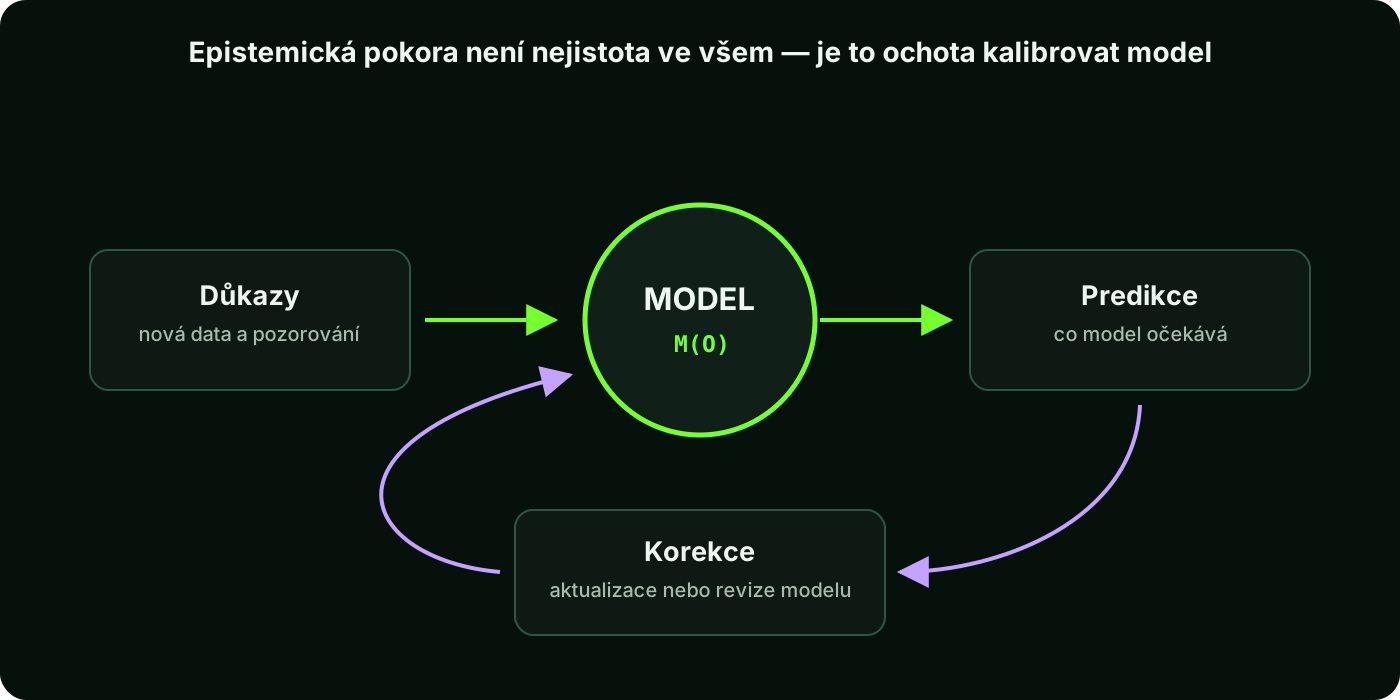
Current psychological literature defines intellectual humility in different ways, but a common element is the metacognitive ability to recognize the limits of your own beliefs and the possibility of your own error. The Overview of Porter and colleagues highlights this particular component, while pointing out that there are more measurement approaches and the concept is not one-dimensional. Porter et al., 2022.
So, epistemic humility does not mean that all models are equally good or that an expert must pretend to be insecure where there is robust evidence. It means something more precise: to distinguish the power of the model from its own identity. It is possible to say 'this model is the best yet, because it explains more data', and at the same time 'if new data disproves the model, I will change it'.
The opinions and West showed that the disposition of actively open thinking contributed to the assessment of arguments, regardless of previous beliefs, beyond the cognitive capacity itself. & West, 1997.
23. Working with uncertainty: the power of opinion should correspond to the power of registration
Epistemic humility is the most understandable when we consider it not personality modesty, but a calibration of certainty. Some conclusions are based on direct measurement, others on several independent indirect indicators, and others are merely a work hypothesis. Talking about everyone with the same certainty is throwing away an important part of the information.
Virtually, the conviction can be seen as a range. "It's possible," "it's likely," "the evidence is strong," and "it's directly documented" are not stylistic variations of one sentence. They express different epistemic states. A good analyst should be able to say not only what he thinks, but also how much he believes it and what his level of certainty would change.
That's a big point in disputes. Two people may have the opposite views, but after a transfer to probability language, one says "70% for X" and the other says "55% for non-X." The difference is much smaller than rhetorical "X is true" versus "X is nonsense." The language of absolute claims often artificially polarizes continuous uncertainty.
The same principle protects an expert from his own competence. One can have a very strong model in one area, but enter a new domain where his usual heuristics do not have the same reliability. Calibration means transferring confidence only where evidence and real expertise go.
In the block model, this idea can be expressed simply: Observer A can be almost perfectly sure that its projection has a ratio of 1: 2, but it should be much less certain that the whole object has only two dimensions. The certainty must relate to a precisely defined claim, not to an indefinite sense of 'I see it right'.
24. Observer D: ability to integrate projections
Add to the quadruple D. He doesn't necessarily see the truth directly. Its advantage is different: it can bypass the object or get statements A, B and C and create a model in which their seemingly contradictory projections become compatible.
D is not looking for "which rectangle wins," but O such that P _ A (O), P _ B (O), P _ C (O) corresponds to observations.This is a form of metaview. For complex problems, the highest intellectual performance may not be quickly chosen by one side, but recognize, what higher model explains why different competent observers have come to different local conclusions.
But D is not outside the system. It has its own limitations, resource selection and assumptions. Therefore, the metamodel must be tested. "I understand all perspectives" can become another form of overconfidence if the observer does not have a correction mechanism.
25. Institutions as multiple observer systems
At the level of organisations, the problem is multiplied. The company, the Ministry or the State have neither retina nor brain. The information is collected by various services with different objectives, professional culture and access to data. The resulting "opinion of the institution" is often an aggregate, compromise or decision-making power-dominant part of the system.
In one company, the same project may look like a technical debt from a development point of view, from a business point of view as a key source of income, from a safety point of view as an unacceptable risk and from a customer's point of view as a functional product. All four perspectives can be supported in fact and still recommend a different approach.
Therefore, the sentence "the organization thinks X" is often a useful shortcut, but analytically, it is appropriate to ask: What part of the organization, what mandate, what data and what inputs?
26. Diplomat, Minister and President: Man versus role
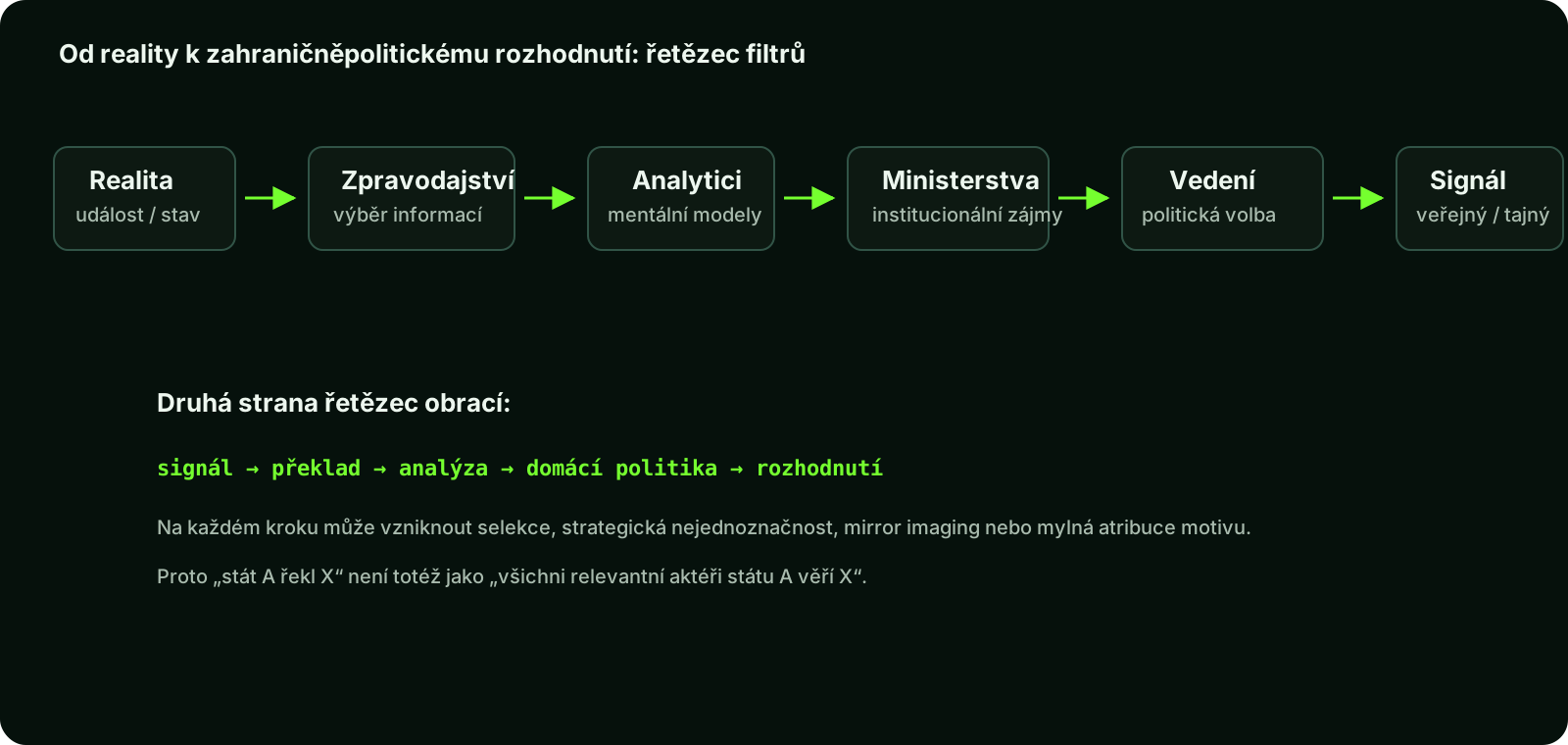
The Ambassador represents his state's official position. His personal opinion may be different, but his professional role limits what he can tell the public. The same applies to the Foreign Minister and to other extent to the Head of Government or State: everyone communicates within the institutional mandate, while also counting on domestic and foreign beneficiaries.
Therefore, diplomatic "we understand your concerns" does not automatically mean "we share your causal model and accept your request." It may be a recognition that the other side has a certain concern without accepting its interpretation of reality.
27. Mirror imaging and security dilemma
Richards Heuer v Psychology of Intelligence Analysis Highlights the risk mirror imaging: when hard evidence is missing, an analyst may unconsciously reflect his own values and logic into the thinking of a foreign actor. What seems irrational from our framework may be coherent within other assumptions, experiences and priorities. Heuer, 1999.
Robert Jervis showed another mechanism: security dilemma. The means by which one state increases its security may reduce the sense of security in another State. It answers with its own weapons or alliances, which the first state interprets as confirmation of the original threat. This can also result in a spiral interaction among actors whose primary objectives are not initially offensive. Jervis, 1978.
The spectrum of perspectives is turning into a dynamic system: observers not only monitor the object, but also change it with their reactions.
28. Two- level games and home audience
Robert Putnam described international negotiations as two-level game: the representative of the State negotiates simultaneously with the foreign partner and with the domestic actors he needs support for ratification or political survival. The 'I cannot accept this' statement can therefore mean 'I would personally accept the compromise, but I cannot enforce it at home'. Putnam, 1988.
The theory of the audit of the costs of James Fearon also models situations in which public escalation can increase the domestic costs of a later retreat. It is a theoretical model with a large-scale debate; but the concept itself illustrates that the public diplomatic signal has more beneficiaries and more functions than a normal private sentence. Fearon, 1994.
29. Same facts, different causal models
Two actors may have the same dataset and yet come to the opposite conclusion, because the dispute lies not in the data but in the causal structure. "State X has increased the military budget" is observation. Interpretation can be: preparing aggression; responding to the threat; compensating for outdated technology; military bureaucracy has pushed for a budget; the government signals the commitment of a third player; or it is mostly domestic policy.
The task of an analyst is not to choose the most dramatic explanation, but to compare which hypothesis best predicts other observable characters and what evidence would distinguish it from competing models. For this reason, Heuer recommends explicit work with alternative hypotheses instead of automatically confirming the first framework.
30. If it's not a misunderstanding, it's a conflict of interest.
Psychologisation has a limit. Some disputes are not the result of misunderstanding. And he wants X, B wants Y, and X with Y can't be maximized simultaneously. Two states can perfectly understand the strategic value of the same territory precisely because they compete for it. Two people can understand the exact cost-benefit distribution, but each one prefers a different distribution.
This is why the analysis must always distinguish first: non-compliance with the facts, model non-compliance, value non-compliance or non-compliance with the allocation of resources?
31. Practical method: how to reconstruct the O object
A spectrum of perspectives can be converted into a simple analytical procedure. It's not an algorithm that guarantees the truth, it's a discipline that reduces the risk of a projection for an object.
| Step | Question | What are we testing? |
|---|---|---|
| 1 | What is really observation and what is interpretation? | Unit P from I |
| 2 | From what position and through which channel was the observation obtained? | Projection limitation |
| 3 | Which data has a second observer that I don't have? | Information asymmetry |
| 4 | Do we use the same words in the same sense? | semantic compatibility |
| 5 | What kind of causal model links facts to the conclusion? | Hidden intermediate steps |
| 6 | What other models explain the same data? | alternative hypotheses |
| 7 | What would disprove my model? | falsification and calibration |
| 8 | Is a public statement really a private preference? | Social and strategic initiatives |
| 9 | Is this a dispute about truth or interest / status? | the purpose of the conflict |
| 10 | Can I describe the perspective of the other side so that it can be accepted as fair? | quality of the model of the second actor |
| 11 | What part of the security do I add and what do they provide? | epistemic humility |
| 12 | What new measurement would the most narrow the scope of possible O? | information value of the next step |
The last question is particularly important. More data is not automatically better if they only repeat the same projection. The largest information value can have a new perspective that distinguishes between two competing models.
32. How the dispute changes according to the type of problem
One of the practical consequences of the study is that there is no single universal "better way of communicating." First, we need to figure out what kind of disagreement we're dealing with. Only then can you choose the tool.
| Type of non-conformity | What typically helps | What often doesn't help |
|---|---|---|
| Other data | share resources, measurement and origin information | repeat the conclusion louder |
| Other meaning of terms | operationalize terms, give examples | arguing about the same word with different definitions |
| Other causal model | list intermediate steps, prediction and alternative hypotheses | add additional data that do not distinguish models |
| Missing expertise | build the necessary foundations, show the structure of knowledge | assume that one technical term replaces several years of context |
| Conformities / social pressure | safe space for disagreement, anonymous posture collection | publicly require immediate consent |
| Statutory conflict | separate the correction of the claim from the humiliation of the person | winning rhetoric and public cornering |
| Conflict of values | name values and trade- offy | pretend it's just technical facts |
| Conflict of interest | negotiating, compensation, rules and power arrangements | endless explanation of why the other side has "understand" |
| Strategic deceiving | verifiable commitments, independent verifications, advertisements | rely on a declaration of goodwill |
This is also the answer to the frequent frustration of analytically oriented people. If the real problem is social, status or interest, further factual arguments can have almost zero effect. Not because the facts are worthless, but because a variable is being solved other than the argument that is aimed at.
Recognition of the type of dispute also helps to distinguish between a situation where it makes sense to continue from a situation where it is rational to end a conversation. If both sides want to specify the O model, you can look for better data. If one party merely maximizes or intentionally deceives status, information discussions do not solve the problem in themselves.
33. Model limits and typical errors
Error 1: "All have a part of the truth"
Sometimes, no. Some statements are simply incorrect or incompatible with the evidence.
Error 2: "Expert has the whole object"
The expert may have a wider model, but remains an observer with domain and information limits.
Error 3: "Higher IQ = Higher Rationality"
Cognitive ability and disposition for open, non-confirmatory reasoning are not the same constructions.
Error 4: "Inconsent = Misunderstanding"
The second model can understand exactly and yet reject it for other values or interests.
Error 5: "Silence = Consent"
A public signal may be an adaptation to social costs, hierarchy or fatigue.
Error 6: "Meta-view = neutrality"
Even those who integrate more perspectives can selectively choose which perspectives they consider legitimate.
Ironically, the biggest risk of the model is its success: one can start to think that it is he who is the "observer D" who sees all the others from the outside. Therefore, the metamodel must include a permanent possibility that there is another observer E with a relevant dimension that D has overlooked.
34. Synthesis: Understand the projection without losing reality
The problem of human misunderstanding cannot be reduced to the difference between intelligence. Sometimes the real source is the different quality of knowledge. Other times the different purpose of conversation, social pressure, status, strategic behavior or a different causal model. In international relations, institutions, domestic policy and security interactions join in, so a long filter chain is created from a simple "A said B".
A spectrum of perspectives gives these mechanisms a common language. Object O represents reality. PBH (O) projection is available. IBOR is an interpretation created by a mental model. SET is what is finally said. And the recipient of this signal creates another interpretation. A mistake can occur at any step - but also information that another observer does not have.
At the same time, however, the second sentence applies: not every projection is compatible with the object. Epistemic humility is not a resignation to the truth. It is a more accurate way to approach it: separate observations from interpretation, test competing models, actively search for your own blind spot and keep the level of certainty relative to the quality of the evidence.
American Power, Hegemonic Space and Repeating Patterns of Foreign Policy →
Resources and further reading
Expertise, knowledge and explanation
Metacogical, rationality and bias
Conformities, public consent and private preferences
International relations, diplomacy and analytical errors
Methodological definition: "A quad of perspectives', the O → P → I → S and the term" epistemic downloads' are the author's analytical structures used in this article. They are not presented as established names of psychological theories. For Dunning-Kruger effect, the original interpretation and the latest methodological criticism and replication with a small effect are deliberately indicated.