
Hard disk (HDD): from the tonne RAMAC to 44TB HAMRs
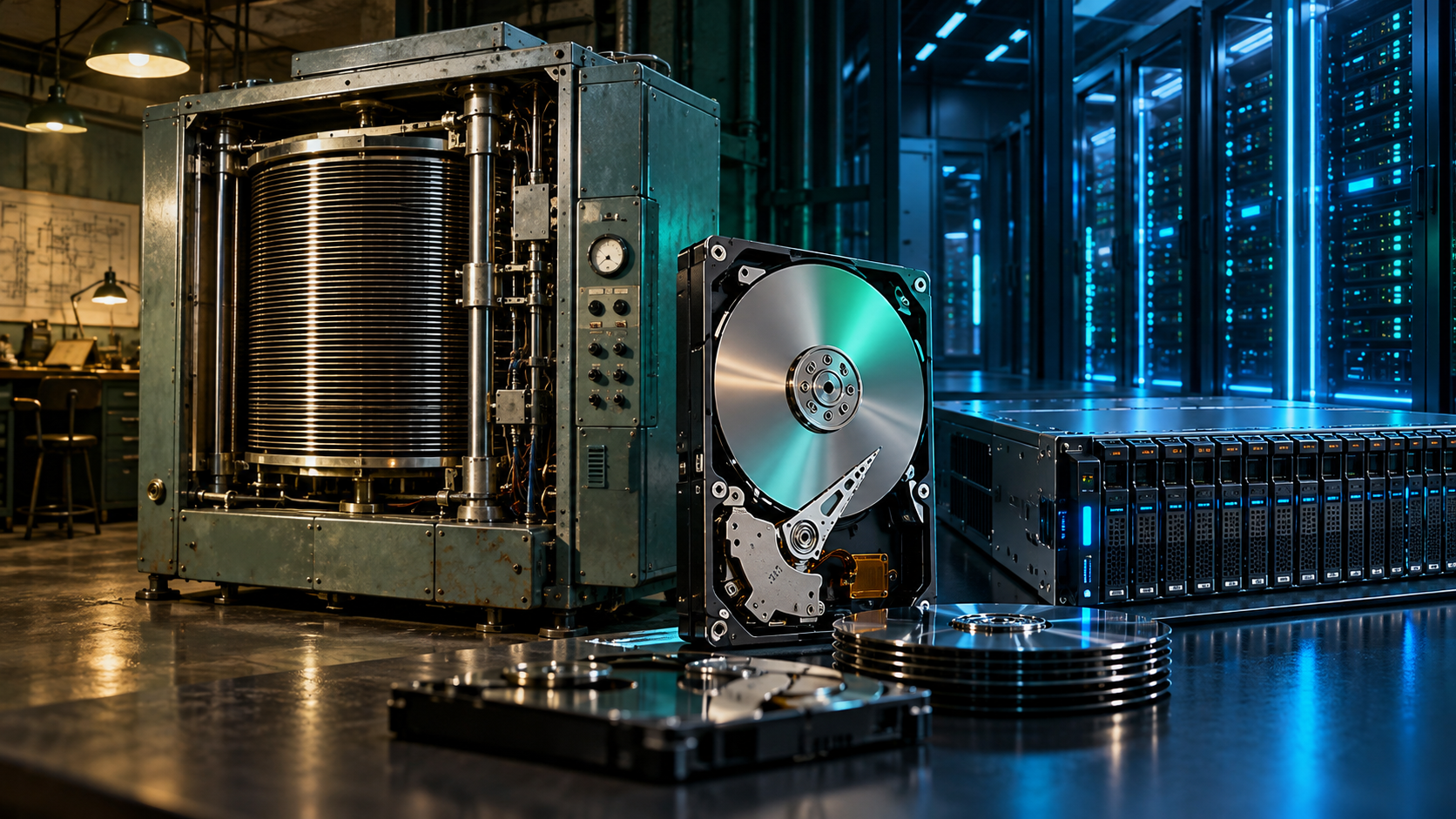
From one cabinet to an exabate datacenter
The hard drive is one of the longest-surviving basic principles of digital technology. Since 1956 the essence has not changed: data is stored magnetically on rotating solid plates and the head is moved over the desired place. But almost everything else changed - bit size, servo accuracy, media materials, head construction, signal coding, error correction, fences, disk atmosphere and the way firmware plans to write.
The first disk device weighed over a ton and saved several megabytes in order. Modern 3,5 ″ HDD enterpriseweighs about three quarters of a kilogram and contains dozens of terabytes. The capacity did not increase because the fence was increasing - on the contrary it decreased - but because it increased dramatically the area density of the record.
1956 - IBM 350 RAMAC: the beginning of a random approach
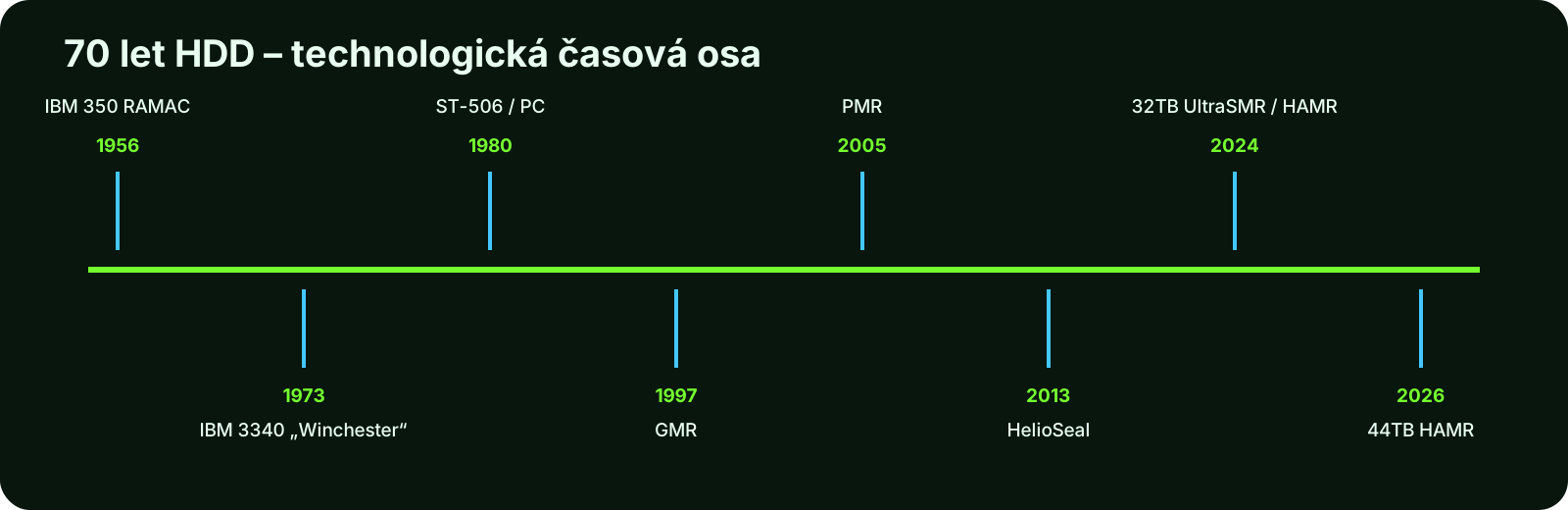
The symbolic beginning of commercial HDD is considered to be: IBM 350 Disk Storage Unit, part of IBM 305 RAMAC. IBM system announced September 1956. Inside, there were 50 fences with a diameter of 24 inches which rotated approximately 1,200 rpm. Capacity was 5 million characters; today's conversion usually gives about 3.75 MB according to the way the encoding was interpreted.
The value of RAMAC was not only in the volume of data. Brought random access: servo-controlled arm could move a pair of heads to the desired track without sequential rewinding of the media. The average approach was about hundreds of milliseconds. Today's HDD has access in milliseconds, but the principle of "find a clue, wait for rotation, read the sector" remained.
Historical sources show different prices according to configuration. The Computer History Museum for the disk mechanism itself lists about $3,200 per month or $45,000 purchase price; another historical record indicates a lower monthly lease for a specific configuration. It is therefore not appropriate to present a single number without context.
60. and 70. years - disk pack, servo and "Winchester"
60. years of exchange disk links have been passed. The user could remove the whole pack of the fence and replace others - it was practically a giant exchange carrier. The construction quickly shifted from heavy pneumatic mechanisms to more accurate actuators and higher density of tracks.
IBM 3340, 1973, was a major milestone, associated with the designation Winchester. The drive brought a more cosy head- drive with the assembly and heads working very close to the surface. The name "Winchester" became synonymous with hard drive in a number of countries, including the Eastern Block, for many years.
Key changes were made inside the servo-control. The narrower the tracks, the less mechanical it took to aim them according to the rough position. The disk needed to write and read its own servo information, which was used to regulate the position of the actuator in a closed loop.
1980- 1990 - miniaturization and entry to PC
The year 1980 is connected to Seagate ST-506: 5,25 ″ HDD with a capacity of 5 MB and a price of around $1,500. It was physically compatible with 5.25 ″ mechanical shaft and became the basis of the first PC hard drives. The subsequent models used similar interfaces and codes of MFM or RLL.
Important historical correction: the first 3,5 ″ HDD did not bring IBM in 1987. Computer History Museum attaches the first commercial 3,5 ″ disk to the company We're having a baby in 1983.. In 1988 PrairieTek introduced the first 2.5 ″ HDD, which was a key step for laptops.
Miniaturization has brought a surprising advantage: the smaller fence has a lower circumference speed and a lower inertia moment, so a more compact and robust mechanism can be constructed. The producers therefore gradually left the 8 ″ and 5,25 ″ class in favour of 3,5 ″ for desktops / servers and 2,5 ″ for mobile devices.
Interface: from ST-506 and SCSI to IDE, SATA and SAS
Old drives were not "intelligent devices" in the sense of today. The ST-506 interface was transmitted by low-level signals and a large part of the controller was on a separate card. The SCSI has moved more intelligence into the device and has offered advanced commands, queues and support for more peripherals.
IDE/ATA integrated the controller directly into the disk - from there Integrated Drive Electronics. PATA used a parallel 40 / 80-vein cable. Since the beginning of 2000, it has been gradually replaced by SATAwhich simplified cabling, increased signal speed and brought functions like NCQ. The server world also uses SASwhich follows on to SCSI and supports dual ports, extensive topology and enterprisesmanagement.
It is important to distinguish Interface speed and Drive speed. SATA 6 Gb / s theoretically transmits much more than normal HDD can sequentially read. The modern HDD is therefore mostly limited by the media, head and mechanics, not by the SATA line itself.
Modern HDD Anatomy
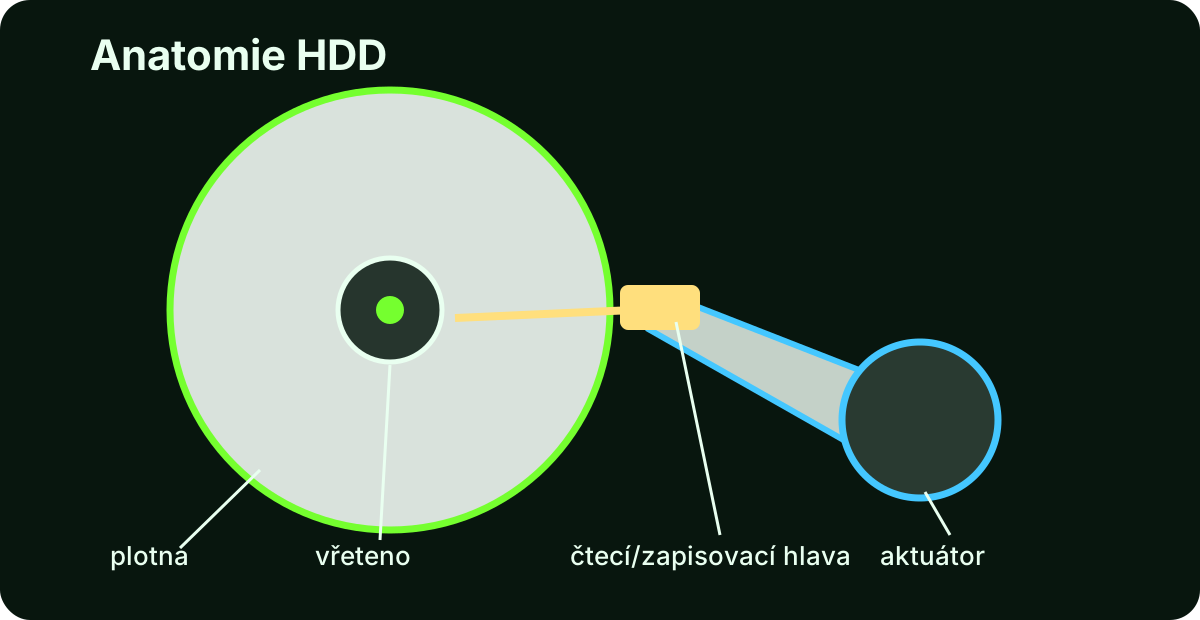
Plates are usually made of aluminium or glass base with many layers applied: adhesive, background, magnetic, protective and extremely thin lubricant. Spinach with fluid- dynamic beaming, holding very stable speed. Voice-coil actuator moves shoulders with heads similar to the principle as the speaker coil.
At the end of the shoulder is slider with a reading and writing element. When the stove is turned, the gas is generated by aerodynamic air bearing, so the slider "flies" nanometers above the surface. The pre-amplifier is often directly inside the HDA near the head, because the signal from the reading sensor is very weak.
The external PCB contains a controller, memory / cache, motor driver, SATA / SAS interface and firmware. Some adaptive data may be specific to specific mechanics; therefore, for some repairs it is not enough to simply replace the plate with the same looking piece.
Track, sector, top hat, servo and 4K sectors
They're focused on the surface of the stove. tracks. Traditionally, the trail is divided into sectors. Historical drives worked with the physical sectors 512 B. Modern Advanced Format has switched to physical 4KiB sectors because a larger block allows for more efficient ECC and smaller synchronization and identification fields.
For drives marked 512e, the physical sector is 4 KiB, but the interface emulates eight 512B logical sectors for compatibility. 4Kn exhibits 4KiB logical sectors directly. Incorrect alignment of the partition at 4K border can cause read-modify-write penalization.
Modern HDD no longer shows the host the real CHS coordinates. The operating system uses the LBA. Firmware itself maps LBA on physical geometry, manages reserve sectors, zoned bit recording, servo areas and error correction.
How HDD physically writes and reads
Minutes
The writing part of the head is a miniature electromagnet. The current in the winding creates a flow in the magnetic pole and its field is overlapping small areas of the record layer. Data are not in the simple sense of "one domain = one zero or one; real channel uses transitions coding, PRML / NPML and sophisticated detection algorithms. However, for the purpose of understanding the bit area can be seen as a stable magnetic state.
Řadič → write channel → proud v zapisovací cívce → magnetický tok v pólu → změna magnetizace média
Reading
The reading sensor uses magnetoresistance. The surrounding magnetic field converts electrical resistance of a multi-layer structure; the pre-amplifier and the read channel convert very small analog changes into digital symbols. The following are the equalization, detection and ECC.
Magnetické přechody → MR/GMR/TMR senzor → změna odporu → analogový signál → read channel → ECC → data
Therefore, the modern head actually contains a separate entry and reading element: optimal physics for generating a strong field is different from physics for sensitive measurement of a weak field.
MR, GMR and TMR - Revolution of Reading Heads
Induction reading heads stopped at increasing density. Magnetic resisting sensors have enabled you to read smaller and weaker magnetic areas. Second half of 90. Flight has been implemented in HDD GMR - Giant Magnetoresistance. IBM was one of the first to get GMR into mass production of HDD in 1997.
GMR uses multiple thin magnetic and non-magnetic layers, the resistance of which depends on the relative arrangement of magnetization. Albert Fert and Peter Grünberg won the Nobel Prize for Physics in 2007 for the basic discovery of GMR. The commercial significance was huge: a more sensitive head allowed the read track to be reduced and the density to be soared.
The next step is to TMR - Tunnel Magnetoresistance, where the current tunnels through a very thin insulating barrier. Today, TMR is the basis of extremely sensitive reading elements of modern HDDs.
Superparamagnetic limit and magnetic "trilemes"
Capacity cannot be increased by simply reducing magnetic grains indefinitely. Too small magnetic volume has a low energy barrier and heat movement can reverse magnetization over time. That's a superparamagnetic problem.
Developers deal with three conflicting requirements: thermal stability requires high magnetic anisotropy; Recording requires the available head field to be able to repolate the medium; Readability / SNR In turn, it requires a strong enough and clean signal. This trilemy is directly produced by PMR, HAMR and MAMR.
PMR - magnetic writing
Older LMR recorded magnetization mainly in the plane of the stove. PMR (Perpendical Magnetic Recording) Orients magnetisation predominantly perpendicular to the surface and uses a soft magnetic background layer that closes the magnetic flow of the writing pole. The result is a stronger local field and better stability of smaller bits.
Toshiba announced the first PMR products on the 1.8 ″ platform for 2005. Within a few years, PMR has become the standard of virtually all high capacity HDDs. In common terminology, the label is often used today CMR for conventional independent tracks and modulation from SMRs; but physically modern CMR drives still use perpendicular writing.
Helium - why manufacturers closed the disk as a pressure vessel
With multiple plates, aerodynamic friction and turbulence grow. Helium is significantly thinner than air, so rotating plates give less resistance. This reduces power consumption of the engine, heating and unwanted forces on slider and stove.
HGST commercialized technology HelioSeal in enterprisedisks in 2013. The hermetic housing allowed more thin fences to fit into the same 3.5 ″ height. Helium has gradually become a common part of high-capacity nearline drives.
Helium HDD is not "filled once and forever without leakage 'in absolute terms; the manufacturer must design extremely low permeation of connections and passages. Some models also have a diagnostic attribute associated with the helium state, but its interpretation is vendor-specific.
SMRs and UltraSMR - shingles writing
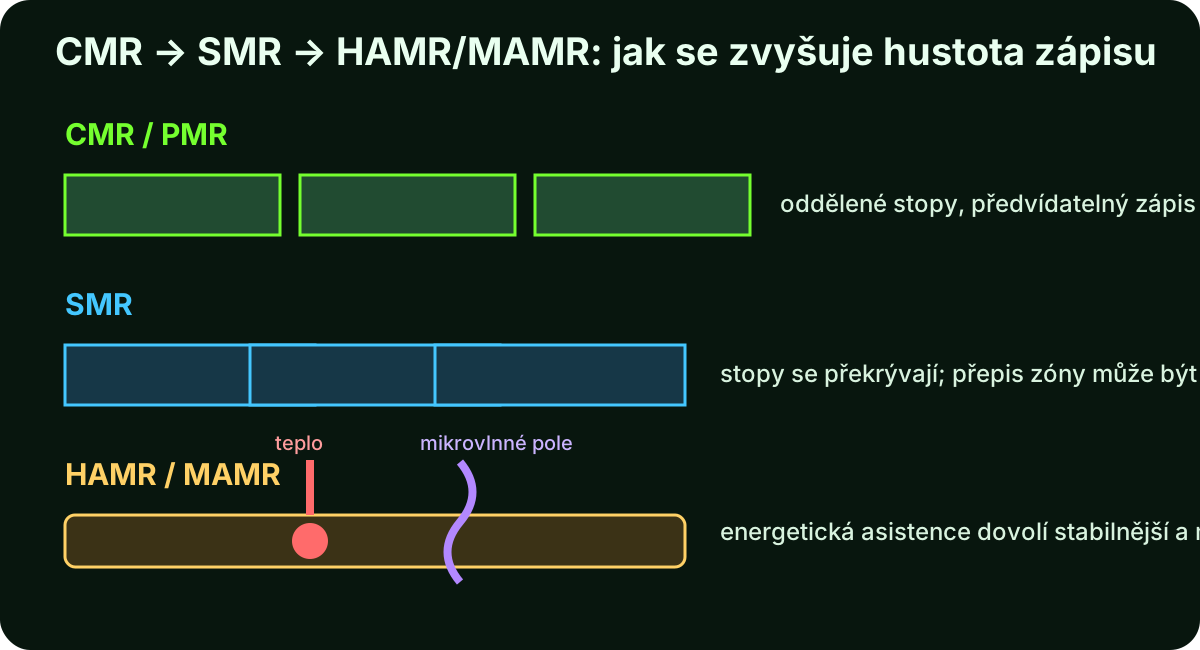
The writing pole is wider than the reading sensor. SMRs use this: the new track partially covers the edge of the previous track, like roof tiles. The reader's head still reads a narrow, uncovered stripe, so you can increase the number of feet per inch.
The price for this density is write amplification. If you need to change the track in the middle of the shingles zone, you can't just rewrite it because writing would damage the subsequent overlay tracks. Firmware must group the data and rewrite the larger whole.
Three main SMRs
- Drive-managed SMR: The host sees a common block disk; complexity hides firmware and media cache.
- Host-aware SMRs: The disk can handle normal commands, but the guest can optimize writing by zones.
- Host-managed SMR: the software must respect the sequential rules of the zones; suitable for specialised cloud systems.
For consumer drive-management SMR, sequential copy on empty disk may look quite normal. The problem will occur after filling the CMR cache or in random overwriting, where the permeability can fall by up to two. Therefore, the type of record is important when selecting a disk for RAID rebuild, database or active work dataset.
UltrasmR Western Digital combines very tight track pick, ePMR, advanced error correction, firmware and other techniques. In 2024 WD introduced 32TB UltrasmR enterprise disk with 11 padding and with 26TB CMR / ePMR variant. In 2026, the 40TB UltrasmR ePMR reported as a qualifying roadmap, not a widely available mainstream.
HAMR - Heat- Aided Magnetic Recording
HAMRs solves the triloma by using a medium with high magnetic anisotropy, which is very stable at normal temperature, but is heated locally during writing. Koervivitis will drop sharply and the available field of the writing head may be repolated by the bit. After cooling, high stability returns.
The laser is integrated into the head; and NFT - near- field transducerwhich concentrates optical energy into the area of tens of nanometers. The temperature of the entry area is hundreds of degrees Celsius, often reported around 400-500 degrees Celsius, but the heated volume is extremely small and the time in the nanosecond area.
The technologically demanding HAMRs are not just "laser endurance or endurance." The life of NFT, the protection surface tribology, temperature profile repeatability, temperature position accuracy of the heat hotspot against the writing pole, material structure of the media and interaction of adjacent tracks are being addressed.
In 2026 Seagate announced the production qualification of the second generation of the Mozaic 4 + platform with more than 4 TB on the stove and capacities up to 44 TB at hyperscale customers. This is an important point: HAMRs are no longer just laboratory demonstrations, but manufacturing technologies.
MAMR, ePMR and Western Digital Path
MAMR - Microwave-Asisted Magnetic Recording Using high-frequency magnetic system excitation to reduce the required entry field. The classic concept is used by the spin- torque oscillator, which creates a microwave field in the GHz area and twinkle magnetic moments of the media.
The market development is more complex than the simple division "Seagate = HAMRs, WD = MAMR." Western Digital introduced ePMR - energy- assisted PMRfor which the electrical current in the head helps improve the writing process. ePMR is used in today's CMR and UltrasmR products. MAMR remains part of a wider research and technology portfolio.
Therefore, it is appropriate to read the datasheet for a specific disk, not derive physics from the whole brand marketing generation.
Capacity milestones: how several MB has turned into tens of TB
| Year / period | Typical milestone | What enabled him |
|---|---|---|
| 1956 | IBM 350: ~ 3,75 MB | First practical random-access drive. |
| 1980 | 5 MB in 5.25 ″ | Miniaturization, ferrite heads, PC form factor. |
| 1990 | Hundreds MB | IDE / SCSI, thin-haired heads and media. |
| 1991–1997 | GB class | MR and GMR heads, better read channel. |
| 2005–2007 | Hundreds GB → 1 TB | PMR, higher areal density. |
| 2013–2016 | 6- 12 TB | Helium, more fences, SMRs. |
| 2020–2023 | 18-24 TB | ePMR / CMR, 9-10 + fotene, OptiNAND / firmware. |
| 2024–2026 | 32TB UltrasmR; HAMR to 44 TB | 11 ploten, ePMR / UltrasmR and HAMR4TB + on the stove. |
Interactive chart: capacity development and prices per 1 GB
The green curve shows a representative maximum capacity, blue indicative nominal price for 1 GB. Both vertical axes are logarithmic. The chart uses a clean JavaScript without external libraries and works offline.
Important: the historical HDD price series are not a single stock exchange index. The graph therefore uses logarithmic interpolation only to illustrate the trend; the table below distinguishes this.
Development after individual years 1980- 2026
| Year | Representative capacity / maximum | Indicative price | Data type | Milestone |
|---|---|---|---|---|
| 1980 | 5 MB | $213 000 / GB | documented / anchor point; source point | Seagate ST-506: 5 MB, 5.25 ″ - HDD is entering microcomputers. |
| 1981 | 10 MB | $295 000 / GB | documented / anchor point; source point | |
| 1982 | 13 MB | $260 000 / GB | log. interpolation; source point | |
| 1983 | 16 MB | $175 000 / GB | log. interpolation; source point | Rodito RO352 - first commercial 3,5 ″ HDD. |
| 1984 | 20 MB | $160,000 / GB | documented / anchor point; source point | |
| 1985 | 32 MB | $88 234 / GB | log. interpolation; log. interpolation | |
| 1986 | 51 MB | $48 658 / GB | log. interpolation; log. interpolation | |
| 1987 | 82 MB | $26 833 / GB | log. interpolation; log. interpolation | |
| 1988 | 132 MB | $14797 / GB | log. interpolation; log. interpolation | PrairieTek 220 - first 2.5 ″ HDD, important for laptops. |
| 1989 | 212 MB | $8 160 / GB | log. interpolation; log. interpolation | |
| 1990 | 340 MB | $4,500 / GB | documented / anchor point; source point | |
| 1991 | 677 MB | $3 224 / GB | The number of the vehicle type to be tested shall be the number of the vehicle type approved. interpolation | MR heads and rapid growth of surface density. |
| 1992 | 1 GB | $2 310 / GB | log. interpolation; log. interpolation | |
| 1993 | 2 GB | $1,656 / GB | The number of the vehicle type to be tested shall be the number of the vehicle type approved. interpolation | |
| 1994 | 2 GB | $1 186 / GB | log. interpolation; log. interpolation | |
| 1995 | 4 GB | $850.00 / GB | documented / anchor point; source point | |
| 1996 | 8 GB | $324.57 / GB | log. interpolation; log. interpolation | |
| 1997 | 17 GB | $123.93 / GB | The number of the vehicle type to be tested shall be the number of the vehicle type approved. interpolation | IBM lists GMR heads in serial HDDs. |
| 1998 | 26 GB | $47.32 / GB | log. interpolation; log. interpolation | |
| 1999 | 41 GB | $18.07 / GB | log. interpolation; log. interpolation | |
| 2000 | 64 GB | $6.90 / GB | log. interpolation; source point | |
| 2001 | 100 GB | $4.11 / GB | The number of the vehicle type to be tested shall be the number of the vehicle type approved. interpolation | |
| 2002 | 150 GB | $2.45 / GB | log. interpolation; log. interpolation | |
| 2003 | 224 GB | $1.46 / GB | log. interpolation; log. interpolation | SATA starts replacing PATA in common PC. |
| 2004 | 334 GB | $0.872 / GB | log. interpolation; log. interpolation | |
| 2005 | 500 GB | $0.520 / GB | documented / anchor point; source point | Toshiba is starting the commercial PMR era. |
| 2006 | 707 GB | $0.378 / GB | log. interpolation; log. interpolation | |
| 2007 | 1 TB | $0.275 / GB | The number of the vehicle type to be tested shall be the number of the vehicle type approved. interpolation | 1 TB in a single 3,5 ″ disk. |
| 2008 | 2 TB | $0.200 / GB | documented / anchor point; source point | |
| 2009 | 2 TB | $0.110 / GB | The number of the vehicle type to be tested shall be the number of the vehicle type approved. interpolation | |
| 2010 | 3 TB | $0.060 / GB | documented / anchor point; source point | |
| 2011 | 4 TB | $0.060 / GB | The number of the vehicle type to be tested shall be the number of the vehicle type approved. interpolation | Flood in Thailand - global failure of production and price jump. |
| 2012 | 5 TB | $0.060 / GB | log. interpolation; source point | |
| 2013 | 6 TB | $0.052 / GB | The number of the vehicle type to be tested shall be the number of the vehicle type approved. interpolation | HGST HelioSeal - commercial helium enterprise HDD. |
| 2014 | 8 TB | $0.046 / GB | The number of the vehicle type to be tested shall be the number of the vehicle type approved. interpolation | 8TB class, more pronounced SMRs and helium expansion. |
| 2015 | 10 TB | $0.040 / GB | documented / anchor point; source point | |
| 2016 | 12 TB | $0.038 / GB | The number of the vehicle type to be tested shall be the number of the vehicle type approved. interpolation | |
| 2017 | 14 TB | $0.037 / GB | The number of the vehicle type to be tested shall be the number of the vehicle type approved. interpolation | |
| 2018 | 15 TB | $0.035 / GB | log. interpolation; source point | |
| 2019 | 16 TB | $0.037 / GB | The number of the vehicle type to be tested shall be the number of the vehicle type approved. interpolation | |
| 2020 | 18 TB | $0.040 / GB | documented / anchor point; source point | 18TB nearline enterprise. |
| 2021 | 20 TB | $0.028 / GB | The number of the vehicle type to be tested shall be the number of the vehicle type approved. interpolation | 20TB class. |
| 2022 | 22 TB | $0.019 / GB | documented / anchor point; source point | |
| 2023 | 24 TB | $0.015 / GB | documented / anchor point; source point | 24TB CMR enterprise. |
| 2024 | 32 TB | $0.014 / GB | The number of the vehicle type to be tested shall be the number of the vehicle type approved. interpolation | 32TB UltrasmR / ePMR for WD; HAMR enters a large deployment. |
| 2025 | 36 TB | $0.013 / GB | documented / anchor point; source point | |
| 2026 | 44 TB | $0.018 / GB | documented / anchor point; source point | Seagate Mozaic 4 + - up to 44 TB qualified in hyperscanners. |
ČSSR and Czech Republic - availability and prices
Direct price comparison in CSSR and CR is more difficult than the world's technological axis. Before 1989, there was no open retail market for western PC components. Disks appeared in businesses, research, computing centres and imported systems; therefore, the price of a separate HDD was often not "a cost for the citizen."
After 1990, the situation changes very quickly. In the first years, HDD could represent a significant part of the price of the whole PC. In 90. The cost of MB was falling sharply over the years, while capacity grew from tens of MB to hundreds of MB and GB units. At the turn of the millennium, tens of GB, hundreds of GB in the mid-2000s and since the end of the decade terabytes become the standard.
| Year | Published Czech Point / Indicative Market Context | Note |
|---|---|---|
| 1990 | PC sets with 20MB HDD in order tens of thousands of Kcs; upgrade 20 → 40 MB several thousand Kcs. | HDD is a luxury and expensive part of the routine. |
| 1995 | WD 1 GB Fast ATA-2 about 7808 CZK in preserved price list. | 1 GB becomes an achievable high-end capacity. |
| 1996 | WD 850 MB about CZK 6,832 in the period price list. | Strong year-on-year drop in the price per MB. |
| 2000 | 4- 13 GB typically several thousand CZK. | Dozens of GB's are moving fast to the mainstream. |
| 2004 | 80GB HDD under CZK 2000 without VAT in period price lists. | Capacity ceases to be a luxury item. |
| 2010 | 500GB-1TB class around low thousands of CZK. | Before the flood price shock. |
| 2011–2012 | Temporary multiple price of some models. | Flood in Thailand and lack of mechanics / components. |
| 2019 | 1TB around ~ 1000 CZK and 2TB around ~ 2,000 CZK in public supplies. | The order of the units of the Czech crowns to the crown of the GB. |
| 2026 | Consumer 2- 8TB drives are commonly used in the order of units of 1000 CZK; enterprising 20TB + significantly higher. | The TB price remains the main advantage of HDD versus SSD. |
For pre-revolutionary prices in Kčs, there is no sufficiently consistent retail price list available for many years. The exact figures are therefore only given where they can be supported by a specific period or archive source; other data serve as a historical context.
2011 - Thai floods and global market shock HDD
Thailand was one of the most important centres of HDD production and their components. The floods flooded industrial zones in the second half of 2011, interrupted the production of discs, motors, heads, actuators and supply chains. The result was a sharp drop in supply and a jump in retail and OEM prices.
But it is inaccurate to say that the floods themselves "caused the creation of a large troika." The consolidation was already underway: Western Digital announced the takeover of HGST and Seagate the takeover of the Samsung HDD division in 2011, still in the context of a long-term merger of the market. But the flood has intensified the supply crisis and shown the vulnerability of a geographically concentrated chain.
Long-term consequences
- OEM producers have started to deal more with long-term contracts and diversification of supply.
- The price / GB ratio of HDD deteriorated dramatically for several quarters.
- The SSD has relatively approached the price and accelerated its transfer to the flash storage site in the notebooks.
- Manufacturers have more differentiated the series according to workload: desktop, NAS, surveillance, enterprise nearline.
How many producers have remained "the big three"
HDD history is also a history of consolidation. IBM sold the Hitachi disk division, created HGST, and later purchased Western Digital. Seagate has gradually acquired the Maxtor and HDD activities of Samsung. Toshiba took over part of Fujitsu's HDD business and other assets. A number of brands such as Quantum, Conner, Micropolis, Miniscribe, Rodime or Maxtor have died or been swallowed up.
In 2026, the production of classical HDDs is mainly made up of Seagate, Western Digital and Toshiba. This does not mean that each sold external disk has one of these marks per box - a range of OEM products used inside the drive of one of these manufacturers.
Reliability: MTBF, AFR, URE and physical fail mechanisms
MTBF for HDD enterprisemay be 2 to 2.5 million hours, but it is not a forecast that one disk will run for 250 years. It's a population parameter for a model of reliability under defined conditions. For practical planning is more interesting AFRbut also it depends on the model, age and operational environment.
Backblaze worked with hundreds of thousands of data HDDs in Q2 2026 statistics; the aggregated AFR population was around 1.4%, but there were large differences between models. Such a fleet cannot be mechanically converted to a home disk.
Typical physical and systemic causes
- defective or degrading sectors and failure of the ECC reserve,
- head crash or degradation of reading / writing heads,
- bearing / motor and spin-up problems,
- vibration and servo tracking errors,
- PCB, power supply or preamp failure,
- SATA / SAS line errors - often cable or backplane, not a stove,
- firmware / translation layer and internal metadata,
- In addition, new components and material interfaces for modern energy-assisted technologies.
The data available to the public so far do not allow the universal "HAMRR AFR = x%" to be said honestly against "PMR AFR = y%." The installed HAMR population is younger, more concentrated in hyperscanners and the data of individual manufacturers are not directly comparable to Backblaze. In the article we therefore separate laboratory / product specifications from real fleets statistics.
HDD vs. SSD in 2026
| Property | HDD | SSD |
|---|---|---|
| Sequential performance | ~ 150- 300 MB / s according to model and zone | Hundreds MB / s up to many GB / s |
| Random approach | Millisecond, hundreds of IOPS | Microseconds, tens of thousands to millions of IOPS |
| Price / TB | Significantly lower for large capacities | Higher but still falling |
| Capacity of one mainstream enterprise facility | Tens TB | Also tens to hundreds of TB for specialized SSD, at a different price |
| Shaking | Mechanically sensitive | Without moving parts |
| Ideal role | Nearline, archive, backup, NAS, object storage | OS, database, active dataset, VM, cache, AI hot tier |
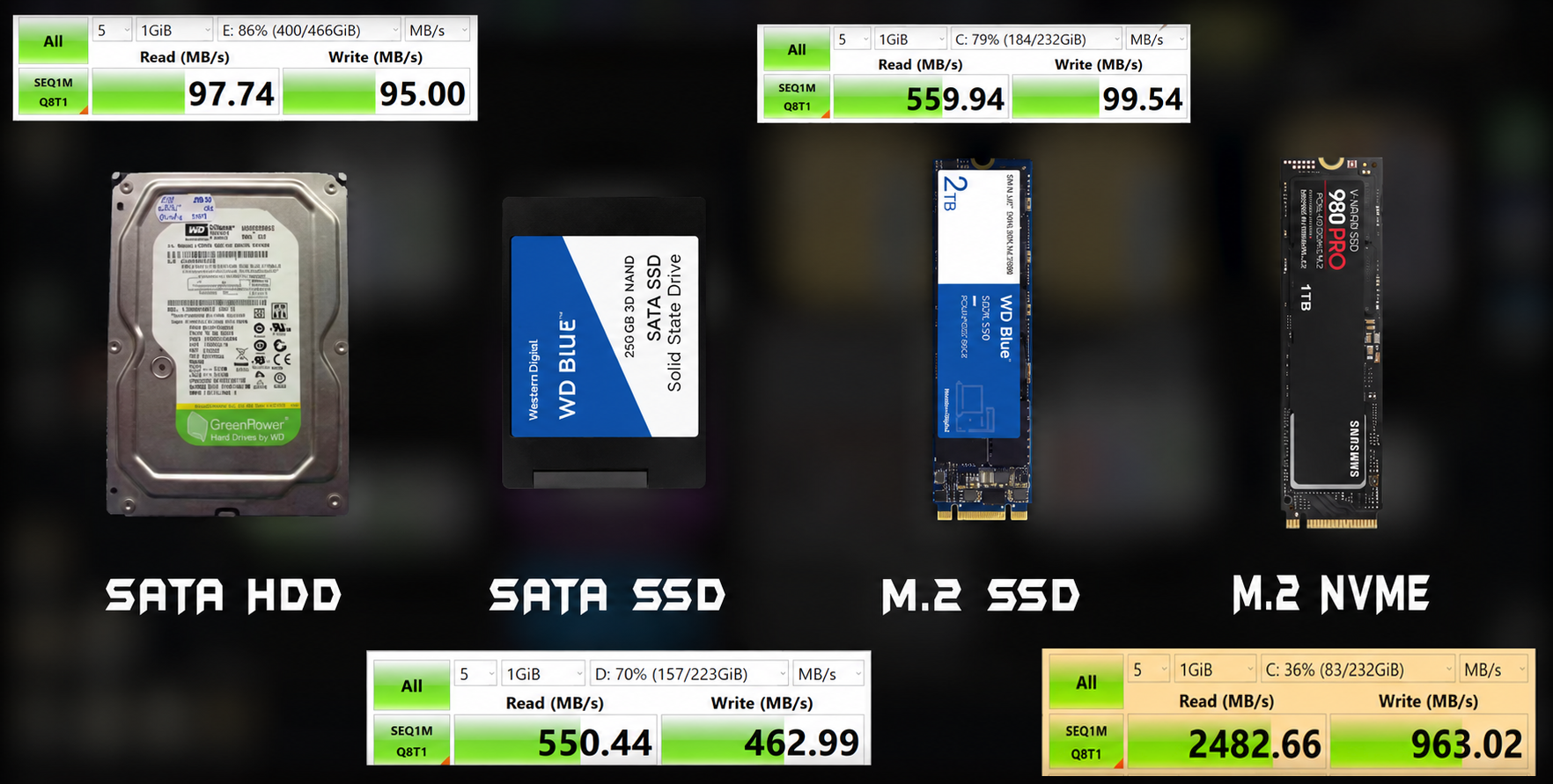
The modern datacenter therefore often does not use "HDD or SSD," but the hierarchy: flash holds hot data, HDD holds massive nearline / retention layer and the tape can remain in the coldest archive.
HDD Future: more TB on the stove, more heads and smarter firmware
Further growth may not come from just one technology. HAMR increases bit density, more fences increase physical area, SMR / UltrasmR reduces track pitch and advanced ECC allows you to work with worse SNR. Manufacturers also develop a multi- actuator architecture that can increase IOPS and sequence aggregated performance without doubling the whole mechanics.
HDD probably doesn't disappear suddenly. Rather, it will move from laptops and ordinary work PC to NAS, backups, surveillance, cloud datacenter and exabite storage, where terabyte economy is more important than microsecond latency.
Resources and further reading
- Computer History Museum - IBM 350 RAMAC
- IBM - RAMAC history
- ASME - IBM 350 engineering landmark
- Computer History Museum - ST-506 and Rodime 3,5 ″
- Computer History Museum - PrairieTek 2.5 ″
- Toshiba - first PMR products
- Western Digital - 32TB UltrasmR / 26TB CMR ePMR
- Western Digital - 2026 roadmap 32TB / 40TB qualification
- Seagate - Mozaic 4 + / 44 TB
- Backblaze - Drive States Q2 2026
- Backblaze - public HDD data for download
- Archive of the Czech PC Price List 1995
- Czech time overview of prices HDD 2004