
To Have, To Be and To Listen
From the Buddha and Erich Fromm to Universal System Theory
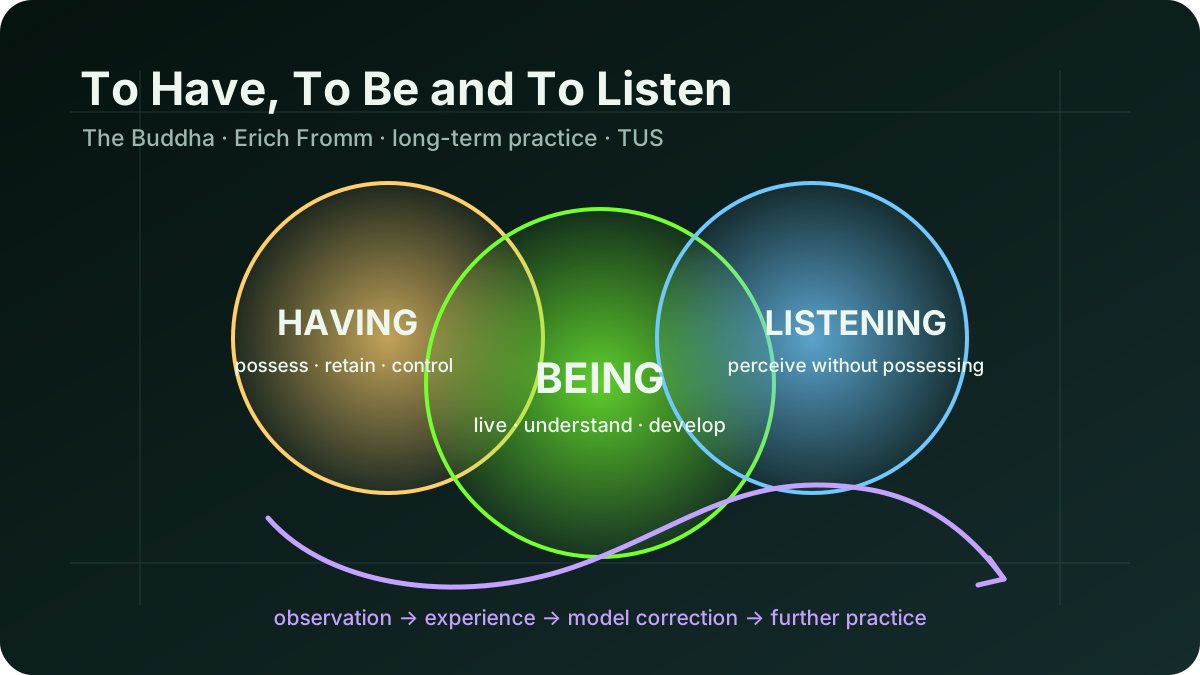
Buddhist tradition, Erich Fromm and the Theory of the Universal System are created in different times, cultures and intellectual frameworks. I don't want to make one system of them back. I am interested in something else: why some structural motives appear independently in personal experience, older traditions, humanistic psychology and later in the system language TUS.
Erich Fromm He was a psychoanalyst, a social psychologist, and a humanist. He dealt with human freedom, alienation, love, consumer society, the ability of man to truly live and the possibility of creating a healthier society.
TUS uses a different language. They talk about the system, information flows, feedback, biological interface, ego as a temporary organizational layer, information noise and ongoing calibration of man.
I experienced a similar feeling of known terrain in about 1997 while reading Buddha's Trail And then again at Fromm's.
Not because Buddha or Fromm formulate the TUS. They didn't do it. And it would not be fair to re-dress his humanistic psychology into a cosmology he never stood for.
Interesting thing is something else: there are a number of problems from a completely different side, which the TUS describes in the system language.
What does it really mean to listen? What does it mean to love a man without us owning him? Why can we have more and less and more? Why can't we just know how to live? And why does real change not begin by repairing the world around us, but by the quality of the system that we perceive in the world?
Here, various independent cuts are starting to meet: own experience, Buddhist work with the mind, Fromm's humanistic psychology and later system formulation of TUS.
1. When reading begins with recognition
I experienced a significant experience of this type in approximately 1997 while reading Buddha's Trail.
I was very happy for her. Not because I suddenly discovered a whole new way of life. A lot of the text seemed to me in a strange way known.
It felt like,
"Yes. That's exactly how I feel. "
About three quarters of what I read, for me, the basic principle was not entirely new information. I rather found very precise - and often beautifully poetic - naming something that already existed in me as an intuition, experience or way of looking.
It wasn't about finding the authority that told me what to believe. It was a recognition: I'm not the only one who sees things that way.
2. The joy of an independent convergence
When two people or two traditions come independently to similar observations, it is not automatically proof that they are right.
But it's interesting information.
If I have long-term experience of a principle and then find that something similar was formulated by a person in a completely different time and cultural environment, there is a reason to ask another question:
Why is this formula reappearing?
Maybe it's a cultural design. Perhaps a more general quality of human psyche. Maybe a deeper systemic relationship. That is only the subject of examination.
But the penetration of two independent maps is worth paying attention.
3. What was new mattered just as much
Just because I perceived a large part of the Buddhist text as a known terrain, doesn't mean he had nothing to give me.
On the contrary. The rest of the parts helped me to replenish areas I had not been concerned with, had not thought through, or felt uncertain.
The reading thus had two current functions:
- recognition and confirmation of part of the map itself,
- replenishing the places that have been missing so far.
I've accepted some elements. Others later were modified. Some of them are still open.
It's this way of working with other people's thoughts that I have remained.
4. An author is not someone to whom I surrender my judgement
I don't read to find out what to believe.
I'm reading another person as another observer of the system. He has a different experience, a different time, a different language, a different culture, and he has his own blind spots.
That's why I don't care about the question. "I agree with what?"but also:
- What does he see that I haven't seen?
- Where do we see a similar structure?
- Where do we break up and why?
- What will be added to his map by my own?
- Which part of his model could be as flawed as mine?
That's not how reading becomes taking doctrine. It becomes a dialogue between two maps.
5. Metaphor as information compression
I was also attracted to their poetry in Buddhist texts.
A metaphor is not evidence and may not be a precise technical description of reality. But it can very effectively transfer relationship structure. One image can give you an intuitive understanding of something that an analytical description would explain on several sides.
In this sense, the metaphor can be understood as a form of information compression.
That's why the metaphors use TUS: smoke, vortex, current, filter, noise, software or cache.
They're not automatic physical mechanisms. They're work paintings. After their use, it is necessary to return to the exact claim and ask:
What does the metaphor really mean and what have we added to it?
6. From the Buddha through Marcus Aurelius to Fromm
I later experienced a similar sense of recognition while reading Marcus Aurelius’s Meditations. I did not take this to mean that Stoicism says the same thing as Buddhism or Fromm. What struck me was that a person from another age and intellectual tradition described an experience I had already sensed in myself: pause, turn attention to one’s own judgment, and do not let the first automatic reaction have the final word.
Aurelius did not write these notes as a public manual or a finished theory. They are repeated attempts to remind himself what he can shape through his own conduct and what must be accepted as an external event. In my own translation of George Long’s public-domain English text: “Nowhere can a person find a quieter or freer retreat than in their own soul” (Meditations, IV.3). Elsewhere: “Take away your judgment, and the complaint that you have been harmed disappears” (IV.7). This does not mean denying real injury or excusing injustice. It means distinguishing an event, one’s interpretation of it, and the response one chooses.
This practical dimension spoke to me: not escape from other people, but more conscious participation in shared life; not suppression of feeling, but attention to how judgment intensifies or softens our response. Reading Aurelius gave me a feeling similar to reading the Buddha or Fromm: I had sensed something of this inwardly before I encountered it in a book, and I was glad that someone else had captured the experience in his own way. I treat this as a personal resonance and a reason to compare perspectives, not as proof that their teachings are identical or that they validate TUS.
In a similar way, Erich Fromm worked for me later.
Again, not as the founder of a system that I should accept, but as a person whose view of certain parts of human life has very strongly resonated with what I have observed for a long time.
His considerations about love, listening, freedom, ownership, the character of society and, above all, the distinction between orientation have and be For me, it wasn't just the lyrics to read.
The same mechanism was working again:
- I recognized some of the thoughts,
- Part of me made me think in a new direction,
- I didn't have to accept the part.
7. Comparing perspectives without absorbing their authors
Buddha, Marcus Aurelius, Fromm and other authors are not kit pieces from which I simply assemble TUS. Such a process would only create an intellectual collage.
It's more interesting to look for structural penetration.
For example, Buddhist clinging, Frommo's mode of "have," defense of identity, need to possess the truth, fear of loss and automatic ego reaction are not the same concepts. However, they may be affected by a similar mechanism in some situations.
That is the possibility that makes sense to explore.
At the same time, differences must be maintained. Buddha didn't teach TUS. Fromm didn't teach TUS. The TUS is not a modern transcript of Buddhism or Fromm's psychology.
It's not about making the predecessors of their own theory, it's about comparing independent cuts.
8. Experience first, then a gradually emerging system
The theory of the Universal System was not created by one day creating a theory and then living by it.
The order was reversed.
I have practically used and gradually developed a series of principles that I am now formulating in TUS language from the end of the 90's. flight. There was, of course, no name for TUS, today's system terminology or a comprehensive structure.
However, there was a long-term question:
How to work with yourself so that you can less subject to your own ego, better understand others, accept your own mistakes, stay trapped in old wrongs and live more conscious and free?
It wasn't a one-time change. Rather a long-term process: to observe your own reactions, try to change them, fail them, come back, reanalyze them, read them, compare your own experience with other people's ideas, accept something, refuse something and understand something differently after years.
The texts and authors who helped me to refine the map in this process were previously Buddhist traditions and later Erich Fromm.
Him Art of love, thinking about listening, the way of thinking about the art of living and, above all, the distinction between orientation have and be for me, they weren't just philosophical texts. They were one of the materials for their own lives.
I didn't mean to "read" Fromma. I wondered what would happen if some of his ideas were actually used in contact with people, in conflicts, in relationships and in working with their own reactions.
I gradually began to notice that many of these principles did not work in isolation.
Listening is about ego. Ego has to do with the need to own the truth. The need to own the truth is linked to the difficulty of accepting your own mistake. Failure to accept error affects human relations. Unresolved injustice is consuming attention. The need for external recognition changes the motivation of the negotiations. Fear changes the interpretation of information. And the way a person interprets information changes their behavior in retrospect.
It started to consist of individual topics Network of Relations. And it slowly created the need to create a wider system image.
It wasn't just one moment of discovery. The TUS was folded gradually. Just like my own perspective was gradually changing.
9. Before the name, there was a way of life
Therefore, it is not important for me to say, "I have started living on the TUS from a certain day." That day does not exist.
It's much more accurate to say:
The TUS is a later naming and systematizing of something I have tried to live, observe and refine for a long time.
So the theory didn't create a practice. The practice gradually created a theory. And at the same time, it still creates it.
If it turns out during further experience that some part of the model is not working or has been formulated badly, there is no reason to protect the theory from its own experience. Theory's about to change.
10. The wish to share it developed gradually
Nor did the need to convey this kind of reasoning suddenly arise.
It grew gradually together with how individual experiences, books, observations and self-corrections began to combine into an increasingly understandable structure.
The longer I worked with these principles, the more I saw their relationship. And I also realized how difficult it is to find a similar context when they are scattered between psychology, philosophy, systemic thought, natural science, different cultural traditions and ordinary human experience.
Therefore, a simple idea was gradually created:
What if some of these things were put together in one place so that they could see their possible relationships?
Not to create another set of lessons. But so that you can look at things that you know from a different perspective.
The year 2026 is therefore not the beginning of this need. It is the moment when I have decided to make the result of the long composing real public.
11. I do not want to persuade anyone
The TUS does not arise with the ambition to convince someone: "I'm right, and that's how the world works." I don't understand it, and I wouldn't want it to be read.
I offer another option:
What if some seemingly separate phenomena can be seen as various manifestations of common systemic relationships?
Maybe I do. Maybe only partially. Maybe we'll leave some parts of the TUS completely over time. It's okay.
The point is not to win the dispute over the right image of Universe. The point is to offer a model that can be thought about.
The reader may not agree. He doesn't have to accept the TUS ontology. She doesn't have to accept any of her hypotheses. It is enough if some part of him allows him to ask a question he has not asked before, or to see a known problem from a different angle.
12. Not a new truth, but a different arrangement of familiar questions
I am not saying that I am bringing "salvation" in the form of a completely new idea.
A large part of the subject of TUS is old as mankind itself: ego, consciousness, fear, misunderstanding, love, clinging to property and identity, good life, working with error, individual and whole relationship, death and the boundaries of human perception.
These questions were answered by philosophy, religion, psychology, and science long before me.
The TUS is not trying to erase the past and start over. They try to put more different views together and look for possible relationships between them.
Its originality - if any - may not consist in discovering individual components. It can consist primarily of their arrangement into one open system framework.
13. Why publish anonymously
That is directly related to the way I decided to publish the TUS: anonymously.
Not because I'm ashamed of my opinions. Not even because I want to create secrets around the author.
On the contrary. I don't want the author to be important.
I don't need to create an identity: "I, XY, have come up with a theory that has given something to the world." I don't want to collect confirmation of this identity through the likes, the number of followers or a crowd of people who say they agree with me.
If any thought is useful, its usefulness does not increase by knowing my civil name. And if it's wrong, my name won't save it.
Therefore, I would like to see the least author between the reader and the text.
Not "Who wrote it?"
But: "Does that make sense to me? What's in it for my experience? Where do I see a mistake? How would this model be improved? "
14. Anonymity does not mean indifference to data
Just because I publish TUS anonymously doesn't mean I don't care if anyone gets to the texts.
I therefore follow the number of visits, lines or registered users on the website.
But the reason is important to distinguish.
I am not concerned with creating an indicator of my own value: "How many people are following me?" Nor about ego-metrics: "How many people have I influenced?" Indeed, I could not make such a conclusion from these data honestly.
Visiting a site doesn't mean you read an article. Like doesn't mean he accepted his argument. Registration does not mean consent to TUS. And none of these variables itself say whether the text has changed anyone.
For me, these numbers are of much more simple importance:
They're telemetry systems.
They help to sort out if someone gets to the content, which parts of the site people open up, whether some texts read more than others, whether people are coming back and how much space can be useful to develop.
In other words, I don't care: "How many people follow the author?"
I'm curious: "How many people could have been given the opportunity to meet this information?"
15. Metrics as feedback, not reward
From the point of view of systemic thinking, it would be strange to create a public information system and then deliberately reject any feedback on its functioning.
The server has logs. The app has a diagnostic. The experiment has measurements. The web has traffic and other aggregated indicators.
The measurement itself is not a problem. The key is, what the meaning of the number I attach.
10,000 visits ≠ 10,000 completed readings
And certainly not:
10,000 visits = 10,000 people influenced
The metric is not a confirmation of the accuracy of the TUS, proof of its social value or the measure of the value of the author. There's only more information about the system's state.
Like button is just a rough data point. Registered user is not a "follower." He's the guy who created the account. Nothing more from this information is in itself flowing.
16. First we must learn to listen
Listening seems like a simple biological function. The sound reaches the ear, the nervous system processes it, and one hears it.
But hearing and listening are not the same..
When a second person talks, his information doesn't enter empty space. It passes through our previous experiences, expectations, fears, the need to be right, the relationship with the speaker and the immediate emotional state.
So we often don't just listen to the other. At the same time, we listen to ourselves - and sometimes, above all, to ourselves.
Fromm associated real listening with concentration and inner silence. In the system language of TUS, the same problem can be described by means of a filter of the other system and this filter is not neutral.
Two people can use the same words and attribute different information content to them. Many conflicts therefore do not have to begin with a real conflict of values, but with an interpretation.
17. Listening means quieting the ego for a moment
Real listening requires a special operation.
I have to stop preparing my own answer for a while. I don't need to prove immediately that I understand. I don't have to look for a mistake. I don't have to make a counterargument in my head. I don't even have to decide if I agree with the other.
First, I'll try to reconstruct his model:
What's he saying? What kind of world does it have to see to make sense of its statement?
That's a lot more challenging than just hearing words.
As long as the space between me and the other person is filled with me, I have nowhere to take the other person.
18. The Art of Loving: love is not something that merely happens to us
In a common imagination, love is often something that happens to us. We find the right person, we fall in love, and if the relationship stops working, we're looking for a better love object.
Fromm turned that look around. The problem, according to him, lies not only in finding the right object, but above all in the capacity of a person to love.
Love is understood as an active productive orientation associated with care, responsibility, respect and recognition of the other person. The connection to the other is not to destroy its integrity or its independence.
Loving someone doesn't mean: "You belong to me."
It means more like: "I care about you developing like you."
19. Can a person be possessed?
The language of everyday life is interesting: "I have a wife," "I have a boyfriend," "I have children." We use the same design as things.
Of course, we know that a man is not a car. But psychologically, the line between relationship and ownership can sometimes be blurred.
A partner is supposed to meet expectations. The baby's supposed to represent the parents. A friend is supposed to be loyal even if he doesn't agree. Once the other person starts acting outside our model, a sense of betrayal can arise - perhaps because we have not lost only the match, but the control.
20. ‘Having’ and ‘being’
Fromm in the book That Have or to Be? distinguished two basic orientation of existence - mode have and mode be.
"Having" doesn't just mean owning property. One can also "have" an opinion, truth, partner, social position, identity, knowledge, ideology or even spiritual experience.
In the ownership regime, we relate to the world by keeping something as part of our own self. That's why we're at risk of losing.
"Being" is not passive. It is the live use of your own abilities, creation, world-relations and the development of man as a subject, not the accumulation of things or identity.
21. The ego wants to possess
Ego, for practical reasons, likes solid objects: my name, my job, my country, my family, my faith, my political party, my theory, my truth.
Such identification provides stability, but also creates a system error. If I identify too strongly with opinion, the attack on this opinion will cease to be information. He's becoming an attack on me.
A man who is rightShe must defend her. A man who trying to recognize, can change his model.
22. Even TUS can become something to possess
It is here that the TUS must be able to turn its own criticism against itself.
It would be easy to create a theory that criticizes ego, dogmas and rigid systems - and then start defending it as another dogma.
"I have a TUS." "I already know how Universal works." "The others haven't understood it yet."
At that point, I wouldn't use the theory to get to know. I would use it to consolidate my identity.
That's why the TUS must remain a map. And a good map is being repaired when new terrain is discovered.
23. The ego's highest form may be believing that I no longer have one
The same problem exists when working on yourself.
You learn to observe your reactions, forgive, don't cling to and control your own projections. And then a new identity can emerge: "I'm the man who's already mastered the ego."
Ego's not gone. It just made an upgrade. His new property became his own "enlightenment."
Therefore, both TUS and MUB must be part of the recursive control: Am I not creating another elegant version of myself that I need to protect?
24. The art of living is not a collection of correct opinions
One can read Fromm, philosophy and psychology and explain the mechanism of ego perfectly. Yet, in the first conflict, he can behave exactly the same as before.
Because information is not integration yet. The model is not yet an ability. The map is not yet the way.
This is where the TUS needs the MUB: notice the reaction on a normal day, stop automation, observe your own projections and when failing to add another layer of guilt to the original error.
Record the error. Fix the model. Go on.
25. To love is to see a person as a subject, not a function
When I meet an 80-year-old woman, I don't want to reduce her to an old lady.
It's just her current condition. She was a child, a girl, maybe a partner, mother, daughter. She loved someone, lost someone, scared something, had her first time.
I don't want to reduce a person to one mistake, one conflict or one opinion.
In the system language: the local state of the element is not identical to the history or the complete structure of the element.
26. Forgiveness does not mean forgetting
If someone hurts me, I can keep the information. But I don't have to do it all over again emotionally.
There is no forgiveness DELETE DATA. Is more like STOP PROCESS.
Memory remains. Experience remains. If there's a need to change the boundaries of a relationship, I'll change them. If I can't trust another, I don't have to trust him. But I don't have to restart the same anger process every morning.
I don't need to own my own injustice.
27. Listening without love, and love without listening, both fail
I can't really recognize a person if I can't listen to them. I can't respect him if I'm only listening to my own projections instead. I can't love him if I need to own him. And I can't be free if my identity depends on what I have to keep.
Listening, love, freedom and the regime of being are therefore not four separate topics. They're different cuts of one problem:
How to be in a relationship with the world without constantly making it an extension of my own ego?
28. ‘Having’ is not only an individual problem
Fromm wasn't just a psychologist. He was also interested in the relationship between the character of man and society.
The social system does not just make rules. It also creates certain types of desirable person.
The modern market environment can promote a tendency to understand the character as something that needs to be offered, presented and made valuable in the market. Today we are not just selling labor. We sell the image of ourselves, the number of followers, reach, personal brand, lifestyle, opinion and sometimes authenticity.
29. When even authenticity becomes a product
Social networks create paradox. One should be authentic, but one must also be sufficiently attractive to gain attention.
They have to be spontaneous - in the right way. Original - but clearly. Personal - but algorithmic distributive.
Ego gets a constant metric: how many people have seen me, how much I appreciate, how much he agrees with me, how much he's been watching me.
In such a system, it is difficult to distinguish: Am I doing something because I think it's good? Or because I need a system reaction?
30. An anonymous act as a small experiment
That is why it makes sense to do a simple experiment: do something useful so that no one knows about it.
If I help only if the assistance is linked to me, part of the reward is not in the result itself. He's in the image of my person.
If I remove the possibility of a social reward, the question remains: I'm still gonna do it?
It is neither moral competition nor the claim that public aid is less valuable. It's a diagnostic tool.
31. Where Fromm and TUS closely converge
Fromm's "be" is not a passive meditative state. It is an active, productive relationship to the world: to create, to know, to love, to be responsible and to use your own skills, but not to own the world through them.
The TUS would describe a similar problem as a system in which information and energy can flow without excess defensive loops of ego.
Languages are different. One is humanist-psychological. Second system-information. lt's not a problem. But in practical terms, they overlap surprisingly strongly.
32. A crucial distinction: neither the Buddha nor Fromm is TUS
Buddhist tradition and Fromm's work do not prove multidimensional reality, information units or the TUS model of consciousness.
His concepts of "be," productive orientation, love or listening are primarily in the area of psychology, humanism and social criticism. The TUS, on the other hand, contains even more bold ontological hypotheses.
Therefore, it would be a mistake to say: "Buddha or Fromm actually discovered the TUS."
More interesting is the claim:
When two very different paths hit similar structural problems in the area of human life, it is worth exploring exactly what they have in common - and where they differ.
33. The Buddha and Fromm as independent reference points
Neither Buddha nor Fromm need be the authority to confirm the TUS. They can be more useful: independent test points.
If the TUS proposes certain relationships between clinging, ego, identity ownership, communication noise and quality of relationships, we can see whether similar structures appear in independent traditions and models - for example, Buddhist work with the mind or Fromm in a psychoanalytical and humanistic framework.
Sometimes I do. Sometimes, no. And differences are as valuable as concord.
Good theory is not just looking for confirmation. He's looking for friction.
34. To possess TUS, or to live it?
Perhaps the most interesting Frommov question can be asked in the end by the TUS itself.
Do we want the TUS to be or live it?
Having a TUS means knowing her concepts, explaining information units, talking about filters, using the word entropy, discussing dimensions and creating another part of the whole theory of identity.
Living her practical principles is less effective: to notice her own reaction before I release her on the other; to say 'I was wrong here'; to actually listen to someone; not to win every debate; not to confuse a person for his mistake today; to do something good without an audience; and to re-check her own model just when I most believe I am right.
That's not cosmology anymore. It's everyday traffic.
35. Data without the need to possess the outcome
The same principle applies to web analysts.
I can have a million visits, 100,000 likes and 10,000 users and make these numbers part of my identity. Or I can use the same numbers just as information about the system.
The number doesn't have an ego in itself. Ego is only created in the meaning we give him.
That's why it's not my goal to maximize "How many people know me." The more interesting question is: "Does the content get to people so that they can even meet him?"
And then the result is theirs. They can accept, reject, disassemble, question, forget or use it to use one single thought and throw away the rest.
I don't need to own or control that anymore.
36. Perhaps this is where true ‘being’ begins
You don't have to own the whole world to be in it. He doesn't have to own another person to love him. He doesn't have to own the truth to look for it. He doesn't have to have a perfect identity to work on himself.
And he doesn't need the definitive theory of Universe to try to understand his structure more accurately.
Perhaps some openness is a necessary condition of knowledge. Because the system that already has the final answer is no longer receiving new data.
37. The art of listening, loving, living — and correcting one's model
Here for me lies the strongest common motive that can be observed from Buddhist work with mind over Fromma to practical layer of TUS.
It's not in terminology. It's not metaphysics. It's on the move.
From ownership to relationship. From automatic response to observation. From ego defense to correction. From external validation to internal activity. From man to man to man to the living process. From the truth I have to the knowledge I'm involved in.
And from the idea of being perfectly "tuned," to the permanent question:
What do I see in my own system right now?
Buddhist tradition has been used to approach this area through work with attention, clinging and thinking. Fromm through humanistic psychoanalysis and social criticism. The TUS is trying to formulate it in a system and information language.
We don't have to say it's the same thing.
You just have to notice that at one very important point, both of these directions point in a similar direction:
The quality of the world we create among ourselves also depends on the quality of the system that each of us enters.
And this system cannot be repaired once and for all.
It can only be maintained continuously.
Listen. Love. Observe. Fix it. And be.
Sources and further reading
The links are used to verify Fromme's terms and bibliographic data. The comparison does not say Fromm was a TUS oncologist.
- Marcus Aurelius, Meditations, translated by George Long (MIT Internet Classics Archive)
- International Erich Fromm Society - Import Data
- Erich Fromm's Credo
- Fromma's term dictionary: have, be, alienation, ego and social character
- Erich Fromm's texts
- Rainer Funk - Erich Fromm's Concept of Social Character