
World Order and Path to Multipolarity
A related political study of the old world order, decolonization, Vietnam, Yugoslavia, Kosovo and United Nations reforms.
Content
- 1. Old World Order and Search for New
- 2. From colonial world to multipolarity
- 3. Vietnam: War within the Cold War
- 4. Yugoslavia: From a non-participating federation to a break-up
- 5. Kosovo and NATO 1999
- 6. UN, veto and reform of multilateralism
- 7. Why Ants Cooperate — and Why Humans Need More Than a Supercolony
1. Old World Order and Search for New
A related political study of the old world order, decolonization, Vietnam, Yugoslavia, Kosovo and United Nations reforms.

1.1 What “world order” means
A world order is not a single secret headquarters. It is a network of rules, institutions, currencies, alliances, trade routes, information systems and unevenly distributed capabilities. After 1945 the universal UN Charter coexisted with a Security Council whose five permanent members possess the veto. Decolonisation multiplied sovereign states without automatically removing economic and security dependence.
The study therefore distinguishes the legal order of the UN from hegemonic arrangements. The former restricts force and provides a common language; the latter asks who can enforce, bypass or selectively interpret rules. The same distinction informs Power Pattern.
1.2 Decolonisation and non-alignment
Bandung in 1955 and the first Non-Aligned summit in Belgrade in 1961 were not passive neutrality. They were attempts by newly independent states to act without automatic subordination to Washington or Moscow. Chapter 2, From the colonial world to multipolarity, develops this history.
| Layer | Central problem | Deep dive |
|---|---|---|
| Colonialism and decolonisation | Who sets borders, resource ownership and institutional models | Decolonisation and NAM |
| Cold War | Proxy wars, alliances, revolutions and counter-insurgency | Vietnam |
| Europe after 1989 | Federal dissolution, nationalism, intervention and borders | Yugoslavia and Kosovo |
1.3 Interventions and double standards
Criticism of Western intervention is strongest when it also accounts for domestic repression and the conduct of other powers. Vietnam, Yugoslavia, Iraq and Libya are not identical cases, but they can be tested by common questions: who used force, what legal basis was offered, whether a Security Council mandate existed, how stated goals were verified, and who bore the long-term costs.
1.4 Who may create a state?
Self-determination collides with territorial integrity. Kosovo, the Kurds, Palestine, Western Sahara, Eritrea, East Timor and South Sudan show that practice is not automatic. A comparative framework is in Nations without a state.
1.5 A multilateral alternative
The normative goal of this study is a more peaceful system in which common legal standards apply to allies and opponents, claims to self-determination first receive a political route, and global problems are addressed cooperatively. Removing the veto would require a Charter amendment ratified by every permanent member. Practical interim proposals include veto restraint in mass-atrocity situations, public justification, stronger representation of the global South and more consistent use of the General Assembly. See The UN, the veto and reform.
Sources for chapter 1
2. From colonial world to multipolarity
Decolonization, Bandung, the Movement of the Uninvolved and the attempt of the global South to act beyond subordination to power blocks.
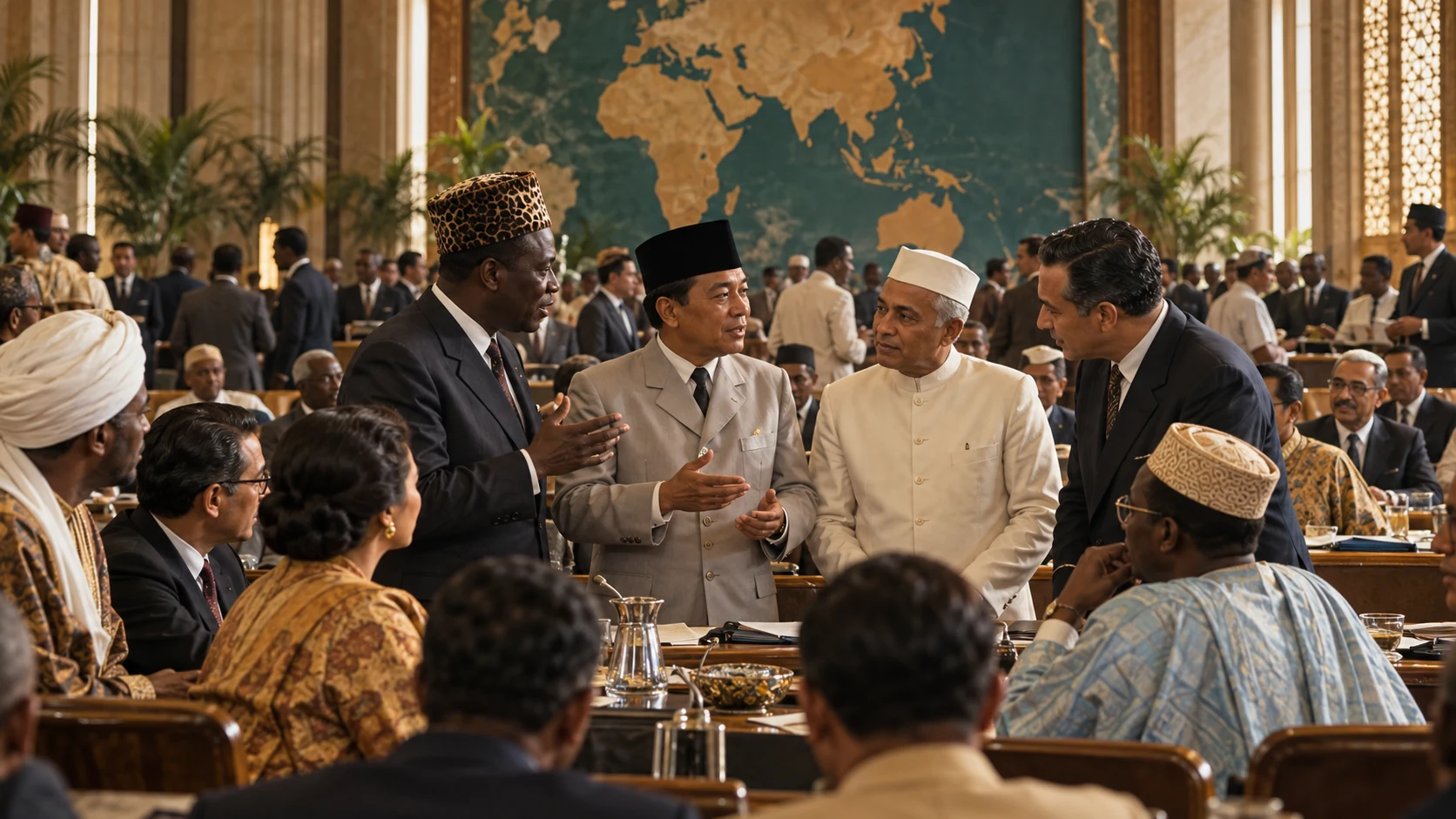
Inparticipation did not mean indifference. It required that new independent states not have to accept the geopolitical discipline of one of the blocks.
2.1 The legacy of the colonial system
Formal independence has not removed the boundaries created by the colonial administration, dependence on exports of several raw materials, and unequal access to capital and technology. The UN recallsthat almost a third of the world's population lived in dependent territories when it was created. Resolution of the General Assembly 1514 (XV), 1960 It has linked decolonization to the right of nations to self-determination.
Frantz Fanon pointed out that the political flag itself does not guarantee social emancipation. Its texts are interpretations, not a neutral statistical description, but help explain whether colonial power can be transferred to economic and cultural structures after the administration has left.
2.2 Bandung 1955: common language without unified ideology
The Asian-African conference in Bandung has linked states to various regimes and foreign orientations. Its conclusions highlighted sovereignty, non-interference, equality, peaceful resolution of disputes and opposition to colonialism. It was not about creating a third military bloc, but about coordinating countries that refused to be merely an object of the Cold War. The history of this follow-up is set out in the following table: Official overview of the Movement of the non-participants.
2.3 Belgrade 1961 and the institution of non-participation
The first NAM summit in Belgrade has translated the Bandung principles into more permanent political cooperation. Him Final document It combined peace, disarmament, anti-colonialism and economic development. Yugoslavia could also play this role because, after the Tito-Stalin dissension in 1948, it did not enter the Soviet bloc. Inparticipation was different from neutrality: members could be active, support liberation movements and, in individual crises, tend to be different parties.
2.4 Divergent actors, common need for autonomy
| Actor | Benefit | Opposition or limit |
|---|---|---|
| Josip Broz Tito | Independence on Moscow, Federal Model, Belgrade Summit | Authoritarian elements and unresolved national tensions |
| Javaharlal Nehru | Asian cooperation, peaceful coexistence, strategic autonomy | The border war with China has shown a limit on principles |
| Gamal Nasser | Arab anti-colonialism and nationalisation of the Suez Canal | Repression at home and military failures |
| Kwame Nkrumah | Panafricanism and continental coordination | Economic vulnerability and coup d'état 1966 |
| Cuba | Support for anti-colonial fighting and medical cooperation | Close links to the USSR complicated the image of independence |
Similar ambivalence discovers an article about Libya and the Pan-African project.
2.5 What participation has done and what has not
NAM has created a voting and diplomatic network, supported decolonization and opened up the issues of the new international economic order. But it did not eliminate conflicts between its own members, authoritarianism, or dependence on military or economic assistance in Great Power. Its importance today is therefore not in the romantic idea of a single "global south," but in the continuing demand for broader participation in the creation of rules.
Sources for chapter 2
3. Vietnam: War within the Cold War
From French Indochina to Geneva, the Gulf of Tonkin and the Phoenix program to Paris's agreements and unification.
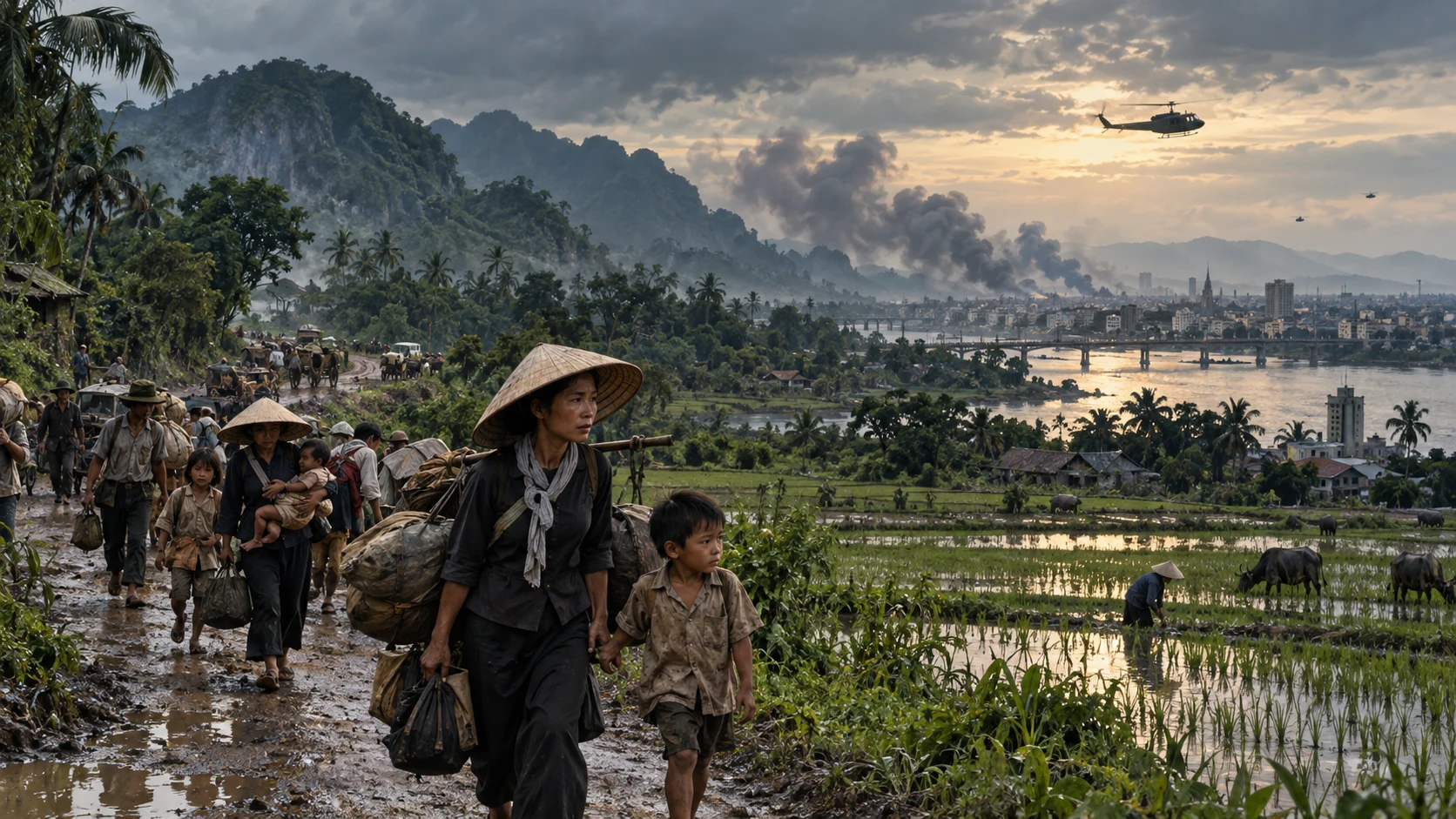
At the same time, Vietnam was a war for decolonization, civil war, conflict over the state and one of the main Cold War fighting grounds. A single sign doesn't explain the whole case.
3.1 From French Indochina to Dien Bien Phu
Vietnam's nationalism cannot be reduced to imports of Soviet communism. Håchi Minh associated national independence with the socialist program; Viet Minh fought against the Japanese occupation and then against the return of French colonial power. The defeat of France at Dien Bien Phu in 1954 opened the Geneva negotiations. This anticolonial dimension connects this discussion with chapter 2, From colonial world to multipolarity.
3.2 Geneva 1954: a temporary line that has hardened at the border
The agreements created temporary military zones and envisaged national elections. The US did not sign the final declaration, but unilaterally declared that the threat or the restoration of aggression would be considered a serious breach; the text is available in the edition FRUS. The US State Department today states in its overview that the US supported NgClosing DiPreparation in the refusal of elections. The division has thus turned from a transitional arrangement into two competing state projects.
3.3 Tonkin Bay and Open War
The incidents of August 1964 provided a political basis for the Tonkin Resolution. Official historical overview of the USA while admitting doubts as to whether the second reported attack actually happened. The escalation involved Operation Rolling Thunder and the deployment of hundreds of thousands of American soldiers. Complete Pentagon Papers in the National Archive of the USA allow public claims to be compared with internal decisions.
3.4 Phoenix programme: news network, detention and violence
Phoenix has coordinated American and South Vietnamese efforts against the political and logistical infrastructure of the National Liberation Front. The category "neutralisation" included capture, defection and killing; it is therefore not synonymous with execution. However, the programme combined problematic news lists, administrative detention and strong pressure on results, creating room for false accusations, torture and extrajudicial violence. The period of institutional definition illustrates American Congress Record with MACV Directive 525-36; also makes archive materials available CIA Reading Room.
3.5 Civilian population and responsibility
The massacre in Mzolai showed not only the crime of the unit, but also the failure of the first investigation. Official volume US Army on investigation He described the original procedure as a cover. Extensive bombing, forced displacement, mines and chemical defoliants have passed on a large portion of the civilian war costs. The exact sums of victims vary according to definitions and sources; therefore, this chapter does not present one estimate as an undisputed number.
3.6 Paris agreements, US exit and unification
The 1973 Paris Agreement allowed American fighting forces to depart, but it did not end the war between the North and the South. Saigon fell in April 1975 and the country was formally united in 1976. Victory has eliminated colonial and foreign military control, but it has also brought repressive reeducation camps, exodus of part of the population and other regional wars. Therefore, anti-colonial legitimacy does not relieve the victorious state of responsibility for postwar treatment.
Sources for chapter 3
4. Yugoslavia: From a non-participating federation to a break-up
Titus' federal and self-governing experiment, its social base, economic tension, nationalism, and war of disintegration.
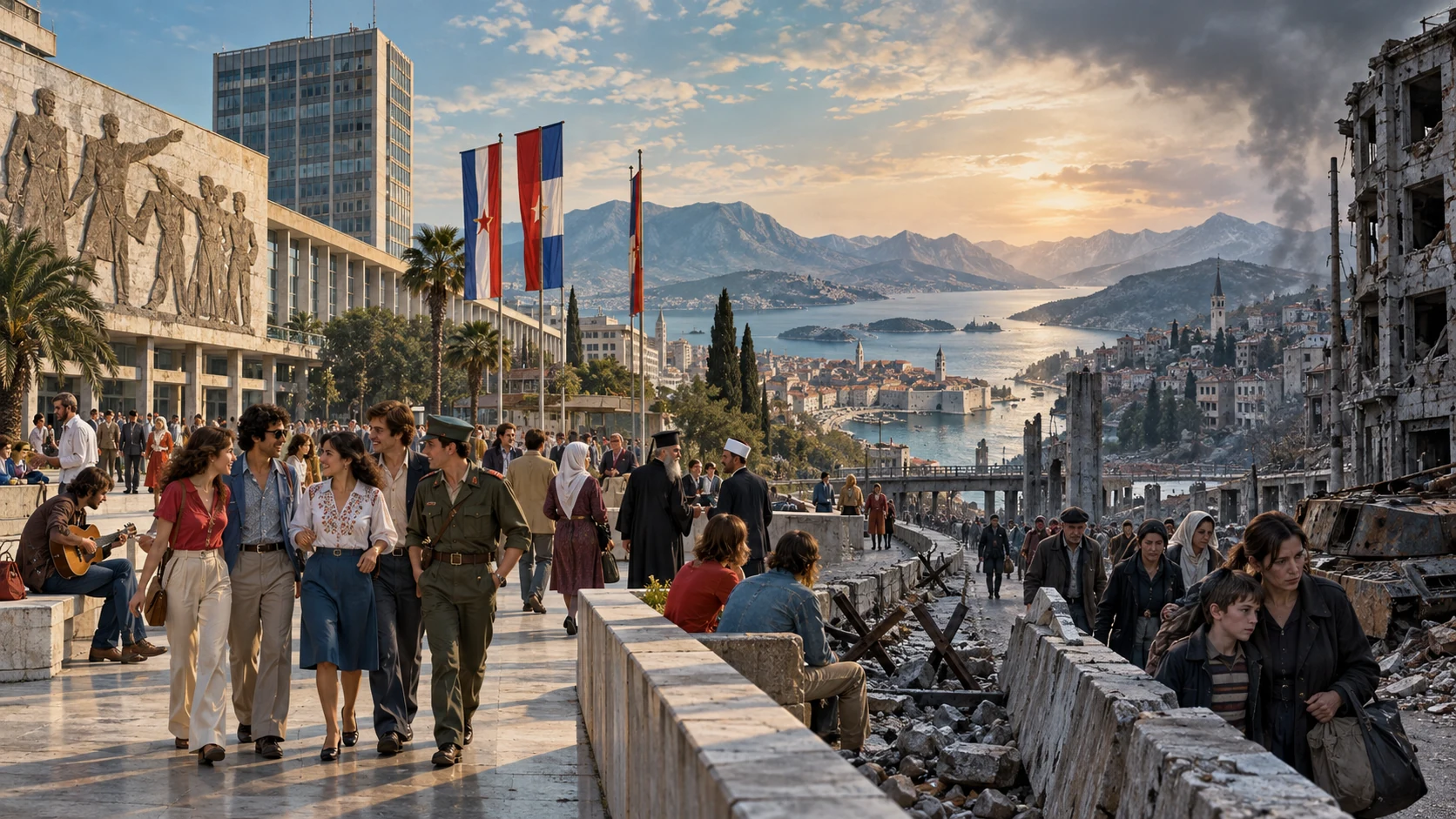
Yugoslavia was not an idyllic federation destroyed solely by the outside, nor by the artificial prison of nations doomed to extinction. Its breakdown was created by a combination of institutional weaknesses, economic crisis, nationalist mobilization, domestic elites' decisions and the transformation of the international environment.
4.1 Socialism outside the Soviet bloc
After the Tito-Stalin discord in 1948, Yugoslavia developed its own model of working-class self-government, federal order and more open contact with the West. Together with strategic independence, this has allowed an important role to play in Movement of non-participants. The system has brought industrialization, social mobility and relatively free travel, but has preserved the monopoly of the Communist Union, the repressive security forces and limited scope for organised opposition.
4.2 Federation, autonomy and balance
Six Republics and two autonomous regions within Serbia had a complex system of shared power. The 1974 Constitution strengthened the Republics and the collective Bureau. This construction protected weaker members from the centre's dominance, but after Titus' death in 1980, it made it difficult to respond to the crisis. The historical memoirs of World War II, the different levels of development and the redistribution disputes could be politically activated.
4.3 Debt, unemployment and loss of legitimacy
80. foreign debt, inflation, unemployment and regional inequality have joined together over the years. International creditors and stabilization programs have affected the area of domestic politics, but the claim that Yugoslavia "broke the IMF" would be too mechanical. The economic crisis has weakened the federal compromise; domestic leadership has transformed it into stories that one nation is living or oppressing another.
4.4 From constitutional conflict to war
The rise of Slobodan Milošević, the restriction of autonomy of Kosovo and Vojvodina, Slovenian and Croatian requirements for the Confederation, unilateral steps of the Republics and disputes over the Yugoslav People's Army have gradually narrowed the scope for an agreement. Foreign recognition of Republics affected the timing and legal form of disintegration, but did not create nationalist programs or armed structures out of nothing.
| 1991 | The war in Slovenia and the wider conflict in Croatia. |
| 1992–1995 | The war in Bosnia and Herzegovina, ethnic cleansing, siege and mass crimes. |
| 1995 | The Dayton Agreement ended the Bosnian War and created a complex post-war state. |
| 1998–1999 | Kosovo's conflict and NATO intervention, as examined in chapter 5. |
4.5 Crimes cannot be dissolved in a single national story
The International Criminal Tribunal for the former Yugoslavia has created a large judicial archive to hold individuals accountable across the parties. The judgment is not the full history of society, but it is of greater weight than the nationalist legend. ICTY Judgments Database it allows for the separation of documented operations, chain of command and concrete actions from the collective guilt of nations.
4.6 What the case shows
The Federation needs not only a constitution, but also a legitimate way of dealing with inequalities and disputes about authority. Economic stress will not create war itself, but it can facilitate the elite to transfer social uncertainty into ethnic fear. Foreign actors have influence, but analytical honesty requires the domestic actors to be attributed their own decision-making. The next phase discovers Chapter 5 continues this account: Kosovo and NATO 1999.
Sources for chapter 4
5. Kosovo and NATO 1999
The Kosovo conflict, UÇK, Serbian repression, Rambouillet, NATO bombing, civilian damage, international law and Resolution 1244.
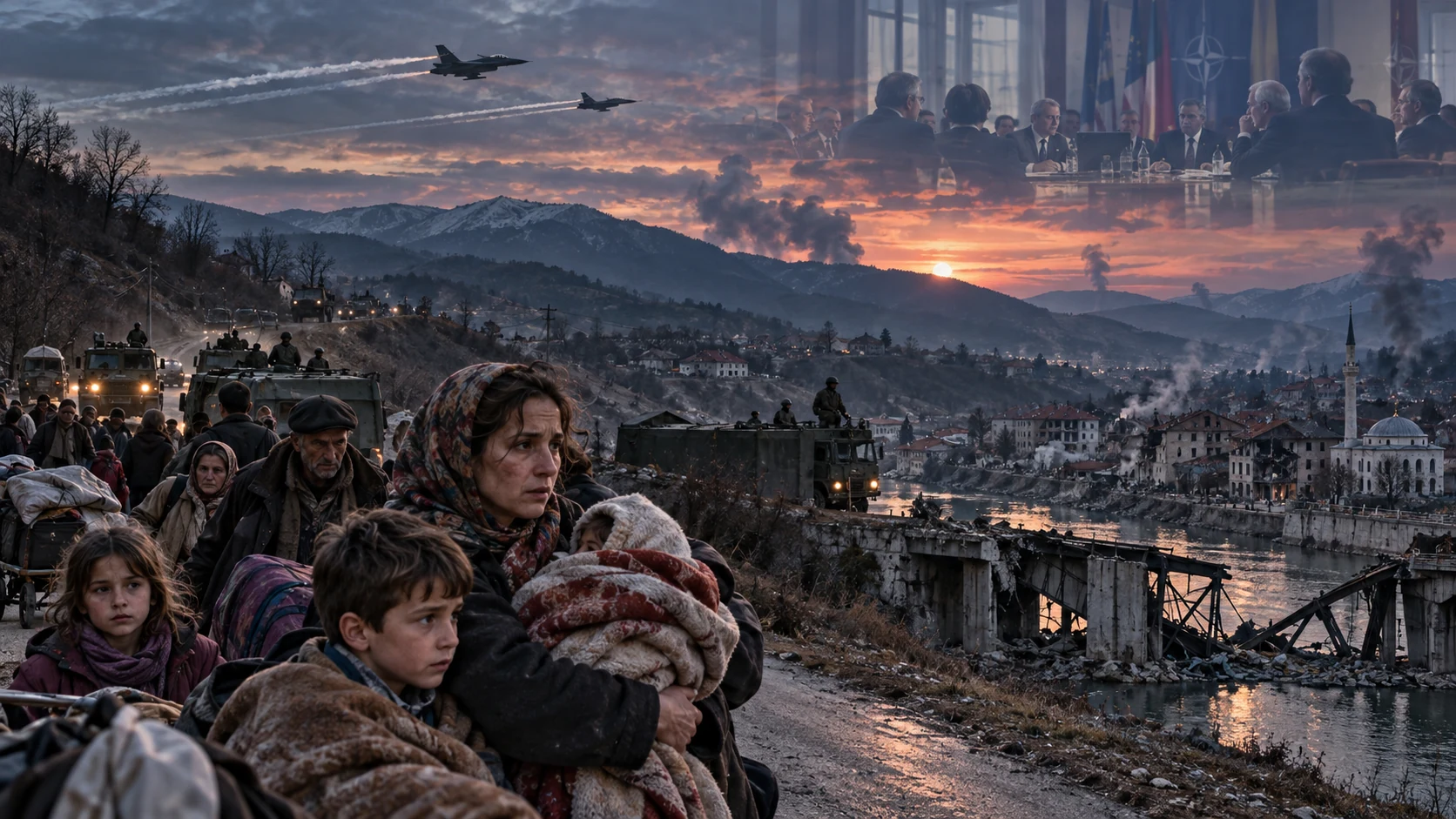
The refusal to use force illegally or legally in question does not require denying the repression and crimes of the Yugoslav and Serbian forces. Similarly, documented crimes themselves do not create the mandate of the Security Council, which was absent in March 1999.
5.1 Abolished autonomy and non-violent resistance
Kosovo had extensive autonomy in socialist Yugoslavia, which led Serbia at the end of 80. The flight has been severely limited. The Albanian majority has built parallel institutions and the Ibrahim Rug movement has long been promoting non-violent strategy. Its weak results, police repression and regional weapons flow following the collapse of Albania in 1997 strengthened the armed UÇK.
5.2 UÇK, State repression and spiral of violence
UÇK attacked the police, the state's leaders and Albanian opponents. The Yugoslav and Serbian forces were in line with operations that affected civilians and created a large displacement. ICTY judgments, for example Milutinovic et al., provide detailed factual findings for violent movements and force operations. The crimes of UÇK and later retaliation attacks against Serbs, Roma and other minorities cannot be omitted from the same picture.
5.3 Rambouillet: real action and power pressure
The proposal envisaged extensive autonomy of Kosovo and an international military presence. Annex B to the dispute gave NATO forces wide access and privileges in the territory of the Federal Republic of Yugoslavia. This does not mean that the negotiations were merely an excuse, but it helps explain why Belgrade rejected the text. The analysis must separate the Kosovo need for protection from the question of whether the conditions and subsequent application of force were legally proportionate.
5.4 Operation Allied Force
NATO launched air strikes 24. On behalf of the President, NATO presentsthat the campaign lasted 78 days and was to stop the humanitarian disaster. The attacks have affected military targets, infrastructure and civilian objects; individual incidents require self-assessment of proportionality and differentiation. Time frames, for example film from Belgrade, capture civilian experience, but do not solve legal disputes themselves.
5.5 Legality, legitimacy and dangerous precedent
The UN Charter recognises the use of force in self-defence and on the basis of a decision of the Security Council. NATO has neither relied on the attack of a member nor on the new Council authorisation. The defenders are talking about exceptional humanitarian legitimacy; critics are talking about violations of the Charter and a precedent that allows strong states to decide without a universal mandate. The independent Kosovo commission used the famous wording of the "illegal but legitimate" - an analytical court, not a binding court decision.
The Czech Republic authorised flights and subsequently transit and support of alliance forces shortly after joining NATO. Government Resolution No 357 This practical participation is evidenced by the government, which also declared that it does not plan to send troops to ground war without the UN's mandate or the approval of Yugoslavia.
5.6 Resolution 1244: autonomy, international governance and open statehood
Resolution of the Security Council 1244 Appointed the international civilian and security presence and "substantial autonomy 'of Kosovo, referring to the sovereignty and territorial integrity of the Federal Republic of Yugoslavia. The declaration of independence of 2008 and the differences in recognition show a conflict of self-determination and integrity. The case therefore follows directly from the study Nations without a State and shall not be used as a simple template for any separatist conflict.
Sources for chapter 5
6. UN, veto and reform of multilateralism
Universal organisations with unequal power distribution: the Security Council, veto, the General Assembly and the realistic ways of reform.
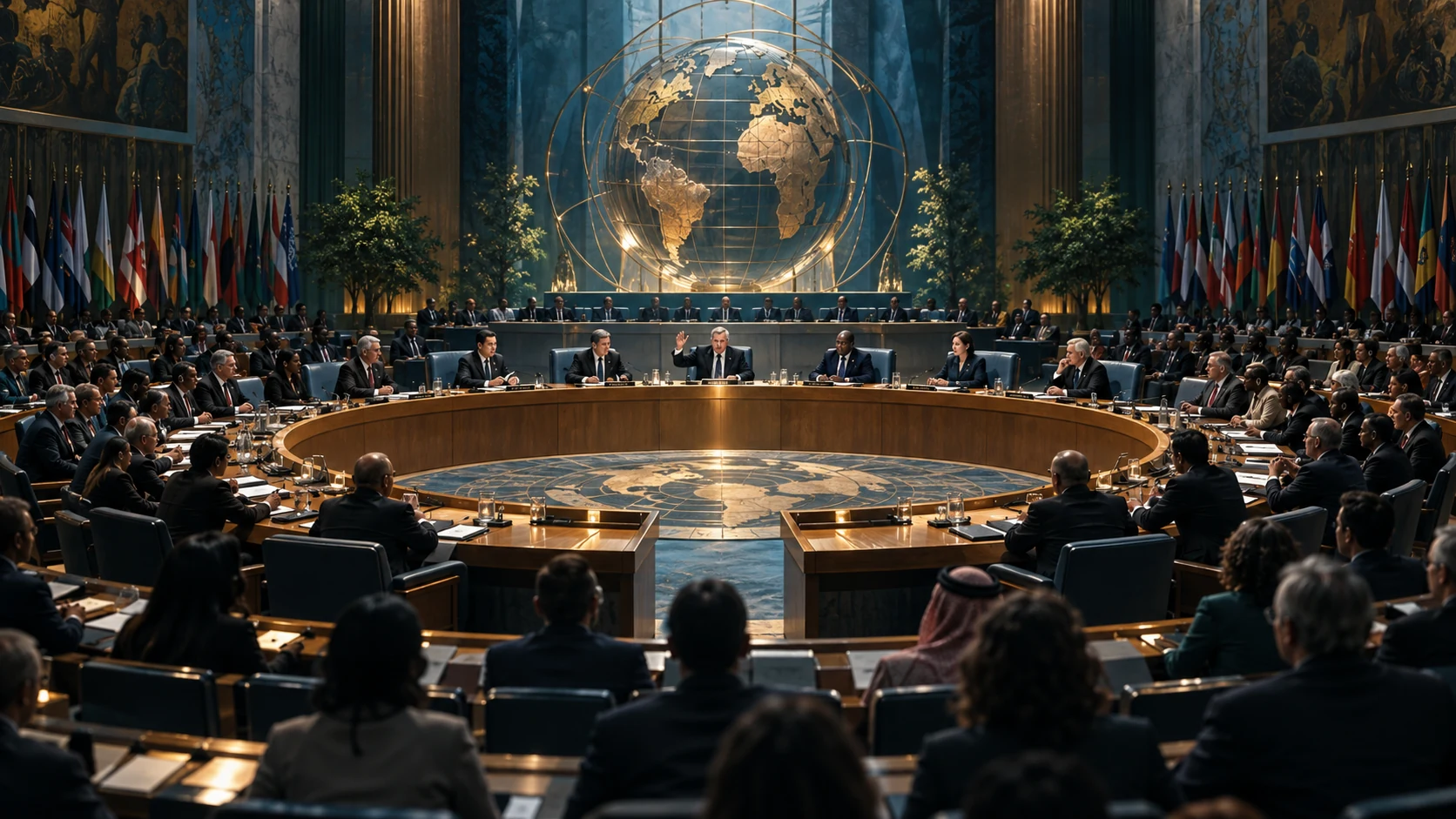
The UN is not the world government. It is also a legal framework for equality between states and institutions in which the victorious powers of 1945 have been granted a permanent privilege. This contradiction is not an accident; it is part of the original compromise.
6.1 Universal Charter and Concert by Great Powers
UN Charter Prohibited threat by force and its use, affirms the sovereign equality of members and gives the Security Council the primary responsibility for peace. However, Articles 23 and 27 also guarantee permanent membership and a special voting position for China, France, Russia as the successor to the USSR, the United Kingdom and the US. Without this compromise, the great powers would probably not join the organization; they can block the joint action with it in the crises where they are most interested.
6.2 Veto is not a vote against, but a lack of consent of a permanent member
For substantive decisions, nine votes and the consent of permanent members are required; the delay does not constitute a veto in practice. Overview of rules and historical voting keeps United Nations Security Council. Veto can prevent escalation between powers, but also paralyze the response to war or mass violence. Its use by all permanent members is to be assessed by the same meter.
6.3 World presentation 1945
Africa and Latin America don't have a permanent member. India is more populous than most P5 and Germany, Japan, Brazil, and South Africa bear a significant share of economic and regional responsibility without the same authority. However, enlargement raises the question of whether additional privileges will arise or of a more representative council. The current intergovernmental negotiations summarise United Nations General Assembly.
6.4 Reform from attainable to constitutional
| Tool | Benefit | Limit |
|---|---|---|
| Public reasons for veto | Increases political responsibility | It shall not prevent the use of: |
| Voluntary restrictions on mass crimes | It can unblock an emergency reaction | Not legally enforceable |
| Enlargement of the Council | Better regional legitimacy | Dispute over new members and the type of mandate |
| General Assembly and "Uniting for Peace" | Greater legitimacy and recommendations | It does not have all the powers of law enforcement of the Council |
| Change of Charter | Can he reconstruct the rules themselves | Article 108 requires ratification of all P5 |
6.5 The ideal of a world without veto and its transitional journey
A world in which no State has an hereditary decision-making privilege is a defensible normative objective. However, it cannot be passed on as a simple administrative change. According to Article 108 of the Charter two thirds of the members, including all permanent members, must ratify the amendment. The transitional strategy must therefore combine pressure on restraint, more representative advice, the General Assembly's control, regional diplomacy and long-term confidence building.
This objective follows up from the article Nations without a State: a peaceful path to new statehood needs a forum whose decision-making is not seen as an instrument of one power group.
Sources for chapter 6
7. Why Ants Cooperate — and Why Humans Need More Than a Supercolony
Argentine ant, evolution of supercolonies, human institutions and Borg as a warning against cooperation without freedom.

The question "if ants work together, why can't people do it?" is a useful beginning, not a biological proof of the political agenda. Ants and people work together through other mechanisms; it is the difference that shows what institutions human cooperation needs.
7.1 Supercolony is not the only organism
Argentine ant (Linepithema humile) creates networks of multiple queens in a packed area. Workers between compatible nests do not exhibit normal territorial aggression, they can move and share resources. The European dominant supercolony was followed along over 6,000 kilometres of coastline; behavioral tests found compatibility between some European, California and Japanese populations. But this does not mean that all Argentine ants in the world form a single peaceful colony: there are rival supercolonies, and borders and aggression are more pronounced in the original South American area.
Study Tsutsui et al. (PNAS, 2000) associated invasion success with reduced genetic variability and lower aggression within species. Sunamura et al. (2009) described intercontinental behavioural compatibility; later Global Genetic Analysis This image was more accurate.
7.2 Success was also created by the limitations of internal war
A colony that uses less energy to fight genetically and chemically similar neighbors can invest more in food, offspring and expansion. The founder's effect reduced the variety of recognition marks and created extensive tolerance networks. That's an evolutionary advantage in a rolling environment, but it's not a conscious decision for the common good. Ants have neither a universal rights project nor a moral principle of equality; they respond to kinship, odor signals and selective pressures.
7.3 Intra-party cooperation can mean violence on the outside.
Argentine supercolonies can push out the original species, change the food networks and support the pests from which they acquire the honey trees. Internal cooperation is therefore not in itself an ethical ideal. It can increase the ability of one group to monopolize the environment. The political analogy must always ask two questions: who is included in the 'we' and who bears the cost of its success?
7.4 People already know how to work together - the problem is the scale and the boundaries of the group
One cooperates with the non-compatriots, creating law, currencies, scientific institutions, rescue systems and global technical standards. Research on cultural evolution shows that human cooperation is based on learning, reputation, sanctions, trust and institutions, but often remains group-limited. Experimental studies across companies captures the current ability to cooperate with foreigners as well as the continuing parochialism.
So the question is not why people can't work together. It is about why institutions that coordinate millions of people within the state often stop using the same scale beyond it. The theme follows directly to the article UN, veto and reform of multilateralism and the author's starting point in methodology.
7.5 Borg: maximum coordination at the price of a person
Borg from Star Trek are a good negative metaphor. Official overview of Star Trek is described as a collective formed by forced assimilation, in which the individual loses his free will. The ant colony is also not a liberal society of individuals, but its members are not biologically entering into a political treaty. To pass this model on to people would be to confuse coordination with obedience.
| Model | Cohesion source | Relationship with an individual | Main risk |
|---|---|---|---|
| Ant supercolony | Relatives, chemical recognition, evolution | The individual is not an autonomous political entity | Invasion dominance over the surrounding area |
| Borg collective | Forced technological assimilation | Individual is suppressed | Total government without consent |
| Open human federation | Right, trust, reciprocity and common objectives | Person retains voice and dignity | Bugeriasies, dominance of stronger and secretive |
7.6 Cooperation without assimilation
The sensual human analogy is not one smell of consciousness. It is polycentric cooperation: more decision-making levels, clear rules, control options, fair allocation of costs and the right to leave or appeal. Elinor Ostrom in his a Nobel lecture It has shown that common resources do not have to be managed by the market or the central state alone; communities can establish permanent rules if they have confidence, information and responsibility.
The political ideal of this study is therefore not humanity turned into superorganism. It is a network of co-operating companies that deal with climate, science, health and peace together, but preserve the pluralism of cultures and free persons. The anti-war must not be uniformity; it can be a federation of differences.