
Brian Eno
Eno redefines synthesis as the architecture of space: the ambient is an environment, not a linear narativus. Generative approach means that the work is defined by rules, not fixed sequence.
In production practice, Enos is important for working with chain effects, reverberation, delaym and the concept of 'system' as tools.
Výtvarné umění a Roxy Music
Brian Eno se narodil roku 1948 v Suffolku a studoval výtvarné umění. Jeho rané projekty spojovaly zvuk, instalaci a performance. Roku 1971 se připojil k Roxy Music jako hráč na syntezátor a studiový experimentátor; účastnil se prvních dvou alb a skupinu opustil v roce 1973. Zájem o obraz, grafický design a systémy s proměnlivým výsledkem si přenesl i do další tvorby.
Sólová alba a ambientní hudba
V roce 1974 vydal Here Come the Warm Jets a Taking Tiger Mountain (By Strategy). Another Green World (1975) spojilo písně s krátkými instrumentálními miniaturami. Eno začal používat pojem ambientní hudba pro zvuk, který může být současně přítomný i nenápadný. Music for Airports vytváří z opakovaných frází pomalu proměnlivé prostředí místo tradiční skladby s dramatickým vrcholem. Další alba řady Ambient zkoumají vztah mezi tichem, prostorem, nahrávkou a poslechem.
Producent a spolupracovník
Eno působil jako producent nebo spoluautor na nahrávkách Davida Bowieho, Talking Heads, U2 a dalších. S Robertem Frippem vytvořil řadu experimentálních alb; spolupráce s Bowiem zahrnuje berlínské období i pozdější Outside. Ve studiu často pracuje s omezením, náhodou, vrstvením a přeskupováním materiálu. Karty Oblique Strategies, vytvořené s Peterem Schmidtem, nabízejí podněty pro překonání tvůrčího zablokování.
Generativní hudba a odkaz
Eno používá pojem generativní hudba pro systémy, jejichž pravidla vytvářejí proměnlivé průběhy bez jediné pevné verze. Tento princip rozvíjel ve zvukových instalacích, dlouhotrvajících kompozicích i audiovizuálních dílech. Jeho vliv spočívá nejen v konkrétních albech, ale také v chápání studia, technických omezení a procesu jako součástí kompozice.
Text je přeložené a redakčně zpracované shrnutí hesla anglické Wikipedie. Původní heslo · historie úprav · CC BY-SA 4.0.
Discography / Selected works
| Year | Work | Note | Reference |
|---|---|---|---|
| 1975 | Discreet Music | Processes, delays | Wikipedia |
| 1978 | Ambient 1: Music for Airports | Definition of the ambient | Wikipedia |
Links
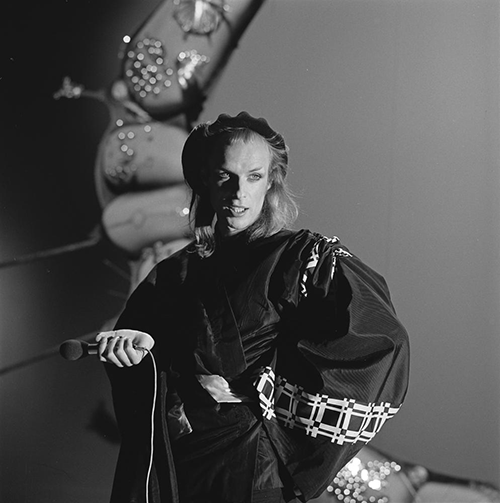
Brian Eno reframes synthesis as an architecture of space: ambient is an environment rather than a linear narrative. In generative music, a work is defined by rules instead of a fixed sequence.
Eno's production foregrounds effect chains, reverse and delay, treating a system itself as an instrument.
Visual art and Roxy Music
Brian Eno was born in Suffolk in 1948 and studied visual art. His early projects moved between sound, installation and performance. He joined Roxy Music in 1971 as a synthesizer player and studio experimenter, appearing on the first two albums before leaving in 1973. His interest in images, graphic design and systems with changing outcomes continued in his later work.
Solo records and ambient music
Eno released Here Come the Warm Jets and Taking Tiger Mountain (By Strategy) in 1974. Another Green World (1975) combined songs with short instrumental miniatures. He used the term ambient music for sound that could remain present without demanding constant attention. Music for Airports turns repeated phrases into a slowly changing environment rather than a conventional work with a dramatic climax. Later albums in the Ambient series explore relationships between silence, space, recording and listening.
Producer and collaborator
Eno has produced or co-written records by David Bowie, Talking Heads, U2 and many others. With Robert Fripp he made a series of experimental albums; his work with Bowie includes the Berlin period and the later Outside. In the studio he often uses constraints, chance, layering and rearrangement. The Oblique Strategies cards, created with Peter Schmidt, offer prompts for overcoming creative deadlock.
Generative music and influence
Eno uses the term generative music for systems whose rules produce changing forms without a single fixed version. He has applied the idea to sound installations, long-form compositions and audiovisual work. His influence lies not only in particular albums but in treating the studio, technical limitations and process as parts of composition.
This is a translated and edited summary of the English Wikipedia article. Original article · revision history · CC BY-SA 4.0.
Selected works
| Year | Work | Notes | Link |
|---|---|---|---|
| 1975 | Discreet Music | Processes, delays | Wikipedia |
| 1978 | Ambient 1: Music for Airports | Definition of the ambient | Wikipedia |
References and links
Footnotes
- Generative music is a potential form realized over time, not exhausted by one playback. ↩