
Úvod
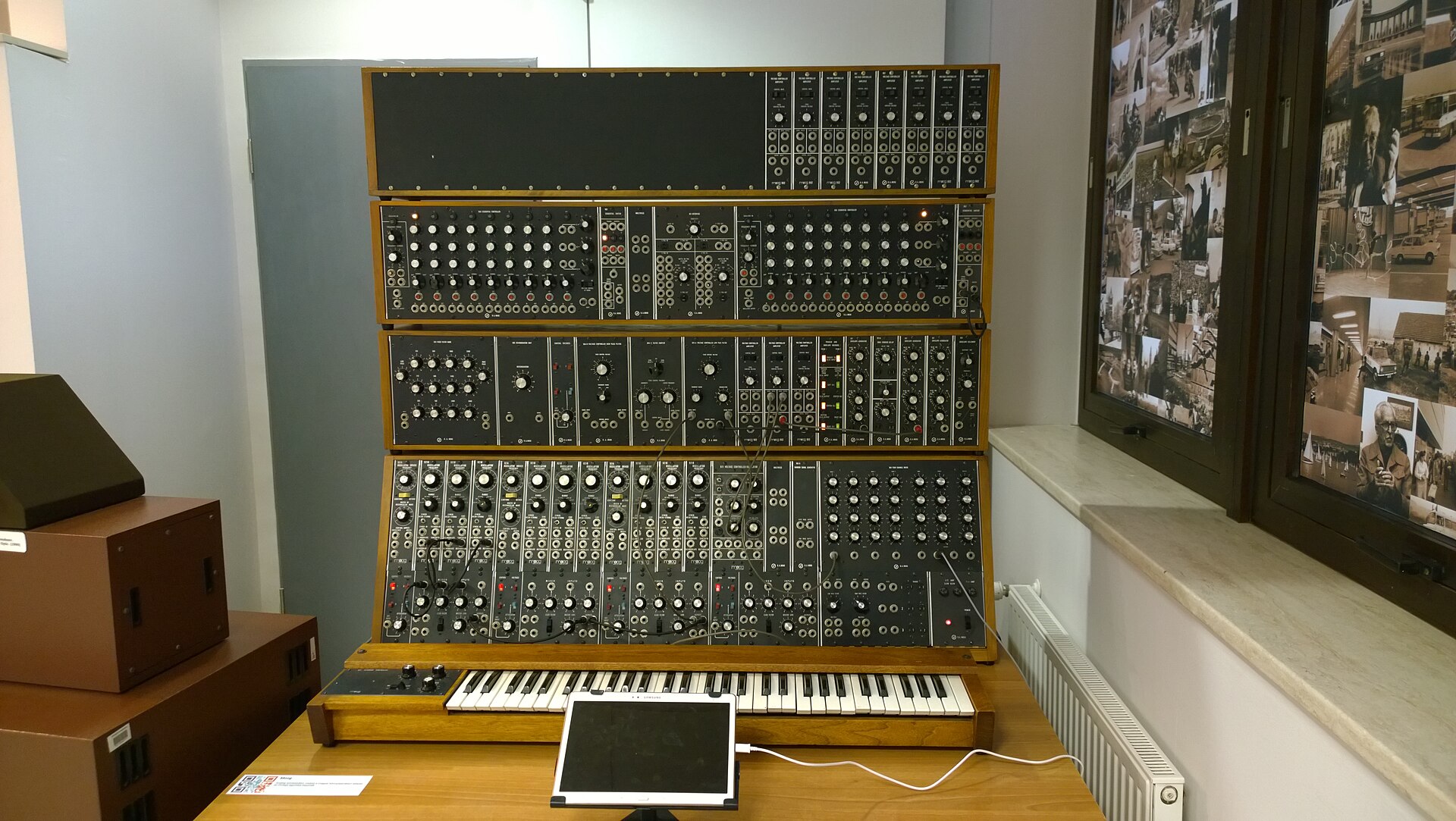
Introduction: how to read the history of synthesis
This overview has two objectives: (1) to offer a historical map of the development of music synthesis and (2) to provide concepts that allow synthetic sound to be analysed. I see the synthesization here as a way of organising sound - as working with parameters, processes and media.
The history of synthesis is not linear. It's a network of exchanges between lab and practice, between academic institutions and popular culture, between hardware and software. Each technological solution also creates an aesthetic norm: the way in which 'right' is created sound, rhythm, space and musical gesture.
When listening and reading music synthesis helps to distinguish three levels: signal (DSP, circuit, spectrum), composite (form, rhythm, harmony, process) and cultural (institutions, media, audience). These planes are interconnected continuously in electronics: for example FM synthesis (Chowning, 1973) is simultaneously a mathematical method, a composite tool and a cultural signature 80. flight.
The text is divided into chapters after decades (timeline), into a summary of synthesis technologies and portraits of authors who represent various modalities of electronic creation. The chapters refer to sources and literature; bibliography summarises the sources from which individual claims can be verified.
The overview links basic parameters of synthesis with specific tools, compositions and methods of study work.
| Fusion principle | Key data / parameters | Example HW / SW | Aesthetic effect |
|---|---|---|---|
| Subtractive | source, filter, resonance point, envelope, LFO | Moog, Minimoog, Diva | Cuts, full-bodied, classical synthesis |
| FM | carrier / modulation ratio, index, algorithm, envelope | Yamaha DX7, FM8, Dexed | sounds with rich side bands, metal textures |
| Wavetable | Table, interpolation, position, morph, speed | PPG, Serum, Pigments | smooth colors, digital morphing |
| Granular | grain size, density, position, pitch, cover | Reactor, Granulator, Omnisphere | Textures, identity disintegration, "clouds" area |
| Modular | patch, CV / Gate, mix, modulators, signal path | Eurorack, VCV Rack | process, life, variability |
| Sampling | sample, bitrate, samplerate, loop, transposition | Akai, Contact, Ableton Simpler | citation, remix, hybrid layer |
Mini-dialing: oscillator, filter, envelope, LFO, modulation, aliasing, sampling, CV, MIDI, MPE, granularity.
Network of people, technology and musical directions
Musical synthesis was not produced after one line
Researchers, composers, designers and interpreters met in studies, universities and the music industry. The following links distinguish direct cooperation, documented influence and broader context.
Paris studio and long tone
Pierre Schaeffer brought Éliane Radigue to work with specific sounds and tape-recorder bands; Radigue later worked as an assistant Pierre Henry. From this background it came to its own language of feedback, long forms and subtle frequency changes.
From studio avant-garde to electronic pop
Karlheinz Stockhausen was one of the documented influences Kraftwerk; Kraftwerk then inspired the next generation including Depeche Mode and Daft Punk. This is not the only reason: pop, experimental film, club culture and new tools have also entered this line.
Moog, Carlos and the Public Ear
Wendy Carlos pointed to the album Switched- On Bachthat a modular synthesizer can carry a full-fledged interpretation and recording work. Robert Moog and his team created an instrument ecosystem; cooperation between musicians, technicians and producers was also important.
Research FM and millions tool
John Chowning developed FM synthesis at Stanford. Its commercial use was licensed by Yamaha and the DX digital series transferred this principle to studies, households and pop production.
Pulse, repetition and transformation
Steve Reich followed on to the American experimental scene and collaborated with Terry Riley. Its phase shifts and repetitive structures have become a reference point for later electronic and dance creators; the relationship here is a cultural influence, not a claim about direct teaching.
Studio as an Tool
Brian Eno, Jean-Michel Jarre and Vangelis they represent different paths: an ambitious process, large scenic electronics and a film sound landscape. They are linked by work with study and synthesizer, but their musical language is different.
People, instruments and musical ideas
Musical synthesis did not develop along a single line
Researchers, composers, instrument makers and performers met in studios, universities and the music industry. These lines diverge direct collaration, documented inflation and a browser shaded context.
Paris studios and the long tone
Pierre Schaeffer introduced Éliane Radigue to specify sounds and tape work; she later assisted Pierre Henry. From this background she developed a distinct language of feedback, extended forms and subtle frequency change.
From studio avant-garde to electronic pop
Karlheinz Stockhausen was among the documented outbreaks on Kraftwerk; Kraftwerk in turn inspired later generations, including Depeche Mode and Daft Punk. This was not a single-cause link: pop, experimental film, club culture and new instruments also mattered.
Moog, Carlos and the listening public
He Switched- On Bach, Wendy Carlos demonstrated that a modular synthesizer could support full interpretation and recording work. Robert Moog and his team built an instrument ecosystem shaped by musicians, engineers and manufacturers.
FM research becomes an instrument
John Chowning Developed FM synthesis at Stanford. Yamaha licensed its commercial use, and the DX line brought the principle into studies, homes and pop production.
Pulse, repetition and change
Steve Reich Emerged from the American experimental scene and worked with Terry Riley. Reich's phase ships and repreparing structures became a reference for later electronic and dance artists; this is a cultural inflation, not a claim of direct teaching.
The studio as instrument
Brian Eno, Jean-Michel Jarre and Vangelis followed by different paths: ambient process, large- scale electronic performance and clinical sound worlds. Their studio practice contacts them, while their music languages remain disinct.
Charikter Play: self-reflection and sound
Try the related web player with localized self-reflection guide.
Open Chakter Play →Technologie
Synthesis technology
Technology can be read as a dictionary of procedures, but more fruitful is to understand it as a general theory of modulation. Most systems combine the source (oscillator / noise / sample) and control processes (envelopes, LFO, sequencers, algorithms). In the analogue tradition, this logic is realized by voltage (CV), in digital numbers (DSP).
In terms of teaching, it is important to clarify the relationship between the 'method' and 'interface': the same synthesis principle can be controlled by a keyboard, sequencer, gestational controller or algorithm. The aesthetics often arise from the interface and from the "direct touch" with parameters.
Subtractive synthesis
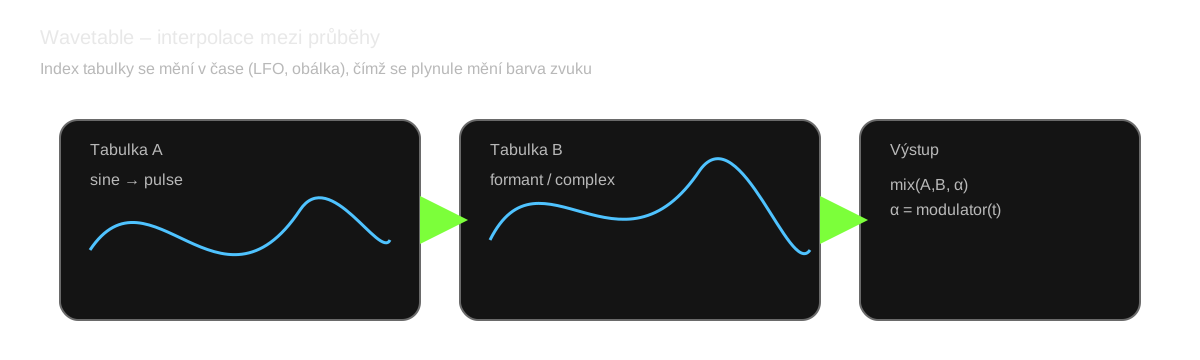
Subtractive synthesis starts with a rich spectrum (saw, pulse, noise) and takes the frequency by filter. It is an ideal didactic model because the link between cutoff / resonance and perceived color is instantaneous. In practice, subtractive synthesis shows that the filter is a composite tool: it can play melody, make form (opening in time) and define space (combination with the reverse).
FM synthesis
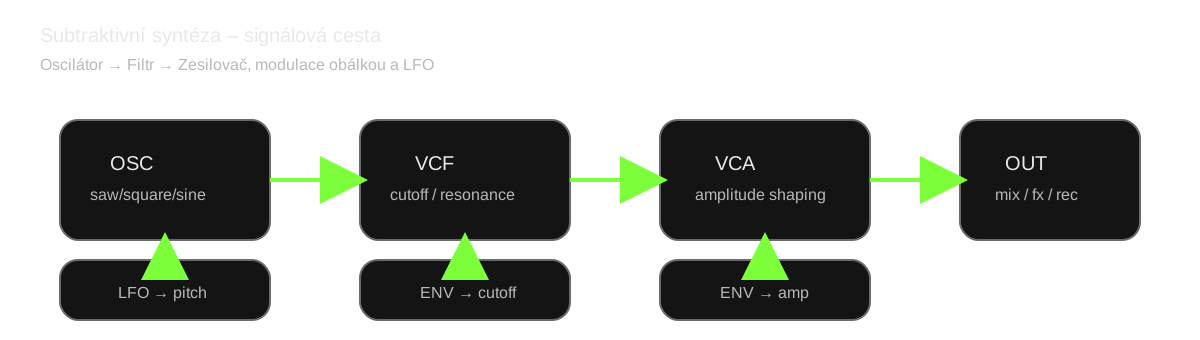
FM is historically connected to computer music (Chowning, 1973). In practice, the modulation index and the frequency ratio of the carrier and modulator are essential. Didactic is convenient to start with vibrations (small index) and gradually add the envelope of the modulator: the student hears the spectrum opening in time and the 'colour dynamics' are created.
Wavetable synthesis
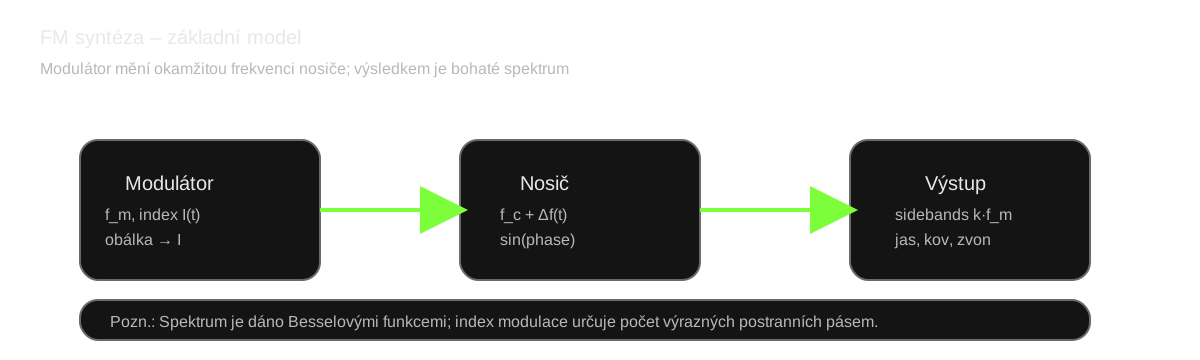
Wavetable works with interpolation between the courses. Instead of filter (which takes the ingredients) here the color arises by changing the source. The table index modulation creates a spectrum morphing that is perceived as a continuous material change.
Granular synthesis
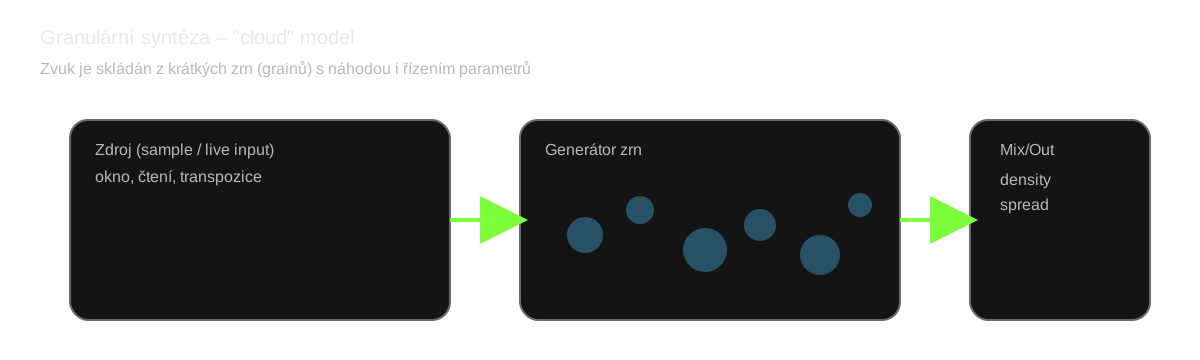
The granular approach decomposes the sound on the grains in milliseconds and composes them into "clouds." It is explained well on the terms density, dispersion, envelope of grain and position in the source. Granularity is also a technique and aesthetics: it can be fine (texture) or radical (sound identity breakdown).
Modular synthesis
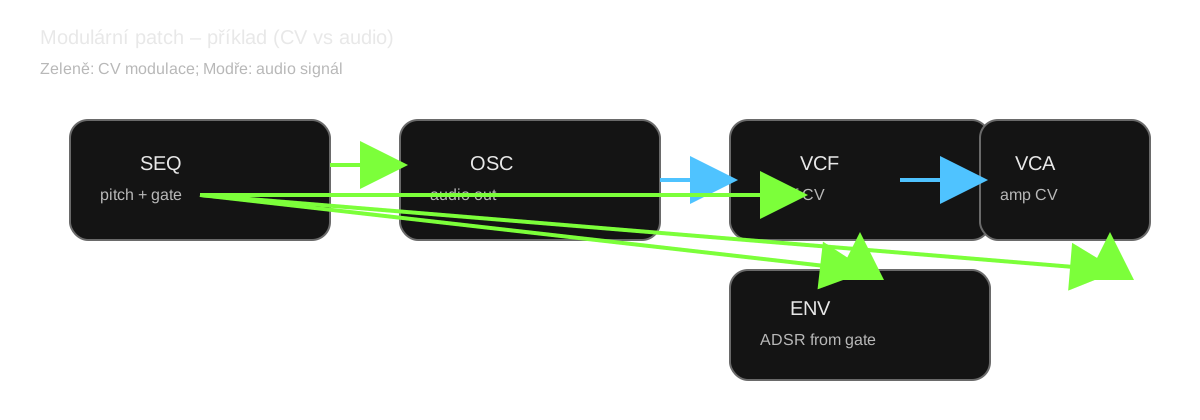
Modular is architecture and culture. Patch is a situation: a system that develops. In the pedagogical modular teaches signal-flow, hierarchie modulation and also work with chance. The aesthetically modular supports process music and 'live' variability.
Sampling and hybrid production
Sampling moves the question of synthesis: sound can not only be generated but also quoted. In modern production is typical hybrid connection: subtractive bass, wavetable lead, granular texture and samped drums. For analytical work it is useful to see how these layers are divided by spectrum and space.
Typical parameters: sample, loop length, bitrate, sampling frequency, transposition, wave modulation and filtering. In practice, sampling is often a bearer of cultural heritage.
| Method | Key parameters | Typical sound |
|---|---|---|
| Subtractive | cutoff, resonance, attack / decay / sustainability / release, filter type | Hot bass, ringing surfaces |
| FM | carrier / modulator ratio, modulation index, enterprise debt | shiny piano sounds, shiny surfaces |
| Wavetable | table shift, morph speed, interpolation | live morphing, digital textures |
| Granular | grain size, density, position, pitch, randomness | prevailing atmosphere, sound decay |
| Modular | CV routing, gate / trigger, mix, modulator sources | organic processes, live changes |
| Sampling | loop body, sample rate, bit bottom, formant, resynthesis | citation, remix, sound mass |
Synthesis technologies
Synthesis can be read as a vocable of techniques, but it is more used to understand it as a general theory of modulation. Most systems combine a sound source (oscillator, noise or sample) with control processes such as invelopes, LFOs, sequencers and algorithms. In analogue instruments this logic is implemented with voltage (CV); in digital systems, with numbers (DSP).
Teaching synthesis also means distinguishing a method from its interface. The same synthesis principle can be controlled by a keyboard, sequencer, gestural controller or algorithm. Aesthetic character often comes from the interface itself and from how directly the performance can touch the parameters.
Subtractive synthesis
Subtractive synthesis starts with a harmonically rich spectrum - a sawtooth, pulse or noise - and removes frequencies with a filter. It is an effective teaching model because the link between cutoff, resonance and perfected timbre is immediate. The filter is also a compositional tool: it can shape a melodic contour, create form by opening over time, and define space when combined with reverse.
FM synthesis
FM synthesis is historically linked to computer music (Chowning, 1973). Its key variables are the modulation index and the frequency ratio between carrier and modulator. A user demonstration begins with vivito at a low index, then add a modulator enharipe so listeners can hear the spectrum open over time and timbre become dynamic.
Wavetable synthesis
Wavetable synthesis interpolates between stored waseforms. Rather than removing components with a filter, it changes the source itself. Modulating the table position morphs the spectrum, creating a continuous change in sonic material.
Granular synthesis
Granular synthesis breaks sound into millisecond-scale grains and arrangements them into clouds. Its central parameters include density, dispersion, grain development and position within the source. Granularity is both a technique and an aesthetic: it can produce subtle texts or radically dissolve a sound's identity.
Modular synthesis
A modular synthesizer is both an architecture and a culture. A patch is a changing situation: a system in motion. Modular instruments teach signal flow, modulation hierarchy and the use of chance. Aesthetically, they encourage processes-based music and live variation.
Sampling and hybrid production
Sampling changes the question of synthesis: sound can be generated, but it can also be quoted. Modern production of ten combines a subtractive bass, a wavetable lead, granular texts and sampled drums. Analysis can focus on how these layers share the spectrum and spatial field.
Typical parameters include the sample, loop length, bit bottom, sample rate, transposition, wave modulation and filtering. Sampling also often carries a cultural reference.
| Method | Key parameters | Typical sound |
|---|---|---|
| Subtractive | cutoff, resonance, attack / decay / sustainability / release, filter type | warm basses, ring falls |
| FM | carrier / modulator ratio, modulation index, enterprise debt | bright piano-like tones, shimmering pats |
| Wavetable | table shift, morph speed, interpolation | live morphing, digital texts |
| Granular | grain size, density, position, pitch, randomness | Immersive atmosphere, dissolving sounds |
| Modular | CV routing, gate / trigger, mixing and modulation sources | organic processes, live variation |
| Sampling | loop body, sample rate, bit bottom, formant, resynthesis | quotation, remix, sonic weight |
Footnotes
- For a detailed discussion of granular synthesis, see Roads (2001) in References.↩
Footnotes
- For granular detail see Roads (2001) - listed in References. ↩
Other important synthesis methods
Additive synthesis
The sound is the sum of the sine parcils. It is extremely relevant for X / Y work because it allows you to control the common harmonics grid accurately while modeling timbre.
AM / ring modulation
The multiplication of signals creates the sum and difference components. In X / Y geometry, these new frequencies can quickly change topology; however, with the whole number of carrier loads, the result remains periodic.
Phase modulation and FM
Frequency and phase modulation generate sidebands. They are very effective in music, but for readable X / Y they require index and ratio of carrier: modulator.
Waveshaping and wavefolding
Non-linear transformation adds harmonious. It is applicable to the polygonal character of the pattern, but must be distinguished from unwanted clipping.
Vector synthesis
Audio signals directly control the coordinates of the vector drawing. See separate chapter Oscilloscope Music and X / Y Music.
Physical modelling, spectral / resynthesis and formant synthesis
These methods extend the audio palette, but their wide or time spectrum is more demanding for simple X / Y geometry. They provide a useful contrast to controlled harmonic synthesis, showing how spectral variation affects the readability of a figure.
Other important synthesis methods
Additive synthesis
Sound is built by summing sinusoidal parties. This is especially used for X / Y work because it allows precise control of a shaded harmonic grill and of timbre.
AM / ring modulation
Multiplying signals creatures sum and differential components. In X / Y geometry these new frequences can quickly change the figure's topology, while integrated carriers still produce a periodic result.
Phase modulation and FM
Frequency and phase modulation generate sidebands. They are musically power, but legitimate X / Y figures require control of the modulation index and carrier-to-modulator ratio.
Waveshaping and wavefolding
Nonlinear transformations add harmony. They can give a figure a polygonal character, but should be distensed from unintended clipping.
Vector synthesis
Audio signals directly control the coordinates of a vector drawing. See the chapterOscilloscope Music and X / Y music.
Physical modelling, spectral / resynthesis and formant synthesis
These methods broadcast the sonic palette, but their wide or time- boiling spectra can be compared to represent in simple X / Y geometers. Here they are used as a contrast to controlled harmonic synthesis.
Interactive example · without sound
How the ratio of frequency to phase changes pattern
The graph calculates two harmonic components and draws their relationship over time or at X / Y coordinates. The phase will affect the shape, frequency ratio, number and density of the intersection.
The scheme is a mathematical illustration. This is not about recording a particular track or simulating a particular historical device.
Timeline
Timeline after decades
The timeline is deliberately "pedagogical." It is not a complete list, but a map that links technology, aesthetics and institutional frameworks. Three questions can be asked for each decade: what was the dominant medium, what were the typical composite strategies and what was the cultural context (studies, Labels, film, club).
1900- 1920: electromechanics and tone electrification
The electrification gives the idea that the tone can be generated without a traditional resonator. Early apparatus and first fantasy about distributed music (music as a service) are created.
1920-1930: Theremin and gesture in space
Theremin brings performance based on body and field. Music becomes a visible gesture, even if the sound source is not tangible.
1940-1950: band music, musique concrète
The studio works as a tool: cut, loops, speed change, reverse. There is a discipline of microhearing that will later affect both the ambient and glitch.
1950- 1960: institutional electronics and parametric thinking
Radio and university studies legitimize electronics. Parameters such as height, volume, length, colour and space become composite material (Stockhausen).
1960- 1970: modular, voltage and padding
Moog and Buchla are opening a modular epoch. Patchery supports thinking in functions and modulation; the form can be an emergent feature of the system.
1970-1980: polyphonia, sequencers, pop entry
Electronics is settled in popular music. The sequencers introduce a time grid; repetition becomes a structural value.
1980-1990: Digital, FM, MIDI
FM synthesis (Chowning, 1973) and MIDI are standardized by the ecosystem. The control and sound department allows layering, fast production and sound identity of the decade.
1990- 2000: sampling and club infrastructure
Sampler changes audio ontology: sound can be quoted and transformed. Club culture strengthens precise timing, loophole work and microwaves.
2000-2010: DAW, softsynths, automation
DAW is consolidating production. Automation allows microtime drama of parameters; the project becomes a versational "session."
2010-2025: hybrid renaissance and post-Calculation of digital
Eurorack returns padding to the mainstream while increasing generative and post-Calculation digital aesthetics (glitch, algorithmic rhythms).
| Period | Key media / tools | Cultural context | Typical work / event |
|---|---|---|---|
| 1920–1930 | Theremin, electromechanics | experimental concerts, film effects | Leon Theremin, Clara Rockmore |
| 1940–1950 | tape, concrète | Paris studios, radio | Schönberg, Pierre Schaeffer |
| 1960–1970 | Moog, Buchla, analog modular | university studies, avant-garde | Stockhausen, Morton Subotnick |
| 1980–1990 | FM synth, MIDI, digital keys | pop, film music, club | Yamaha DX7, Kraftwerk |
| 2000–2010 | DAW, softsynth, laptop | home studio, non-talk | Aphex TwinAbleton Live |
| 2010–2025 | Eurorack, granularity, AI plugins | live experiments, post-digital | modular scene, generative music |
A timeline by decade
This timeline is designed as a learning map, not an exhaustive list. It contacts technology, aesthetics and institutions. For each period, considerer three questions: what was the dominant medium, which compositional strategies were typical, and what was the cultural setting - studios, record labels, film or clubs?
1900- 1920: electronics and the electrification of tone
Electricity assumed that tones could be generated without a traditional resonator. Early instruments appeared along the first visions of distributed music - music promised as a service.
1920-1930: the theremin and gesture in space
The theremin made performance determined on the body moving through an electric field. Music became a visible gesture even though its sound source could not be touched.
1940-1950: tape music and music concrète
The studio became an instrument: sounds could be cut, looped, slowed down, sped up and reversed. This close attention attention to sonic detail later infected ambient and glitch music.
1950-1960: institutional electronic music and parametre-based thinking
Radio and university studios established electronic music as a field. Pitch, ludness, duration, timbre and space beyond compositional materials, notable in the work of Stockhausen.
1960-1970: modular systems, voltage and patching
Moog and Buchla used in the modular era. Patching encouraged composers to think in functions and modules; musical form could emerge from the system itself.
1970-1980: polyphons, sequencers and the move into pop
Electronic instruments became established in popular music. Sequencers introduced a temporal grid, and repetition became a structural element.
1980-1990: digital synthesis, FM and MIDI
FM synthesis, developed by Chowning in 1973, and MIDI helped standardize the ecosystem. Separating control from sound made layering and faster production easier, and defined much of the decade's sonic identity.
1990-2000: sampling and club infrastructure
Sampler changed how sound could be under stood: it could be quoted and transformed. Club culture stolen precision timing, searching and microvariation.
2000-2010: DAWS, software synthesisers and automation
The DAW consolidated production. Automation enable fine-grained, time- based control of parameters, while a project became a versionable session.
2010-2025: hybrid revival and the post-digital
Eurorack brought patching back into wide view, while generative and post-digital aesthetics - from glitch to algorithmic rhythms - continued to grow.
| Period | Key media / instruments | Cultural context | Representative work / event |
|---|---|---|---|
| 1920–1930 | Theremin, electronic instruments | experimental concerns, film effects | Leon Theremin, Clara Rockmore |
| 1940–1950 | tape, musique concrète | Paris studios, radio | Schoenberg, Pierre Schaeffer |
| 1960–1970 | Moog, Buchla, analogue modular systems | University studios, the avant-garde | Stockhausen, Morton Subotnick |
| 1980–1990 | FM synthesisers, MIDI, digital keyboards | pop, movie music, clubs | Yamaha DX7, Kraftwerk |
| 2000–2010 | DAWS, software synths, laptops | home studios, netlabels | Aphex TwinAbleton Live |
| 2010–2025 | Eurorack, granular synthesis, AI plugins | live experiments, post-digital culture | modular scene, generative music |
Footnotes
- FM synthesis is close tied to research at Stanford; see Chowning (1973) in References.↩
Footnotes
- FM is historically forced to Stanford work; for academic citation see Chowning (1973) in References. ↩
Hudba pro osciloskop X/Y
Calculation of the total number of samples per sample · X/Y Oscilloscope →
Oscilloscope Music, vector synthesis and "music for the eyes"
Oscilloscope Music is the current precedent for music in which the image is not a separate animation but a direct result of stereo audio signal. The Jerobeam Fenderson and Hansi3D project sends the same left / right signal to speakers and to X / Y inputs of the analog oscilloscope. This creates a very close link between what the listener hears and what he sees.
This discussion on this context follows another question: How far can you increase the musical complexity without making a mathematical image illegible?
Musical strategies for readable X / Y
| Strategy | Sound | Image |
|---|---|---|
| Small integer ratios | clean interval relationships | stable Lissajous |
| Harmonic layering | richer timbre | Edge and details without losing a common period |
| slow modulation | Color Development / Movement | rotation, breathing, spiral impression |
| Uncontrolled polyphony | may be musically rich | often quick filling of the surface and loss of figure |
Related work
Oscilloscope Music - Fenderson / Hansi3D, production from around 2013, album 2016.
Vector Synthesis - wider practice of creating vector images audio signals for oscilloscopes, Vectrex and laser systems.
Official Oscilloscope Music - About
album Oscilloscope Music (2016)
Vector Synthesis library
X / Y / Brightness and multi-channel vector synthesis
The two channel Oscilloscope Music maintains a very strict relationship between the heard stereo signal and X / Y image. Derek Holzer's Vector Synthesis extends this principle by a third Brightness a channel that allows the beam to be extinguished during movements between separate objects. For oscilloscope, the minimum X / Y / Brightness; for a single stereo audio, five channels. ILDA-style configuration uses X / Y and color channels, up to eight outputs in the current separate stereo audio.
Wave Generator 0.1.6.1 therefore maintains PURIST 2CH as the main branch of the design question and adds VECTOR 3 / 5 / 6 / 8CH as a comparative extension.
Oscilloscope music, vector synthesis and music for the eyes
Oscilloscope music is a modern example of work in which the image is not a separate animation but a direct connection of a stereo audio signal. Jerobeam Fenderson and Hansi3D send the same left / right signal to loudspeakers and to the X / Y input of an analogue oscilloscope. What listeners hear and see is therefore probably connected.
This chapter follows that context with a different question: how complex can music become before its mathematical image stops being legal?
Musical strategies for legal X / Y figures
| Strategy | Sound | Image |
|---|---|---|
| small integer ratios | clear interval relationships | stable Lissajous figure |
| harmonic layering | richer timbre | eds and detail while retaining a common period |
| slow modulation | evolving color and motion | rotation, breathing and spiral- like motion |
| uncontrolled polyphons | may sound rich | often files the screen quickly and obscures the figure |
Related work
Oscilloscope Music - work by Fenderson / Hansi3D, developed from around 2013; album released in 2016.
Vector synthesis - a browser practice of drawing vector images with audio signals on oscilloscopes, Vectrex displays and laser systems.
Official Oscilloscope Music - About
Oscilloscope Music album (2016)
Vector Synthesis library
X / Y / brightness and multichannel vector synthesis
Two- channel oscilloscope music preparations a strict relationship between stereo sound and the X / Y image. Derek Holzer's Vector Synthesis extension of the idea with a third Brightness channel, which can blank the beam while it moves between separate objects. The project documents at least X / Y / brightness for oscilloscope use and five channels for separate stereo audio. ILDA-style output uses X / Y plus color channels, up to eight outs while keeping stereo audio separate.
Wave Generator 0.1.6.1 therefore keeps PURIST 2CH as the primary research path and add VECTOR 3 / 5 / 6 / 8CH as comparative extensions.
Interactive example · without sound
How the ratio of frequency to phase changes pattern
The graph calculates two harmonic components and draws their relationship over time or at X / Y coordinates. The phase will affect the shape, frequency ratio, number and density of the intersection.
The scheme is a mathematical illustration. This is not about recording a particular track or simulating a particular historical device.
Bibliografie a prameny
Bibliography (APA / ISO) + Resources
The bibliography is designed deliberately as' skeleton 'for academic citation: APA and ISO format are given for key items. For web sources, I add direct links (official pages, institutions, encyclopaedic records).
Academic resources
Chowning, J. M. (1973). The Synthesis of Complex Audio Spectra by Means of Frequency Modulation. Journal of the Audio Engineering Society, 21(7), 526–534. (APA)
CHOWNING, John M. The Synthesis of Complex Audio Spectra by Means of Frequency Modulation. Journal of the Audio Engineering Society, 21(7), 526–534, 1973. (ISO)
Roads, C. (2001). Microsound. MIT Press. (APA)
ROADS, Curtis. Microsound. Cambridge, MA: MIT Press, 2001. (ISO)
Deutsch, D. (Ed.). (2013). The Psychology of Music (3rd ed.). Academic Press. (APA)
DEUTSCH, Diana (ed.). The Psychology of Music. 3rd ed. Academic Press, 2013. (ISO)
Emmerson, S. (2007). Living Electronic Music. Ashgate. (APA)
EMMERSON, Simon. Living Electronic Music. Farnham: Ashgate, 2007. (ISO)
Institutions and official resources
References (APA / ISO) and further sources
These references provide a starting point for further reading. Key works are listed in both APA and ISO- style formats; web sources link directly to official pages, institutions and catalogue records.
Books and academic sources
The test chemical is a test chemical. M. (1973). The Synthesis of Complex Audio Spectra by Means of Frequency Modulation. Journal of the Audio Engineering Society. (APA)
CHOWNING, John M. The Synthesis of Complex Audio Spectra by Means of Frequency Modulation. Journal of the Audio Engineering Society, 21(7), 526–534, 1973. (ISO)
The test chemical is a test chemical. (2001). Microsound. MIT Press. (APA)
ROADS, Curtis. Microsound. Cambridge, MA: MIT Press, 2001. (ISO)
Deutsch, D. (Ed.). (2013). The Psychology of Music (3rd ed.). Academic Press. (APA)
DEUTSCH, Diana (ed.). The Psychology of Music. 3rd ed. Academic Press, 2013. (ISO)
The test chemical is a test chemical. (2007). Living Electronic Music. Ashgate. (APA)
EMMERSON, Simon. Living Electronic Music. Farnham: Ashgate, 2007. (ISO)