
Manifest Theory of the Universal System
Condensed ontological and system core TUS. The 0.4.6 edition explicitly separates the internal statements of the model from empirically documented facts and from the work metaphor.
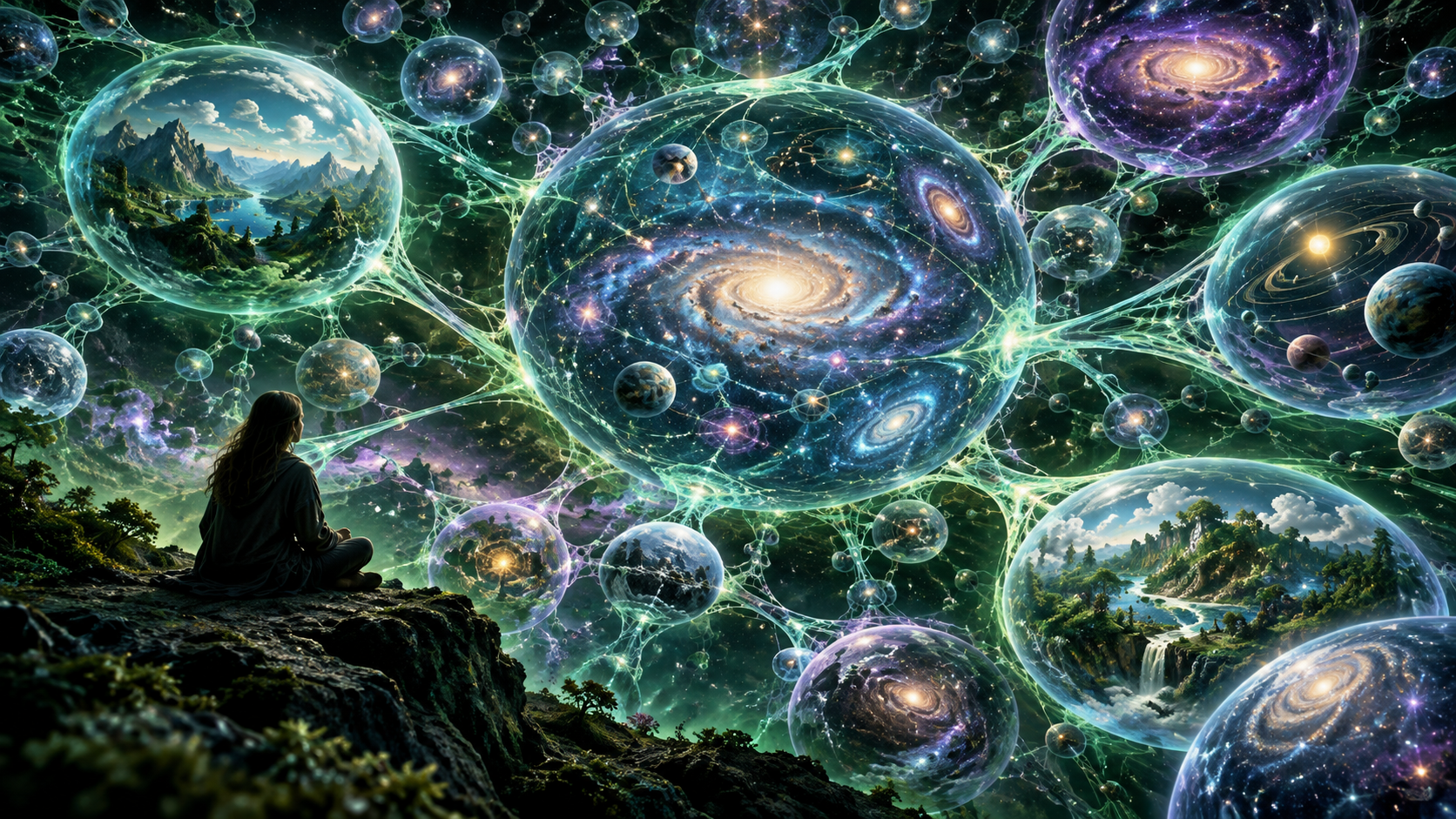
0. Methodological status of the Manifesto
Definition: The TUS is a transdisciplinary copyright model that seeks a common language for relations between information, consciousness, biological systems, free will, communications and a hypothetical wider structure of reality. Part of the concepts are based on commonly observable limitations on perception and human communication; part of the system's inference; part of the ontology of IU, wider information layers, reincarnation or quantum transmission remains a work hypothesis.
Revision rule: where data contravenes the model, the model shall be modified. The aesthetic elegance and subjective strength of experience are not in itself evidence.
Manifest Theory of Universal System (MTUS)
New paradigm for understanding multidimensional reality, consciousness and evolution information
Working Web Edition 0.4.6 - consolidation of manifesto, theory and practice
Motto: "No one is perfect, but we should try..."
Preamble
The Reductionist scientific method is extremely effective in decomposing complex phenomena into measurable parts, but it does not always have to capture emergent relationships, context and subjective experience. The TUS therefore tries to complement the analytical view with a system perspective: to monitor not only the elements, but also the bonds, feedback and time change.
The manifesto uses language theory systems, information and fluidised geometric metaphors. It doesn't declare a metaphor for physical evidence. Its ontological parts have a working model status that must remain open to correction and separate observations from interpretation.
1. Ontological whole (Universal) instead of anthropomorphic God
What mankind has called "God" in the history of myth and religion is not a personalized being, a judge or an emotional entity that requires worship.
- Definition: God is Ontological whole (Universal). It is an absolute summary of all existing dimensions, universes, interspace space, mathematical laws and information fields.
- Characteristics: Ontological whole does not operate on the basis of human morale or mood, but on the basis absolute system harmony, balance and constant balance of asymmetry.
- Fractal structure: Reality is arranged fractionally. Each subsystem (including human) reflects the generative formula of the Universe. We are not separated from Universe; we are its direct, manifest element. Universal experiences and recognizes itself through us.
2. Geometry of Reality: Blending Interactive Environment
In working geometry of TUS we distinguish three levels: Universum as a whole of all that exists; Individual universes as arbitrary systems which may have a different structure and legality; and dimension or realitywhose relations are described by the author's central metaphor intermingling varied smoke in one space. So they intersect dimensions and realitiesnot whole universes, understood as individual sources of smoke.
- The immediate coexistence: Individual dimensions or realities in this model are not separated by solid walls. They can intersect in the same superior space, like two different smoke. Each spring (reality or dimensional layer, not the entire universe) retains its own interaction characteristics ("colour") and internal arrangement. Permeability in itself does not mean data transmission: according to the default TUS hypothesis, these layers are structurally separated by their interaction codes and do not automatically exchange field, object or event data.
- Local Biological Interface (Brain): The human brain doesn't create consciousness. Works like transceiver (receiver and filter) set exclusively to the primary interaction environment of our reality. The task of biology is drastically to limit multidimensional data flow from Universal to a narrow trough of five senses and linear time, so that the 3D organism can survive and perform its tasks in the material world.
- Hypothesis of a more sensitive interface: TUS provisionally allows that exceptional human experiences may involve different operation of the biological information interface. Historical and religious figures can be compared here as sources of experience and ethical practice; they do not by themselves demonstrate an “antenna”, a central information matrix, or data transfer from a wider reality.
3. Cosmogonia: Rhythm of systemic breathing and local reality
In TUS is Universum superior to everything that exists. Individual universes are its specific systems; each may include a different number of dimensions and reality with its own interaction characteristics. Exactly. dimensions and realitiesNot the whole universe, it describes the metaphor of blending colored smoke.
The creation and development of universes is understood as cyclically in the cosmological hypothesis of TUS. The image of rhythmic "breathing" here indicates transitions between the formation, development and possible reintegration of individual space systems; it is not literally a conscious person.
- System exhalation (expansion): The Big Bang is interpreted as an initial phase of development in this hypothetical model One Universe. Within this framework, a specific configuration of local laws and possible realities or dimensions is established. Each such dimensional or real estate layer can be shown figuratively by its own coloured source of smoke. So one color spring doesn't denote the entire universe.
- Structural Real Estate Department: Dimensions and realities can coexist within the superior structure and figuratively intersect, yet they are distinguished by their interaction codes. The blending itself does not constitute a communication channel. The TUS does not assume automatic, let alone immediate exchange of topographical or other data between these layers. On mutual links Different universes no such data sharing mechanism is postulated at this point.
- Local information in our reality: The hypothesis of the bird information network relates solely to the communication of organisms inside one reality, ours. Subjective experience recorded in Annex A, Anomaly I, is not evidence of interaction between dimensions or universes in the TUS. The manner in which complex spatial information may be transmitted between birds remains hypothetical.
- System inhale (contraction): In the TUS model, after the development phase of a particular universe, there may be a hypothetical contraction or other form of reintegration into the wider structure of Universal. According to this hypothesis, the information obtained during its existence could contribute to the further development of the whole. This image must not be confused with an already proven cosmological mechanism or with the process of transforming individual realities.
4. Information units as Universal data probes
Universum in its pure, absolute form of higher dimensions cannot experience local experience, limitations and development. It uses peripheral subsystems for this purpose.
- Soul concept: A tradition called "soul" is defined as Information Unit (IU). In the context of smoke geometry it is a specifically structured, concentrated microvortex in the information field. Works as an autonomous memory unit and data probe.
- Purpose of existence: Every system deployment (life) in the material world serves to accumulate unique experiences and emotional contexts. These experiences enrich, upgrade and expand the consciousness of Universe himself after the cycle has ended.
5. Internal mechanics: Information signature and dynamic compatibility
This chapter systematically develops the internal logic of TUS and transforms metaphors into precise work axioms.
5.1 Information signature ($I _ i $)
The term Information Unit (IU) describes the hypothetical continuity of consciousness across cycles. Information signature ($I _ i $) is an accurate concept for the characteristic arrangement of relationships that clearly identifies this unit. The signature is not a substance, matter, human ego or autobiographic memory. It's a mathematical pattern of organization. Just as the vortex is defined by the specific movement and structure of the liquid stream (not by other water chemistry), the information signature is a permanent imprint in the superior structure of the system that persists even after the disappearance of the local 3D biological manifestation.
5.2 Dynamic compatibility and Self-organisation
The entry into reality of the Information Unit is hypothetically described in the TUS as an emergent self-organisation based on an immediate state, not as an intervention by a personalised control centre. For formal elaboration we introduce working, not yet operated compatibility function:
C(I_i, B_j, E_t)
where $I _ i $represents the hypothetical unit information signature, $B _ j _ information configuration of the emerging biological system and $E _ t $current environment context over time $t. The writing defines the dependency of the proposed model but does not yet determine the numerical form of the function or the actual measured mechanism.
According to the hypothesis, the system responds to current differences and asymmetry similar to the fluid flowing. The emerging biosystem could create conditions of increased compatibility with certain signatures. Terms Information vacuum and magnetic attraction There are analogy, not introduced physical quantities or forces.
5.3 Dynamic information differentiation
The ontological whole is absolutely uniform. However, static, undifferentiated unity could not generate development and change. To bring about the central "life brew and whirlpool", the system applies Dynamic information differentiation principle. By deliberately creating local borders (biological bodies and sensory filters), Universal isolates individual observers. These restrictions place observers in unique information perspectives, creating different experiences that could not arise in a uniform state.
5.4 Open future and moral interpretation of karma
Since the future in Universe does not exist in advance, compatibility function responds exclusively to current state of elements at time t. Compatibility is a purely system mechanical process of self-organisation. It must therefore not be confused with anthropomorphic moral evaluation. Karma in this concept is not punishment, guilt or merit; the suffering of individuals cannot be interpreted retroactively as necessary or deserved, but as a raw context experience of the system.
6. Hyperspace and double selection of reality: Interactions codes and biological filter
The relationship between multiple realities and our consciousness is defined by the principle that we refer to as "Double Castle Reality".
6.1. Colour of smoke as a character of interaction
Term colour in the smoke geometry of the TUS does not indicate visible electromagnetic spectrum, but working markings interaction code - a hypothetical set of rules which differ from one another dimensions and realities. Their sources may intersect in space in the model but remain structurally separate; orthogonal here means intended interaction separation, not already a mathematical proven orthogonality in a defined area of states. A common location is not a communication channel.
6.2. Double selection mechanism
The hypothetical observability of any reality dimension is subject to two filters:
- Structural selection: Given by the architecture of dimensions and realities, which are separated even in hypothetical blending by their interaction codes; their automatic sharing of information is not studied.
- Biological selection: It is given by a local organizational interface (brain) that is calibrated and locked in hardware only to process information from one particular layer of reality.
6.3 Hypothesis of modified selection
The TUS is working on thinking that altered states of consciousness could change the selection and processing of available information content by biological interface; the comparison is the tuning of the receiver. This alone does not show the receipt of data from another dimension or reality. The experience described in Anomaly I refers to the hypothetical local bird information network inside our realityNot to tune into another universe or dimension.
7. Phase Concentration Mechanism (Condensation) to a New Body
The transition of the Information Unit from a timeless state to 3D mass resembles a phase conversion, when invisible steam condenses into a solid, heavy drop.
- Code Condensation: In the figurative model of TUS, the dispersed Information Unit, due to self-organisation relationships, could be locally defined and organised. This transition is compared to the creation of Faith and condensation: it is not the result of the decision of the central dispatcher, but the hypothetical dynamics of compatibility between the signature, the biosystem and the environment.
- Quantum locking: In the material 3D world, conception and embryogenesis occur in parallel. Under a previously unverified TUS hypothesis, the signature could be linked to a biological interface under certain developmental conditions. Images on microtubes, quantum linkage and "locking" memory of past cycles represent possible mechanisms proposednot a brain function detected or a derived physical process.
8. Local localisation (reincarnation) and balancing code
The process of hypothetical entry of the Information Unit (IU) into biological reality and its return to TUS is newly described as self-organisation of the wholenot as a decision by anthropomorphic "central dispatcher." Universal's superior rules are manifested in this concept by the very dynamics of relationships, not by the will of a personal administrator. This is an internal model mechanism, the physical existence of which has not yet been demonstrated.
- Emergent deployment: The emerging biological system, marked by the information configuration $B _ j $, is connected to the current state of the environment $E _ t $in the model. Hypothetical Information signature $I _ i $could connect to such system according to the compatibility function $C (I _ i, B _ j, E _ t) $ Chapter 5. Terms Information gradient, vacuum and Attraction describe the proposed analogy of self-organisation selection; they are not confused with the observed physical forces or experimentally measured variables. In a specific biological configuration, such a connection would take place without a conscious choice of individual ego and without knowing the future.
- Suffering is not a punishment: Life's tragedy, disease, and short life are not a moral punishment or evidence of guilt in this model. The TUS is hypothetically considering that experience arising even under difficult conditions can be part of a wider information history of the whole. However, it cannot be inferred from this that someone's suffering was necessary, predetermined, deserved or caused by the need for the system to obtain data. Compassion, help and responsibility for specific negotiations are of practical importance.
- Re-balancing code: Term Karma The TUS interprets as a hypothetical preservation of the consequences of negotiations in the information signature. The negotiations that created asymmetry could affect compatibility in a later self-organisation cycle. This relationship is not yet mathematically derived or empirically proven. It is not the right to attribute the suffering of particular people back to their alleged past actions.
- Free will and an open future: The biological disposition and circumstances of man create the starting conditions, not the final scenario of all events. Within the framework of the TUS, the scope for free will is understood as an opportunity to respond to the current situation in a new way, to change relations and to influence future developments. This continuous formation of differences and their balancing is metaphorically described as "var and whirlpool" system.
9. Quantum transmission and data leak anomalies
The transfer of information between the higher dimension and the 3D brain does not take place as a propagation of the classical signal through space, but inlinearly and immediately through quantum bonding mechanisms.
- Instant synchronization: The information unit and the physical brain are permanently quantum-bound. The entry of brain experiences into Universe and the return of intuition takes place immediately, without time delay, as one shared multidimensional thread of reality.
- Data flows (Talents): The hardware is formatted when redeployed. However, sometimes a biological filter shows microscopic permeability and occurs data leak from past iterations. This does not manifest as a film memory, but as pre-installed software - exceptional talent, talent or ability (e.g. genius musical understanding in young children).
10. System operators and open future
Evolution of Information Units has no limits. After complete passing and clearing the code within 3D reality, the system is moved to higher spheres.
- Software Promotion: The perfectly cleaned Information Unit is no longer sent to the 3D body as a passive data collector. Under the TUS hypothesis it can be deployed into higher dimensions or other universes to perform structural and managerial tasks; the term "source of smoke" refers to dimension or reality, not to the whole universe.
- The essence of angels: The beings in history called angels or archangels are these highly evolved System operators. They have absolute system justice because they are free from human ego software.
- Time limit: Operators from higher dimensions sees the complete past after the present moment "now" in the whole global context. But they do not see forward into the futureBecause the future in Universe doesn't exist yet - it's not written in advance. Only seconds after a second is coformed through the free will of billions of Information Units. These operators only intervene in human development by means of fine information impulses and synchronisation (coincidences) if the stability of the system so requires.
11. Deconstruction of fear of death: Ego vs. Immortal Information Unit
Fear of death is revealed as system error (bug) in the interpretation of reality, caused by an incorrect understanding of your own settings.
- Ego as a temporary profile: The biological filter (brain) creates an auxiliary program called "Ego" during life. This program is used to protect the 3D body (self-preservation instinct) and covers itself with earthly identity (name, property, relationships).
- End Illusion: Ego is right to suspect that the physical death of his base (brain) will destroy. Because the ego doesn't see beyond the 3D filter, it sees the demise of its profile as the absolute end of everything, and it falls into an existential dread.
- Reality of recycling: Death from the point of view of the TUS is not the destruction of the user, but the deletion of one temporary user profile after the game is played. The very essence - the immortal Information Unit - is not dying. By delaying the body, only the limiting filter is turned off, the ego dissolves and the immortal soul code returns to a smooth, timeless form where the integrated data is passed to the system and prepared for another recycling cycle (new deployment).
12. Calibration and maintenance of the biosystem: a comparative layer
Religious and philosophical traditions contain practical methods for working with attention, attachment, emotion, relationships, and moral conduct. TUS can compare them with its language of filters, noise, and feedback. This is a systemic analogy, not evidence for TUS ontology or a claim that historical traditions described a biological receiver for a wider reality.
- Jesus and relational ethics: Teachings about love, forgiveness, and relations with others can be read as practical methods that reduce lasting resentment and make repair possible. A “software rewrite” can be a useful metaphor, but it does not establish karmic debt or quantum transfer.
- Buddha and work with the mind: The Noble Eightfold Path and meditation offer historically developed methods for working with attention, attachment, suffering, and automatic reactivity. TUS can compare them systemically to reducing information noise and improving regulation of the biosystem. This comparison neither defines the physical nature of nirvana nor demonstrates synchronization with a central information matrix of the Universe.
13. Social subsystems: Free will, ego and limits of understanding
13.1. Why is the social plane part of the TUS
The theory of the Universal System describes reality as a structure of relationships, feedback links and locally limited perspectives. At the level of human life, this framework is not reflected by the fact that cosmological forces directly determine political history. More useful is analogies between organisation of information in the system and how people perceive, interpret and communicate reality. In this chapter, no nation state is "another universe" or any ideology "another dimension." These are different mental and institutional models the same shared reality.
The main question is not "why does Universal create conflict?" "why do people who share one world often fail to agree on what they see in it and how they can freely influence their answer?"
13.2. From reality to understanding: several layers of filter
Consider object or event O. Every observer gets a certain amount of reality. PBH (O). It connects with knowledge, experience, language, emotions and expectations to interpretation IBOR, which is then compressed into a statement SET. The beneficiary hears the statement, not the entire original context. That's why there's another interpretation. IBCs (IBCs).
O \longrightarrow P_i(O) \longrightarrow I_i \longrightarrow S_i \longrightarrow I_j(S_i)
This string takes the basic resolution from BazookaWEB Why don't people understand each other?. It doesn't explain supernatural data transmission, but it shows, where the meanings of normal communication may differ. The same word can denote a different mental model, a short sentence can condense years of experience and apparent consent can actually be just courtesy, conformity or an attempt to end the dispute.
The biological and psychological filter has a distinctive meaning in this social application: attention and sensory limitations, previous experience, knowledge structure, value assumptions and social pressure. It is not proof of the existence of other dimensions, nor of the literal tune of two people to different "smoke colours."
13.3. Ego: protection of identity and barrier of repairs
Ego in TUS indicates temporary organizational core personal identity. It is not evil in itself: it allows for orientation in its own story, to preserve borders and to defend itself against threats. The problem begins when protection of the image outweighs the effort to understand things.
One does not have to respond to the content of the message, but to what the message means to him: 'I am not an expert', 'I am losing authority', 'my group is wrong', 'I would have to apologize'. Fixing the facts will turn into a fight for status. Ego can select, downplay or transform information so it doesn't have to change the beliefs. Such a procedure is not a prerogative of one level of education or ideology.
The difference between ego and critical thinking: Healthy self-esteem allows you to say no; a defensive ego rejects well-documented correction just because it sees it as defeat. The objective of the TUS is not to "delete ego," but to reduce its power over how we treat arguments and other people.
13.4. Free will as an answer space
The TUS assumes that the entry conditions are not fully under individual control. Our lives are shaped by biological disposition, environment, education, circumstances and limitations. We do not therefore see free will in this model as absolute independence from causes, but as space in which we can reflect an automatic reaction and change it as possible.
This is where the filter and ego meet:
- Complaint: I'll meet with unpleasant claims or criticism.
- Automatic response: Defending status, attacking, twisting, or stopping listening.
- Conscious recognition: I'll separate the facts, interpretation, interest and my own sense of danger.
- Selected answer: I can disagree factually, verify the source, admit the error, ask for an explanation or set a line.
Not everyone is as easily available; stress, illness, social inequality or threats can significantly narrow the room. That is why free will is not an instrument to blame people for all their living circumstances.
13.5. Why people don't understand each other - seven different mechanisms
Behind the "we don't understand each other" sentence, there may be qualitative differences:
- Data non-compliance: One person doesn't know something or has the wrong information.
- Non-conformity in terms of: The same words refer to different things.
- Disagreement in perspective: each sees a different part of the same object.
- Mismatch in the causal model: people know the same facts, but otherwise explain their causes.
- Difference in expertise: The short wording of one hides assumptions that the other does not have.
- Defense of ego and status: the public recognition of errors shall have a subjectively high price.
- Actual conflict of values or interests: people understand each other, but they want different results.
TUS can help Recognize the type of disagreementnot explain everything with one universal noise.
13.6. Person to company: filter accumulation
Institutions are not one brain or ego. They are composed of people, information channels, hierarchies, rules, duties and incentives. The same plot can be seen by an analyst as a legal problem, a diplomat as a bargaining chip, a soldier as a security risk and a citizen as a threat to his own life.
That is why BazookaWEB's political texts on veto law, international law, US paradox, or long-term power patterns have a meaningful connection to TUS: they follow, how selective perspectives, interests, public roles and decisions of individuals are composed into institutional results. It is not the cosmological evidence of TUS and, even less so, the claim that war or multipolarity are "physically inevitable."
For example, veto is an institutional rule with specific history, motives and legal implications. The "blocked feedback" analogy can explain why dealing with certain crises is difficult, But it is not proof that nature must subsequently incite war. Political decisions are the responsibility of their actors.
13.7. Why understanding is not enough - but still worth
Better communication alone will not remove conflict about territory, resources or security. Sometimes both sides know exactly what the other wants and that is why they are in dispute. Difference misunderstandings from conflicts of interest is a necessary condition for the fair use of TUS in the social area.
Yet understanding is important. It can prevent misescalation, expose false consent, improve the real limits of compromise and allow action without humiliating the other party. Free will is manifested here as responsible work with power: the ability not to abuse the advantage, not to call any disapproval as hostility, and not to hide your own interests as a pretend universal truth.
13.8. Ethical principle and method "Observer D"
Of Article Why don't people understand each other? we take over the work figure Observer D. He may not have direct access to the absolute truth. His advantage is the ability to reconstruct different perspectives so that he understands why they were created, and at the same time he was able to examine their mistakes.
Practical sequence for TUS:
- What did I really observe and what is my interpretation?
- Which data or experience does the other side have?
- Do I disagree with the threat to my identity?
- Is this about facts, values, status, or interests?
- What makes me think I'm wrong?
- How do I answer to preserve my own borders and the dignity of others?
Motto TUS: "No one is perfect, but we should try..." In this chapter, the aim is to better calibrate your own judgment and the conscious treatment of freedom of decision. It is not a requirement of infallibility or passive consent.
13.9. Scope and boundaries of social application
Here we use system analogy, not cosmological causal law. The conclusions on the functioning of communication, ego, institutions and conflicts must be verified by psychology, sociology, history, law and concrete sources. Claim on the interaction codes of dimensions, information signatures or their postmortem continuity not confirmed by this Chapter. The benefit of the TUS application is the framework for integrating perspectives, monitoring links and responsible decision-making, not replacing empirical analysis.
Thematic links to BazookaWEB: Why don't people understand each other?, Methodology of political science articles, UN, veto and reform of multilateralism, American paradox, Power Pattern, Terrorism and International Law.
13.10. Attunement, genuine understanding and ego pseudo-resonance
In TUS terminology, attunement a long-term process in which one continuously weakens automatic egos management and learns to maintain a calmer, wider and less defensive perspective. It's not about rank, definitive status, or evidence of higher human value.
Two people who are similarly tuned can very quickly recognize the harmony. They do not have to constantly prove their own truth or position; their communication may be more economical, because they are both naturally directed towards understanding, self-correction and harmony. They may differ substantially in specific opinions.
TUS also distinguishes Ego pseudoresonance: two untuned people can "understand" very well if they confirm each other's own status, injustices, prejudice or need to win. Conformity itself is therefore not proof of tuning.
The asymmetry of recognition is possible: a person with long-term experience can be more sensitive to the defence and status reactions of the other, while the other interprets his peace through his own expectations. But this feeling is not infallible either. Every belief "I see the other right" must be subject to the same self-control as other judgments.
13.11. Specification of free will: chariot and horse
For the relationship Information Units, emotions, egos and free will uses the TUS old, graphic metaphor the charioteer and the horses.
- Wheelchair represents a conscious observer and the ability to choose direction.
- Horses represent emotions, instincts, instincts and rapid reactions of the biological system.
- Harness represent the attention, self-regulation and ability to create space between impulse and negotiation.
- Car represents the biological body and the nervous system.
- Path represents specific living conditions that one does not fully control.
When the horse rushes, the chariot consumes almost all the capacity to maintain the team. If the horses are calmer and react to the reins, they can follow the path, the surroundings, and more aware to choose the next approach. The goal is not to remove emotions. The goal is not to let emotion and ego automatically decide instead of conscious choice.
Therefore, tuning requires almost continuous practice. After a long and consistent work, ego can be significantly moved into the background, but it never becomes a reason to believe that one can no longer succumb to self-deception.
13.12. Permanent self-deception control
It's the feeling of self-tuning that can take over the ego. Therefore it is part of the TUS constant doubt about own calibration. One should constantly ask whether one is acting out of peace and effort to understand, or whether the ego has only found a more sophisticated way of winning.
Practical control issues:
- Am I responding to actual content or to feeling threatened by my identity?
- Would I be able to admit that I'm wrong about this situation?
- What would convince me otherwise?
- Am I trying to understand each other, or am I waiting for him to acknowledge my view?
- Don't I use the term "tuning up" as a new way to feel higher than others?
- Am I really calm, or did my ego just find a calmer way to be right?
This check is not a one-off test. It is a permanent part of working with ego while protecting against the TUS becoming another identity that one uses to promote itself.
These articles provide context and examples of human systems; they are not evidence for TUS cosmology.
- Proč si lidé nerozumějí / Why people misunderstand one another
- Metodologie politologických článků / Methodology of political-science articles
- OSN, veto a reforma multilateralismu / UN veto and reform
- Americký paradox / The American paradox
- Power Pattern
- Terorismus a mezinárodní právo / Terrorism and international law
13.13. Related BazookaWEB articles
Conclusion of the manifest
The manifesto proposes a shared language for exact knowledge, personal experience and systemic relationships without presenting these domains as proof of one another. Within TUS, a person is understood as an active participant who can cultivate perception and response. Hypotheses about the fluid nature of reality, quantum relationships and consciousness remain open parts of the model; the practical conclusion is more responsible work with one's own filter, not a claim to final knowledge of the Universe.