Politics · Economic History · International Relations
From Trade to War
Who began with the power pressure, how his mechanisms were transferred between states and where long competition became concrete decisions that unleashed two world wars?
Last updateEurope / Prague
Article
Length and reading time29 079 wordscontinuous: standard ≈ 146 min · slower ≈ 224 minstudy: standard 190–219 min · slower 291–336 min
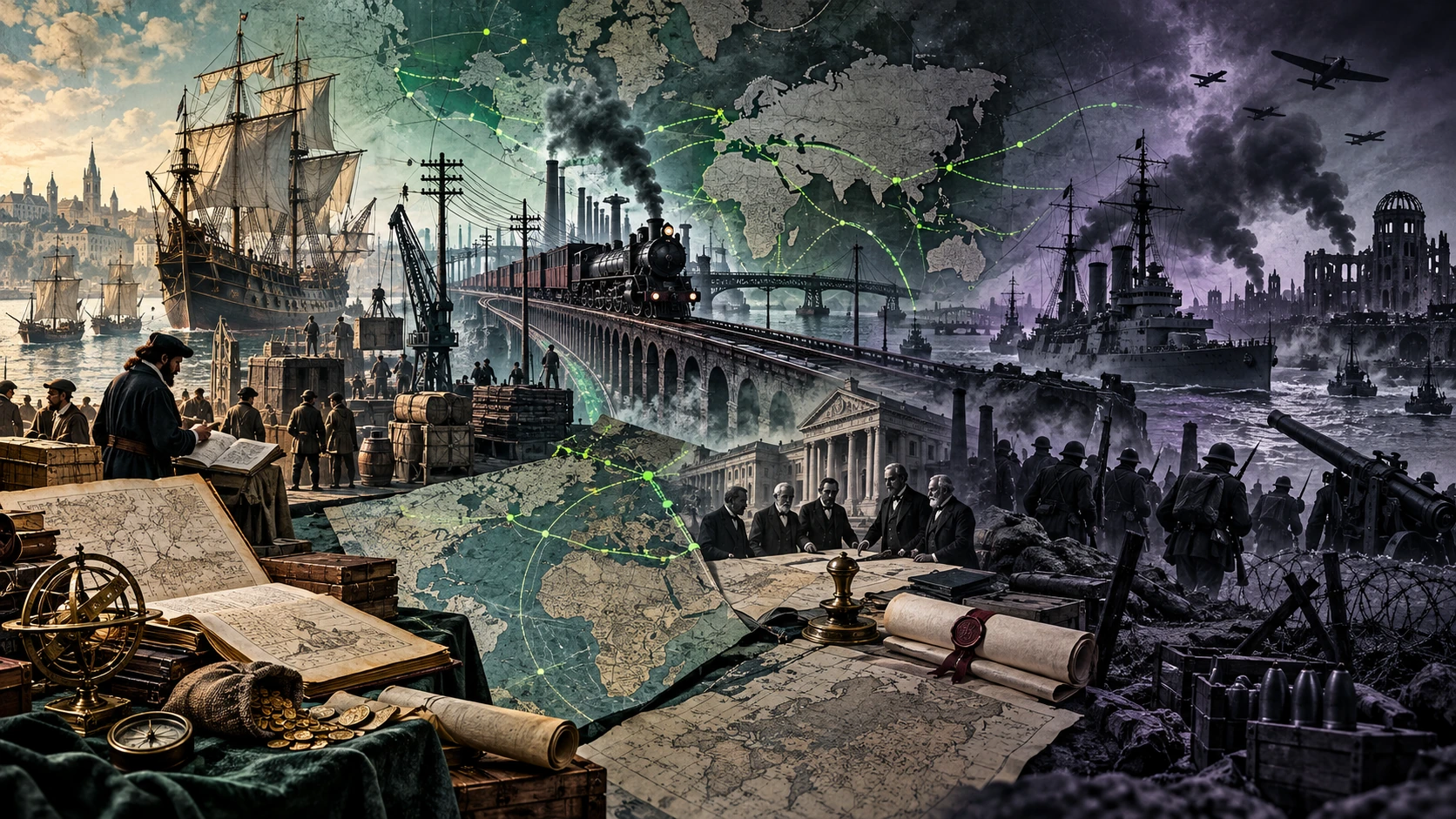
From trade routes to war mobilization. The digital authors' illustrations created for this article; historical synthesis, not a single event record.
01 / Historical study
We're not looking for a single date. We're looking for decisions that have changed the rules.
When did the world wars start? The answer "1914" and "1939" is only correct when we talk about specific military conflicts and their conventional dating. The whole other question is, who first started to promote economic or strategic interests through military pressurehow this kind of action spread among the powers and when the decision-making chains became a conflict crossing the borders of continents.
The initial graphic chronology of 1934-1939 resembles actual events, but it may distort interpretation by selecting and graphical equality of agreements, ultimatum and aggression. Therefore, we do not accept it as a finished interpretation: we verify individual data and complete a much longer time context. This text offers a long genealogy of global power competition from the Portuguese expansion of 1415 to 1945. Year 1415 is by claiming the first ever aggression: the conquering empires existed millennia before. It is an analytical beginning to the selected story of European overseas expansion, which allows for the combination of commercial interests, military pressure, colonial governance and the world market. [ceuta]
Main resolution
Create conditions for war Calculation to decide on war → Start aggression. We will therefore assign each event to the actor, documented action, mechanism, immediate consequences, follow-up decisions and degree of certainty of the link.
The method of work follows the analysis Power Pattern: the power creates a space for political, economic or security ties and uses trade, contracts, finance, alliances, sanctions or strength, depending on the degree of resistance. This model is test hypothesisNot by "one state behind everything." Local companies and governments have their own interests and decision-making space.
02 / Historical study
How do we know the escalation chain - when it cannot be proven?
Economic / security interest
→
Application
→
External pressure
→
Reaction and arms
→
Next crisis
For every article in this sequence, we have to ask: Who was the specific decision to be taken? Was it the government, the army, the business company, the diplomat, or the local political movement? What do contracts, records of meetings, production statistics or military orders prove? Is there still a connection at the level of historical analogy, or can the transmission of information, resources, people or specific decisions be shown?
A · Direct Document
Text of the contract, order, period correspondence, statistics or generally accepted date.
B · Substantial interpretation
Historical interpretation linking documented events; causal link is argued, not mechanically guaranteed.
C · Hypothesis
Possible interpretation that requires additional sources or comparison with alternatives.
The control case is as important as the successful escalation chain. Sometimes powers have met on the ground and yet they have decided not to start a war. If research only records cases where war followed, it will mislead the impression of inevitable.
Question
What can be documented
What's not coming out of it yet?
Capacity
supply of raw materials, credit, licences, ships or weapons
that the supplier managed a later political decision by the customer
Intent
order, memorandum, contract, minutes
that the plan was implemented exactly according to the original plan
Trigger
ultimatum, mobilization, incident or specific military order
that the trigger itself explains the long structural causes
Liability
who had the power to choose between the available options
that the former pressure automatically relieves the latter of responsibility
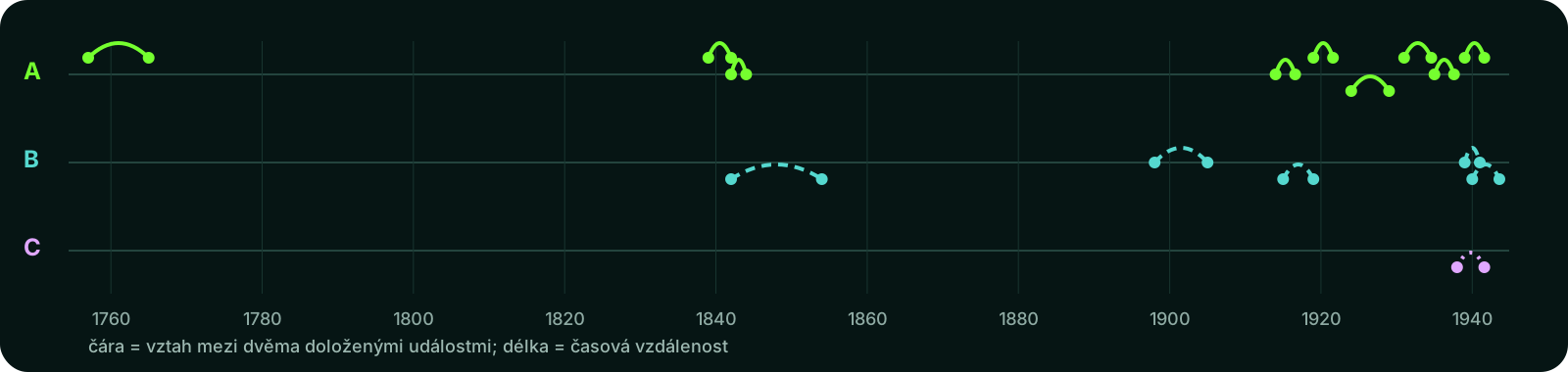
A network of causal links. The full line indicates a direct document (A), an intermittent, supported interpretation (B) and a dotted disputed hypothesis (C). The scheme is a copyright visualization created for this article from the attached data table.Research tool
Time axis of power escalation 1415-1991
Filtering selection of significant events, not mathematical proof of their causal connection. The slider adds historical events to the selected year. The older centuries are condensed to the period from 18. The century has been given more space; the button can be switched to the detailed scale 1750-1991. The timeline continues from the end of the war to decolonization and Indochina to the collapse of the Soviet bloc. It follows separate articles about Indochina, Decolonization and World Order and US interventions after 1945.
1991
141517001800190019451991
Space View
Map of expansion, spheres of influence and conflict
The map uses the same year, area, mechanism and search term as the timeline. Points indicate the location of events; the colour areas and routes indicate where the control or the power range was extended during the period. It's not a precise reconstruction of historical boundaries.
eventwar or military actionsphere of influence or controlled territoryroute of expansion or power transfer
The map captures events in the selected year.
Areas are deliberately schematic: they express the direction and scope of the process pursued, not the exact state border in each year. Click on the point or area to see the explanation and link to the source.
CHAPTER / 01
1. Why seek the beginning of trade and overseas expansion
When we ask who "started" the process leading to world wars, we must not mix up a few different questions. One concerns the beginnings of armed coercion in history; there was no modern state or European power first. The second concerns the moment when trade, maritime force and territorial power began to interconnect into a regular global system. The third is heading for immediate decisions of 1914 and 1939. A historian can answer each one differently without speaking against himself. It is these differences that form the methodological basis of this study.
The Portuguese conquest of Ceuta in 1415 is a usable beginning for one particular development line: European ocean expansion. But it was not the first time the business city was conquered, or the first time the violence had an economic motive. The Portuguese expeditions combined dynastic and religious ambitions, profit-seeking, traffic control and an effort to penetrate established trade networks. There is a dispute over the exact order of motives; good history must therefore avoid the statement that Ceuta had one clear plan to dominate the world. The result was to obtain a strategic location that enabled further operations and provided experience in managing the overseas point of support. They shall inform of the wider chronology Smithsonian National Museum of Asian Art and professional text Encyclopaedia of Portugal Expansion.
In the 15th and 16th centuries, remote areas were getting more intense contacts. Seagoing has made it possible to move goods, soldiers and information faster between the coastlines of Africa, America and Asia. Without maritime technology, financial institutions, maps and navigation, overseas expansion would not take place at the same rate. But he himself did not determine the technical progress: the decisive was what the monarchs, business consortia and cruise commanders used it for. The same ship could be used for exploration, trade, diplomatic action and port blockade. If we want to describe the Power Pattern later, we need to capture this transition from power to decision.
In many cases, there was a regular sequence. First, traders sought access to a commodity or port; then they demanded exemptions from local rules, warehouses and fortified stations; then they demanded military protection and the right to intervene in local politics. But such a sequence is not a universal historical law. Some trade ties existed long without direct colonization and local rulers were able to negotiate or restrict the presence of Europeans. The balance of strength and the local political situation, not the mere arrival of a merchant ship, were crucial.
Moreover, America's conquest has marked disastrous changes for the indigenous population: not only military subjection, but also forced labor, population movements and epidemics. To explain the European empire only by succeeding in technological development would mean to overlook that its costs were paid primarily by the people whose fate was decided without their consent. Here, for the first time, the distinction between the law, as expressed by the European power, and the real possibility of others to reject it, is shown sharply. For the purposes of our study, it is not necessary to argue that each European country has acted the same way. More importantly, it is to be shown when and how similar instruments appeared in different actors.
The resulting power order was not only made up of direct colonies. Privileged ports, trade monopolies, capital loans, protection contracts, diplomatic guarantees and alliances were important. In one area, the governor and the military crew could decide, in another company with a royal charter, and elsewhere, the local government, economically linked to foreign trade. This is why the term "colonial expansion" cannot be reduced to colour the map. If the article only recorded direct anexuals, it would overlook part of the mechanisms that created inequality between states.
There is another important distinction. The long-term structural link between European expansion and the emergence of the world market is not the same as the demonstrable chain of orders leading to the First World War. No one can reliably draw a single line from the Portuguese King John I. to the German Emperor Wilhelm II. In 1914, specific people acted in a particular political situation and had alternatives. Colonial history has given them some possibilities, conflicts and ideas of prestige; it has not given them a decision to attack. Therefore, the study in each chapter separates the long duration of the system from the short duration of the diplomatic crisis.
The beginning of Ceuta is therefore of limited importance: it allows monitoring of the creation of an international network in which trade privileges increasingly rely on armed force. It is not a judgment that the Portuguese "caused both world wars," but a research choice that can compare similar instruments at different times. The actual responsibility for each subsequent step must be demonstrated separately. This is true even when some historical analogies seem to us to be remarkably similar.
CHAPTER / 02
2. Where to begin? Tordesillas, Ceuta and rules of the adoption of the distant world
The search for the first agent of world wars must not change in the search for the first person to ever attack a neighbor. That would lead us to ancient times and would not explain anything important. More meaningful is to determine when the Global competition infrastructure: long-distance shipping, port hubs, state-owned commercial monopolies, military superiority on the oceans and treaties whereby powers granted rights to other companies. 1415, when the Portuguese army conquered Ceuta, is a useful entry point for this institutional history; however, it is not the date of the "first causes" wars of 1914 and 1939. The University of NOVA in Lisbon explains the importance of Ceuta in the history of Portuguese overseas expansion: Encyclopedia of Portugal Expansion, Ceuta.
The Portuguese didn't control the Indian Ocean with a single battle. They needed a network of points of support, passages and deals with local rulers. The conquest of Goy in 1510 and Malakka in 1511 was significant because the ports served as hubs of trade and military routes. In addition to the direct occupation, there were tributary relations, ship's IDs, threats of blockades and violent enforcement of the monopoly. Local traders were not merely spectators of the European arrival: they created alternative networks, negotiated and sometimes fought. It was not a simple transition from "free trade" to its European control; the Indian Ocean had its own rules, powers, wars and commercial institutions before Portuguese expansion. The new feature was a combination of ocean-wide range and state-protected armed control of maritime routes. For wider material see Smithsonian National Museum of Asian Art: Encompassing the Globe.
The Treaty of Tordesillas, 1494, concluded by Castile and Portugal, is presented as a division of the world. More precisely, it is said that two Iberian courts have defined their sphere of overseas entitlement; the power of the parties to the contract did not automatically affect the inhabitants of the territories they had decided on without their participation. In our analytical model, this is an important early demonstration of the legitimacy mechanism: the agreement between strong players changes their mutual claims, but it does not show third parties' consent. A similar problem will return to the Berlin Conference on Africa, and to the decision-making process of China after the First World War. At the same time, it would be a mistake to regard all these contracts as legally or historically identical: they had other subjects, other participants and a different context.
The chain that can be demonstrated here is an institutional, not a direct military, cause of 1914. The port's occupation has expanded its trade control capabilities, helped finance further expeditions, and competitors responded by their own maritime and colonial projects. It does not mean that Portugal "started world wars." It follows that a mechanism can already be seen in the early modern times, when economic infrastructure, military power and legal entitlement are jointly represented.
It is also useful to note for comparison the situations where European powers had to retreat. Maritime domination did not mean the permanent and complete subordination of every Asian port. It is precisely the variability of power ratios that helps separate the model from the idea of a one-way, predetermined march of European domination. Portugal has brought to many places the technology of armed long-distance trade, but local companies and other European powers have consistently challenged its claims. The historical cause of long-term competition was not one signature, but a recurring decision on who can determine trade rules by force.
CHAPTER / 03
3. Atlantic, forced labor and economic logic of imperial power
One of the hardest examples of the link between trade and violence was transatlantic trade with enslaved Africans. The violent drag-off, transport to America and forced labor on plantations or mines cannot be described as mere trade. Those seeking a "formula of power" must also include the fact that a significant part of wealth and production capacity was created in the suppression of the freedom of specific people. Economic profit was not a by-product of the system; it was the main reason for maintaining it for a number of participants.
This system included traders, insurance companies, credit houses, shipyards, planters and state bodies. The relationship was not always smooth: governments could impose tariffs, private companies sought privileged status, and competing states argued over islands or trade routes. Nevertheless, there has been a steady practice in which the armed protection of maritime routes and ownership institutions also served to reproduce the law enforcement economy. Specific groups of persons and routes carried may be based on a database SlaveVoyageswhich allows to link aggregate estimates with individual voyages. In the article, we deliberately do not convert trade volumes into alleged "percentage blame" of individual nations; this would confuse historical statistics with non-existent moral metrics.
Special attention deserves the possibility of resistance. The enslaved people in history did not only act as an object of foreign action: they resisted, fled, negotiated, formed their own communities and participated in the uprising. Likewise, African companies were not the only homogeneous group. Local states and trade networks had different relations with European buyers, and their attitudes have changed. We must therefore not take the image of Europe as the only actor acting, while the rest of the world is simply responding. Ironically, such an interpretation would repeat the way some colonial authorities think.
In particular, the imperialist competition has created material and institutional preconditions for conflict to be linked to later world wars. Colonial territory could serve as a source of finance, raw materials, naval bases, soldiers and political prestige. The countries that competed in Europe also argued for trade and control overseas. Their conflicts could therefore be transferred between continents. This explains the global reach of some wars, but it does not explain in itself why war was chosen in a particular year instead of compromise.
Experience with colonial categories is also needed when comparing documents. The Western diplomat could have described a forced treaty as a free arrangement between governments; the local negotiator could have seen it as the only way to prevent the bombing of the coast. Both documents then use the same name "contract ', but the circumstances of the signature are not equivalent. That is why the study distinguishes the way in which we negotiate: a voluntary compromise, asymmetric negotiations, an ultimatum under threat of force and occupation. In the history of power, the process is often as important as the resulting signature.
However, it would be a mistake to measure European negotiations in the sixteenth century by a mechanically later UN Charter. There was no prohibition of threat and use of force in the form known after 1945. That doesn't mean we have to deter the older violence. This only means that we must base our legal characterisation on the standards, treaties, debates and gradually evolving rules. The historical condemnation of forced labour and murder is not the same as the retrocession of a particular modern crime. It is the careful separation of moral, historical and legal judgment that gives the research precision.
Another partial conclusion arises from the Atlantic case: trade and war are not two separate areas that sometimes meet. In certain arrangements, trade itself requires a permanent enforcement regime and state power protects its economic return. This is a fundamental motive for our later analysis of opium wars and Japanese raw materials supplies. It does not, however, mean that any business relationship promotes aggression or that any subsequent trader shares the objectives of the State to which it sells. We must always prove the relationship between exchange and violence specifically.
CHAPTER / 04
4. Business companies as political power: India and the Seven Years War
The British East India Society is an extremely valuable case study to find the beginnings of the power formula. It was created as a privileged trading company, but gradually possessed its own armed forces and intervened in the administration of the territory. The decisive milestones were the battles at Plassey in 1757 and at Buxar in 1764. The British Parliament explicitly describes how society, thanks to military victories, has turned into territorial and political power that has dominated the incomes of the Bengal, Bihar and Orisa regions. For the history of power mechanisms, this is a directly documented transition from business privilege to factual administration and tax collection. British Parliament: Parliament and the East India Company.
In this transformation, it is not simply possible to separate private and public. The company was an enterprise with an interest in income and risks, but it also used the army and sought political security of its positions. At first, the British State was not the direct administrator of every move it made; but later it had to respond to its crises and began to control the trade empire more closely. For our model, it follows that "who started" may not always be a government. A historical actor may be a private-law organisation with a state privilege and a capacity to use coercion. To automatically credit all of her actions to one person or to one government would be inaccurate.
At the same time, domestic political forces and interests were colliding on the Indian subcontinent. The East India society did not move in the air-void: it entered into conflicts with local rulers, it made alliances and it benefited from existing contradictions. The absence of a single political centre made it easier to intervene, but its achievements were not predetermined. We should therefore distinguish between British command decisions, domestic allies, economic motive and a specific military operation for each war. It's the only way to understand why society has succeeded somewhere and found resistance elsewhere.
The seven-year war from 1756-1763 shows another stage of development. The conflicts between Britain and France and North American possession and trade in India have been linked to European competition. There was also a war at sea and in the Caribbean, with the regional struggle not only of European soldiers, but of allied local communities. National Army Museum Points out that this war can be considered as one of the first global wars; Smithsonian Stresses the involvement of more continents. However, this characteristic is not consistent with the conventional designation "World War I," which historical terminology usually reserves the conflict beginning in 1914.
Here we can test what a global escalation network means. The border conflict in North America did not automatically proceed as a struggle in Germany or India. The transfer needed diplomatic decisions, alliances and strategic calculations: who can support who, how to protect trade routes, how to use the weakening of the opponent in another area. The war was not a "plague" without actors, but a sequence of separate decisions that responded to each other. In the twentieth century, a similar distinction will be needed to examine how the conflict between Austria and Serbia has turned into a general European war.
At the same time, the results of the seven-year war have transformed other policies. Britain has strengthened its position in North American holdings and India. France lost some of its direct opportunities to compete in the same space, but its interests did not disappear. War debts and fiscal demands have been burdened by governments and influenced their relations with the subjects. This reminds us that any power expansion can create new commitments that future generations need to finance. Victory can therefore also create future conflict: the controlled territory must be managed, defended and economically integrated.
We are getting two analytical tools from the comparison of the East India Company and the Seven Years' War. The first says that a private economic operator can gradually acquire public military and administrative power. The second shows that geographically separated disputes can be combined through alliances and economic links. None of them yet prove the cause of the war in 1914. But they both explain why the great powers were entering a new European crisis with a branched network of commitments and foreign interests, which was difficult to separate from domestic politics.
CHAPTER / 05
5. Bengal: society, tax return and armed power in the same hands
The British East India Company offers an extremely well documented case in which the trade organisation has turned into a territorial power. After the victory at Plassey in 1757 and at Buxar in 1764, it expanded its influence over the collection of revenue in Bengal, Bihar and Orisa. The British Parliament directly links military victories to control public revenues in the overview of society's history: UK Parliament: Parliament and the East India Company. It was not a simple colony managed by the Ministry from the outset; corporate interest and political sovereignty were overlapping in an institution that the British state needed to control at the same time.
The accounting side of the story is crucial to the relationship between trade and war. Tax control allowed for military, official and other expansion, while the war could open up a new source of income. This is how it arises feedback mechanism: economic power finances military capacity and military capacity changes the rules on revenue collection. However, we must add local rulers, bankers, traders and military units to the scheme, because the company was unable to enforce control without Indian allies and extensive cooperation. Local actors were able to act in their own favour, but at different stages they had very unequal negotiating options.
The famine in Bengal in 1770 shows the danger of reducing the government's economic consequences to cash-only revenues. The disaster took place in climate change, agricultural vulnerability and hard fiscal requirements. Historian John R. McLane describes the high mortality rate and the fact that the company did not reduce its requirements for part of the surviving population after famine: Cambridge University Press, The Famine of 1770. It is not right to argue that a single tax policy has created famine; but it is justified to examine how the fiscal regime has affected the company's ability to respond to a disaster.
In 1773, parliamentary regulatory action followed and London's intervention continued in the next decades. The British Government itself saw that a private company had powers with public implications, while at the same time it could create a financial crisis. One more link is therefore essential for Power Pattern: the private contract does not operate outside the State. The state can grant the company a monopoly, guarantee security, provide the army, regulate it and then take over its government functions. It is therefore not enough to catalogue only kings and generals in the story of empires; businesses, banks, concession companies and institutions must also be in the records capable of redirecting commercial interest into power over the population.
The Bengal case is part of the remote genealogy of the modern international order, not among the direct causes of the 1914 crisis in July. It is important primarily as a comparative laboratory: here is a mechanism of trade-fiscal pleasant- military-territorial power to see almost step by step. When applying for later periods, we must ask whether such continuity is really repeated, who is managing it and whether there is no alternative explanation. For example, if the state buys weapons but does not use them against its neighbours, it is not proof of an existing aggressive plan; if the company sells the machine, it is not automatically a codecision on a future invasion.
CHAPTER / 06
6. China before the opium wars: a clash of ideas about trade and sovereignty
In Europe's popularization stories, the first opium war is simplified to a conflict of "isolated China" with "free trade." That image is not accurate. The Qing Empire maintained extensive internal and international economic ties, and European societies came to the Chinese-Asian area in which there were established rules, trade hubs and power relations. The possibility of exchanging goods was not in conflict, but also the question of who will determine its conditions, who will have diplomatic privileges and whether foreign buyers will be subject to local jurisdiction. Europe was not a single player: British, French, Dutch and American traders had different interests, even though they were following similar privileges on some issues.
The British opium trade produced in the Indian colonial system has turned economic exchange into a major political conflict. The Chinese authorities have dealt with smuggling, the social and financial consequences of consumption, and their own authority in law enforcement. In 1839, Commissioner Lin Ce-sú sought to stop imports and the Chinese authorities seized large-scale opium stocks. From a British perspective, it was also an intervention in the interests of traders and a dispute over the treatment of British subjects. The British government has finally used military force. It is necessary to consistently distinguish the government's arguments from the outcome of the case: a military victory has created new rules of foreign trade according to the demands of a victorious power. Documents and period materials offers The National Archives: Hong Kong and the Opium Wars.
Nanking contract of 29. On August 1842, she opened five ports, confirmed Hong Kong's transfer to Britain and set financial performance. It is necessary not to repeat frequent inaccuracies: not all later privileges of foreigners come directly from this one document. Significant additional commitments appeared in successive agreements which extended consular powers and the legal status of traders. For legal analysis, this means monitoring contract chain"not to replace 1842 with the only signature" that allegedly created the whole "system of non-equal contracts."
The United States was not the main assailant of the first opium war, but after the British victory, it was the Wang- sia contract in 1844 that it had earned its own benefits. American Office of the Historian He directly explains that Washington was looking for privileges similar to those acquired by Britain. This continuity is a strong example of our analytical model: the victory of one power will create a new environment and another state can gain similar benefits without its own invasion. However, this does not imply the same responsibility for the conduct of military operations. The British Government decided to intervene; the US Government subsequently used China's changed position diplomatically.
In the second opium war, which developed in 1856-1860, Britain once again intervened and France was a major ally. As a result, further enlargement of foreign rights and the opening of new places for foreign presence has been achieved. In 1860, Beijing was looted and burned down by the Old Summer Palace in the Allied advance. The extent of material damage and violence against the population cannot be accurately expressed by one universal figure without the definition of springs. The precise nature of the use of force is important: the objective was not to defend the British territory from the Chinese invasion, but to change the circumstances within the Chinese diplomatic and commercial space. A brief chronology and diplomatic context provides US Ministry of Foreign Affairs.
But China was not exclusively a passive object of foreign intervention. The Qing government has been dealing with large domestic uprisings, fiscal problems, regional power networks, and the need to reform the military and the economy. These circumstances have complicated her dealings with foreign powers. Therefore, we must not settle for a single formula "the West was strong, China was weak." The difference in military technology played a significant role, as did organisations, decision-making and internal conflicts. Various reform attempts show that Chinese players perceived the possibilities of modernization; however, political and institutional obstacles caused them not to be introduced in the same way as the Japanese after 1868.
Let us also distinguish the short and long-term perspective. The wars immediately meant territorial, financial and legal concessions. In the long run, they have become a source of political memory and an important argument for reforms and nationalist movements. The later term "century of humiliation" explains the importance of conflicts in historical memory, but it is not in itself proof that all Chinese politics of the following century was the only response to British negotiations. Historical motives change and new generations act in different conditions. The importance of opium wars for the creation of World War II is therefore sought through specific transfers of experience and institutional changes, not in the idea of inevitable retaliation.
For our article, the opportunity to show three different aspects of a single event is extremely valuable: British arguments for the protection of trade and citizens, Chinese arguments for the application of their own laws and American efforts to obtain subsequent contractual benefits. Such tripartite comparisons protect the text from unilateral. It also illustrates a major point: different states did not have to participate in the same invasion to gain benefits from its outcome. If we want to reveal the extent of direct and indirect participation, we must name each of these negotiations separately.
CHAPTER / 07
7. Opium wars under scrutiny: when trade disputes turn into a restriction of sovereignty
Opium wars are called the British drug right. This formulation describes the important dimension of the first war, but covers the broader design of trade, customs and diplomatic claims. British demand for Chinese products, Indian opium trade and a limited foreign trade system in Canton created long-term tensions. Chinese officials have tried to suppress illegal opium imports while defending the right of the empire to set rules on its own territory. When Lin Ce-sú's official seized opium supplies in 1839, the British government chose a military response. The Nanking Treaty, after the defeat of China in August 1842, provided for Hong Kong's withdrawal, port opening and compensation; the period documents explain the British National Archives: Hong Kong and the Opium Wars.
It is important to distinguish the war objective, the text of peace and the successive regime of rights. The Nanking Treaty itself did not contain all the legal mechanisms which subsequently created the network of contract ports. The additional contracts governed consular jurisdiction, customs duties and special privileges of foreign nationals. In 1844, the United States received similar privileges by the Wang- sia Treaty without taking part in the first opium war. This is precisely the causal link: Britain's military victory has transformed the diplomatic possibilities of other powers. The US State Department reconstructs individual arrangements here: US Office of the Historian: China, 1830-1860.
The Second opium war of 1856-1860, led by Britain and France, extended foreign rights and deepened the presence of foreign states in the Chinese inland. The final phase brought about the allied occupation of Beijing and the destruction of the Old Summer Palace. From the perspective of Chinese state power, it was a repeated crossing of the border between diplomacy and coercion. From the perspective of European governments, demands have been defended by commercial, diplomatic and security arguments. The analysis must record both arguments, but it is not required to consider them legally or empirically equivalent: military enforcement of privileges is a verifiable act, regardless of period propaganda.
The internal Chinese crisis is also needed: the great uprising of Taiping, social inequality, regional military organisations and the structural problems of the Qing Dynasty. The weakening of the empire cannot be attributed solely to the West. Nor would it be right to argue that foreign intervention was irrelevant when it created specific territorial, financial and legal obligations. The strongest explanation links both: foreign coercion has limited the government's ability to decide, while domestic conflict has reduced the resources that the government could defend its interests.
Important connection to 1919: Chinese delegates at the Paris Peace Conference again demanded the removal of foreign privileges and the return of territorial rights. So the dispute was not ended by any single "opening China" in 1842; it survived as a long-term problem of sovereignty and equality of states. It is in this sense that opium wars can be combined with later nationalist mobilization, but not to claim that all Chinese revolutions and Japanese invasions have been mechanically caused.
Chinese participant in the boxing uprising (1900) - A period photo from the collections of American state archives. A visual document, not an illustration of all the actors in the uprising. Source and licences: Wikimedia Commons (Public domain - photos of US Army Signal Corps). Coalition units in Beijing (1900) - Captain C's photograph. E. O'Keefa, American National Archives; published by the US Navy Museum. Source and licences: Wikimedia Commons. License: Public domain - photos of American National Archives (Nara).Nanking Treaty (1842). A engraving based on John Platt's painting, engraved by John Burnet; published in 1846. License: Public domain / PD-Art. Original and licence information,
CHAPTER / 08
8. Chinese defeat as Japanese warning: documented information transmission
Unlike many distant historical parallels, we can demonstrate a real knowledge transfer in China and Japan. Japanese texts on the opium war appeared in the 1940s. Work Kaigai Shinwa The 1849 was a British warship, Chinese defeat and coastal defense issues. Readers were receiving information through Chinese reports and Dutch contacts in Nagasaki. So they knew about European military superiority before Perry's expedition. The basic sources are being analysed MIT Visualizing Cultures: The Opium War in Japanese Eyes.
This is a methodologically significant fact. The causal link here is not only derived from the fact that China's war was "before" and Japan was "later modernised." We have documented information that Japanese scholars and officials have read, translated and commented. But at the same time, some period Japanese illustrations of the Chinese conflict captured fictional or exaggerated combat achievements. As proof of the perception of the time, they are valuable, as a precise record of the course of the battle, not. We should mention this directly at the reproduction, so that the image escort does not create a false impression of photographic objectivity. MIT: Spring Gallery.
In 1853, Commodore Matthew Perry arrived with four American warships in the bay near Edo. He brought in the demands of the US government to open up selected ports, to provide assistance to shipwrecked ships and other forms of contact. He returned in 1854 with a more numerous squadron and the negotiations resulted in 31. On March, in the Kanagawa Treaty. The idea of "Japan was completely closed, and the Americans brought it trade" is misleading. Japan had limited, carefully regulated links with the outside world; US pressure has undermined its existing rules and pushed decisions to open selected ports. US National Archives, US Office of the Historian.
The Kanagawa Agreement has not yet contained a full free trade regime. The more significant breakthrough was the Harris Treaty of 1858, which extended the access of foreign buyers, introduced consular legal privileges and limited Japanese tariff autonomy. The Japanese Foreign Office places it among the unequal contracts. The order is also important: Japan was under military pressure at the time of the first port opening, but political and trade conditions were changing through other contracts. So it is not a single shot, not a single treaty, but a process of forced adaptation that has had internal political consequences. Japanese archive MOFA.
With foreign ships coming, the conflict over the legitimacy of the Shogunate has intensified. Part of the elites considered that the current government was unable to defend the country, and demanded both political and military changes. But modernization was not a simple American project: it was the response of Japanese players to external threats and domestic competition. In 1868, Meiji Restaurant was a major institutional change, including rebuilding the army, education, industry and state finance. The goal was to gain the ability to deal with foreign powers from a less subordinate position. External pressure can be seen as a significant impulse, but it does not determine the form of reforms or later imperial policies.
In the modern state, new tensions have also been created between defense and expansion. Japan needed military power to protect its own independence; at the same time, its leaders began to claim that country security required control of surrounding areas and strategic routes. Such arguments have appeared in many countries, but historically, it is necessary to distinguish between the real existence of the threat from the political decision to subject the neighbouring society. It is not logical for a state exposed to an unequal treaty to respond to its own colonization. Japan has gradually chosen this path through concrete political decisions.
A substring is therefore offered, which can be better demonstrated than the abstract thesis on the centuries-old "Western Plan." The British victories in China have been reflected in Japanese read texts; the American squadron has demonstrated the dominance; the Japanese elites have created the need to change institutions; the reformed state has expanded its own military capabilities over the decades to come. But here, the causal path is over. In order to explain Japan's specific aggression, it is also necessary to include sources of Korean, Chinese and Russian policy, domestic military and economic interests. The argument thus divided is more precise than the conclusion that Japan's expansion was merely a "reaction to the West."
CHAPTER / 09
9. Japanese Reformers between fear of colonization and their own power elections
Perry's 1853 expedition didn't bring a mere friendship offer to Japan. American warships and the negotiation process have created a clear asymmetry of force. Kanagawa Treaty of 31. On March 1854, the US ships were allowed to use the ports of Šimodo and Hakodate for supplies and provided support to shipwrecked sailors. American National Archives explicitly highlight a substantial nuance: this contract still Japan has not opened up the general trade. He enforced another contract in 1858; see National Archives, Treaty of Kanagawa. This distinction is important for our coercive map: a display of trade rights from 1858 would otherwise cover the intermediate stage of supply ports.
Japanese intellectuals and officials have been watching China's experience for a long time. Western military achievements have highlighted the dangers of technological imbalances and the possibility of losing political autonomy. But the local response was not uniform: part of the elites advocated limited cooperation, part rejected foreign influence, and other groups wanted political change. In 1868, Meiji's restaurant opened the way for modernization of government, education, infrastructure and armed forces; at the same time, it was a national Japanese conflict of power and legitimacy. MIT Visualizing Cultures: The Opium Wars in Japanese Eyes helps explain how information about China has been reflected in Japan's public space.
Modernisation did not just mean ordering several European ships. It was a rebuilding of institutions capable of collecting taxes, educating officers, driving railways and producing in domestic factories. There is a link between the efforts to maintain autonomy and subsequent aggression in the form of built-up military capacity; But there are other separate political decisions between defense and aggression. It would be historically unsustainable to claim that Perry ordered a later attack on China or that the US founded Japanese militarism. It would be equally unsustainable to ignore the fact that US pressure has accelerated the debate about whether the state can only stand up if it can use similar means as Western powers.
After 1868, Japan took over foreign knowledge selectively. British specialists influenced the Navy; French and German military and institutional models were applied in other sectors. The state also sought its own technical schools, arsenals and industrial enterprises. The "who armed Japan" label has no answer: one provided construction, other machinery, other raw materials, but Japan's public administration, taxes and domestic production played a major role.
It is useful for historical causality to follow also unequal contracts from 1858. Limited customs autonomy and extraterritorial activity have become important subjects of long-term review diplomacy. That explains why the Japanese elites wanted the international status of the "equal" West. However, this does not explain why a later decision has been made to subdue Korea: equality in relation to European powers and respect for the independence of neighbours are not the same. Japan could seek to revise its own non-equal contracts while creating non-equal contracts for others. This asymmetry is more important than the comfortable idea that the former victim inevitably becomes an aggressor.
Foreign capital and technology: which can be attributed to a specific contract
One cumulative percentage of "foreign participation in Japanese modernization" would be mixed by state investment, private capital, machine import, consultancy work and licensed production. More accurate is to track individual channels. Western pressure opened up access to technology, but the State of Meiji decided on their purchase, takeover and domestic development. The US period analysis describes industrialization as a long-term domestic strategy that linked civil production to military capacity (FRUS 1935,).
Channel
An example to be provided
What proves
What doesn't prove
forced access
Kanagawa 1854 and Harris Treaty 1858
opening ports and contractual privileges
That the US controlled later Japanese industrialization
expertise
Foreign advisers and teaching in the State of Meiji
transmission of specific technical and organisational procedures
that the recipient only copied without its own development
finished product
Battle cruiser Kongó, built by Vickers in Britain and completed in 1913
direct proof that the result and technological superiority report in Japan circulated
forced opening of Japan
follow-up Japanese missions, purchase of technology and reform of institutions after 1868
strong document for modernization; not automatic proof of motive for any subsequent aggression
War-free crisis: Fashoda and Agadir
diplomatic concessions and negotiated compensation
Control cases prove that power pressure did not necessarily end in war.
collective security failure at 30. Years
Manchuria, Ethiopia and non-intervention violations in Spain
proof of weakening of deterrence; specific decisions of each government still need to be evaluated separately
American expedition in Japan (1854). Wilhelm Heine, period depiction of the landing 8. 3. 1854; Library of Congress. License: Public domain / PD-Art. Original and licence information,First page of the Kanagawa Treaty. Document entry, US National Archives, Record Group 11. License: Public domain - US Federal Government. Original and licence information,Russian-Japanese War (1904- 1905). The period of art reconstruction of the sinking of Petropavlovsk; IWM, reproduction of historical image. License: Public domain / PD-scan according to Commons. Original and licence information,
Interactive Overview · Japan
Maritime knowledge and technology: what was transmitted and when
Four documented examples are displayed simultaneously to directly compare training, institutional takeover, pre-war contract and international restrictions. They are not confused with evidence that the supplier country has determined a later Japanese policy.
CHAPTER / 10
10. Japan as an imperial power and a Western partner, 1874- 1910
After the Meiji Restaurant, Japan's position in Asia changed. The country expanded foreign trade, built a modern army, and foreign missions were studied by European institutions. The development of industry enabled its own weapons production, but did not assume immediate self-sufficiency: Japan needed foreign machinery, capital, know-how and some raw materials. Therefore, when we ask the question of 'who armed Japan', we cannot answer a single state flag. It is necessary to examine the specific decades, technology, company, license and whether the product ended up in the military or in the civilian economy.
Tensions with China have escalated around the Korean Peninsula. The first Chinese-Japanese war in 1894- 1895 led to a Japanese victory. The Shimonosek Treaty has brought Japan to Taiwan, the Peskador Islands and extensive compensation. Japan has also certainly begun to interfere with the Korean fate. Here, the former fear of foreign superiority has turned into a policy in which Japan itself used military force and diplomatic pressure to promote privileged status towards its neighbours. This cannot be undone by saying that it 'was merely a imitation of Europe'. The models of European imperialism were available, but the specific responsibility belonged to Japanese governments and soldiers.
A major milestone has become the British-Japanese alliance concluded in 1902. For Britain, it was a way to protect Asian interests and balance Russian power; for Japan, it was a diplomatic recognition by a major European power. Such an alliance created an international space in which Japan was perceived not as an isolated state exposed to warships, but as a partner in maintaining a certain regional balance. This does not mean that Britain automatically approved every later Japanese territorial move, but its alliance changed Tokyo's diplomatic capabilities.
The Russian-Japanese war in 1904-1905 showed that Japan could militarily defeat the great European empire. The dispute mainly concerned the power position in Korea and Manchuria. The 1905 Portsmouth peace, mediated by US President Theodore Roosevelt, has closed open conflict, but has not solved long-term competition over northeast Asia. Peace also did not automatically mean recognition of the free choice of Koreans; in regional diplomacy, Korea's position remained a matter of power. US Office of the Historian: Portsmouth Treaty.
It is here that the so-called 1905 Taft-Kacura memorandum is included. Interview by US War Minister William H. The Taft with Japanese Prime Minister Kacura Taró was a diplomatic assurance about American and Japanese strategic interests in the Pacific, particularly in relation to Philip and Korea. It wasn't a formal secret alliance agreement. However, the recording of negotiations is an important source of evidence as to how two powers have considered the fate of third companies. The US State Department summarises American-Japanese relations in the early century. The exact classification of the document is more important than an effective label: one-time diplomatic interview cannot be confused with a cohabitation agreement.
In 1910, Japan formally anected Korea, completing a gradual process of pressure and restraint of Korean autonomy. It would be misleading to describe Korean society as a nameless space between Russia, China and Japan. Korean leaders, intellectuals and citizens sought their own political goals; some sought to modernise the state, others resisted foreign interference. It is their perspective that must remain present in the interpretation, because our model of power expansion is to explain the loss of sovereignty, not to reproduce the language of the power of the times.
In terms of finding the causes of the later war in the Pacific, several layers have been created. Japan has gained experience with war, its own management of colonies and the use of railways or ports for strategic purposes. Western powers gradually recognised him as an important partner, but also associated with economic competition. In some periods, cooperation was more advantageous than confrontation; later, interests were split. Without this accrual, it cannot be understood why the states that supplied or concluded contracts with Japan fought against it after 1941. There was no permanent alliance; there were changing interests and decisions.
CHAPTER / 11
11. Korea as a litmus paper: contracts, protectorate and distribution of interests
Korean history allows comparison of the proclamations of international equality with the concrete steps of the great powers. In 1876, Japan enforced a treaty with Korea in an atmosphere of military pressure. Its importance was not only to make ports accessible, but to start a long competition for Korea's position between Japan, China and Russia. The idea that Korea was "empty space" among powers is incorrect: there was a local government, social institutions, its own reform programs, and domestic disputes. Outreach has limited their possibilities, but it has not completely erased them.
The first Chinese-Japanese war in 1894- 1895 was just affecting the issue of influence on the Korean Peninsula. Japan's victory has allowed China to gain extensive concessions, including Taiwan. At the same time, European powers were afraid of changing regional balance. Japan was taught not only by technical specialists, but also by its own experience of diplomacy of stronger states: negotiations were held in the shadow of armies, sailors and potential territorial gains. Such knowledge is not in itself a causal order; it only shows the environment in which Japan's foreign policy has been decided.
The Russian-Japanese war 1904-1905 was led by power in Manchuria and Korea. Her end was helped by US President Theodore Roosevelt in Portsmouth. The United States did not act as an uninterested observer without its own interests: their position in the Pacific changed after the Philippines and Guam were acquired. This link was reflected in the US War Minister William Taft's meeting with Japanese Prime Minister Kacura of the day 29. July 1905. The preserved record of their conversation about Korea and the Philippines publishes Theodore Roosevelt Center / Library of Congress.
Important terminology resolution: "Taft-Kacura" is called a secret agreement in the literature section, but the document is preserved primarily a record of political understandingnot a ratified military treaty that would legally transfer Korea to Japan. But in 1905, Japan really took control of Korean foreign relations. American diplomatic papers capture the text of the Japanese-Korean Agreement and its consequences: FRUS, November 1905. Korean state sovereignty continued to be restricted until the annexation of 1910.
This case shows a significantly different role in one event. Japan made a decision to limit and subsequently abolish Korean independence; the US signalled the acceptance of Japan's regional status in a diplomatic interview; the British-Japanese alliance strengthened the wider security context. To give all these players the same responsibility would be as misleading as to erase their mutual ties. The first method is to the Power Pattern model: who has occupied the territory, who has recognised its claim, who has provided it with skills and who has had the opportunity to change the situation?
At the same time, the Korean perspective shows why it is not enough to collect only the contracts of two powers. The State concerned may be the subject of negotiations, even if it has not been given an equivalent decision-making option. The conflict between the diplomatic language of friendship and the actual loss of the possibility of conducting its own foreign policy is more accurate here than the general claim that the great powers "have agreed" in the world.
CHAPTER / 12
12. United States: from the rejection of European colonization to its own overseas estate
The American story shows why it is more appropriate for our study to monitor tool changes than to pre-list every power in its fixed role. The United States was created as a republic that broke away from the British colonial estate. But in the nineteenth century, their governments were also expanding control on the North American continent, fighting the original nations militarily, and pushing their borders. The historical claim that a state has experienced colonialism does not in itself mean that it cannot later use imperial procedures. Similar logic was seen in Japan, but American development had its own domestic context, legal tradition and economic motivation.
Monroe's doctrine of 1823 initially turned against the new European colonial intervention on the American continent. But it has gradually also started to function as an argument for a special American position in the Western hemisphere. It is necessary to distinguish between the original text and later interpretations: all subsequent US interventions can not be read retroactively until the 1823 text. The link between the doctrine and real intervention should be through dated documents and decisions of individual administrations in our model. The very existence of the political doctrine is not proof that all later conflicts were planned in its creation.
The United States' war with Spain in 1898 was a turning point. Cuba, Puerto Rico and the Philippines were part of the Spanish imperial space. The American public was divided between the interventionist and the anti-imperialism, with humanitarian, strategic, business and prestigious motives in political arguments. The war victory has greatly expanded America's maritime and diplomatic presence. US Office of the Historian: Spanish-American War shows the link between military conflict and change in US foreign status.
But in the Philippines, it wasn't just about changing two flags on the administration building. The local independence movement fought Spain and expected its own state. When the US acquired the Philippines after the Paris Treaty of December 1898, the Filipino leaders, under Emilio Aguinaldo, rejected the subordination to a new foreign administration. In 1899, the Filipino-American war broke out. In American records, it was called "insurrection," while the Filipino view described it as a continuation of the struggle for independence. The exact nomenclature is therefore part of the dispute over legitimacy. US Office of the Historian: Philippe-American War and Filipino National Commission for Culture and Art provide two important perspectives.
In this case, we have a well-documented procedure that is remarkably similar to the former European colonial mechanisms: military victory over the original territorial owner, diplomatic transfer of sovereignty without the consent of a large proportion of the local population, resistance to new administration and the subsequent anti-insurgency war. This is a stronger claim than a flat-rate assessment that America has "become the same country" as some European empire. The similarity concerns specific instruments; broader political systems and domestic conflicts remained different. Moreover, the US debate on anexis shows that politics was not generally accepted in the United States.
At the turn of the century, Washington also pursued the "open door" policy in China. American diplomacy advocated equal trade opportunities for foreign powers and the preservation of the Chinese territorial framework, because the formal division of China into exclusive colonial areas could harm US traders. That is not the same thing as an openly declared plan to annul China directly. At the same time, this was not an unbiased defense of China's economic self-determination: US policy also protected its own market access. US Office of the Historian: John Hay and the Open Door and period diplomatic correspondence allow the double nature to be directly demonstrated.
It is the neighbourhood of US policy in China and the Philippines that reveals an important analytical error: it cannot be assumed that the power is using the same tactics everywhere. Where he has direct control of the territory, military crews and colonial administration can be formed. Where free market access is more favourable, it may promote an international trading regime without territorial anexification. The result in both cases may be a strategic advantage, but the legal and human consequences differ. In the Power Pattern model, the economic influence must therefore not be confused automatically with military occupation.
CHAPTER / 13
13. When defense against competition grows in imperial system: USA 1823-1918
The 1823 Monroe doctrine is often remembered as defending America from European colonization. In the original context, it was about defining the American position on new European interventions in the Western Hemisphere. The United States did not have the capacity to order the European Navy on all seas at that time. But the importance of doctrine gradually changed with the rise in American power. This transformation is valuable to Power Pattern: the same reference to security can, at different times, act as a defence against foreign pressure and as a tool for regional decision-making.
In 1898, the US fought Spain. The result was, among other things, the US control of Puerto Rico, Guam and the Philippines and the end of the Spanish colonial administration of Cuba. The US State Department openly describes that the US has also become a Pacific power through this conflict: Office of the Historian, Spanish-American War. A distinction must be made between Cuban independence efforts, US military intervention and the consequent regime of dependence. The collapse of one empire does not automatically guarantee the full sovereignty of the people of the territory that has been removed from its control.
The Philippines provides a particularly clear example. The Philippines revolutionaries have already fought Spain, but after Spanish defeat they have been in conflict with the US. The war launched in February 1899 shows that Washington took the decision to hold the territory, although the Filipino movement sought its own state. The American diplomatic historical survey lists over 4,200 dead American soldiers, more than 20,000 Filipino fighters and up to 200,000 Filipino civilians who died from violence, hunger and disease; this is about estimate with definition of categories, not the balance sheet table as precisely as found: US State Department, Philippe-American War.
The overseas hold was of importance for the sea route to Asia, coal supply, ship repair and commercial presence. It is only in this context that one can understand why the US was interested in the status of Japan, China and Korea. It is no coincidence that the 1905 Taft-Kacura interview linked the Philippines to the Japanese position in Korea. This does not prove one common plan for all future wars, but it does demonstrate trade in diplomatic recognition of strategic interests. Therefore, one military action can grow a new map of commitments and concerns far from the original battlefield.
In Latin America, the next shift was Roosevelt's amendment to Monroe's doctrine of December 1904. European powers had previously blocked Venezuela for debt. Theodore Roosevelt formulated the possibility of an American "international police force" in the Western hemisphere. US National Archives: Roosevelt Corolary publish the original document and its circumstances. The claim to refuse European intervention was thus associated with the claim of the US to intervene independently because of stability, debt and security. It's a precisely identifiable change in doctrine, not an indefinite slogan about American expansion.
After 1903, American influence was reflected in concrete interventions in the Caribbean and Central America. Washington has sent ships to support the Panama secession from Colombia and the subsequent treaty has given him extensive rights in the flood zone; Office of the Historian describe this process including the strategic importance of the canal. American intervention in Nicaragua in 1912, the occupation of Haiti in 1915-1934 and the military administration of the Dominican Republic from 1916 to 1924 were not one operation or the same legal regime. However, they show that regional entitlement has in some cases turned into a long-term military presence. For individual cases see diplomatic documents to Nicaragua, overview of Haiti occupation and documents relating to the occupation of the Dominican Republic.
In 1918, US troops also engaged in allied operations in northern Russia and Siberia during the Russian Civil War. The US's period documentation captures different areas of operation, as well as the debate in Washington on whether and how to continue the intervention; Overview of the US Ministry of Foreign Affairs It's a military mission to the end of World War I. These interventions cannot be brought into a single plan: they differed between targets, local actors and length, and their relationship to the former Monroe doctrine should be seen as a change in American possibilities and arguments, not as an automatic consequence of the 1823 document.
At the same time, there was a domestic American opposition to anexus and imperial politics. So American actors did not act unanimously. The distinction between government, army, traders and opponents of imperialism is essential if we want to explain the responsibility for concrete action. In this case, some of the former overseas empires' mechanisms are repeated, but institutions, the legal language and wider economic conditions are changing.
CHAPTER / 14
14. Africa: Berlin Conference and the Difference between Diplomatic Agreement and Colonization
The Berlin Conference of November 1884 to February 1885 is an eloquent example of an international agreement that sought stability between powers without giving adequate space to the inhabitants of the territory concerned. German Chancellor Otto von Bismarck hosted the meeting of 14 states, including the US. The programme included sailing and trade in the Congo and Niger basins, procedures for claims on coastal areas and diplomatic rules to limit conflicts between colonial applicants. African political representations were not equal participants. This is confirmed by the very fact that archive of the German Ministry of Foreign Affairs.
The conference is not a good example of a simple claim that 'European powers sat above the map and drew all the borders of Africa today'. The German archive explicitly points out that it did not set the exact limits. But it has created a legal and diplomatic framework in which powers could further enforce their claims, particularly through the principle of effective occupation. Such a distinction is important: the conference act was not a map of the final division, but it helped to create a procedure for the control competition. The following anexisms, agreements and military interventions then followed up on their own regional conflicts and often on previous trading stations.
Moreover, the case of the Congolese Free State shows how deeply misleading the name of the political unit can be. The territory was internationally recognised as the personal possession of the Belgian King Leopold II, not as a self-governing state of its inhabitants. Forced labour and brutal raw materials extraction systems show that the declared principle of free trade or a civilisation mission can coexist with extreme coercion. It is not possible to take over a single victim's sensational figure without verification; different estimates are based on different sources and demographic assumptions. The mechanisms of forced quotas, punishment and confiscation of revenues, which have been demonstrated, nevertheless, clearly demonstrate the historical nature of the case.
For our research, diplomacy is essential to third parties. When more powers agree on rules for the distribution of access to the territory, there can be relative restrictions on the conflict between them, but at the same time further weakening the political possibilities of the people of the space. Thus, there is no simple equation for "diplomatic agreement = peace." Peace between two powers can be redeemed by passing on their demands together to weaker political units. Nor is it right to consider any multilateral negotiations a mere trick; the concrete effects depend on its conditions and the participation of the companies concerned.
At the turn of the century, the colonial competition intertwined with European diplomacy. The 1898 Fashoda crisis has shown a sharp rivalry between British and French plans in Africa, which, nevertheless, ended in a diplomatic compromise. This is the necessary control case: there was a crisis with serious tension, but it did not go to war. Britain's later heartfelt agreement with France in 1904 transformed the relationship of former rivals. It is therefore not possible to draw a mechanical rule that the more colonies of powers they wanted, the more inevitable the direct conflict between them was. The powers of the competition sometimes institutionalized and traded with concessions.
On the contrary, the Moroccan crisis of 1905 and 1911 illustrates how the colonial issue increased tensions within the European alliance system. Germany sought to challenge the French procedures in Morocco and strengthen its diplomatic position; in both crises, Britain has opted towards France. In 1911 Germany sent the Panther gunboat to Agadir, which triggered a sharp international response. The dispute ended with an arrangement involving compensation in equatorial Africa. So once again, we are seeing the difference between a demonstration of force and a real war: the crisis has strengthened suspicion, but the war has prevented negotiations. The context analyses in detail Oxford Academic: The Rhetorical of the Moroccan Crises.
Our analytical question here is different from "who was good and who was bad." We ask why the military demonstration in Agadir ended in 1911, while the Sarajevo crisis escalated in 1914. The difference was the configuration of commitments, time pressure, government decisions and their perception of risk. Colonial experience is one part of the explanation, not the automatic cause. This thesis can be verified on a more precise time axis of July 1914.
CHAPTER / 15
15. Africa: the legal rules of colonization, raw materials interests and tensions among Europeans
The Berlin Conference in 1884-1885 sometimes describes itself as a meeting where European powers immediately cut Africa to the present borders. That's inaccurate. The conference mainly addressed trade and navigation in the Congo region and rules on how to notify and demonstrate new colonial demands on the African coast. The German diplomatic archive states that African officials were not invited and that the principle of effective occupation motivated powers to further expand: German Federal Foreign Office, General Act 1885. The difference between the agenda and the subsequent colonization is crucial, as the causes need to be documented precisely.
At the same time, the specific Congolese case reveals how the Free Trade Declaration can be combined with extremely asymmetrical government power. In addition to the formal provisions of the Berlin document, there was international recognition of the Congolese Free State associated with the Belgian King Leopold II. Private land control and later forced labour in raw materials mining are a mechanism different from the classic interstate war conflict. The comparative question is not only "who conquered," but also "what schemes of work, taxes and trade restrictions have been created for formal recognition of the new state."
At the same time, Africa cannot be told without African action and resistance. Some countries have waged wars with Europeans, others have concluded sub-agreements, regrouped coalitions or traded in variable conditions. Ethiopia is extremely important to our story: in 1896 it defeated the Italian forces at Adwa, and thus showed that European expansion did not mean an inevitable victory in every conflict. Partial failures and local resistance must not fall out simply because they do not fit into a simple pattern of ever-increasing European hegemony.
Colonial rivalry also created crises between European powers and each other. In the Fashoda crisis of 1898, Britain and France got into serious diplomatic conflict because of their African ambitions. In 1904, Entente cordiale concluded the agreement. The following Moroccan crises in 1905 and 1911 showed that German efforts to revise colonial conditions could worsen European relations. Historians Martin Thomas and Richard Toye are reconstructing in detail the diplomatic rhetoric of Fashoda and Morocco: Oxford University Press, The Rhetorical of the Moroccan Crises. Here, we can already monitor the link between colonial competition and the policies of those states that opposed each other in 1914.
But the direct statement "Berlin Conference caused World War I" would not have been able to bear the evidence. The Moroccan crises helped create suspicion and diplomacy of blocks, but they were not the only necessary condition of war. The causal network also includes European security, the Balkans, mobilising planning and concrete July decisions. The tension between Paris and Berlin could also be dealt with by agreement, which is important for our comparison of "escalation versus brakes." It is the contrast between Fashoda, which the powers have settled diplomatically, and July 1914, when diplomatic coordination collapsed, that allows for differences in decision-making.
Berlin Conference (1884). Adalbert von Roessler, period drawing published 1884 / 1885. License: Public domain. Original and licence information,
CHAPTER / 16
16. The Boxer Uprising: Eight Powers, One Strike and Different Targets
The late nineteenth century in China shows, in a clear way, how the current trade privileges can turn into a multinational military operation. The boxing uprising around 1900 was directed against foreign influence and also hit Chinese Christians and missionaries. Violence, which took place on several sides, led to the siege of the Divine Divine Divine Divine Affairs in Beijing and the military intervention of the coalition of eight powers. The campaign was also attended by Britain, France, Germany, Russia, the United States and Japan. The result was further significant interference with China's political and financial standing. National Army Museum: Boxer Rebellion.
Defending endangered diplomats and civilians from the wider political use of the outcome of military action must be distinguished. The first goal could have been an urgent motivation for governments; the second allowed for further commitments and privileges. It is therefore not right to reduce the entire intervention to "war for opium" as it is not right to say that it was only a neutral rescue operation without any power implications. Historical responsibility requires monitoring of what individual governments have actually ordered and what their forces have done on the ground. It is important to include violence against the Chinese civilian population in the Allied process, not just the suffering of foreign communities.
The importance of this case for China and Japan's future relationship is essential. Japan acted here as one of the intervening powers alongside the states that, decades ago, militarily forced Japan to change its own rules of contact with the world. The time sequence is remarkable: Perry's coercion in the 1950s, the 1868 modernization and joint military intervention on Chinese territory in 1900. But it cannot be concluded from the timeline that Perry had planned a Japanese campaign to China in advance. On the contrary, we have a number of internal Japanese decisions that have allowed the country to become one of the region's military powers.
The case of eight powers also offers us a methodological contrast to the later European year 1914. In 1900, several competing states acted together against one crisis in China. In 1914, a part of the same powers found themselves in a great war against each other. This proves that international alliance and hostility were not permanent historical essences. There was agreement in one particular foreign policy objective, but not a general agreement of all their interests. A single picture of a single year's collective action cannot therefore serve as evidence of a secret, continuous alliance in the next decades.
China: spheres of influence were not just colored areas on the map
Diplomatic papers from 1899 and 1922 allow a distinction between several layers of foreign interest. The first American Note Open Door explicitly mentions ports, railways, mining companies, customs and port charges (document of 6. September 1899). The Washington Conference later requested to register contracts on railways, mining, ports, roads, public works and state revenue (record from 1922,).
Area of interest
Tool
The following definitions apply:
ports and customs duties
contract port, leased territory, customs rule
Chinese formal administration could have survived alongside foreign privileges
Railway
concessions, foreign credit, operating control
a private contract could create political pressure, but it was not automatically a state anecdotal
mining and raw materials
licences and exclusive rights in a specific area
the economic advantage had to be assessed by the contract holder and the support of his government
arms and public finances
supply, loan or security of income
capacity and dependence are not the same as direct management of Chinese policy
Thematic Map · China
Ports, railways and foreign privileges in China
The map shows documented sites of contractual and infrastructure interests, not a coherent "national sphere." The time slider distinguishes the moment when the claim is acquired from a later change in administration. The records are based on period diplomatic documents and agreements; a private contract does not in itself mean that it was run by the government.
The signs show ports, railway nodes or areas covered by springs. They do not define the exact limits of concessions or the level of day-to-day control.
CHAPTER / 17
17. Japan between Britain and the US: why was not the ally of 1914 the enemy of 1941
The British-Japanese alliance concluded in January 1902 responded to the then East Asian balance and, among other things, to Russian influence. Britain has gained significant diplomatic recognition from a strategic partner to protect its Asian interests. In 1914, Japan entered the First World War on the side of the Agreement. It used the war of European states to occupy German positions in China and the Pacific. This story illustrates that the 1941 postwar conflict block was not timeless. The alliance is evolving; the same fleet can be a friend, partner or opponent at another time.
Technological cooperation was more complex than selling individual rifles. The Navy needed construction knowledge, ship builders, propulsion units, artillery systems, port infrastructure and long-term training. The battle cruiser Kongó was built for Japan by British company Vickers and the ship was included in the service of 1913. Japan, however, continued to build its own shipyards and production capacity. In search of "who armed Japan" it is therefore necessary to register import of finished weapons separately from transfer of the project and later domestic production. Otherwise, we will overestimate the European share and underestimate Japan's responsibility for its own budgetary and strategic decisions.
In security terms, the gradual negotiation of the fleet restrictions during the interwar period was also important. The Washington Maritime Conference 1921-1922 responded to the growing costs of the arms race; the resulting tonnage ratios were intended to prevent further escalation. For Japan, the restriction was also the subject of a domestic political debate on prestige, security and international status. The US State Department describes a series of interwar naval conferences and their political circumstances: US Office of the Historian, interwar diplomacy. The story shows again that military capacity was not only the result of unlimited competition; there were also concrete attempts to limit them to contract.
Moreover, economic and military connections need not be moving at the same speed. The US could criticise Japan's practice in China, while its businesses continued to sell goods that were applicable to the war industry. Britain could have helped build the Japanese navy historically, yet later to fight the Japanese war. This time variability is crucial. Without it, the ability to distinguish what traders knew in 1905 is completely lost from what governments decided in 1941. Proven long-term technological assistance is not in itself evidence of prior agreement with the later invasion.
From China and Korea's point of view, the British recognition of Japan as a great power partner was of different importance than from London's point of view. It strengthened the state's position, which was able to exercise direct power over its neighbors. There should therefore be at least three parallel records in our article: diplomacy between powers; real military and commercial transfers; changes in the sovereignty of those companies whose territory was at stake. It is only the connection of all three planes that shows who has gained power from a specific agreement and who has borne its costs.
Japanese battleship Mikasa (February 1905) - Japanese Navy during the Russian-Japanese War; period photo in Kure. Source and licences: Wikimedia Commons (Public domain - Japanese historical photograph by metadata Commons).
CHAPTER / 18
18. Why arms, alliances and imperial prestige formed an explosive mixture
In 1914, Europe was not simply divided into two mechanically connected blocks that would have to be attacked. The alliance had various legal obligations and public expectations. Germany and Austria-Hungary were in a closer military relationship than Britain and France before the fighting began. The French-Russian alliance was different from the diplomatic rapprochement between Paris and London. This distinction underlines Open University in the overview of the alliance system in 1914. Simplified maps of colour blocks are didactically useful, but they must not replace the content of specific contracts and political decisions.
The naval competition between Britain and Germany has turned military spending into an international prestige issue. For London, the Navy was crucial to communication between islands, empire and trade routes. For Berlin, building a strong fleet was a manifestation of the position of a united industrial power. Home policy also played a direct role: arms programs could link governments to industry and public associations and influence national-size ideas. However, this does not mean that the shipyards have automatically decided to declare war; the capacity and decision-making authority are two different variables.
The Balkan wars of 1912-1913 increased uncertainty about the borders, the influence of Serbia and the future of the Habsburg monarchy. Austria's leadership saw the rise of Serbian nationalism as a security problem for the multinational state, while Serbia pursued its own interests and supported some of its political environment by South Slavic programmes. In such an environment, the local incident could be read as a test of the entire power arrangement. But this interpretation alone is not enough: the specific response of Vienna after the assassination was determined by ministers, monarchs, generals and diplomats, not by the abstract "Balkans."
Colonial competition from previous decades played a double role. Sometimes the great powers converge after compromise, sometimes they create long-term suspicions. The Anglo-French agreement in 1904 followed a period of sharp competition in Africa. The German-French tensions around Morocco have shown that the question of recognising the position of one power can also be a question of prestige of the other. The common security policy was then created not only against real threats, but also for fear that any concession would encourage the rival to further demands.
For Power Patterson, this implies a more subtle wording: power competition does not always create an inevitable spiralbut it creates an environment in which certain political actions seem more urgent to the decision makers. When bad communication, mobilization schedules and excessive confidence in a short war add to the fear of retreat, escalation risks increase. On the contrary, if prestige is separated from existential security and a credible mediation is created, the crisis can end without war. Research should therefore compare not only 1914, but also cases where the superpowers agreed after serious colonial disputes.
From Bosnian Anexus to Balkan Wars: Missing Bridge to July 1914
The 1914 crisis was not created in a vacuum. In 1908, the Austrian-Hungarian Anexation of Bosnia and Herzegovina sharpened the dispute with Serbia and showed how the regional conflict can rely on the support of the powers. The Balkan wars in 1912-1913 then weakened the Ottoman Empire, extended Serbia and changed the expectations of all actors. Vienna feared the growth of Serbian influence, Serbian nationalists combined national and national targets, and Russia wanted to avoid further humiliation after a previous diplomatic retreat.
This sequence is not an automatic highway to the cylinder. In every crisis, there were possibilities for compromise. In July 1914, however, earlier experiences changed the risk estimate: the concession might have looked like encouraging the opponent and mobilizing as the last safe window. That's why it's necessary to read the chronology of the July crisis directly for individual decisions,, not as the only block allegedly inevitable escalation.
CHAPTER / 19
19. July 1914 after days: who had the option to stop the decision
For the question of who started World War I, the July crisis is a rare case where we have a well documented sequence of decisions in days. 28. June 1914 In Sarajevo, Austrian-Hungarian heir to the throne František Ferdinand and his wife, Sophie, were murdered. The assassination created a political crisis, but did not impose an automatic obligation to declare war. Almost a month has passed between the assassination and the military operations. The historical explanation must therefore begin by examining what government officials have actually done in these weeks. Historic Annika Mombauer processed the exact chronology: Open University: The July Crisis.
In days 5-6. 1 July The German leadership supported the tough Austrian-Hungarian approach towards Serbia, usually described as a "bianco chequé." This decision had great escalation strength, as it signalled support for the Viennese leaders even at the risk of spreading the war. 7. 1 July in Vienna, the ultimatum was the subject of conditions. The wording of the document itself was part of the political choice, not the inevitable technical continuation of the assassination investigation. It makes sense to speak of Germany's responsibility to promote risk policy and Austria's responsibility to act militarily for its own ultimatum.
Date 23. 1 July Vienna has submitted an ultimatum to Serbia with a 48-hour deadline. Serbia 25. 1 July The Commission has also taken the view that the Commission has not taken any action to address the problems identified in the decision to initiate the formal investigation procedure. Vienna has not accepted the answer and has broken diplomatic ties. A day later, Britain tried to get the power to mediate. 28. 1 July Austria-Hungary declared war on Serbia. This date is important: the immediate European war did not start with the German invasion of Poland or with the Russian mobilization, but with the Austrian-Hungarian war decision against Serbia. However, this does not mean that only one state was responsible for the subsequent continental expansion of the conflict.
From 29. until 31. 1 July the negotiations and mobilization have been mutually affected. Russia has gradually taken a decision on large-scale mobilisation; German planners have seen it as an imminent military threat. 1. August Germany declared war on Russia, 3. August France and 4. August Britain entered the war after the German invasion of neutral Belgium. The close link between the military timetable and diplomatic decisions reduced the scope for compromise. Yet mobilization plans were not living beings with their own will: governments could decide on their use, change priorities and bear the cost of delays. The responsibility must not be dissolved in the phrase that "the Allied System itself has launched a war."
There are several different causal nodes in this sequence: the assassination created a crisis; the German assurances strengthened Vienna's willingness to take risks; the ultimatum brought conflict to state level; the refusal to brokage limited diplomatic options; the mobilization and invasion extended the war between the powers. Each knot has a different actor and a different level of evidence. It is also possible to answer the question of 'who started' without having to give all the benefit back to one agreement from the ancient century.
The article is also important Confronting knowledge at the time with a later result. Vienna could count on the local punishment of Serbia; Berlin could have believed that by supporting the ally it would prevent strategic weakening; St Petersburg could have seen mobilization as a guarantee of its own influence. But these are not automatic apologies. A political actor may have security concerns while consciously accepting the disproportionate risk of war. Historically, it is most accurate to ask whether the decision has increased the likelihood of violence, whether there was a known alternative and whether the person concerned could have predicted the consequences.
CHAPTER / 20
20. World War I as a global conflict - even for companies without a choice
When the European crisis turned into a world war, its scope was not determined solely by the place of the Western and Eastern Front. Britain, France, and other powers have mobilized the human and material resources of their colonies. The conflict has hit Africa, Asia, the Middle East and the ocean routes; the non-European population has borne the cost of a war that has mostly not been provoked. Colonial governments were getting soldiers, cargo carriers, food, transport and raw materials. In some areas, there have been direct fights, elsewhere forced props and economic ties being cut. UNESCO: The First World War and its consections in Africa documents the extent of African participation and the serious social consequences.
In particular, the East African campaign shows how differently the war manifested itself outside the main European battlefield. British and Allied forces fought against German colonial troops; military movements and supplies required extensive logistics. Carriers and locals often bear an extraordinary burden that European comprehensive battle maps do not detect. National Army Museum: East Africa camp and Commonwealth and the First World War show how important African soldiers and labor were. The statement of the global war must therefore include those who have been mobilized without direct participation in decision-making.
Similarly, India's position was difficult. Many British Indian soldiers fought in European and non-European operations, while Indian political movements discussed the form of self-government and future independence. The military deployment could be presented as loyalty to the empire, but for some political leaders, it also meant an argument for a post-war change in India's position. Such situations cannot be seen as a one-way use of colonies: mobilized societies have created their own political expectations, which could have become a source of further tension.
In Asia, Japan entered the war on the side of the Agreement and gained the opportunity to expand its influence on German holdings and port positions. So the British-Japanese alliance had practical consequences before Japan became an adversary of Britain and the US. The historical map of the "allies of 1941" would lead us astray here: the position of powers changed over time, and in one war, the partner could be the enemy in another. The analysis of power mechanisms must record these changes, otherwise it will assume permanent political blocks where there were variable interests.
The war also expanded the ability of states to manage the economy, organise production and mobilise civil society. The armies needed new amounts of ammunition, transport and fuel; government contracts and foreign loans linked industry to the financing of conflict. This does not mean that the weapons manufacturers "caused the war" just because they were getting orders. The business motive, the State purchasing decision and the military order must be separated. At the same time, without an industrial base and financial resources, a conflict of the same magnitude would not be possible in the long term.
In this chapter, the basic question is: who had the opportunity to say no? The governments of great powers could decide to mobilise and declare war. Colonial residents often had much more limited legal and political means of influencing their involvement. The asymmetry of the decision-making space is an important feature of imperial systems. But this is not proof that individual colonial societies did not have their own policies; on the contrary, their response to war and post-war expectations help explain the subsequent emancipation and conflicts of the twentieth century.
CHAPTER / 21
21. China 1915 and 1919: two documents linking the World War to the later crisis in Asia
China was formally on the side of the First World War winners, but its ability to enforce its own demands remained limited. Japan still used European concentration on the European fronts during the war. 18. 1 January 1915 It submitted to the Chinese Government the 21 requests that intervened in the status of Shanitong, South Manchuria, internal Mongolia and other areas of administration or economy. Japanese National Archive lists the content of the requirements, ultimatum of 7. The Commission therefore considers that the measures in question are compatible with the internal market. 1 May after the removal of part of the largest points: National Archives of Japan, Twenty-One Demands.
It was not just a "China versus Japan" dispute. Japanese pressure was linked to the European war and the Japanese taking over German rights and positions in China. At the same time, American diplomacy has critically assessed the impact of requirements on the principle of open doors. US historical correspondence mentions concerns about China's sovereignty and the approach of competing traders: FRUS 1915, overview of correspondence. It is interesting to distinguish between two motives of American resistance: defence of Chinese integrity and defence of non-discriminatory US business options. They could have been supported in practice, but they were not identical.
In 1919, China's expectations turned against the post-war conference in Paris. Chinese delegates demanded the return of German rights in Shanitong China; but the decisive powers agreed to Japan's claims. British National Archives have published materials explaining that Britain, France and Italy have made commitments to Japan during the war and that the Paris decision reports have provoked mass demonstrations in China 4. May 1919: UK National Archives: May Fourth Movement. This is the specific link between the First World War, secret diplomacy and East Asian political mobilization.
A concrete Chinese compromise proposal of 23 can be read from the archives of the US Foreign Ministry. April 1919. Chinese delegates proposed that Germany should pass on its rights to the winning powers for the subsequent return to China; they also considered paying Japan's military costs: FRUS, Paris Peace Conference, Chinese delegation. This refutes the simplification that the Chinese delegation merely refused any negotiations. This was a dispute over a specific mechanism for the transfer of rights and the principle of whether the European war allows a third country to expand control over the Chinese territory.
Movement 4. On May, it became a broad political, cultural and intellectual mobilisation. The effect of the immediate Shantung decision must be separated from the later, much more complex development of Chinese political parties and revolution. It cannot be said that a single Paris article has established all later conflicts. However, it can be shown that the peace process, which was represented as an attempt to create a new international order in Europe, has created a very visible sense of unequal treatment in China. So one world war was not just concluded by treaties; its Asian results became material for a new political confrontation.
This is perhaps the most important missed link of the entire first version of the article. The historical axis of 1854-1919-1931 shows three different levels of coercion: forced opening of the market, post-war diplomatic transfers of rights and military occupation. Their common denominator is the asymmetry of power, not the identity of a particular actor. Our model is more accurate when it can name this common mechanism and at the same time it does not confuse the British decision of 1842 with the Japanese decision of 1931.
CHAPTER / 22
22. 1919: peace, which created new order and new disputes
Paris Peace Conference, launched on 18. On January 1919, it was intended to end European war conflicts and create a more sustainable international order. But the winning governments did not come up with the same program. France sought security against the future German attack, Britain sought balance and protection of its imperial position, the US stressed the principles of President Woodrow Wilson, and Italy upheld its own territorial requirements. New countries have sought international recognition and many other companies have demanded autonomy or independence. Alone France Diplomacy publish documents showing the contradictions and expectations of the participants.
The Versailles Treaty established for Germany territorial losses, restrictions on the armed forces and post-war financial liabilities. The social picture of "Versailles Germany destroyed, so Hitler had to come" is historically too simple. The German policy of the 1920s has been undergoing changes and the period of relative stabilisation proves that the rise of Nazism was not a direct automatic consequence of a single signature. Nor is it true that compensation, military restrictions and a new system of borders had no meaning: they provided material for political dispute, propaganda and revisionist programs. USHMM: Treaty of Versailles.
The League of Nations was a major innovation to create a forum for collective security and diplomatic conflict resolution. But the new system was born in an environment where strong states still had a different willingness to make their own interests subject to a joint decision. The US did not become a member of the organization itself, although the US President was strongly advocating its creation. Some new states have received international support, while the inhabitants of former German and Ottoman holdings have often been subject to the mandated administration of other powers. The word 'mandate' cannot therefore prove itself that it was a fully free choice of local people.
It is the mandated system that shows continuity and change. The post-war language has increasingly spoken about the care of the population and international responsibility, but the true administration of many territories has been carried out by the winning powers. The literature describes legal ambiguities and diplomatic disputes about the creation of mandates. Cambridge: The United Kingdom and the Beginning of the Mandates System. If our formula monitors the transformation of coercive instruments, it must also record a change in the legitimizing language: direct conquest and international mandate were not legally identical, but both arrangements could mean limited self-governance for local companies.
At the same time, there has been a new minority and border issue in Europe. The disintegration of Austria-Hungary and other empires has created new states, including Czechoslovakia, Poland and Yugoslavia. The right to national self-determination was faced with mixed settlements, transport links and the economic interdependence of the regions. There was no simple division of borders that would fully suit all groups. In doing so, the new states were not unjust recipients of decisions by the great powers: their leaders were actively negotiating and sometimes using military power themselves. The development around Teschen in 1919-1920 is an eloquent example of Czech and Polish history.
The post-war economy was further burdened by debt, reparations, inflation and the need to restore production. Financial mechanisms could create long-term dependencies, but their effects were not all the same, and exaggerated claims about a single foreign "control centre" often fail. For each loan or reparation plan, we must determine who provided the funds, who accepted them, what the conditions were and whether later political action can really be linked to the flow of finance. We will transfer this principle to the chapter on German arms and funding for Japanese industrialisation.
The most dangerous shortcut is: "Versailles caused World War II." It explains a part of dissatisfaction, but it cannot explain why a particular party came to power, why it chose a racial dictatorship and why it took an aggressive decision in 1938-1939. The Nazi emergence also depended on the global economic crisis, the failure of Republican institutions, political violence and the calculation of conservative elites. USHMM: Adolf Hitler and the Nazi Rise to Power expressly stresses that this development was not necessary in advance.
CHAPTER / 23
23. War finance and German reparations: money did not move in just one direction
The First World War was not financed solely by ordinary taxes. The warring states used loans, emissions, foreign credit, currency instruments and extraordinary measures. Such funding allowed for a long war of industrial scale, but after it ended, it left state debts and politically sensitive commitments. For our article on the causes of further conflict, it is important to observe, who owed who, for what purpose and what happened after the payments were stopped. German reparations, US Allied debts and private bank loans often mix, although they are three legally different types of liabilities.
The Versailles Treaty of 1919 established a framework of liability and payments, but the amount of 132 billion gold marks was not the final number laid down directly by the signature of the contract. The Reparac Commission has appointed it for the year 1921. The original payment schedule is published by the American diplomatic archive: FRUS, Schedule of Payments, May 1921. This is not just a small accounting detail; in seeking the causes of political discontent, the article must properly separate the peace obligation from the later determination of a specific nominal amount and the payments actually made.
In the 1920s, a new solution was sought. Dawes' 1924 plan adjusted the payment rate and created conditions for international loans to Germany. US banks financed Germany's economic recovery; Germany could have paid for reparations to Britain and France; these countries used some of the income to repay US war debts. The U.S. State Department is explicitly reconstructing this Triangular cash flow: Dawes Plan, Young Plan, reparations and war debts. So money didn't travel the easy way, "America finances aggression." Part of the loans were part of the attempt to stabilize the Republic and to settle post-war commitments.
At the same time, this stabilisation created vulnerability: if foreign capital had stopped flowing, the economy dependent on refinancing could have gotten into severe problems. This is what has been shown in the crisis in the late 1920s and early 1930s. Young's 1929 plan anticipated further changes in payment terms, but the global economic crisis has damaged its implementation. In 1931 a moratorium was announced and in 1932 it was a de facto termination of the reparation regime in Lausanne. It is important not to submit that Germany still applied the original Versailles amount regularly in 1939: that would be factually incorrect.
So what do the finances really explain? Above all, economic dependence between countries, social uncertainty in the withdrawal of capital and political conflicts over justice in the postwar system. They do not explain themselves to the Nazi racial program or to the decision to invade Poland. If financial instability had automatically led to an aggressive war, all the severely affected states would have to do so. It is this contrast that shows why we must put political elites, ideology and institutional weaknesses in the causal chain.
A comparison with Japan may be useful, but it must respect different structures. Japan addressed access to energy and raw materials for an import-dependent economy, Germany's post-war commitments, and later the issue of expanding the source base. In both cases, the economic argument was linked to security, but both mechanism and timing were different. Analytical similarity is not an historical identity.
Signature of the Versailles Treaty (1919). Mirror hall in Versailles, photograph 28. 6. 1919; Nara. License: Public domain. Original and licence information,
CHAPTER / 24
24. 1928 and failure to ban war: why peace treaties sometimes are not enough
After World War I, there was a strong movement for the legal restrictions of war. Kellogg's-Briand's pact signed 27. August 1928 condemned the war as a tool of national policy and demanded peaceful resolution of disputes. The documents also included powers that, years later, used military force themselves: Germany, Italy, or Japan. History of the Pact and its limitations explain US Office of the Historian: Kellogg-Briand Pact.
It is important from a legal and political perspective that the pact was primarily worded by a commitment, but did not provide an effective mechanism for forcing it to be broken. The participants also insisted on self-defense options. If the aggressor called the invasion a protective action, it was not easy to enforce a collective response in time. The nation's society had its own procedures, but its members differed in the willingness to bear the costs of sanctions or military measures. It is not a simple "failure of the law": the political means needed to enforce it were also weak.
The Japanese invasion of Manchuria in 1931 showed the problem very quickly. The international investigation brought important knowledge, but it was not able to restore the situation to its previous state. In Europe, there have been other crises, the actors of which have repeatedly talked about security and the need to correct injustice. At this stage, the declared rules were met with the de facto willingness of the great powers to force their fulfilment. The role of the economic crisis is also important: governments faced domestic uncertainty and public opposition to a new war, which limited their scope for risky confrontation.
Yet, 1928 should not be depicted as a worthless episode. The document contributed to the development of a standard that aggressive war is not a common legitimate instrument for resolving disputes. After 1945, the principle of prohibition of threat and use of force was formulated more widely in the UN Charter. UN: Charter and its legal principles. In the long term, it is therefore important to distinguish the short-term inability to stop a specific invasion from broader legal developments. Our Power Pattern must not turn into a claim that international law is always just a mask of power; sometimes it is a real constraint and sometimes a strong state seeks a way around it.
To assess responsibility, we need a question that will normally not be answered by the mere appointment of contracts: Who broke the rule, who decided not to intervene, and what options did he really have? The intruder is responsible for his actions. A state that has not intervened may be held by another political responsibility for the decision to tolerate the situation. But he is not automatically co-author of the invasion just because he was unable to stop it. This distinction is essential not only for 1931 but also for Munich 1938.
CHAPTER / 25
25. Why does the economic crisis not explain the whole emergence of Nazism?
The post 1929 global economic crisis has shaken the political systems of many countries. In Germany, it has deepened unemployment, undermined confidence in the parliamentary regime and facilitated the radical movement to receive support. The Nazis combined economic promises with nationalist rhetoric, anti-Semitism and criticism of the Versailles order. But it would be a mistake to write that "America has caused the economic crisis, causing Hitler's government" as if there were no other decisions and political options between these events. The crisis was created in an internationally interconnected economy, but Hitler's accession to the leadership of the German government had a specific domestic political mechanism. USHMM: The Nazi Rise to Power.
In January 1933, President Paul von Hindenburg appointed Adolf Hitler Chancellor in the context of the political negotiations of conservative elites who wanted to use Nazi support while controlling Hitler. The Nazi Party then quickly dismantled democratic institutions and created a dictatorship. The economic emergency created conditions, but it did not issue a decree of power and established racial persecution. Foreign trading partners and banks had to deal with the new regime in a changing environment; for each particular contract, it is necessary to distinguish between whether they served civil production, direct arms, or otherwise.
Debates about foreign financing for the German economy often slide to the conclusion that one particular country "financed Hitler." To accept such a claim, we would need to monitor dated loans, beneficiaries, creditors, the actual use of funds and changes after 1933. We would also have to separate private companies from government decisions. Transferring all pre-war German economic relations into a united intention to start a war would be historically unfounded. However, this does not prevent a critical examination of specific supplies of weapons, including licences, fuels and strategic metals.
The Nazi government gradually removed the military restrictions resulting from the postwar order. In 1935 she renewed the general defence obligation and in 1936 she remilitarised Rhineland. German action has tried to force past treaties on France, Britain and other states. The foreign reactions were influenced by the experience of the First World War, pacifist mood, economic possibilities and various assessments of German intentions. The lack of a firm collective response could strengthen Germany's belief of the possibility of further action, but the responsibility for breaking the commitments remained with the German Government.
1929: stock market crash wasn't the whole story
The '1929 crisis' mark leads to two abbreviations: that global depression began on the only day of October on Wall Street and that Nazism emerged directly and inevitably. The October crash was a dramatic signal and part of a deeper turnover, but depression developed in several waves: the fall in production and trade, bank panic, credit cuts, and monetary and fiscal policy mistakes were mutually reinforcing. The Federal Reserve Chronology itself distinguishes the crash of 1929, the regional banking panic of 1930-1931 and the international financial crisis of 1931-1933; Overview Federal Reserve History Therefore, it helps to separate the trigger event from the mechanism that made the recession a long depression.
Germany entered this stage with a special vulnerability. The stabilisation after hyperinflation and Dawes' plan was partly based on short-term foreign loans. When confidence deteriorated after 1929 and creditors started withdrawing funds, the problem was transferred from international funding to banks, businesses and households. The 1931 American diplomatic reports describe German reliance on short-term capital and the spread of banking panic from Austria; the period document is available in the Czech Republic. Foreign Relations of the United States. This does not mean that "Americans caused Hitler": it shows a specific financial channel and, at the same time, domestic decisions that deepened the crisis further.
In Germany, the economic shock has merged with the already existing problems of the Weimar Republic: political fragmentation, the dispute over financing unemployment insurance, the consequences of war and reparations, as well as the mistrust of a part of the population towards the parliamentary system. In March 1930, the government of Hermann Müller fell after a dispute over unemployment insurance. Heinrich Brüning's next cabinet relied on presidential emergency decrees and promoted budget deflation. These elections were not an automatic economic law; they were political responses, whose costs were unevenly borne by the various population groups. The USHMM describes how the crisis has hit Germany and how support for radical parties has increased, highlighting both wider conditions and political mobilisation: The Great Depression.
The Nazis have exploited the crisis through organised propaganda, local networks, promises of national renewal and the search for scapegoats. Anti-Semitism was neither an by-product of unemployment nor an answer dictated by economic statistics; it was a long-term part of their ideology. Moreover, electoral success was not a simple linear function of poverty: it depended on the region, social status, political identification, the choice of parties and the way in which elections and institutions developed. The economic shock has increased the scope for a radical offer, but it does not explain why specific people voted for it, nor why conservative politicians have opened up Hitler's way into government.
The crucial constitutional moment came 30. On January 1933, when President Paul von Hindenburg appointed Hitler Chancellor after the negotiations of the German political elites. Hitler was not automatically placed in office by stock market failure or directly elected by a majority of all voters. The subsequent steps - the fire of the Reichstag, emergency measures, the law authorising and the liquidation of political competition - required concrete actors, legal instruments and violence. Overview USHMM: Adolf Hitler and the Nazi Rise to Power expressly distinguishes electoral growth, appointment and subsequent destruction of democracy.
For our causative model, therefore, there is a more accurate chain: International financial vulnerability → economic and social shock → political response disputes → breakdown of trust and growth of extremist parties → decision to elit to appoint Hitler → constitutional and violent removal of democratic brakes. Each arrow has a different power and a different type of evidence. This sequence does not shift responsibility for Nazi crimes to foreign creditors or to an abstract "crisis"; it allows us to examine more precisely how the crisis changed the environment in which people and institutions made decisions.
What's in the case?
The 1929 crisis was an important accelerator and condition, not a sufficient explanation of the advent of Nazism. The institutions, ideology, political organisation and the specific election of the German elites were also crucial.
CHAPTER / 26
26. Manchuria: incident on the railway as a test of the difference between the pretext and the cause
September 1931 is one of the most significant examples of how an incident of limited scale can serve as an excuse for a large military operation. The explosion at the South Manchurian railway line near Mukden gave the Japanese troops the incentive to attack. The Japanese army claimed that the Chinese side was behind the incident. The role of officers of the Kwantung army and pre-arranged operations is fundamentally applied in the historical interpretation. The American diplomatic reports pointed out the unusual preparations of Japanese troops around the route: FRUS 1931, Manchuria.
In literature and surveys, different judgments are presented on the perpetrators of the explosion. Here, it is necessary to work with the quality of resources, not just with the attractive sentence that "everyone knew." US Office of the Historian records Japan's period claim and suspicions against Japanese army officers. Today's historical work has more evidence, but the diplomatic record itself from the first days is not yet a court order. For our article, the strong evidence that Japan used the incident to occupy a large area of military use is sufficient. The very existence of the railway did not give rise to the right to take over Chinese cities.
The Lytton Commission of the Nations investigated the situation and presented a comprehensive report in 1932. The document captures not only military chronology, but also the issues of railways, trade, Manchurian industry, the status of the newly declared Manchuria and the arguments of the parties involved. Full digitised text and maps make available Library of Congress: Situation in Manchuria, Lytton Report. The report was not merely a propaganda drawing; it was the result of an international investigation, even though it had its own period restrictions and compromise proposals.
The economic importance of Manchuria included railways, industrial nodes, agricultural areas and raw materials. The Japanese leadership also presented it as a buffer security area. This again brings us to the familiar combination: strategic infrastructure, military crew, trade rights and claims of threat. This is not proof that every security argument is false; it is a reason to compare the alleged threat with the measure of response and the documented preparation of the action.
The response of the League of Nations was weak in relation to the resulting occupation. The failure to recognise Manchuria has not changed the effective control of the territory. Japan continued to build its power structure and tensions with China grew in the years ahead. Here, empirically, the consequences of the absence of effective enforcement can be observed: military gain has largely remained in place and later negotiations have had to be resolved with the status quo. However, it cannot be mechanically demonstrated that a harder reaction would certainly prevent the war of 1937. It's a powerful historical hypothesis, not the result of a controlled experiment.
Manchuria fits into our study not because it is a copy of the British cast of Bengal or German anexe of Sudet, but because it allows for a comparison of the same sequence: infrastructure → claim to protection → military decision → change of sovereignty → diplomatic normalization of the created state. In any case, we must re-verify whether individual arrows support documents. A historian must not regard a visually handsome scheme as evidence.
Japanese infantry in Manchuria (1931). Tokyo Nichenichi Shimbun, November 1931; period photo. License: Public domain - Japan old photo. Original and licence information,
CHAPTER / 27
27. Poland, contracts from 1934-1939 and decisions on assault
German-Polish Declaration of 26. On January 1934, a document is important but often incorrectly used. Germany and Poland have committed themselves to resolve the dispute by peaceful means. It does not include a military alliance or a joint plan for the division of Czechoslovakia. The stored text makes available Harvard Nuremberg Trials Project. The Declaration had political consequences, however: it allowed both sides to temporarily stabilise bilateral relations and focus on other priorities. The historian has the right to examine how the agreement has been applied to Poland's diplomatic position, but he must separate the documented effect from the unfounded assumption of a secret military alliance.
Similarly, the 1935 British-German Maritime Agreement and the December 1938 French-German Declaration fall within the analysis of foreign policy towards Germany. In 1935, Britain negotiated the size of the German fleet and in fact accepted the substantial expansion of German naval force compared to the restrictions imposed after the First World War. French-German Declaration of 6. On December 1938, she expressed her wish to develop peaceful neighbourly relations and recognised the common border. Neither fact alone proves the intention of London or Paris to participate in future German aggression. Yale Avalon Project: French-German Declaration. If we want to find out whether a deal allowed Germany to strengthen the army or expand the diplomatic manoeuvre space, we must evaluate this effect differently.
The German-Soviet pact of 23 was different in nature. August 1939. The public text resulted in a commitment to non-aggression, but part of it was a secret arrangement to divide Eastern European spheres of influence. This had an immediate connection with the subsequent division of Poland following the German and Soviet invasion. So one category can't be created called "all contracts with Hitler" and they all have the same content. The key is the existing secret protocol and the specific events that followed it. USHMM: German-Soviet Pact.
On 1. On September 1939, German troops attacked Poland. On 3. September, Britain and France declared war on Germany. 17. On September, Soviet forces entered Poland from the east. These three moments form the most important European war sequence in 1939. It is necessary to name the second invasion correctly: the Soviet attack is not only a passive "entry" after the fall of the neighbouring state, but its own military decision, which was involved in the division of Polish territory. USHMM: Invasion of Poland.
Nazi motives exceeded the issue of interwar borders. Hitler's leadership has been monitoring the acquisition of life space in Eastern Europe and the racial rebuilding of occupied companies. The German invasion of Poland is therefore not sufficiently explained by the Gdansk dispute, nor is it explained by the Polish procedure in Těšín. Diplomatic requirements were part of a wider aggressive programme. German planning documents and explicitly declared objectives of the regime are important, not just propaganda claims about alleged protection of national groups. USHMM: World War II in Europe.
The Polish state may not have been flawless to make his attack an aggression. It is possible to critically evaluate the Polish ultimatum of Czechoslovakia, interwar national policy and authoritarian features of some governments, while showing that Germany has militarily attacked Poland to promote its own expansion. Historical precision is not about finding morally impeccable states, but about analysing concrete actions. The same logic should apply to all the regions of our article: the aggressive policy of one country does not automatically overpower the right of its inhabitants not to be attacked by another power.
CHAPTER / 28
28. Europe 1935-1939: real contracts, different content and different responsibilities
It is advisable to separate the European security system in order to understand the disintegration of European security. peace-living agreements, Armaments limits, Territorial dictates and secret agreements on spheres of influence. Poland and Germany signed the non-violent dispute resolution declaration in January 1934. In June 1935, Britain and Germany concluded a maritime agreement setting a limit on German tonnage for the British fleet. France and Germany made a joint declaration in December 1938 on peace relations. But the secret protocol of the German-Soviet Pact of August 1939 was quite different: it set the limits of spheres of influence in Eastern Europe. The original text is available in Yale Avalon Project.
The 1935 British-German agreement is a valuable example of a ambiguous historical effect. London wanted to limit possible naval arms competition, but at the same time recognised the German fleet much larger than the postwar restrictions allowed. American diplomatic correspondence records German proposal 35: 100 and British argument: Frus 1935, give me the negotiations. Politically, it is possible to discuss whether the agreement has weakened the common course of action against Hitler. However, it cannot be concluded from the text that Britain and Germany planned a joint attack on Czechoslovakia or Poland.
Munich Agreement 1938 It was based on the imminent threat of war and Hitler's territorial pressure. Czechoslovakia could not fully participate and lost border territories, including parts of defence infrastructure. Poland suddenly used the crisis to occupy Teschen and Hungary gained further areas of the first Viennese arbitration. Polish Museum of History of Poland reminds of the ultimatum of 30. September and Polish occupation as of October: Museum of History Polski, Zaolzie. USHMM, Czechoslovakia documents also Hungarian territorial profits.
This confluence is analytically demanding, but not paradoxical: Poland participated in the territorial weakening of Czechoslovakia in 1938 and one year later it was the victim of a German and Soviet military attack. One fact does not annul another. The same principle must apply to all states, otherwise the analysis will turn into a moral accounting in which an aggressive act is justified if the victim's earlier wrongdoing is found.
Four agreements, four different legal and political situations
A secret protocol defined the spheres of influence
preceded the German and Soviet attacks on Poland
CHAPTER / 29
29. Ethiopia 1935: when sanctions are declared by institutions, but individual governments decide
The Italian attack on Ethiopia in October 1935 preceded the Second World War in Europe and allowed us to explore how collective peace security worked in practice. Ethiopia was not an unknown territory waiting for European governance: it was a state with its own institutions, diplomacy and membership in the League of Nations. The Italian fascist regime followed an expansive policy that it associated with prestige, colonial dominion and political mobilisation of domestic society. The war was therefore not a simple response to the current economic emergency, but a result of Mussolini's government's policy.
The nation's society imposed sanctions on Italy, but their scope was limited. The powers have solved the dilemma: how to force respect for the rules without causing another European conflict or moving Italy closer to Hitler's Germany. This is where the difference between the legal refusal of aggression and the willingness to pay the price of its suspension is shown. The US diplomatic documentation distinguishes Italian invasion, British and French efforts to settle and refuse the US to participate in the sanctions of the League of Nations: FRUS 1935, Ethiopian-Italian conflict.
Oil and coal have become the subject of debate on the effectiveness of sanctions. But the consideration that an oil embargo would surely stop the war cannot be presented as a proven fact. The economic historian Cristiano Andrea Ristuccia examined industrial statistics and the possibilities for redirecting supplies; his work shows that the result would depend on the exact scope of the embargo and synergies of major suppliers: European Review of Economic History, Sanctions against Italy. Such studies are an example of a good counterfactual method: they do not promise an automatic result, but they examine capacities and specific products.
For our comparison with Japan, there is an unexpected parallel. In both cases, aggression had its own political causes and both of them had a key role to play in the continuation of military operations. The difference was in timing and political synergy between suppliers. Italy faced limited sanctions in 1935-1936, while Japan faced tougher economic pressure in 1941, coupled with tension in East Asia. This allows you to evaluate the efficiency of economic pressure without misplacing him for his own beginning of war.
At the same time, the Ethiopian perspective should be included in the article: State defence, the international diplomatic effort of Emperor Haile Selassie and the humanitarian effects of the fighting. The history of sanctions must not overlay the history of the country under attack. The result was not only the failure of the Western institution, but a concrete loss of sovereignty and the lives of the people of Ethiopia. Here you can see the boundaries of every technocratic model: the color graph of fuel supply cannot explain the human cost of using force itself.
CHAPTER / 30
30. Spain 1936- 1939: war within the state and weapons supplied from outside
The Spanish Civil War is another case in which the division itself into "attacker" and "attacked" is not enough. It was an armed conflict after the military uprising against the Republican government, whose course was fundamentally influenced by foreign intervention. Nazi Germany and fascist Italy supported nationalist insurgents led by Franco, while the Soviet Union provided arms and advisors to the Republic. Volunteers from different countries came as well. United States Holocaust Memorial Museum: Spanish Civil War documenting German Legion Condor, Italian troops and Soviet aid.
At the same time, countries have concluded an agreement on non-intervention that was violated by major foreign participants. For our article, it is an eloquent example of the conflict between public diplomatic commitment and the practical flow of armaments. It is therefore not enough to read who signed the declaration and automatically conclude that he was not involved in the conflict. Export licences, shipping, aeroplanes, personnel and diplomatic reports must be monitored. The presence of foreign arms flows is unequivocal, but political responsibility for internal coup and individual war crimes must be judged separately.
German and Italian intervention provided their military organisations with practical experience with the Air Force, supply and coordination of the units. The bombing of the Basque City of Guernica in 1937 symbolizes the cost of these operations to the civilian population. At the same time, it would be a mistake to call Spain a test of later world war: Spanish players had their own social, religious, political and regional conflicts, which cannot be derived from the foreign plans of Berlin or Moscow alone.
In a broader European context, the Spanish war has deepened mistrust and polarization, while Britain and France have sought to prevent the open spread of conflict. Some governments were willing to risk the reputation and diplomatic costs of non-intervention violations, because they considered winning the preferred party to be strategically important. For the Power Pattern model, this means not only to follow direct anexa, but also to follow Intermediate interventions in the outcome of foreign political conflict. The tool is similar to later proxy wars, but it cannot be automatically argued that each foreign supplier followed the same long-term plan.
The Spanish case is well supplemented by Ethiopia and Manchuria as three distinct tests of the international rules of the 1930s: a direct colonial invasion, the occupation of a foreign area after a crisis event or a civil war intensified by external intervention. All three events have weakened confidence in international security institutions, but they have no similar immediate causes. It is this diversity that allows us to avoid a predetermined theory that the only motive - oil for example - explains every escalation.
CHAPTER / 31
31. China 1937-1941: why the regional war became part of the world conflict
After the occupation of Manchuria, the Japanese-Chinese conflict was not confined to a single location. In July 1937, the clashes at the Marco Polo Bridge near Beijing became a major war. During it, Chinese armies, guerrillas and Japanese shipping forces fought in a number of areas. The urban occupation caused the civilian flight, the disruption of transport networks and supplies, and the creation of huge humanitarian costs. Japanese war crimes, including the massacres in Nanking at the end of 1937, are essential to the nature of the war; they cannot be removed from the story by watching only foreign oil trade.
From an economic point of view, Japan faced a difficult contradiction. Large-scale land operations consumed fuel, metal, machinery and transport, while domestic stocks of some raw materials were limited. The state sought to secure resources in the occupied areas, but the occupation itself required additional military capabilities. This may have been the pressure for further expansion, not because it was the only economically possible path, but because the Japanese leadership refused to abandon its own strategic objectives. The lack of raw materials alone does not order war; the failure to abandon occupation turns the shortage into a political decision to continue.
The international environment remained contradictory. The United States rejected Japan's territorial expansion while continuing its trade relations with goods used in the war economy. Britain and the Netherlands had their own colonial interests in Southeast Asia. China sought foreign support, but it was not a single state actor without internal conflicts; the rivalry of nationalists and communists continued during the struggle with Japan's invasion. Therefore, a distinction must be made between the political objective of the Japanese imperial leadership, the behaviour of industry and the different interests of American or British trading companies.
1940-1941 economic and diplomatic pressure began to change into real supply constraints. The US government has tightened up export regulation of strategic products; Japan's progress to French Indochina has increased its concern that British, Dutch and US interests in Southeast Asia will be threatened. US Office of the Historian: Japan and Pearl Harbor reconstructs progressive deterioration of relationships, while official study of the American army differentiates between individual export restrictions and later de facto oil embargo.
To link this development to World War II is to distinguish two things. The war in China was already underway.When the US began to take harder measures, the US embargo was not therefore its beginning. And when Japan attacked Pearl Harbor in December 1941 and at the same time made its own military decision on other targets in Pacific and Southeast Asia. The sanctions form an important context of timing and Japanese strategic considerations, not an automatic apology for the attack. Without this chronology, a false story arises in which the attack of the American fleet is merely a mechanical response to the "closure of the oil cock."
CHAPTER / 32
32. Czechoslovakia 1938-1939: coexistence of pressure from Germany, Poland and Hungary
The Czechoslovak crisis allows a very clear distinction between primary aggression, opportunistic territorial requirement and diplomacy of great powers. The Nazi regime has been using the German-speaking population in the border to break up the Czechoslovak state. In September 1938, the pressure escalated, and the British and French governments decided to seek a compromise that, according to their expectations, would prevent a great war. Munich agreement from 29.-30. However, it was created on September without the participation of the Czechoslovak delegation in the decision on the terms and conditions. Its signature was not a free choice for Czechoslovakia between equivalent alternatives. USHMM: German Prewar Expansion.
German troops started from 1. to occupy border areas which are collectively referred to as Sudeta on October 1938. The temporal link with the Polish ultimatum and the Polish army's accession to Teschen is essential, but the territory cannot be mechanically confused. Poland did not occupy the German attached Sudets as a German ally; required part of the disputed Teschen, which Czechoslovakia managed. Historically, however, it was a coercive territorial move towards a weakened neighbor. Museum of History Poland admits itself that the Polish Government has used Hitler's pressure on Czechoslovakia and Western policies of concessions.
The Czech-Polish dispute did not begin in September 1938. After World War I, the borders of Teschen were the subject of a serious conflict, including Czechoslovak military procedure in 1919. The local population consisted of Czechs, Poles, Germans and other groups; national, economic and infrastructure interests were not always overlapping. It is this past that must be visible in the interpretation, otherwise the Polish negotiations in 1938 could act as a completely incomprehensible step without a previous dispute. But the historical context is not an automatic justification for ultimatum and military occupation. The understanding of the origin of the claim and the way it is enforced are two separate activities.
Hungary also participated in the disruption of the Czechoslovak territorial integrity. Vienna's first arbitration 2. On November 1938, the resignation of southern Slovakia and the part of Podkarpatské Rusi of Hungary led to the resignation of Hungary. It was the result of international pressure and arbitral decisions under the influence of Germany and Italy, not the free vote of all the people concerned. Later in March 1939 Hungary occupied the Podkarpatské Russian. The inclusion of this step must not only be supported by a simplified three-member scheme of Germany-Poland-Czechoslovakia.
15. On March 1939 the German army occupied the Czech country; the next day, the Protectorate of Bohemia and Moravia was declared. This time detail already shows why the occupation and administrative yield must be distinguished. In doing so, Nazi Germany violated the international assurances associated with Munich and finally broke the existing Czechoslovak statehood. In the same period, the Slovak State was created dependent on Germany. In view of the later war potential, the occupation of Czech countries also had consequences for the control of industry, equipment, transport networks and strategic space.
In our first debate, the hypothesis emerged that Hitler's attack on Poland in September 1939 might have been a response to Polish demands against Czechoslovakia or the "defense of the protectorate." But the time-frame does not provide such a motive. On the contrary, the documented German requirements were directly focused on Gdansk, communication with East Prussia and wider expansionary objectives. In order to accept the claim of 'protectorate defence', we would have to find German strategic documents that call it a prime motive and explain why the invasion was directed against the Polish state as a whole. Such evidence is not substantiated in the sources currently used. USHMM: German pre-war expansion.
The Czechoslovak case shows why the original internet information with plus signs and arrows is problematic. They build a non-attack treaty, an agreement forced by the threat of war, a diplomatic declaration and a real occupation of the territory. Visually, they can act as equivalent documents of "alliance with Hitler," but their content varies greatly. It is legitimate to examine Britain and France's joint responsibility for a policy of concessions; to describe them only on the basis of Munich as military allies of Nazi Germany would be historically inaccurate. The Polish occupation of Teschen and the Polish status of the German invasion of 1939 can also be demonstrated.
33. German-Soviet cooperation 1939-1941: territorial secret protocol and economic contract
Pact signed in Moscow 23. 1 August 1939 He had a public and secret part. In public, Nazi Germany and the Soviet Union committed themselves to non-aggression; the secret protocol defined spheres of influence in Eastern Europe and prepared conditions for the division of Poland. The subsequent developments showed that it was not only a theoretical map: Germany attacked Poland 1. September and the Soviet Union from their direction 17. September. USHMM: German-Soviet Pact summarises the content of the Agreement and its implementation; Yale Avalon Project publish the text of the secret protocol.
Besides the political agreement, there was also economic cooperation. In the document from 28. September 1939 Both governments described the intention to increase the exchange of goods: the Soviet Union was to supply Germany with raw materials and the German Party with industrial products. The original diplomatic text is available in Yale Avalon Project, Nazi-Soviet Relations. Another period arrangement also addressed transit and possible oil supplies: document of 28. September 1939. Here we rarely have a direct link between the strategic cooperation of two governments and a specific economic exchange programme.
This is a qualitative situation different than simply selling machinery in international trade before the war begins. At the same time, Germany and the USSR realised their power intentions towards Poland and considered mutual security of raw materials and industrial needs. But it is also not right to portray a relationship as a firm ideological alliance. Both regimes had deep contradictions and Hitler attacked the Soviet Union in June 1941. Short-term cooperation was one of the stages of a variable conflict of interests, not of a lasting unity of objectives.
The interpretation of Soviet motives is also important. Stalin's leadership sought to delay the conflict with Germany and increase its strategic security, but at the same time it took steps to control the territory of other states. Real security concerns can thus exist at the same time as aggressive action. In Germany's view, it explains the economic need for imports of some diplomatic agreements, but does not justify the planned invasion. This dual view allows both governments to describe the actions without artificial justification for one at the expense of the other.
For connection to Power Pattern is the most valuable pair contract on spheres of influence + material logistics. The political division of space needed military capacity and its operation required resources; economic cooperation was therefore part of a wider context of war. It does not mean that every grain delivery had a direct pre-known use in a particular unit or that every economic contact meant consent to the Nazi ideology. Historical responsibility is growing with a conscious and concrete combination of political decisions, support and subsequent violence.
CHAPTER / 34
34. Oil, scrap, air licences: what exactly does "who armed Japan" mean?
The question of Japan's foreign armaments must be spread out into at least four different accounting categories. The first consists of finished weapons delivered from the outside: aircraft, ships, engines or artillery systems. The second is Technology and Licensingwhich allowed Japanese factories to produce domestic weapons. The third are raw materials and industrial machinery Suitable for both civilian and military use. The fourth represent finance and insurancewithout which the transaction was difficult to carry out. The only summary phrase "West armed Japan" blends the direct delivery of a bomber with the sale of tons of scrap metal and covers the real mechanism.
American archival documents allow for a significant improvement in categorization. In April 1939, Ambassador Joseph Grew informed Washington of five American air experts working in Japanese factories based on previously granted licensing relationships. The document shows links to Lockheed, Douglas and Wright; see FRUS 1939, Ambassador Grew's report.. This document is stronger than the general statement on "Western engineers": we have a date, an institution and a type of technical assistance. But the document itself does not show that US employees have made decisions about Japanese military operations.
Another US analysis of January 1939 looked at the origin of materials used by the Japanese industry in conflict with China. It pointed out that the US share in selected categories of Japanese Imports cannot be confused with the proportion of American origin in all weapons and materials used on the front without further information. FRUS: Provenance of Materials Used by Japan is more important to the methodology of our article than the frequently repeated percentage without denominator. Sources from Japan, domestic production and older stocks must be in the balance sheet of a separate item.
For oil, there is a reasonably documented indicative dependence of Japan on the United States around 80% before embargo. Study in Journal of American History describes the importance of the Dutch East India and Japan's strategic decision-making in 1941: Oil and the American Century. Nor is this the same number for the whole period 1931-1941. The share shall be reported with the time and definition of consumption or import. Oil trade could have helped the operation of both civil and military fleets, but the precise allocation of a specific shipment to a particular military unit often requires additional documents.
When Washington considered embargo in 1941, diplomats also considered the possibility of Japan turning to other sources. In the memorandum from 3. 1 March 1941 The US Foreign Minister has dealt with the possibility of coordinating measures and potential sources of oil in the Gulf region with the British Ambassador: FRUS 1941, Memorandum on Japanese Purchasing of Raw Materials. This confirms that sanctions are not just a switch; they only work to the extent that significant suppliers and financial institutions are actually cooperating.
The opposite is also important: Who disarmed or restricted Japan? Maritime treaties of the 1920s and 1930s, export licences and later sanctions show attempts to change the military balance by agreement or economic pressure. The effect of such measures can only be assessed in relation to Japan's response and available alternatives, not automatically as a provocation that legitimised aggression. The overall picture is therefore more complex than dividing into good-hearted suppliers and evil recipients: individual governments and companies changed strategy at different times and with different levels of information.
CHAPTER / 35
35. Could the world wars have been stopped? Why counterfactual issues matter
A historian cannot say for certain what would happen if at some point a government acted differently. Nevertheless, comparing alternatives is important because it helps distinguish the inevitable result from that conditional by decision. If we want to argue that a step led to war, it is useful to show whether there were other realistic paths at the moment. We do not have to create a fantastic alternative world; we just have to build on the documented proposals that have actually been made and the possibilities that the participants have discussed.
For example, in July 1914, there were proposals for international mediation. They could have failed to support more, but their existence means that war was not the only logical option right from the moment of the Sarajevo assassination. In the German "bianco chequette" it is useful to ask what the importance of early foreign support for a tough Austrian-Hungarian attitude was. At a later stage, it decided how the armies and ministers interpreted mobilization and whether they could maintain political control over the timing of operations. An accurate sequence is important - we cannot confuse decisions made in early July with a response to the end of the month's steps.
The issue of sanctions and enforcement of contracts is similarly offered in the analysis of the years 1935-1939. What would change if the Society of Nations could respond more effectively to Italian aggression against Ethiopia? What options did France and Britain have in the Remilitarisation of the Rhineland? Could other responses to the anschlus or Munich have had consequences for German decision-making? These questions are legitimate, but they are not allowed to be answered by one sentence. We must work with the military balance at the time, domestic public, financial opportunities and risk estimates. The study therefore distinguishes the substantiated alternative from the speculative scenario.
We see two contrast mechanisms in China and Japan. China's defeat in the opium war had direct consequences for other countries' trade privileges; the exact form of successive contracts is documented. By contrast, the question of whether Japan would never wage war with China without a Perry expedition is unverifiable. Japanese reform had more motives and Japanese politicians made their own decisions in many decades. To say that US coercion has made a significant contribution to Japan's transformation is well founded; to call the US the direct source of all later Japanese wars would mean to skip too many independent steps.
The benefit of counterfactual thinking is therefore exactly the opposite of creating a conspiracy story. They make us figure out what we really know, what the interpretation is and where the direct document is missing. It is acceptable to conclude that certain negotiations have increased the risk of war without being attributed the whole result. Such caution does not reduce historical responsibility. On the contrary, it allows it to be attributed specifically to where documents are strongest.
CHAPTER / 36
36. When the formula is interrupted: agreement, limits on power and institutions
The choice of cases for a critical article is easy to find by seeking only successful aggression. We can then begin to believe that any economic competition must end in war. But there are many opposite cases in history. The Pashod crisis of 1898 did not end in the British-French war, and the Moroccan crisis of 1905 and 1911 led to diplomatic compromises. It is precisely such examples that must be built alongside opium wars, occupation and invasions. If war has ever occurred with the same mechanism of coercion and other times a compromise, we must find the variables that have affected the outcome: the ratio of forces, the ability to retreat, the existence of intermediaries, the domestic public and the time needed to decide.
In doing so, not every agreement between strong states protects the interests of the weaker. The Berlin Africa Conference could facilitate European negotiations without respecting the sovereignty of the African political units concerned. This means that we need at least two measures to assess escalation: whether the risk of war between powers has decreased and whether coercion against other companies has increased at the same time. One and the same event can thus be a diplomatic compromise in the European context and the beginning of further subjecting to the local context. In the popularizing text, this contradiction is usually overlooked, although it is one of the most important for the history of power.
The new international institutions, after 1919, were unable to completely eliminate this problem. The nation community sought to resolve disputes by collective decision-making, but Member States were not always willing to use the means necessary to enforce their conclusions. At the same time, mandates were created which kept foreign administration over some territories. The collective security institute did not exclude asymmetry of power or colonial heritage. This does not mean that international organisations were unnecessary. It means that their ability to prevent war depended on the specific political actions of the members.
Finally, we can provisionally formulate a mechanism that can be verified later on in other conflicts: the international system is most dangerous when the effort to unilaterally change the rules, expectations of a weak response, a short decision-making period and the conviction that the postponement will impair their position. This combination helps explain the difference between a crisis managed by diplomacy and a crisis that will go into armed conflict. But it remains a test hypothesis, not a law that proves that war must always break out if four conditions are met.
CHAPTER / 37
37. What exactly does "world war" mean and why dating is part of the argument
A historian can use the term "world war" in two different meanings. In the usual periodical period, the first and second world wars are conflicts marked by 1914- 1918 and 1939- 1945. These are established names that are useful in teaching, archives and international comparisons. But, in an analytical sense, world war may be seen as a conflict on multiple continents involving major power networks and global trade or maritime routes. In this second sense, historians sometimes turn to seven years of war. Such a comparison is not a contradiction of the importance of 1914; it highlights the older ability to convert regional competition into a global conflict. National Army Museum: Seven Years War.
For World War II, it is important that Asian events preceded Europe's 1. September 1939. Japan's occupation of Manchuria since 1931 and the vast war in China since 1937 have formed a historical line which later joined the fight in the Pacific and Southeast Asia. The timeline starting with the German attack on Poland alone would have to explain explicitly in a global article that it is using the European Convention. By contrast, starting everywhere in 1931 without any explanation could unintentionally confuse the gradual combination of several conflicts with one uninterrupted war conducted by the same states since the first day. That is why we refer to events in the timeline as "Asian escalation," "European escalation" and "global interconnections."
Terminology also affects the search for the culprit. If we ask 'who started the war in Europe in 1939', the answer is the German invasion of Poland and follow-up steps, including the Soviet invasion. If we are asking 'who started the war between Japan and China', we must examine Japan's military actions and the specific Asian context. If we ask 'who created a global environment in which both conflicts have become part of a single world war', we are getting a much longer, multi-cause story involving colonial systems, economic dependencies, alliances and concrete political decisions. To change these questions would mean mixing up different levels of responsibility.
CHAPTER / 38
38. How to read sources, statistics and historical pictures
The historical information is very convincing in the simple time series, flags and marks. Their apparent probabilities, however, depend on what the author chose and what he missed. The original 1934-1939 chronology image correctly resembles a series of data, but a combination of symbols may create the impression that the nonoffensive treaty means alliance, territorial ultimatum the same as military conquest and diplomatic declaration as the secret protocol. Therefore, in our article we list for each document the type of act and its factual content. The reader can distinguish historical information from visual interpretation of its meaning.
Similarly, we must treat the period images. The engraving showing the signature of the Nanking Treaty is not a photograph and should not be issued as an immediate image of an unbiased witness. Japanese opium wars can contain conscious dramatic acts; this is why they are valuable as documents of period imagination and fear. The photograph of the political meeting shows the presence of participants, but does not show the content of their private meetings. For each image we therefore list the author, institution or collection, dating, kind of representation and license reference. For broader context, the risk of imaginary illustrations is also highlighted by researchers MIT Visualizing Cultures.
The economic percentages should be used with equal care. The figure on the share of US oil products in Japanese imports is not the same as that of US oil in total Japanese consumption, let alone the share of US products in all Japanese weapons. To allow a serious conclusion, we need to know the numerators, denominator, period, currency or physical unit, the original statistical category and methodology. If this information is missing, we prefer to give a qualitative conclusion rather than an effective but unfounded value. This procedure is also consistent with the methodological caution captured in the American diplomatic materials from January 1939.
The conclusion of our study is not a simple hierarchy of "who is most guilty of everything." It is a method that can be applied to later Cold War conflicts and related text Power Pattern. After each event, the reader should be able to answer five questions: who decided what he really did, what means he used, who was carrying the consequences and whether a direct link to the next escalation is documented. If any answer remains open, the article must admit it. It is openness to unfounded places that allows us to distinguish history from a political story that already knows what the conclusion must be before it begins.
CHAPTER / 39
39. Power Pattern: the mechanics of influence and its boundaries
The link between this article and our earlier Power Pattern analysis deserves a clear methodological definition. It is not a doctrine that one secret organization has planned several centuries of world wars. It is an analytical model that helps identify how powers create politically, economically and securely interconnected areas. The instruments can be contracts, investments, business privileges, traffic hubs, alliances, sanctions, propaganda, military threats, and direct invasion. However, the same category of "influence 'does not guarantee the same legal or moral character of all these funds.
The model should function as a set of control issues in practice. First, we will determine the desired result: access to port, resources, market, military base or diplomatic support. Then we find the decision and the person or institution who made it. We are then looking at how incentives or threats have been created and how the options of the target state have changed. Only then can we ask whether there has been resistance, arms, countermeasures or any other conflict. Each bond is accompanied by sources and determination of whether it constitutes a documented fact, an argument interpretation or an open hypothesis.
The Ceuta case shows a military acquisition of a commercial strategic hub. The East India company shows a transfer of the commercial monopoly in territorial and tax power. Opium wars are coerced into trade and legal concessions. Perry's expedition demonstrates a military threat without a direct battle, but with a significant political outcome. The Berlin Conference illustrates the rules negotiated between strong states without equal representation of the people concerned. Japan's expansion shows how a country that was subjected to former foreign pressure itself became a coercive player.
However, at the European events of 1914 and 1939, the model needs to be supplemented by more detailed escalation theories. Long-term power interests explain why states were sensitive to changes in the balance of forces; they do not explain immediately why one government gave a "bianco check," the other presented an ultimatum and another attacked neutral territory. Here, detailed work must outweigh political decision-making and time-frame. If Power Patterson started replacing a specific analysis, it would turn from a useful tool into a prearranged answer.
The strongest result of our comparison is therefore twofold. We can demonstrate the repetitive power techniques used by various actors in different centuries. At the same time, we can identify very precisely the specific decisions that have unleashed one specific conflict. The connecting argument must remain between these planes: time-documented transfers of experience, material, institutions or specific diplomatic responses. Somewhere we have it, like the Japanese texts on the Chinese opium wars or the German assurances of Vienna in July 1914. There is only a similar mechanism, not a direct historical cause.
This also implies a requirement of symmetry. If we are analysing raw materials supplies for the war-fighting Japan in the US, we should ask the same question to European companies and the Japanese industry itself. If we criticise the Polish cast of Teschen, we must simultaneously verify the old Czech-Polish conflict and not pretend that this will make Germany's responsibility for 1939 disappear. If we are describing European imperialism, we cannot ignore the separate Japanese expansion or Soviet participation in the division of Poland. The consistent application of the same method to different actors is a better defense against propaganda than the exchange of one national legend after another.
CHAPTER / 40
40. Power Pattern Control Experiment: Similar Tool, Different Result
If Power Patterson is a truly analytical model, he must also be able to identify situations that do not confirm his expectations. Not every trade agreement leads to war, not every military pressure to anexus, and not every economic conflict to arms. If we only choose the stories ending with disaster, the model will always "work" because we have excluded different results. In historical research it is therefore reasonable to include one in addition to the escalation chain Contrast, non-escalation case.
The first comparison offers the difference between the 1898 Fashoda and the 1914 July crisis. Both cases contain prestige, geopolitical interest, and the risk of war between powers. Fashoda managed to achieve a settlement and a later convergence; in July 1914, the logic of ultimatum and mobilization quickly prevailed. So the very existence of imperial competition does not automatically predict war. A distinction must be sought between the decisions at the time, the nature of the commitments, the scope for compromise and the ideas of the consequences of the retreat.
The second contrast is the maritime weapons programmes and agreements to limit them. Sometimes the powers have decided to sign the tonnage limits instead of the endless continuation of the races. Such agreements did not have to remove mistrust or new conflicts, but they show that military competition can be temporarily regulated. The problem comes when some government starts to see the restriction as an unacceptable loss of autonomy or believes that the signature of the counterparty is not credible.
The third contrast concerns economic crises. The global economic crisis has damaged democratic and authoritarian regimes. But not all of them subsequently chose territorial expansion and preventive war. The economic shock therefore explains the change in the area of political possibilities, but does not decide itself whether social reform, protectionism, authoritarian rebuilding or military campaign will be a response. Political institutions and ideologies are not just a side decoration of economic history.
Japan is the fourth contrast: mid-19. The century faced military pressure and reacted by modernization. However, a later expansion towards Korea and China required separate decisions. The chain of foreign coercion → modernization → aggression cannot therefore be passed as a law. If it were a law, the same result would have to be achieved for every state subject to an unequal agreement, which is not confirmed by historical experience. The model only works when it explains the different paths.
This implies a practical principle for the data part of the site: each relationship in the chart should have a field type of binding, the strength of the evidence, Time distance, alternative explanation and Source. As far as the time-related situation is concerned, the graph must not visually pretend that it is the cause. Where there is an original memorandum or contract text, it should be given a higher priority than a later political comment. The interactive atlas thus serves critical reading and does not pretend to be sure where the sources do not provide it.
CHAPTER / 41
41. Who was the biggest risk: small states as actors, not just policy subjects
There is a subtle distortion in the considerations of great-power diplomacy: smaller states look like darts between British, German, Soviet or American strategic documents. But Poland, Czechoslovakia, Korea, and China had their own governments, institutional conflicts, political parties, military elites, and options, albeit to a different limited extent. If the Power Pattern erases their actions, it ceases to be a historical explanation. Asymmetry of power does not mean the absence of local responsibility and politics.
Czechoslovakia in 1938 had a real army, fortifications and allied commitments, but acted under the threat of a German invasion and in conditions of failure of expected assistance. The decision to accept the dictate was made in the context of limited possibilities. We must not describe them as if Prague had the same negotiating power as Berlin, London, or Paris. However, it is also right to examine Czechoslovak decisions in national and foreign policy before the crisis, not just the closing date of Munich.
Poland had a long-term dispute over Teschen, which arose after the collapse of the Habsburg monarchy. This context explains the Polish requirements, but does not automatically justify ultimatum and casting at the time of Czechoslovak threat. Polish historians themselves admit to using the situation created by Hitler, yet there are various interpretations of the strategic motives of the Polish leadership. Therefore, it is not enough to compare German and Polish flags in a simple picture to answer the question of "who acted first": specific locations, dates, required territories and military options must be separated.
Korean elites at the beginning of 20. The centuries faced competitive pressure from Japan, Russia and other powers; at the same time, they disputed the country's reforms and direction. In China, regional armies, various political authorities and later rival nationalist and communist forces were operating. The simplified wording that "the West opened China and Japan then attacked it," thus covering decades of domestic development. In our article, relevant local conflicts must be described where they had a direct impact on the resulting escalation.
It is methodologically worth creating a record of the decision-making area in each case. What possibilities did the State under attack have, what capacity it was supposed to oppose, what compromises it proposed, what was forced on it and which steps it chose? The precision of this distinction helps to avoid two extremities: pretending to be equal between the occupant and the occupied and the idea that smaller nations had no history of their own. This way, relations in Asia and Europe can be compared with the same method, but without automatic creating the same moral outcome.
CHAPTER / 42
42. Synthesis without one culprit: beginnings as a network of decisions, not one event
After studying events from European overseas expansion to 1945, the question of 'who started it all' is now clear, but historically difficult. If we are asking about the development of a global armed trade system, we will find early examples in Portugal, Castile and later other colonial powers. If we are asking about forced opening up Asian markets, we have the concrete dates of the British war on China and the US pressure on Japan. If we are asking about the opening of the First World War, the events of July and August 1914 are crucial. If we are asking about the European phase of World War II, the key is the German attack on Poland in September 1939 and the subsequent Soviet invasion. Each question is directed at a different kind of beginning.
But from these stories, several mechanisms common to different times can be reconstructed: the dominance of transport and technology, the armed enforcement of trade rights, the transfer of private interest to state decision-making, the Third Party Power Agreement, the security argument justifying expansion and the repeated weakness of collective response. The mechanisms themselves are not the only cause or secret plan. They're recurring means of actionwhose effects depended on specific people, institutions and opponents.
The strongest causal bonds are not always the longest. Indeed, the British victory of 1842 opened up scope for further unequal contracts in China. The German diplomatic encouragement of Austria-Hungary in July 1914 directly influenced the decision-making in Vienna. Taft's interview with Katura in 1905 documented American and Japanese strategic ideas, but it is not evidence that Washington has planned a later Japanese anexy of Korea. Japan's oil dependence helps explain the calculations of its leadership in 1941, but does not relieve them of their responsibility for the attack. The time distance, the type of document and the independent intermediate are as important to the conclusion as the date on the time axis.
Legal and moral responsibility is also not the same as the long-term structural cause. The country can create an environment of economic dependence without planning a future war; another can make a direct decision to attack a neighbor, even though it itself has faced foreign pressure. It is here that the greatest risk of unilateral reading of history is: if we are only seeking the long origin of violence, we can overlook the moment when it was really decided to use force. If we are only looking for the signature of a declaration of war, we will overlook long-term inequalities and failed attempts to stop the crisis.
The interpretation therefore combines a readable historical study, a precisely dated timeline and traceable sources to each proposed relationship. The image material shall have a certified origin and licence, in particular for propaganda maps and war photographs. The reader should be able to open the original document and see for himself whether the proposed causative arrow actually stands up.
In such a form, the study may link the article Power Pattern With the genealogy of modern wars without a single power attaching automatic responsibility to all history. The most important thing is not that the world always follows one secret rule. It's the fact that The same types of power tools may cause different reactions in other conditions - and that it was the decisions of individual governments that determined when the rivalry turned into aggression and when it remained a conflict that could be solved by diplomacy.
Correlation Chart
When a similar pressure turned into a war - and when not yet
The table does not give countries one common mark. It separates the instrument, the decision-making moment and the result. It is this threesome that prevents any trade from being retroactively declared a war plan.
Case
Useful
Decision point
Result
Strength of binding
Fashoda 1898
Colonial presence and diplomatic pressure
Britain and France have taken a retreat and action
compromise; later convergence
B
Agadir 1911
cannonboat, prestige, territorial compensation
governments continued to negotiate
An agreement without war but deeper mistrust
A/B
July 1914
ultimatum, commitments, mobilization
Several follow-up government decisions
European and then global war
A
Manchuria 1931
railway incident and military occupation
The Japanese army has expanded the operation
Territorial capture and weakening of collective security
A
Ethiopia 1935
Invasion and limited sanctions
Member States have not implemented effective coercion
occupation; loss of confidence in the institution
A
Japan 1941
embargo, negotiation and war planning
Japanese leadership chose attack
Enlargement of the war in Asia and the Pacific
A/B
Interactive comparisons
Why some crises ended in agreement and others war
Select two cases and compare the same questions. This is not a point assessment or a list of culprits: each choice shows a mechanism, decision and proven outcome.
12 / Historical study
So what can really be traced? Three different answers to "who started it"
The beginning of the global power formula examined1415 and the following century
Portugal and later a wider European overseas expansion. The choice of an analytical beginning, not "the first aggressor of mankind."
Direct decision-making that brought the European crisis into world warJuly-August 1914
The assassination, German support for Vienna, the Austrian-Hungarian ultimatum and the declaration of war, the mobilisation and German expansion of the conflict.
The launch of World War II in the European concept1. September 1939
The German invasion of Poland. In Asia, the conflict developed since 1931 / 1937, the USSR attacked Poland 17. September 1939.
In a long period of time, we can document repeated practices - the military opening up of markets, the creation of privileged trading regimes, territorial expansion, the mobilisation of defence fear, and the legitimacy of aggression in the language of security. That's Power Pattern as a comparative tool. It does not prove that Portuguese policy 15. The century "caused" Hitler's decision in 1939.
The case of China and Japan shows a very valuable local causal link: Japanese publications show British military superiority in China; Perry's pressure subsequently showed its importance for Japan. This helps explain the modernization and safety thinking of Japanese elites. But many of their own political decisions have also caused Japanese aggression itself. [mit][usip][Japanese 1937]
The case of 1914 shows how much shorter the decision chain can be evidenced directly: the diplomatic records of the "bianco check," ultimatum, mobilization, declaration of war, invasion of Belgium. In World War II, the Nazi expansion, the disintegration of Czechoslovakia, the secret protocol of 1939 and the military attack on Poland can be similarly traced. [Bianca check][JULY][Pol1939], Preparation of the Code of Conduct for the European Union ("the Code of Conduct ').
Limits of evidence
What can be documented - and where the exact conclusion ends
The study no longer hides individual gaps behind the list of future tasks. The result below is: what sources allow to claim and which abbreviations they do not support.
Question
Conclusion
End Borders
Japanese industrialization
individual contracts, advisors, import of machines and specific boat contracts can be documented
Without a single comparable accounting series, one percentage of the foreign holding for the whole period cannot be reported honestly
British maritime transfer
Kongo and other specific contacts demonstrate the transfer of design and operational knowledge
the capacity transfer does not prove British management of Japanese decisions at 30. Years
Colonial crisis
Fashoda and Agadir provide control cases where pressure ended in agreement
the result cannot be passed on to 1914 without analysis of alliances, mobilization and cabinet decisions
Foreign interests in China
The sources distinguish railways, mining, ports, customs, loans and private concessions
The commercial presence itself is not proof of state control or joint plan by powers
Interwar contracts
authentic texts allow the declaration, weapons limit, consultation and secret division of spheres to be separated
signature with Germany cannot be described as the same kind of alliance without knowledge of the content
transfer of ideas
some precedents are documented by text, correspondence or institutional continuity
the mere coincidence in time of events is not evidence that the earlier case was decided
Supplementary archive documents
The selection of archive documents and expert analyses shall be supplemented by links directly placed on the claims in each chapter.
Each quoted text item has an immediate link in the [identifier] Preparation. Below are all links including archive documents. Examples of larger interpretations are not issued as literal statements of specific sources.
The following links appear directly on individual claims in extended chapters; these are historical archives, museums, ministerial documents and expert studies.
The article does not put history in a single continuous plan. It compares repeated instruments of power, but for each event it separates the documented step, interpretation and open hypothesis. Older pressure may change the possibilities of a later actor; however, it does not undermine his responsibility for his own decision.
Historical photographs and reproduction have a license and a reference to the original record at the author's or institution's description. The author's diagrams summarise the data used in the text and are not a separate historical source.